SUBSCRIBE TO OUR FREE NEWSLETTER
Daily news & progressive opinion—funded by the people, not the corporations—delivered straight to your inbox.
5
#000000
#FFFFFF
To donate by check, phone, or other method, see our More Ways to Give page.
Daily news & progressive opinion—funded by the people, not the corporations—delivered straight to your inbox.
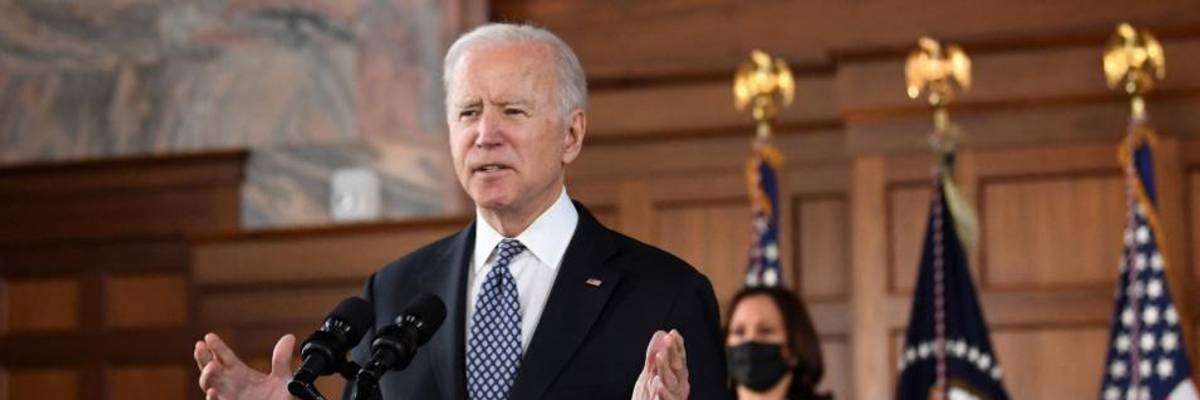
President Joe Biden speaks, flanked by Vice President Kamala Harris, at Emory University in Atlanta on March 19, 2021. (Photo: Eric Baradat/AFP via Getty Images)
To help fund President Joe Biden's forthcoming $3 trillion infrastructure proposal, the White House is reportedly considering ending federal subsidies for fossil fuel companies and increasing taxes on wealthy individuals and corporations.
That's according to two Biden administration officials who spoke to the Washington Post on the condition of anonymity due to the not-yet-public nature of the discussion.
According to the Post, "the centerpiece of the tax increases would probably be a higher corporate tax rate--reversing part of President Donald Trump's steep corporate tax cut in 2017--as well as higher levies on investment income and a higher top marginal tax rate."
As the newspaper reported, Biden's infrastructure legislation is "expected to be broken up into two main components--one focused primarily on infrastructure and clean energy investments, and a second focused on domestic priorities including child care and prekindergarten that the administration has labeled part of the 'caring economy.'"
The bifurcation of the infrastructure plan is also reflected in the revenue-raising options being considered, with each legislative component expected to be funded through different tax hikes.
"The infrastructure section of the legislation is expected to be funded primarily by taxes on businesses, according to officials," the Post reported. "The key measures under discussion include raising the corporate tax rate from 21% to 28%; increasing the global minimum tax paid from about 13% to 21%; ending federal subsidies for fossil fuel companies; and forcing multinational corporations to pay the U.S. tax rate rather than the lower rates paid by their foreign subsidiaries."
"The part of the legislation focused on other domestic priorities, by contrast, is expected to be funded by taxes on rich people and investors," the newspaper noted. "Those measures, according to officials, include increasing the highest income tax rate from 37% to 39.6%; dramatically increasing taxes on wealthy investors; and limiting deductions that rich taxpayers can claim annually, among other measures, the officials said."
According to the Post, the Biden administration is also "considering paying for the package in part through a plan that would lower the cost of prescription drugs," which would enable the federal government to reduce spending on Medicare by as much as $500 billion over 10 years.
Sen. Bernie Sanders on Tuesday unveiled a trio of bills that seek to challenge what the Vermont Independent called Big Pharma's "greed" by slashing prescription drug prices. Meanwhile, as Common Dreams has reported, two-thirds of Americans favor raising taxes on individuals with annual incomes over $400,000.
Biden has emphasized that "his tax increases will not affect people earning less than $400,000 per year," the Post reported. The president's "advisers have called for funding the next major domestic priority with higher levies on wealthy Americans, citing the relative success enjoyed by the affluent during a pandemic that has pummeled the economic fortunes of the working class."
Treasury Secretary Janet Yellen on Tuesday came to Biden's defense after congressional Republicans expressed their disapproval of raising taxes on corporations and rich Americans.
Speaking at a House Financial Services Committee hearing, Yellen told lawmakers that it is crucial for the U.S. "to raise revenues in a fair way to support the spending that this economy needs to be competitive and productive."
"A package that consists of investments in people, investments in infrastructure will help to create good jobs in the American economy and changes to the tax structure will help to pay for those programs," said Yellen.
Biden's long-awaited infrastructure plan has been criticized by progressive advocacy groups who warn, as Common Dreams reported Monday, that $3 trillion is an insufficient amount to invest when the climate and economic crises cry out for the creation of millions of good-paying jobs to expand renewable energy, develop clean mass transit, and implement other projects that would improve the health of communities around the country.
Just days after the congressional Democrats behind the BUILD GREEN Act called for spending $500 billion to electrify public transportation and build electric vehicle charging stations, Biden proposed only $60 billion for green transit.
Climate justice campaigners have pointed out that even Sen. Joe Manchin, a conservative Democrat from West Virginia who is considered a key obstacle to advancing progressive legislation in the upper chamber narrowly controlled by his party, has called for up to $4 trillion in infrastructure spending.
"Biden should realize that if his proposal is milder than what Joe Manchin is calling for, it does not go far enough," said Ellen Sciales, press secretary of the Sunrise Movement. "If $3 trillion is what Biden's team lands on, they'll be neglecting what's politically and publicly popular, and what's quite frankly vital for the future of our society and our planet."
"The crises we face demand at least $1 trillion per year over the next decade," Sciales added. "If Republicans or archaic Senate rules get in the way, Democrats must abolish the filibuster and deliver for the American people."
Dear Common Dreams reader, It’s been nearly 30 years since I co-founded Common Dreams with my late wife, Lina Newhouser. We had the radical notion that journalism should serve the public good, not corporate profits. It was clear to us from the outset what it would take to build such a project. No paid advertisements. No corporate sponsors. No millionaire publisher telling us what to think or do. Many people said we wouldn't last a year, but we proved those doubters wrong. Together with a tremendous team of journalists and dedicated staff, we built an independent media outlet free from the constraints of profits and corporate control. Our mission has always been simple: To inform. To inspire. To ignite change for the common good. Building Common Dreams was not easy. Our survival was never guaranteed. When you take on the most powerful forces—Wall Street greed, fossil fuel industry destruction, Big Tech lobbyists, and uber-rich oligarchs who have spent billions upon billions rigging the economy and democracy in their favor—the only bulwark you have is supporters who believe in your work. But here’s the urgent message from me today. It's never been this bad out there. And it's never been this hard to keep us going. At the very moment Common Dreams is most needed, the threats we face are intensifying. We need your support now more than ever. We don't accept corporate advertising and never will. We don't have a paywall because we don't think people should be blocked from critical news based on their ability to pay. Everything we do is funded by the donations of readers like you. When everyone does the little they can afford, we are strong. But if that support retreats or dries up, so do we. Will you donate now to make sure Common Dreams not only survives but thrives? —Craig Brown, Co-founder |
To help fund President Joe Biden's forthcoming $3 trillion infrastructure proposal, the White House is reportedly considering ending federal subsidies for fossil fuel companies and increasing taxes on wealthy individuals and corporations.
That's according to two Biden administration officials who spoke to the Washington Post on the condition of anonymity due to the not-yet-public nature of the discussion.
According to the Post, "the centerpiece of the tax increases would probably be a higher corporate tax rate--reversing part of President Donald Trump's steep corporate tax cut in 2017--as well as higher levies on investment income and a higher top marginal tax rate."
As the newspaper reported, Biden's infrastructure legislation is "expected to be broken up into two main components--one focused primarily on infrastructure and clean energy investments, and a second focused on domestic priorities including child care and prekindergarten that the administration has labeled part of the 'caring economy.'"
The bifurcation of the infrastructure plan is also reflected in the revenue-raising options being considered, with each legislative component expected to be funded through different tax hikes.
"The infrastructure section of the legislation is expected to be funded primarily by taxes on businesses, according to officials," the Post reported. "The key measures under discussion include raising the corporate tax rate from 21% to 28%; increasing the global minimum tax paid from about 13% to 21%; ending federal subsidies for fossil fuel companies; and forcing multinational corporations to pay the U.S. tax rate rather than the lower rates paid by their foreign subsidiaries."
"The part of the legislation focused on other domestic priorities, by contrast, is expected to be funded by taxes on rich people and investors," the newspaper noted. "Those measures, according to officials, include increasing the highest income tax rate from 37% to 39.6%; dramatically increasing taxes on wealthy investors; and limiting deductions that rich taxpayers can claim annually, among other measures, the officials said."
According to the Post, the Biden administration is also "considering paying for the package in part through a plan that would lower the cost of prescription drugs," which would enable the federal government to reduce spending on Medicare by as much as $500 billion over 10 years.
Sen. Bernie Sanders on Tuesday unveiled a trio of bills that seek to challenge what the Vermont Independent called Big Pharma's "greed" by slashing prescription drug prices. Meanwhile, as Common Dreams has reported, two-thirds of Americans favor raising taxes on individuals with annual incomes over $400,000.
Biden has emphasized that "his tax increases will not affect people earning less than $400,000 per year," the Post reported. The president's "advisers have called for funding the next major domestic priority with higher levies on wealthy Americans, citing the relative success enjoyed by the affluent during a pandemic that has pummeled the economic fortunes of the working class."
Treasury Secretary Janet Yellen on Tuesday came to Biden's defense after congressional Republicans expressed their disapproval of raising taxes on corporations and rich Americans.
Speaking at a House Financial Services Committee hearing, Yellen told lawmakers that it is crucial for the U.S. "to raise revenues in a fair way to support the spending that this economy needs to be competitive and productive."
"A package that consists of investments in people, investments in infrastructure will help to create good jobs in the American economy and changes to the tax structure will help to pay for those programs," said Yellen.
Biden's long-awaited infrastructure plan has been criticized by progressive advocacy groups who warn, as Common Dreams reported Monday, that $3 trillion is an insufficient amount to invest when the climate and economic crises cry out for the creation of millions of good-paying jobs to expand renewable energy, develop clean mass transit, and implement other projects that would improve the health of communities around the country.
Just days after the congressional Democrats behind the BUILD GREEN Act called for spending $500 billion to electrify public transportation and build electric vehicle charging stations, Biden proposed only $60 billion for green transit.
Climate justice campaigners have pointed out that even Sen. Joe Manchin, a conservative Democrat from West Virginia who is considered a key obstacle to advancing progressive legislation in the upper chamber narrowly controlled by his party, has called for up to $4 trillion in infrastructure spending.
"Biden should realize that if his proposal is milder than what Joe Manchin is calling for, it does not go far enough," said Ellen Sciales, press secretary of the Sunrise Movement. "If $3 trillion is what Biden's team lands on, they'll be neglecting what's politically and publicly popular, and what's quite frankly vital for the future of our society and our planet."
"The crises we face demand at least $1 trillion per year over the next decade," Sciales added. "If Republicans or archaic Senate rules get in the way, Democrats must abolish the filibuster and deliver for the American people."
To help fund President Joe Biden's forthcoming $3 trillion infrastructure proposal, the White House is reportedly considering ending federal subsidies for fossil fuel companies and increasing taxes on wealthy individuals and corporations.
That's according to two Biden administration officials who spoke to the Washington Post on the condition of anonymity due to the not-yet-public nature of the discussion.
According to the Post, "the centerpiece of the tax increases would probably be a higher corporate tax rate--reversing part of President Donald Trump's steep corporate tax cut in 2017--as well as higher levies on investment income and a higher top marginal tax rate."
As the newspaper reported, Biden's infrastructure legislation is "expected to be broken up into two main components--one focused primarily on infrastructure and clean energy investments, and a second focused on domestic priorities including child care and prekindergarten that the administration has labeled part of the 'caring economy.'"
The bifurcation of the infrastructure plan is also reflected in the revenue-raising options being considered, with each legislative component expected to be funded through different tax hikes.
"The infrastructure section of the legislation is expected to be funded primarily by taxes on businesses, according to officials," the Post reported. "The key measures under discussion include raising the corporate tax rate from 21% to 28%; increasing the global minimum tax paid from about 13% to 21%; ending federal subsidies for fossil fuel companies; and forcing multinational corporations to pay the U.S. tax rate rather than the lower rates paid by their foreign subsidiaries."
"The part of the legislation focused on other domestic priorities, by contrast, is expected to be funded by taxes on rich people and investors," the newspaper noted. "Those measures, according to officials, include increasing the highest income tax rate from 37% to 39.6%; dramatically increasing taxes on wealthy investors; and limiting deductions that rich taxpayers can claim annually, among other measures, the officials said."
According to the Post, the Biden administration is also "considering paying for the package in part through a plan that would lower the cost of prescription drugs," which would enable the federal government to reduce spending on Medicare by as much as $500 billion over 10 years.
Sen. Bernie Sanders on Tuesday unveiled a trio of bills that seek to challenge what the Vermont Independent called Big Pharma's "greed" by slashing prescription drug prices. Meanwhile, as Common Dreams has reported, two-thirds of Americans favor raising taxes on individuals with annual incomes over $400,000.
Biden has emphasized that "his tax increases will not affect people earning less than $400,000 per year," the Post reported. The president's "advisers have called for funding the next major domestic priority with higher levies on wealthy Americans, citing the relative success enjoyed by the affluent during a pandemic that has pummeled the economic fortunes of the working class."
Treasury Secretary Janet Yellen on Tuesday came to Biden's defense after congressional Republicans expressed their disapproval of raising taxes on corporations and rich Americans.
Speaking at a House Financial Services Committee hearing, Yellen told lawmakers that it is crucial for the U.S. "to raise revenues in a fair way to support the spending that this economy needs to be competitive and productive."
"A package that consists of investments in people, investments in infrastructure will help to create good jobs in the American economy and changes to the tax structure will help to pay for those programs," said Yellen.
Biden's long-awaited infrastructure plan has been criticized by progressive advocacy groups who warn, as Common Dreams reported Monday, that $3 trillion is an insufficient amount to invest when the climate and economic crises cry out for the creation of millions of good-paying jobs to expand renewable energy, develop clean mass transit, and implement other projects that would improve the health of communities around the country.
Just days after the congressional Democrats behind the BUILD GREEN Act called for spending $500 billion to electrify public transportation and build electric vehicle charging stations, Biden proposed only $60 billion for green transit.
Climate justice campaigners have pointed out that even Sen. Joe Manchin, a conservative Democrat from West Virginia who is considered a key obstacle to advancing progressive legislation in the upper chamber narrowly controlled by his party, has called for up to $4 trillion in infrastructure spending.
"Biden should realize that if his proposal is milder than what Joe Manchin is calling for, it does not go far enough," said Ellen Sciales, press secretary of the Sunrise Movement. "If $3 trillion is what Biden's team lands on, they'll be neglecting what's politically and publicly popular, and what's quite frankly vital for the future of our society and our planet."
"The crises we face demand at least $1 trillion per year over the next decade," Sciales added. "If Republicans or archaic Senate rules get in the way, Democrats must abolish the filibuster and deliver for the American people."