
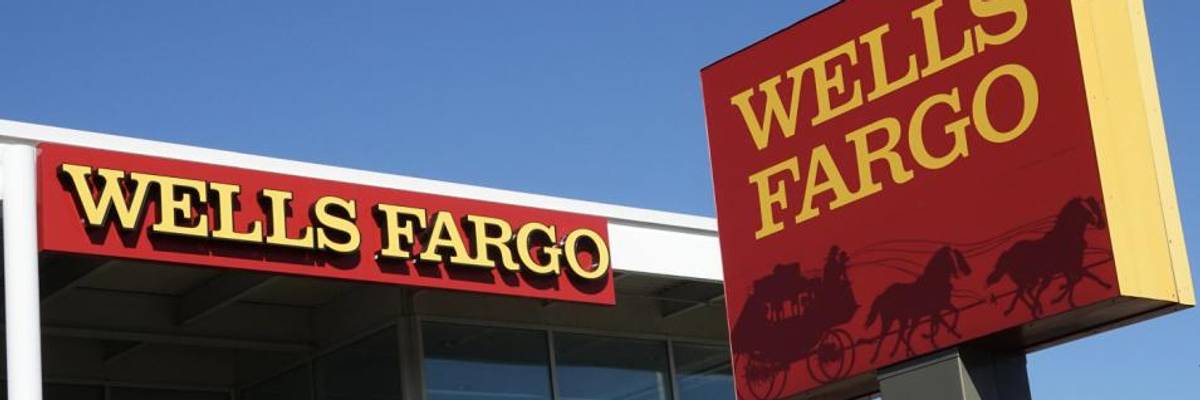
A sign hangs outside of a Wells Fargo bank branch on October 7, 2020 in Niles, Illinois.
As Wells Fargo Sets New Financed Emissions Goal, Climate Campaigners Warn 'Net Zero Is Not Enough'
"What matters most now are concrete actions in 2021 to stop funding fossil fuel expansion and setting a timeline for phasing out fossil fuel financing overall."
Under pressure from investors, policymakers, and green groups, Wells Fargo on Monday followed the lead of other major U.S. banks and set a goal of net-zero greenhouse gas emissions, including its financed emissions, by 2050--a move that climate campaigners welcomed as a positive step but not nearly enough.
"Wells Fargo--like all major U.S. banks--has a long way to go to stop fueling the climate crisis."
--Ben Cushing, Sierra Club
Bank of America, Citi, Goldman Sachs, and Morgan Stanley have also made net-zero commitments for the middle of the century while JPMorgan Chase has pledged to align its financing with the Paris climate agreement, which aims to limit global temperature rise by 2100 to 2degC, though preferably 1.5degC.
"While we're encouraged to see Wells Fargo catch up to the pack making these long-term commitments, Wells Fargo--like all major U.S. banks--has a long way to go to stop fueling the climate crisis," said Sierra Club financial advocacy campaign manager Ben Cushing in a statement Monday.
"What's clear is that 'net zero by 2050' is the new baseline for climate action on Wall Street, but what matters most now are concrete actions in 2021 to stop funding fossil fuel expansion and setting a timeline for phasing out fossil fuel financing overall," he continued. "There's no time left for banks to ponder how to start addressing the biggest and most obvious drivers of the climate crisis."
Cushing--whose group is part of the Stop the Money Pipeline coalition--added in a tweet that activists will maintain pressure on the San Francisco-based big bank over its financing of fossil fuels, a key driver of the human-caused climate crisis:
In the wake of the Paris agreement, Wells Fargo was the world's second largest funder of fossil fuels, behind just Chase, according to Banking on Climate Change 2020, a report from advocacy organizations. From 2016 to 2019, Wells Fargo poured nearly $198 billion into the coal, oil, and gas industry. The next edition of the climate finance report is set to be released later this month.
Jamie Henn, who's also involved with Stop the Money Pipeline and co-founded the environmental advocacy group 350.org, responded to the bank's announcement by emphasizing that "net zero is not enough," adding that "we need the immediate end to financing of fossil fuels and deforestation."
CNN Business exclusively reported on the development Monday afternoon, noting that the bank's move comes shortly after an unusual winter storm in Texas--which experts tied to climate change--led to widespread power outages that increased attention on calls for transitioning from fossil fuels to 100% renewable energy.
While Weiss said that "too often it seems like the brunt of these climate events falls on the more vulnerable portions of society that either can't get out of its path or don't have the same type of stable housing," he also acknowledged the pressure that big banks like his are facing from investors.
"What's important to our investors is important to us. Ultimately, they own our company... And they are speaking pretty loudly," he said. Weiss further clarified that the bank isn't ditching the fossil fuel industry altogether, saying that "it is very much a client-driven strategy, not a declaration against our clients."
Wells Fargo said in a statement that it plans to "measure and disclose financed emissions for select carbon-intensive portfolios; set interim emission reduction targets; deploy more capital to finance climate innovation; and continue to work with its clients on their own emissions reductions efforts."
"The company will also launch an Institute for Sustainable Finance to manage the deployment of $500 billion of financing to sustainable businesses and projects by 2030, as well as support science-based research on low-carbon solutions and advocate for policies that enable client transitions," the bank added.
As Wells Fargo CEO Charlie Scharf put it: "Climate change is one of the most urgent environmental and social issues of our time, and Wells Fargo is committed to aligning our activities to support the goals of the Paris agreement and to helping transition to a net-zero carbon economy."
"The risks of not taking action are too great to ignore, and collective action is needed to avoid the significant impact on our most vulnerable communities," he said. "We have a responsibility to help find solutions and are committed to deploying our resources and working closely with our clients in this transition."
While some campaigners weren't blown away by the bank's new climate pledge, journalist David Roberts put it into the context of the broader trend.
"The scale and significance of the change sweeping finance has not sunk in for most folks," he said. "It's a sea change happening in a wildly compressed time frame."
Danielle Fugere, president of As You Sow, a nonprofit that promotes environmental and social corporate responsibility through shareholder advocacy and other activities, also pointed to the broader trend while urging Wells Fargo to share more about specific actions it will take.
"Wells Fargo's announcement establishes a clear bar for the banking sector--now that six of the top U.S. banks have made this commitment, we expect that others will join in demonstrating that their own financing is in line with the Paris agreement's global net-zero climate goal," Fugere said. "Frameworks like the Partnership for Carbon Accounting Financials can help create global consistency in measuring and reporting progress. We look forward to seeing Wells Fargo take the next steps on this critical pathway."
"We underscore that a net-zero commitment is only the beginning of this important process," she added. "We will be looking to Wells Fargo to fill in the details of its climate plans by setting interim targets and transparently reporting progress toward those goals."
We are at a crossroads
This country and this world are at a monumental crossroads. In a few short weeks, US voters will have an opportunity to beat back the forces of fascism and confront the billionaires who are rigging the economy, our media system, and our democracy, making it increasingly impossible for ordinary people to get by. We’re not just talking about the election. We’re talking about what must be done once these fascist elements are vanquished from power. We need a bolder set of solutions than what either major party has so far been willing to offer and a working-class movement ready to fight like hell for it. Trump didn't emerge from nowhere. The conditions that fueled MAGA authoritarianism were created by decades of radical neoliberal economic policies and a corrupt political system dominated by corporate interests. They slashed taxes on the super-rich, promising that the benefits would trickle down. They said giveaways to the corporate titans would make life more affordable for the rest of us. It was all bullshit. And when a bitter, betrayed populace searches for someone to blame, right-wing demagogues have little trouble finding scapegoats. People know when they're being lied to, but you won't hear any of this from the corporate media. Only independent journalism—powered and funded by people who believe in building a better world—can deliver truly trustworthy daily news. Our Fall Campaign is underway, and we need your help. To power our newsroom through the rest of the year, we need to raise $125,000 by midnight on October 31. So if you share our vision, please contribute whatever you can to sustain our work. |
Under pressure from investors, policymakers, and green groups, Wells Fargo on Monday followed the lead of other major U.S. banks and set a goal of net-zero greenhouse gas emissions, including its financed emissions, by 2050--a move that climate campaigners welcomed as a positive step but not nearly enough.
"Wells Fargo--like all major U.S. banks--has a long way to go to stop fueling the climate crisis."
--Ben Cushing, Sierra Club
Bank of America, Citi, Goldman Sachs, and Morgan Stanley have also made net-zero commitments for the middle of the century while JPMorgan Chase has pledged to align its financing with the Paris climate agreement, which aims to limit global temperature rise by 2100 to 2degC, though preferably 1.5degC.
"While we're encouraged to see Wells Fargo catch up to the pack making these long-term commitments, Wells Fargo--like all major U.S. banks--has a long way to go to stop fueling the climate crisis," said Sierra Club financial advocacy campaign manager Ben Cushing in a statement Monday.
"What's clear is that 'net zero by 2050' is the new baseline for climate action on Wall Street, but what matters most now are concrete actions in 2021 to stop funding fossil fuel expansion and setting a timeline for phasing out fossil fuel financing overall," he continued. "There's no time left for banks to ponder how to start addressing the biggest and most obvious drivers of the climate crisis."
Cushing--whose group is part of the Stop the Money Pipeline coalition--added in a tweet that activists will maintain pressure on the San Francisco-based big bank over its financing of fossil fuels, a key driver of the human-caused climate crisis:
In the wake of the Paris agreement, Wells Fargo was the world's second largest funder of fossil fuels, behind just Chase, according to Banking on Climate Change 2020, a report from advocacy organizations. From 2016 to 2019, Wells Fargo poured nearly $198 billion into the coal, oil, and gas industry. The next edition of the climate finance report is set to be released later this month.
Jamie Henn, who's also involved with Stop the Money Pipeline and co-founded the environmental advocacy group 350.org, responded to the bank's announcement by emphasizing that "net zero is not enough," adding that "we need the immediate end to financing of fossil fuels and deforestation."
CNN Business exclusively reported on the development Monday afternoon, noting that the bank's move comes shortly after an unusual winter storm in Texas--which experts tied to climate change--led to widespread power outages that increased attention on calls for transitioning from fossil fuels to 100% renewable energy.
While Weiss said that "too often it seems like the brunt of these climate events falls on the more vulnerable portions of society that either can't get out of its path or don't have the same type of stable housing," he also acknowledged the pressure that big banks like his are facing from investors.
"What's important to our investors is important to us. Ultimately, they own our company... And they are speaking pretty loudly," he said. Weiss further clarified that the bank isn't ditching the fossil fuel industry altogether, saying that "it is very much a client-driven strategy, not a declaration against our clients."
Wells Fargo said in a statement that it plans to "measure and disclose financed emissions for select carbon-intensive portfolios; set interim emission reduction targets; deploy more capital to finance climate innovation; and continue to work with its clients on their own emissions reductions efforts."
"The company will also launch an Institute for Sustainable Finance to manage the deployment of $500 billion of financing to sustainable businesses and projects by 2030, as well as support science-based research on low-carbon solutions and advocate for policies that enable client transitions," the bank added.
As Wells Fargo CEO Charlie Scharf put it: "Climate change is one of the most urgent environmental and social issues of our time, and Wells Fargo is committed to aligning our activities to support the goals of the Paris agreement and to helping transition to a net-zero carbon economy."
"The risks of not taking action are too great to ignore, and collective action is needed to avoid the significant impact on our most vulnerable communities," he said. "We have a responsibility to help find solutions and are committed to deploying our resources and working closely with our clients in this transition."
While some campaigners weren't blown away by the bank's new climate pledge, journalist David Roberts put it into the context of the broader trend.
"The scale and significance of the change sweeping finance has not sunk in for most folks," he said. "It's a sea change happening in a wildly compressed time frame."
Danielle Fugere, president of As You Sow, a nonprofit that promotes environmental and social corporate responsibility through shareholder advocacy and other activities, also pointed to the broader trend while urging Wells Fargo to share more about specific actions it will take.
"Wells Fargo's announcement establishes a clear bar for the banking sector--now that six of the top U.S. banks have made this commitment, we expect that others will join in demonstrating that their own financing is in line with the Paris agreement's global net-zero climate goal," Fugere said. "Frameworks like the Partnership for Carbon Accounting Financials can help create global consistency in measuring and reporting progress. We look forward to seeing Wells Fargo take the next steps on this critical pathway."
"We underscore that a net-zero commitment is only the beginning of this important process," she added. "We will be looking to Wells Fargo to fill in the details of its climate plans by setting interim targets and transparently reporting progress toward those goals."
Under pressure from investors, policymakers, and green groups, Wells Fargo on Monday followed the lead of other major U.S. banks and set a goal of net-zero greenhouse gas emissions, including its financed emissions, by 2050--a move that climate campaigners welcomed as a positive step but not nearly enough.
"Wells Fargo--like all major U.S. banks--has a long way to go to stop fueling the climate crisis."
--Ben Cushing, Sierra Club
Bank of America, Citi, Goldman Sachs, and Morgan Stanley have also made net-zero commitments for the middle of the century while JPMorgan Chase has pledged to align its financing with the Paris climate agreement, which aims to limit global temperature rise by 2100 to 2degC, though preferably 1.5degC.
"While we're encouraged to see Wells Fargo catch up to the pack making these long-term commitments, Wells Fargo--like all major U.S. banks--has a long way to go to stop fueling the climate crisis," said Sierra Club financial advocacy campaign manager Ben Cushing in a statement Monday.
"What's clear is that 'net zero by 2050' is the new baseline for climate action on Wall Street, but what matters most now are concrete actions in 2021 to stop funding fossil fuel expansion and setting a timeline for phasing out fossil fuel financing overall," he continued. "There's no time left for banks to ponder how to start addressing the biggest and most obvious drivers of the climate crisis."
Cushing--whose group is part of the Stop the Money Pipeline coalition--added in a tweet that activists will maintain pressure on the San Francisco-based big bank over its financing of fossil fuels, a key driver of the human-caused climate crisis:
In the wake of the Paris agreement, Wells Fargo was the world's second largest funder of fossil fuels, behind just Chase, according to Banking on Climate Change 2020, a report from advocacy organizations. From 2016 to 2019, Wells Fargo poured nearly $198 billion into the coal, oil, and gas industry. The next edition of the climate finance report is set to be released later this month.
Jamie Henn, who's also involved with Stop the Money Pipeline and co-founded the environmental advocacy group 350.org, responded to the bank's announcement by emphasizing that "net zero is not enough," adding that "we need the immediate end to financing of fossil fuels and deforestation."
CNN Business exclusively reported on the development Monday afternoon, noting that the bank's move comes shortly after an unusual winter storm in Texas--which experts tied to climate change--led to widespread power outages that increased attention on calls for transitioning from fossil fuels to 100% renewable energy.
While Weiss said that "too often it seems like the brunt of these climate events falls on the more vulnerable portions of society that either can't get out of its path or don't have the same type of stable housing," he also acknowledged the pressure that big banks like his are facing from investors.
"What's important to our investors is important to us. Ultimately, they own our company... And they are speaking pretty loudly," he said. Weiss further clarified that the bank isn't ditching the fossil fuel industry altogether, saying that "it is very much a client-driven strategy, not a declaration against our clients."
Wells Fargo said in a statement that it plans to "measure and disclose financed emissions for select carbon-intensive portfolios; set interim emission reduction targets; deploy more capital to finance climate innovation; and continue to work with its clients on their own emissions reductions efforts."
"The company will also launch an Institute for Sustainable Finance to manage the deployment of $500 billion of financing to sustainable businesses and projects by 2030, as well as support science-based research on low-carbon solutions and advocate for policies that enable client transitions," the bank added.
As Wells Fargo CEO Charlie Scharf put it: "Climate change is one of the most urgent environmental and social issues of our time, and Wells Fargo is committed to aligning our activities to support the goals of the Paris agreement and to helping transition to a net-zero carbon economy."
"The risks of not taking action are too great to ignore, and collective action is needed to avoid the significant impact on our most vulnerable communities," he said. "We have a responsibility to help find solutions and are committed to deploying our resources and working closely with our clients in this transition."
While some campaigners weren't blown away by the bank's new climate pledge, journalist David Roberts put it into the context of the broader trend.
"The scale and significance of the change sweeping finance has not sunk in for most folks," he said. "It's a sea change happening in a wildly compressed time frame."
Danielle Fugere, president of As You Sow, a nonprofit that promotes environmental and social corporate responsibility through shareholder advocacy and other activities, also pointed to the broader trend while urging Wells Fargo to share more about specific actions it will take.
"Wells Fargo's announcement establishes a clear bar for the banking sector--now that six of the top U.S. banks have made this commitment, we expect that others will join in demonstrating that their own financing is in line with the Paris agreement's global net-zero climate goal," Fugere said. "Frameworks like the Partnership for Carbon Accounting Financials can help create global consistency in measuring and reporting progress. We look forward to seeing Wells Fargo take the next steps on this critical pathway."
"We underscore that a net-zero commitment is only the beginning of this important process," she added. "We will be looking to Wells Fargo to fill in the details of its climate plans by setting interim targets and transparently reporting progress toward those goals."