SUBSCRIBE TO OUR FREE NEWSLETTER
Daily news & progressive opinion—funded by the people, not the corporations—delivered straight to your inbox.
5
#000000
#FFFFFF
To donate by check, phone, or other method, see our More Ways to Give page.
Daily news & progressive opinion—funded by the people, not the corporations—delivered straight to your inbox.
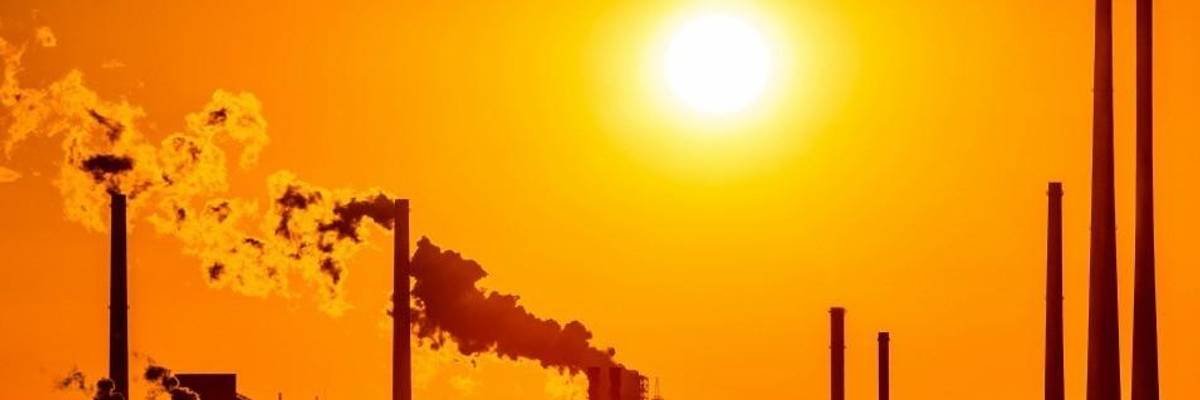
"Our study adds to the mounting evidence that air pollution from ongoing dependence on fossil fuels is detrimental to global health," said co-author Eloise Marais. (Photo: Marcel Kusch/picture alliance via Getty Images)
While arguments for rapidly phasing out fossil fuels and shifting to renewable energy are often based on the climate crisis and its devastating impacts, a study published Tuesday bolsters the public health case for clean power sources, revealing that fossil fuel-related air pollution killed an estimated 8.7 million people in 2018 alone, accounting for 18% of total global deaths that year.
"We now have conclusive evidence that fossil fuels kill millions of people every year."
--Colette Pichon Battle, Gulf Coast Center for Law and Policy
The new findings, published in the journal Environmental Research, suggest exposure to particulate matter from fossil fuel emissions is far more deadly that previously thought. An earlier study put the annual death toll for exposure to outdoor airborne particulate matter, or PM2.5, from all sources at about half that.
"The health gains we can achieve from getting off fossil fuels is twice what we thought it was yesterday," said Dr. Aaron Bernstein, director of the Center for Climate, Health, and the Global Environment at Harvard T.H. Chan School of Public Health, in a statement, referencing previous research showing 4.2 million deaths in 2015.
"Thanks to more rigorous science, we can now see that fossil fuels cause far more harm than previously understood," added Bernstein, who was not a co-author of the study. "Now more than ever we can see the healthier, more just and sustainable world that climate actions can deliver."
Previous research relied on satellite and surface observations, which don't distinguish between particles from fossil fuel emissions and other sources such as wildfire smoke, so "there can be gaps in the data," explained co-author Loretta J. Mickley, a senior research fellow in chemistry-climate interactions at the Harvard John A. Paulson School of Engineering and Applied Sciences (SEAS).
SEAS is home to GEOS-Chem, a global 3-D model of atmospheric chemistry that the study's authors--experts at Harvard University, the University of Birmingham, the University of Leicester, and University College London--used to improve their analysis, which included splitting the globe into smaller, regional boxes--some as small as about 3,000 square kilometers (approximately 1,160 square miles).
"Rather than rely on averages spread across large regions, we wanted to map where the pollution is and where people live, so we could know more exactly what people are breathing," said lead author Karn Vohra, a graduate student at University of Birmingham.
The researchers found that regions with the highest concentrations of fossil fuel-related air pollution have the highest death rates. They also found a higher mortality rate for long-term exposure to fossil fuel emissions, including at lower levels. The findings sparked fresh calls for action.
"This new research supports what Black, Brown, and Indigenous communities have known and said for decades: our communities are being poisoned and killed by fossil fuel pollution and extractive economies," declared Colette Pichon Battle, executive director of the Gulf Coast Center for Law and Policy.
"People of color are on the frontlines of the environmental fallout, fighting decades of unchecked corporate greed that comes at the expense of the most marginalized. We now have conclusive evidence that fossil fuels kill millions of people every year," she said. "Unless we act now, they will kill millions more."
Sen. Ed Markey (D-Mass.)--who led the push for the Green New Deal resolution in the Senate--highlighted the study's findings for the United States: exposure to air polluted by fossil fuels kills an estimated, 350,000 Americans per year. He called for a transition to clean energy and delivering justice to frontline communities.
Co-author Joel Schwartz expressed hope that their study will aid efforts to enact a green transition.
"Often, when we discuss the dangers of fossil fuel combustion, it's in the context of CO2 and climate change and overlook the potential health impact of the pollutants co-emitted with greenhouse gases," he said. "We hope that by quantifying the health consequences of fossil fuel combustion, we can send a clear message to policymakers and stakeholders of the benefits of a transition to alternative energy sources."
Schwartz and co-author Alina Vodonos, both of the Harvard T.H. Chan School of Public Health, developed the new risk assessment model linking fossil fuel air pollution levels to health outcomes, which led to the higher mortality rate findings.
"Our study adds to the mounting evidence that air pollution from ongoing dependence on fossil fuels is detrimental to global health," said co-author Eloise Marais of University College London. "We can't in good conscience continue to rely on fossil fuels, when we know that there are such severe effects on health and viable, cleaner alternatives."
Dear Common Dreams reader, It’s been nearly 30 years since I co-founded Common Dreams with my late wife, Lina Newhouser. We had the radical notion that journalism should serve the public good, not corporate profits. It was clear to us from the outset what it would take to build such a project. No paid advertisements. No corporate sponsors. No millionaire publisher telling us what to think or do. Many people said we wouldn't last a year, but we proved those doubters wrong. Together with a tremendous team of journalists and dedicated staff, we built an independent media outlet free from the constraints of profits and corporate control. Our mission has always been simple: To inform. To inspire. To ignite change for the common good. Building Common Dreams was not easy. Our survival was never guaranteed. When you take on the most powerful forces—Wall Street greed, fossil fuel industry destruction, Big Tech lobbyists, and uber-rich oligarchs who have spent billions upon billions rigging the economy and democracy in their favor—the only bulwark you have is supporters who believe in your work. But here’s the urgent message from me today. It's never been this bad out there. And it's never been this hard to keep us going. At the very moment Common Dreams is most needed, the threats we face are intensifying. We need your support now more than ever. We don't accept corporate advertising and never will. We don't have a paywall because we don't think people should be blocked from critical news based on their ability to pay. Everything we do is funded by the donations of readers like you. When everyone does the little they can afford, we are strong. But if that support retreats or dries up, so do we. Will you donate now to make sure Common Dreams not only survives but thrives? —Craig Brown, Co-founder |
While arguments for rapidly phasing out fossil fuels and shifting to renewable energy are often based on the climate crisis and its devastating impacts, a study published Tuesday bolsters the public health case for clean power sources, revealing that fossil fuel-related air pollution killed an estimated 8.7 million people in 2018 alone, accounting for 18% of total global deaths that year.
"We now have conclusive evidence that fossil fuels kill millions of people every year."
--Colette Pichon Battle, Gulf Coast Center for Law and Policy
The new findings, published in the journal Environmental Research, suggest exposure to particulate matter from fossil fuel emissions is far more deadly that previously thought. An earlier study put the annual death toll for exposure to outdoor airborne particulate matter, or PM2.5, from all sources at about half that.
"The health gains we can achieve from getting off fossil fuels is twice what we thought it was yesterday," said Dr. Aaron Bernstein, director of the Center for Climate, Health, and the Global Environment at Harvard T.H. Chan School of Public Health, in a statement, referencing previous research showing 4.2 million deaths in 2015.
"Thanks to more rigorous science, we can now see that fossil fuels cause far more harm than previously understood," added Bernstein, who was not a co-author of the study. "Now more than ever we can see the healthier, more just and sustainable world that climate actions can deliver."
Previous research relied on satellite and surface observations, which don't distinguish between particles from fossil fuel emissions and other sources such as wildfire smoke, so "there can be gaps in the data," explained co-author Loretta J. Mickley, a senior research fellow in chemistry-climate interactions at the Harvard John A. Paulson School of Engineering and Applied Sciences (SEAS).
SEAS is home to GEOS-Chem, a global 3-D model of atmospheric chemistry that the study's authors--experts at Harvard University, the University of Birmingham, the University of Leicester, and University College London--used to improve their analysis, which included splitting the globe into smaller, regional boxes--some as small as about 3,000 square kilometers (approximately 1,160 square miles).
"Rather than rely on averages spread across large regions, we wanted to map where the pollution is and where people live, so we could know more exactly what people are breathing," said lead author Karn Vohra, a graduate student at University of Birmingham.
The researchers found that regions with the highest concentrations of fossil fuel-related air pollution have the highest death rates. They also found a higher mortality rate for long-term exposure to fossil fuel emissions, including at lower levels. The findings sparked fresh calls for action.
"This new research supports what Black, Brown, and Indigenous communities have known and said for decades: our communities are being poisoned and killed by fossil fuel pollution and extractive economies," declared Colette Pichon Battle, executive director of the Gulf Coast Center for Law and Policy.
"People of color are on the frontlines of the environmental fallout, fighting decades of unchecked corporate greed that comes at the expense of the most marginalized. We now have conclusive evidence that fossil fuels kill millions of people every year," she said. "Unless we act now, they will kill millions more."
Sen. Ed Markey (D-Mass.)--who led the push for the Green New Deal resolution in the Senate--highlighted the study's findings for the United States: exposure to air polluted by fossil fuels kills an estimated, 350,000 Americans per year. He called for a transition to clean energy and delivering justice to frontline communities.
Co-author Joel Schwartz expressed hope that their study will aid efforts to enact a green transition.
"Often, when we discuss the dangers of fossil fuel combustion, it's in the context of CO2 and climate change and overlook the potential health impact of the pollutants co-emitted with greenhouse gases," he said. "We hope that by quantifying the health consequences of fossil fuel combustion, we can send a clear message to policymakers and stakeholders of the benefits of a transition to alternative energy sources."
Schwartz and co-author Alina Vodonos, both of the Harvard T.H. Chan School of Public Health, developed the new risk assessment model linking fossil fuel air pollution levels to health outcomes, which led to the higher mortality rate findings.
"Our study adds to the mounting evidence that air pollution from ongoing dependence on fossil fuels is detrimental to global health," said co-author Eloise Marais of University College London. "We can't in good conscience continue to rely on fossil fuels, when we know that there are such severe effects on health and viable, cleaner alternatives."
While arguments for rapidly phasing out fossil fuels and shifting to renewable energy are often based on the climate crisis and its devastating impacts, a study published Tuesday bolsters the public health case for clean power sources, revealing that fossil fuel-related air pollution killed an estimated 8.7 million people in 2018 alone, accounting for 18% of total global deaths that year.
"We now have conclusive evidence that fossil fuels kill millions of people every year."
--Colette Pichon Battle, Gulf Coast Center for Law and Policy
The new findings, published in the journal Environmental Research, suggest exposure to particulate matter from fossil fuel emissions is far more deadly that previously thought. An earlier study put the annual death toll for exposure to outdoor airborne particulate matter, or PM2.5, from all sources at about half that.
"The health gains we can achieve from getting off fossil fuels is twice what we thought it was yesterday," said Dr. Aaron Bernstein, director of the Center for Climate, Health, and the Global Environment at Harvard T.H. Chan School of Public Health, in a statement, referencing previous research showing 4.2 million deaths in 2015.
"Thanks to more rigorous science, we can now see that fossil fuels cause far more harm than previously understood," added Bernstein, who was not a co-author of the study. "Now more than ever we can see the healthier, more just and sustainable world that climate actions can deliver."
Previous research relied on satellite and surface observations, which don't distinguish between particles from fossil fuel emissions and other sources such as wildfire smoke, so "there can be gaps in the data," explained co-author Loretta J. Mickley, a senior research fellow in chemistry-climate interactions at the Harvard John A. Paulson School of Engineering and Applied Sciences (SEAS).
SEAS is home to GEOS-Chem, a global 3-D model of atmospheric chemistry that the study's authors--experts at Harvard University, the University of Birmingham, the University of Leicester, and University College London--used to improve their analysis, which included splitting the globe into smaller, regional boxes--some as small as about 3,000 square kilometers (approximately 1,160 square miles).
"Rather than rely on averages spread across large regions, we wanted to map where the pollution is and where people live, so we could know more exactly what people are breathing," said lead author Karn Vohra, a graduate student at University of Birmingham.
The researchers found that regions with the highest concentrations of fossil fuel-related air pollution have the highest death rates. They also found a higher mortality rate for long-term exposure to fossil fuel emissions, including at lower levels. The findings sparked fresh calls for action.
"This new research supports what Black, Brown, and Indigenous communities have known and said for decades: our communities are being poisoned and killed by fossil fuel pollution and extractive economies," declared Colette Pichon Battle, executive director of the Gulf Coast Center for Law and Policy.
"People of color are on the frontlines of the environmental fallout, fighting decades of unchecked corporate greed that comes at the expense of the most marginalized. We now have conclusive evidence that fossil fuels kill millions of people every year," she said. "Unless we act now, they will kill millions more."
Sen. Ed Markey (D-Mass.)--who led the push for the Green New Deal resolution in the Senate--highlighted the study's findings for the United States: exposure to air polluted by fossil fuels kills an estimated, 350,000 Americans per year. He called for a transition to clean energy and delivering justice to frontline communities.
Co-author Joel Schwartz expressed hope that their study will aid efforts to enact a green transition.
"Often, when we discuss the dangers of fossil fuel combustion, it's in the context of CO2 and climate change and overlook the potential health impact of the pollutants co-emitted with greenhouse gases," he said. "We hope that by quantifying the health consequences of fossil fuel combustion, we can send a clear message to policymakers and stakeholders of the benefits of a transition to alternative energy sources."
Schwartz and co-author Alina Vodonos, both of the Harvard T.H. Chan School of Public Health, developed the new risk assessment model linking fossil fuel air pollution levels to health outcomes, which led to the higher mortality rate findings.
"Our study adds to the mounting evidence that air pollution from ongoing dependence on fossil fuels is detrimental to global health," said co-author Eloise Marais of University College London. "We can't in good conscience continue to rely on fossil fuels, when we know that there are such severe effects on health and viable, cleaner alternatives."