

SUBSCRIBE TO OUR FREE NEWSLETTER
Daily news & progressive opinion—funded by the people, not the corporations—delivered straight to your inbox.
5
#000000
#FFFFFF
To donate by check, phone, or other method, see our More Ways to Give page.
Daily news & progressive opinion—funded by the people, not the corporations—delivered straight to your inbox.
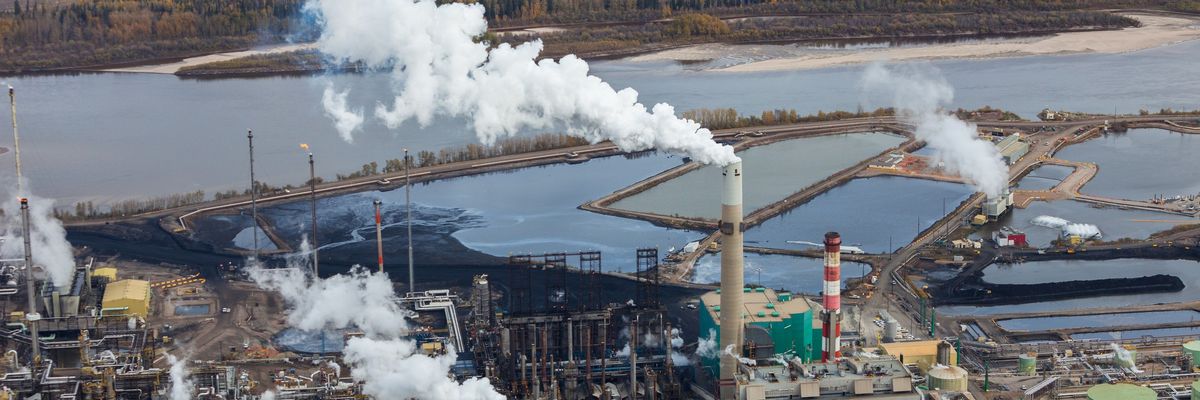
A large oil refinery is shown along the Athabasca River in Alberta, Canada.
"In quantifying the astonishing and largely unreported levels," said a Greenpeace campaigner, "these scientists have validated what downwind Indigenous communities have been saying for decades."
Aircraft measurements of pollutants over the Athabasca tar sands in Alberta, Canada show levels exceeding industry reports by 1,900% to more than 6,300%, scientists revealed Thursday, underscoring the need for humanity to rapidly phase out fossil fuels.
While the Canadian government requires air quality monitoring around oil sands operations, industry figures focus on certain compounds. For this research, published Thursday in the journal Science, experts from Yale University and Environment and Climate Change Canada, a department of the Canadian government, accounted for a wider range of emissions.
After collecting data from 30 flights around 17 tar sands operations in 2018, "what we saw were very large emissions of total gas-phase organic carbon from these facilities," said co-author and Yale professor Drew Gentner in a statement. "On average, the majority of the total gas-phase organic carbon was from often overlooked compounds, which are typically outside of the scope of routine monitoring."
"This report backs up what the communities living in these areas experience—it is so bad they cannot open their windows because it hurts their lungs to breathe—especially at night."
Co-author John Liggio of Environment and Climate Change Canada noted that "the magnitude of the observed emissions from oil sands operations was larger than expected, considering that it was roughly equivalent to the sum of all other anthropogenic sources across Canada when including all the motor vehicles, all the solvents, all the other oil and gas sources, and everything else reported to the inventory."
Nadine Borduas-Dedekind, a University of British Columbia atmospheric chemist who has worked with Liggio but was not involved with this study, told Nature that "I'm concerned by how big this number is."
"You want to be measuring all this carbon. For air quality, for health, but also for climate," she said, explaining that some of the molecules are oxidized to planet-heating carbon dioxide.
Thanks to the tar sands deposits across northern Alberta, which are estimated to contain 1.7-2.5 trillion barrels of oil, Canada trails only Saudi Arabia and Venezuela in terms of total known reserves.
As Inside Climate News detailed Thursday:
The deposits do not technically hold crude oil, but instead a heavier hydrocarbon called bitumen, which must be heated and treated in order to form a liquid that can be piped and refined like oil. That process requires sprawling industrial operations of open pit mines, ever-growing waste ponds, and refinery-like "upgraders." The waste ponds have leached toxic chemicals into groundwater, and a heavy, sulfurous stench often settles over the region. The mines have stripped away an area larger than New York City, lands that had long been occupied by people from several Indigenous First Nations. One of those First Nations, Fort McKay, is now surrounded by mines.
Jean L'Hommecourt, an enrolled member of the Fort McKay First Nation, told Inside Climate News she wasn't shocked by the new findings.
"I was just like, eh, I knew all along," said L'Hommecourt, who has worked to clean up nearby operations. "We feel the physical effects here."
Jesse Cardinal of the Indigenous-led group Keepers of the Water similarly said to The Guardian, "We are told this is all within the limits and OK but this report backs up what the communities living in these areas experience—it is so bad they cannot open their windows because it hurts their lungs to breathe—especially at night."
Asked to comment on the research, Keith Stewart, a senior energy strategist for Greenpeace Canada, wrote in an email to The Independent, "I suppose 'Holy s***' isn't printable."
"In quantifying the astonishing and largely unreported levels of health-damaging air pollution coming out of oil sands operations, these scientists have validated what downwind Indigenous communities have been saying for decades," Stewart added. "This is making people sick, so our governments can and should require these companies to use some of their record-breaking profits to clean up the mess they've made."
Dear Common Dreams reader, It’s been nearly 30 years since I co-founded Common Dreams with my late wife, Lina Newhouser. We had the radical notion that journalism should serve the public good, not corporate profits. It was clear to us from the outset what it would take to build such a project. No paid advertisements. No corporate sponsors. No millionaire publisher telling us what to think or do. Many people said we wouldn't last a year, but we proved those doubters wrong. Together with a tremendous team of journalists and dedicated staff, we built an independent media outlet free from the constraints of profits and corporate control. Our mission has always been simple: To inform. To inspire. To ignite change for the common good. Building Common Dreams was not easy. Our survival was never guaranteed. When you take on the most powerful forces—Wall Street greed, fossil fuel industry destruction, Big Tech lobbyists, and uber-rich oligarchs who have spent billions upon billions rigging the economy and democracy in their favor—the only bulwark you have is supporters who believe in your work. But here’s the urgent message from me today. It's never been this bad out there. And it's never been this hard to keep us going. At the very moment Common Dreams is most needed, the threats we face are intensifying. We need your support now more than ever. We don't accept corporate advertising and never will. We don't have a paywall because we don't think people should be blocked from critical news based on their ability to pay. Everything we do is funded by the donations of readers like you. When everyone does the little they can afford, we are strong. But if that support retreats or dries up, so do we. Will you donate now to make sure Common Dreams not only survives but thrives? —Craig Brown, Co-founder |
Aircraft measurements of pollutants over the Athabasca tar sands in Alberta, Canada show levels exceeding industry reports by 1,900% to more than 6,300%, scientists revealed Thursday, underscoring the need for humanity to rapidly phase out fossil fuels.
While the Canadian government requires air quality monitoring around oil sands operations, industry figures focus on certain compounds. For this research, published Thursday in the journal Science, experts from Yale University and Environment and Climate Change Canada, a department of the Canadian government, accounted for a wider range of emissions.
After collecting data from 30 flights around 17 tar sands operations in 2018, "what we saw were very large emissions of total gas-phase organic carbon from these facilities," said co-author and Yale professor Drew Gentner in a statement. "On average, the majority of the total gas-phase organic carbon was from often overlooked compounds, which are typically outside of the scope of routine monitoring."
"This report backs up what the communities living in these areas experience—it is so bad they cannot open their windows because it hurts their lungs to breathe—especially at night."
Co-author John Liggio of Environment and Climate Change Canada noted that "the magnitude of the observed emissions from oil sands operations was larger than expected, considering that it was roughly equivalent to the sum of all other anthropogenic sources across Canada when including all the motor vehicles, all the solvents, all the other oil and gas sources, and everything else reported to the inventory."
Nadine Borduas-Dedekind, a University of British Columbia atmospheric chemist who has worked with Liggio but was not involved with this study, told Nature that "I'm concerned by how big this number is."
"You want to be measuring all this carbon. For air quality, for health, but also for climate," she said, explaining that some of the molecules are oxidized to planet-heating carbon dioxide.
Thanks to the tar sands deposits across northern Alberta, which are estimated to contain 1.7-2.5 trillion barrels of oil, Canada trails only Saudi Arabia and Venezuela in terms of total known reserves.
As Inside Climate News detailed Thursday:
The deposits do not technically hold crude oil, but instead a heavier hydrocarbon called bitumen, which must be heated and treated in order to form a liquid that can be piped and refined like oil. That process requires sprawling industrial operations of open pit mines, ever-growing waste ponds, and refinery-like "upgraders." The waste ponds have leached toxic chemicals into groundwater, and a heavy, sulfurous stench often settles over the region. The mines have stripped away an area larger than New York City, lands that had long been occupied by people from several Indigenous First Nations. One of those First Nations, Fort McKay, is now surrounded by mines.
Jean L'Hommecourt, an enrolled member of the Fort McKay First Nation, told Inside Climate News she wasn't shocked by the new findings.
"I was just like, eh, I knew all along," said L'Hommecourt, who has worked to clean up nearby operations. "We feel the physical effects here."
Jesse Cardinal of the Indigenous-led group Keepers of the Water similarly said to The Guardian, "We are told this is all within the limits and OK but this report backs up what the communities living in these areas experience—it is so bad they cannot open their windows because it hurts their lungs to breathe—especially at night."
Asked to comment on the research, Keith Stewart, a senior energy strategist for Greenpeace Canada, wrote in an email to The Independent, "I suppose 'Holy s***' isn't printable."
"In quantifying the astonishing and largely unreported levels of health-damaging air pollution coming out of oil sands operations, these scientists have validated what downwind Indigenous communities have been saying for decades," Stewart added. "This is making people sick, so our governments can and should require these companies to use some of their record-breaking profits to clean up the mess they've made."
Aircraft measurements of pollutants over the Athabasca tar sands in Alberta, Canada show levels exceeding industry reports by 1,900% to more than 6,300%, scientists revealed Thursday, underscoring the need for humanity to rapidly phase out fossil fuels.
While the Canadian government requires air quality monitoring around oil sands operations, industry figures focus on certain compounds. For this research, published Thursday in the journal Science, experts from Yale University and Environment and Climate Change Canada, a department of the Canadian government, accounted for a wider range of emissions.
After collecting data from 30 flights around 17 tar sands operations in 2018, "what we saw were very large emissions of total gas-phase organic carbon from these facilities," said co-author and Yale professor Drew Gentner in a statement. "On average, the majority of the total gas-phase organic carbon was from often overlooked compounds, which are typically outside of the scope of routine monitoring."
"This report backs up what the communities living in these areas experience—it is so bad they cannot open their windows because it hurts their lungs to breathe—especially at night."
Co-author John Liggio of Environment and Climate Change Canada noted that "the magnitude of the observed emissions from oil sands operations was larger than expected, considering that it was roughly equivalent to the sum of all other anthropogenic sources across Canada when including all the motor vehicles, all the solvents, all the other oil and gas sources, and everything else reported to the inventory."
Nadine Borduas-Dedekind, a University of British Columbia atmospheric chemist who has worked with Liggio but was not involved with this study, told Nature that "I'm concerned by how big this number is."
"You want to be measuring all this carbon. For air quality, for health, but also for climate," she said, explaining that some of the molecules are oxidized to planet-heating carbon dioxide.
Thanks to the tar sands deposits across northern Alberta, which are estimated to contain 1.7-2.5 trillion barrels of oil, Canada trails only Saudi Arabia and Venezuela in terms of total known reserves.
As Inside Climate News detailed Thursday:
The deposits do not technically hold crude oil, but instead a heavier hydrocarbon called bitumen, which must be heated and treated in order to form a liquid that can be piped and refined like oil. That process requires sprawling industrial operations of open pit mines, ever-growing waste ponds, and refinery-like "upgraders." The waste ponds have leached toxic chemicals into groundwater, and a heavy, sulfurous stench often settles over the region. The mines have stripped away an area larger than New York City, lands that had long been occupied by people from several Indigenous First Nations. One of those First Nations, Fort McKay, is now surrounded by mines.
Jean L'Hommecourt, an enrolled member of the Fort McKay First Nation, told Inside Climate News she wasn't shocked by the new findings.
"I was just like, eh, I knew all along," said L'Hommecourt, who has worked to clean up nearby operations. "We feel the physical effects here."
Jesse Cardinal of the Indigenous-led group Keepers of the Water similarly said to The Guardian, "We are told this is all within the limits and OK but this report backs up what the communities living in these areas experience—it is so bad they cannot open their windows because it hurts their lungs to breathe—especially at night."
Asked to comment on the research, Keith Stewart, a senior energy strategist for Greenpeace Canada, wrote in an email to The Independent, "I suppose 'Holy s***' isn't printable."
"In quantifying the astonishing and largely unreported levels of health-damaging air pollution coming out of oil sands operations, these scientists have validated what downwind Indigenous communities have been saying for decades," Stewart added. "This is making people sick, so our governments can and should require these companies to use some of their record-breaking profits to clean up the mess they've made."

