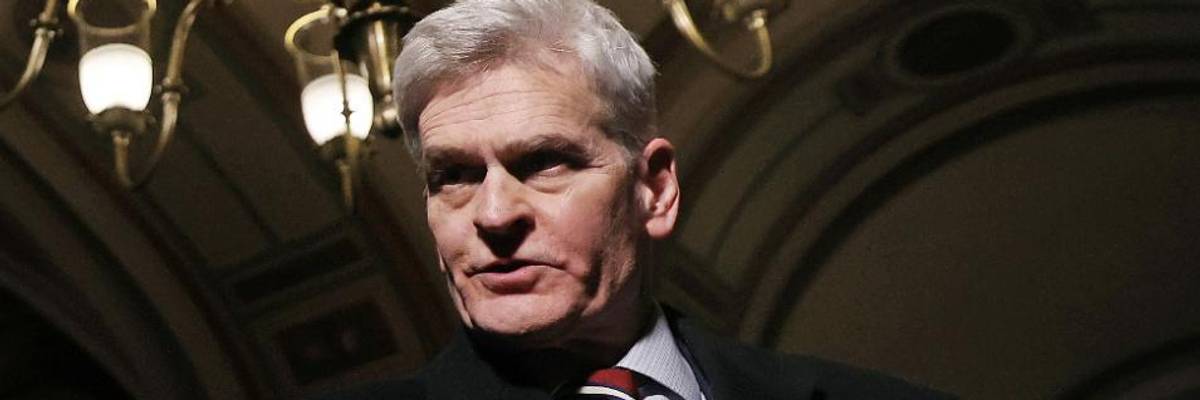
Sen. Bill Cassidy (R-La.) talks with reporters as he leaves the Capitol after the first day of former President Donald Trump's second impeachment trial February 9, 2021 in Washington, D.C. (Photo: Chip Somodevilla/Getty Images)
Just Six GOP Senators Join Democrats in Reaffirming Trump Impeachment Trial as Constitutional
Sen. Bill Cassidy, the only Republican to change his vote from last month, said that "the House managers made a compelling, cogent case—and the president's team did not."
The U.S. Senate on Tuesday evening reaffirmed that former President Donald Trump's impeachment trial is constitutional, with just six Republicans joining Democrats on the vote, which came after hours of opening arguments from House impeachment managers and Trump's widely criticized attorneys.
This is the second time in as many weeks that the Senate has voted on the trial's constitutionality. In late January, Republican Sens. Susan Collins (Maine), Lisa Murkowski (Alaska), Mitt Romney (Utah), Ben Sasse (Neb.), and Pat Toomey (Pa.) joined Democrats for a similar vote forced by Sen. Rand Paul (Ky.).
All but one Republican--Sen. Bill Cassidy (La.)--doubled down on that position Tuesday. Cassidy explained after the vote that "the issue at hand is, is it constitutional to impeach a president who has left office, and the House managers made a compelling, cogent case--and the president's team did not."
Tuesday's vote could indicate an unwillingness by most GOP senators to convict Trump, which would require two-thirds of the chamber.
The vote came after Trump's attorneys attempted to argue that, despite precedent, the trial isn't constitutional because Trump is no longer president. Like with the previous vote, which came days after Trump left office, Republicans--particularly Senate Minority Leader Mitch McConnell (Ky.)--came under fire again Tuesday for delaying Trump's trial until after President Joe Biden's inauguration and Democrats took control of the Senate by the narrowest margin possible.
"This trial could have taken place while Trump was in office, if McConnell and Senate Republicans had not delayed it," said Stand Up America founder and president Sean Eldridge in a tweet Tuesday. "Their delays in no way exonerate Trump for inciting a violent and deadly insurrection. Convicting and disqualifying him is still critical to defending our democracy."
While the House impeachment managers, led by Rep. Jamie Raskin (D-Md.), were praised for a powerful 13-minute video that bolsters the charge--as laid out in the single article of impeachment--that Trump incited the deadly insurrection at the U.S. Capitol on January 6, Trump's attorneys were widely mocked and criticized.
As Andy Kroll summarized for Rolling Stone:
House Democrats on Tuesday afternoon laid out their case for why the Senate should proceed with an impeachment trial against a former president, citing the Constitution, the Federalist Papers, and the writings of legal scholars of all ideologies. Afterward, attorney Bruce Castor, a member of Trump's defense team, stepped up to microphone. What ensued was a meandering and at times incoherent legal argument from Castor, one that by turns flattered the senators in attendance ("senators are family men and women"), evoked Castor's youth in suburban Philadelphia ("here's little Bruce"), and offered the obligatory Ben Franklin quote.
While both Castor and David Schoen--who spoke second, after a last-minute shuffle--were slammed for their performances, Castor even drew critique from former Trump attorney Alan Dershowitz, who said on Newsmax: "There is no argument. I have no idea what he's doing. I have no idea why he's saying what he's saying."
A flood of similar criticism of both Castor and Schoen came from a diverse collection of experts, advocates, and other political commentators:
Castor, for his part, told reporters, "I thought we had a good day."
We are at a crossroads
This country and this world are at a monumental crossroads. US voters have an opportunity to beat back the forces of fascism and confront the billionaires who are rigging the economy, our media system, and our democracy, making it increasingly impossible for ordinary people to get by. We’re not just talking about the election. We’re talking about what must be done once these fascist elements are vanquished from power. We need a bolder set of solutions than what either major party has so far been willing to offer and a working-class movement ready to fight like hell for it. Trump didn't emerge from nowhere. The conditions that fueled MAGA authoritarianism were created by decades of radical neoliberal economic policies and a corrupt political system dominated by corporate interests. They slashed taxes on the super-rich, promising that the benefits would trickle down. They said giveaways to the corporate titans would make life more affordable for the rest of us. It was all bullshit. And when a bitter, betrayed populace searches for someone to blame, right-wing demagogues have little trouble finding scapegoats. People know when they're being lied to, but you won't hear any of this from the corporate media. Only independent journalism—powered and funded by people who believe in building a better world—can deliver truly trustworthy daily news. Our Fall Campaign is underway, and we need your help. To power our newsroom through the rest of the year, we need to raise $125,000 by midnight on October 31. So if you share our vision, please contribute whatever you can to sustain our work. |
The U.S. Senate on Tuesday evening reaffirmed that former President Donald Trump's impeachment trial is constitutional, with just six Republicans joining Democrats on the vote, which came after hours of opening arguments from House impeachment managers and Trump's widely criticized attorneys.
This is the second time in as many weeks that the Senate has voted on the trial's constitutionality. In late January, Republican Sens. Susan Collins (Maine), Lisa Murkowski (Alaska), Mitt Romney (Utah), Ben Sasse (Neb.), and Pat Toomey (Pa.) joined Democrats for a similar vote forced by Sen. Rand Paul (Ky.).
All but one Republican--Sen. Bill Cassidy (La.)--doubled down on that position Tuesday. Cassidy explained after the vote that "the issue at hand is, is it constitutional to impeach a president who has left office, and the House managers made a compelling, cogent case--and the president's team did not."
Tuesday's vote could indicate an unwillingness by most GOP senators to convict Trump, which would require two-thirds of the chamber.
The vote came after Trump's attorneys attempted to argue that, despite precedent, the trial isn't constitutional because Trump is no longer president. Like with the previous vote, which came days after Trump left office, Republicans--particularly Senate Minority Leader Mitch McConnell (Ky.)--came under fire again Tuesday for delaying Trump's trial until after President Joe Biden's inauguration and Democrats took control of the Senate by the narrowest margin possible.
"This trial could have taken place while Trump was in office, if McConnell and Senate Republicans had not delayed it," said Stand Up America founder and president Sean Eldridge in a tweet Tuesday. "Their delays in no way exonerate Trump for inciting a violent and deadly insurrection. Convicting and disqualifying him is still critical to defending our democracy."
While the House impeachment managers, led by Rep. Jamie Raskin (D-Md.), were praised for a powerful 13-minute video that bolsters the charge--as laid out in the single article of impeachment--that Trump incited the deadly insurrection at the U.S. Capitol on January 6, Trump's attorneys were widely mocked and criticized.
As Andy Kroll summarized for Rolling Stone:
House Democrats on Tuesday afternoon laid out their case for why the Senate should proceed with an impeachment trial against a former president, citing the Constitution, the Federalist Papers, and the writings of legal scholars of all ideologies. Afterward, attorney Bruce Castor, a member of Trump's defense team, stepped up to microphone. What ensued was a meandering and at times incoherent legal argument from Castor, one that by turns flattered the senators in attendance ("senators are family men and women"), evoked Castor's youth in suburban Philadelphia ("here's little Bruce"), and offered the obligatory Ben Franklin quote.
While both Castor and David Schoen--who spoke second, after a last-minute shuffle--were slammed for their performances, Castor even drew critique from former Trump attorney Alan Dershowitz, who said on Newsmax: "There is no argument. I have no idea what he's doing. I have no idea why he's saying what he's saying."
A flood of similar criticism of both Castor and Schoen came from a diverse collection of experts, advocates, and other political commentators:
Castor, for his part, told reporters, "I thought we had a good day."