
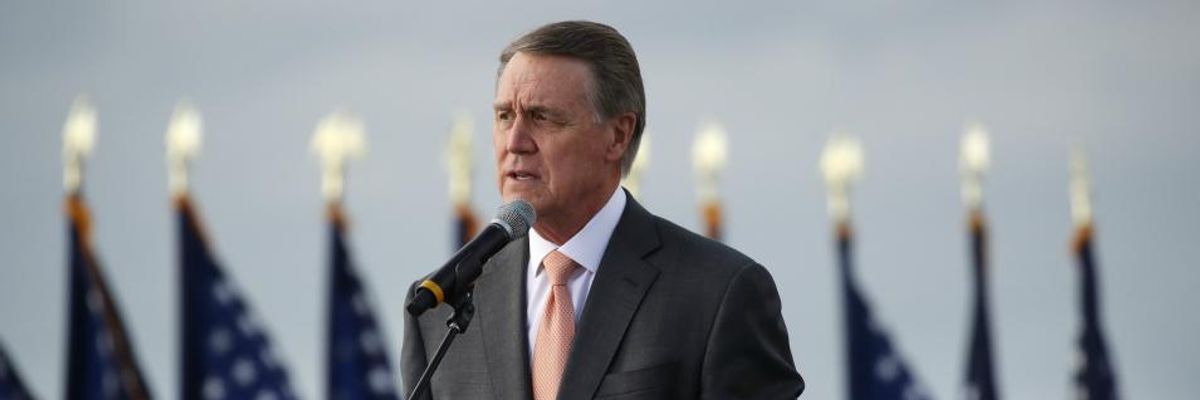
Sen. David Perdue (R-Ga.) attends a rally on December 04, 2020 in Savannah, Georgia. (Photo: Spencer Platt/Getty Images)
With Perdue and Loeffler Under Fire for Shady Transactions, Warren Intros Bill to Ban Lawmakers From Trading Stock
"With U.S. senators brazenly trading stocks to profit off a raging pandemic, the Anti-Corruption and Public Integrity Act is more urgent than ever."
Sen. Elizabeth Warren on Friday reintroduced legislation that would bar members of Congress from owning or trading individual stock as two of her Republican colleagues--Georgia Sens. David Perdue and Kelly Loeffler--continue to face criticism from their Democratic runoff opponents over suspiciously well-timed transactions earlier this year.
"This legislation would dramatically improve some of the greatest systemic weaknesses in our laws and enforcement structures that allow corruption--both illegal and legal--to pervert the powers of government against the people."
--Liz Hempowicz, Project on Government Oversight
Warren and Rep. Pramila Jayapal (D-Wash.), the lead sponsor of companion legislation in the House, alluded to the controversy surrounding Perdue and Loeffler's trades, some of which came around the time senators were receiving briefings from the White House as the coronavirus first began spreading in the United States. Faced with accusations of insider trading, Perdue and Loeffler have both denied wrongdoing.
"After nearly four years of the most corrupt president in American history and with U.S. senators brazenly trading stocks to profit off a raging pandemic, the Anti-Corruption and Public Integrity Act is more urgent than ever in order to rein in corruption, strengthen ethics, end lobbying as we know it, improve the integrity of our judiciary, reform campaign finance laws and finally ensure that we put people over profits and communities over corporations," Warren and Jayapal said in a joint statement Friday.
As the New York Times reported earlier this month, Perdue--who made an estimated 2,596 trades in a single Senate term--"purchased up to $260,000 worth of Pfizer stock between February 26 and February 28, in the early days of a market downturn. On the 28th, he issued a news release reporting that he had regularly attended briefings led by the coronavirus task force; records subsequently showed that he had bought the third tranche of Pfizer shares that same day."
Jon Ossoff, Perdue's Democratic challenger, has repeatedly called attention to the Georgia senator's prolific trading and labeled him a "crook."
"His blatant abuse of his power and privilege to enrich himself is disgraceful," Ossoff said of Perdue during a "debate" earlier this month that the Georgia senator refused to attend.
Loeffler, one of the richest members of Congress, has also come under fire for her stock trades. As Mother Jones reported last month, "On January 24, just three weeks into her Senate career, Loeffler attended a private Senate briefing by Dr. Anthony Fauci, director of the National Institute of Allergy and Infectious Diseases, and Dr. Robert Redfield, the head of the Centers for Disease Control, about the coronavirus threat."
"Afterward, Loeffler continued to publicly downplay the risk from the virus and its economic impact," Mother Jones noted. "But in the three weeks following the meeting, Loeffler and [her husband Jeff] Sprecher made more than 20 stock sales amounting to between $1.25 million and $3.1 million. Loeffler also bought stock in two companies that produce teleworking software."
During a debate earlier this month with Democratic challenger Raphael Warnock, Loeffler was asked directly whether she believes members of Congress should be barred from trading stock while in office.
Loeffler dodged the question, saying, "What's at stake here in this election is the American dream. That's what's under attack."
In addition to prohibiting members of Congress from owning and trading stock, Warren and Jayapal's legislation would also ban lawmakers, cabinet secretaries, federal judges, and other top government officials from serving on corporate boards; impose a lifetime ban on lobbying by former members of Congress; and overhaul the nation's campaign finance system.
"This legislation would dramatically improve some of the greatest systemic weaknesses in our laws and enforcement structures that allow corruption--both illegal and legal--to pervert the powers of government against the people," Liz Hempowicz, director of Public Policy at Project on Government Oversight, said in a statement.
We are at a crossroads
This country and this world are at a monumental crossroads. In a few short weeks, US voters will have an opportunity to beat back the forces of fascism and confront the billionaires who are rigging the economy, our media system, and our democracy, making it increasingly impossible for ordinary people to get by. We’re not just talking about the election. We’re talking about what must be done once these fascist elements are vanquished from power. We need a bolder set of solutions than what either major party has so far been willing to offer and a working-class movement ready to fight like hell for it. Trump didn't emerge from nowhere. The conditions that fueled MAGA authoritarianism were created by decades of radical neoliberal economic policies and a corrupt political system dominated by corporate interests. They slashed taxes on the super-rich, promising that the benefits would trickle down. They said giveaways to the corporate titans would make life more affordable for the rest of us. It was all bullshit. And when a bitter, betrayed populace searches for someone to blame, right-wing demagogues have little trouble finding scapegoats. People know when they're being lied to, but you won't hear any of this from the corporate media. Only independent journalism—powered and funded by people who believe in building a better world—can deliver truly trustworthy daily news. Our Fall Campaign is underway, and we need your help. To power our newsroom through the rest of the year, we need to raise $125,000 by midnight on October 31. So if you share our vision, please contribute whatever you can to sustain our work. |
Sen. Elizabeth Warren on Friday reintroduced legislation that would bar members of Congress from owning or trading individual stock as two of her Republican colleagues--Georgia Sens. David Perdue and Kelly Loeffler--continue to face criticism from their Democratic runoff opponents over suspiciously well-timed transactions earlier this year.
"This legislation would dramatically improve some of the greatest systemic weaknesses in our laws and enforcement structures that allow corruption--both illegal and legal--to pervert the powers of government against the people."
--Liz Hempowicz, Project on Government Oversight
Warren and Rep. Pramila Jayapal (D-Wash.), the lead sponsor of companion legislation in the House, alluded to the controversy surrounding Perdue and Loeffler's trades, some of which came around the time senators were receiving briefings from the White House as the coronavirus first began spreading in the United States. Faced with accusations of insider trading, Perdue and Loeffler have both denied wrongdoing.
"After nearly four years of the most corrupt president in American history and with U.S. senators brazenly trading stocks to profit off a raging pandemic, the Anti-Corruption and Public Integrity Act is more urgent than ever in order to rein in corruption, strengthen ethics, end lobbying as we know it, improve the integrity of our judiciary, reform campaign finance laws and finally ensure that we put people over profits and communities over corporations," Warren and Jayapal said in a joint statement Friday.
As the New York Times reported earlier this month, Perdue--who made an estimated 2,596 trades in a single Senate term--"purchased up to $260,000 worth of Pfizer stock between February 26 and February 28, in the early days of a market downturn. On the 28th, he issued a news release reporting that he had regularly attended briefings led by the coronavirus task force; records subsequently showed that he had bought the third tranche of Pfizer shares that same day."
Jon Ossoff, Perdue's Democratic challenger, has repeatedly called attention to the Georgia senator's prolific trading and labeled him a "crook."
"His blatant abuse of his power and privilege to enrich himself is disgraceful," Ossoff said of Perdue during a "debate" earlier this month that the Georgia senator refused to attend.
Loeffler, one of the richest members of Congress, has also come under fire for her stock trades. As Mother Jones reported last month, "On January 24, just three weeks into her Senate career, Loeffler attended a private Senate briefing by Dr. Anthony Fauci, director of the National Institute of Allergy and Infectious Diseases, and Dr. Robert Redfield, the head of the Centers for Disease Control, about the coronavirus threat."
"Afterward, Loeffler continued to publicly downplay the risk from the virus and its economic impact," Mother Jones noted. "But in the three weeks following the meeting, Loeffler and [her husband Jeff] Sprecher made more than 20 stock sales amounting to between $1.25 million and $3.1 million. Loeffler also bought stock in two companies that produce teleworking software."
During a debate earlier this month with Democratic challenger Raphael Warnock, Loeffler was asked directly whether she believes members of Congress should be barred from trading stock while in office.
Loeffler dodged the question, saying, "What's at stake here in this election is the American dream. That's what's under attack."
In addition to prohibiting members of Congress from owning and trading stock, Warren and Jayapal's legislation would also ban lawmakers, cabinet secretaries, federal judges, and other top government officials from serving on corporate boards; impose a lifetime ban on lobbying by former members of Congress; and overhaul the nation's campaign finance system.
"This legislation would dramatically improve some of the greatest systemic weaknesses in our laws and enforcement structures that allow corruption--both illegal and legal--to pervert the powers of government against the people," Liz Hempowicz, director of Public Policy at Project on Government Oversight, said in a statement.
Sen. Elizabeth Warren on Friday reintroduced legislation that would bar members of Congress from owning or trading individual stock as two of her Republican colleagues--Georgia Sens. David Perdue and Kelly Loeffler--continue to face criticism from their Democratic runoff opponents over suspiciously well-timed transactions earlier this year.
"This legislation would dramatically improve some of the greatest systemic weaknesses in our laws and enforcement structures that allow corruption--both illegal and legal--to pervert the powers of government against the people."
--Liz Hempowicz, Project on Government Oversight
Warren and Rep. Pramila Jayapal (D-Wash.), the lead sponsor of companion legislation in the House, alluded to the controversy surrounding Perdue and Loeffler's trades, some of which came around the time senators were receiving briefings from the White House as the coronavirus first began spreading in the United States. Faced with accusations of insider trading, Perdue and Loeffler have both denied wrongdoing.
"After nearly four years of the most corrupt president in American history and with U.S. senators brazenly trading stocks to profit off a raging pandemic, the Anti-Corruption and Public Integrity Act is more urgent than ever in order to rein in corruption, strengthen ethics, end lobbying as we know it, improve the integrity of our judiciary, reform campaign finance laws and finally ensure that we put people over profits and communities over corporations," Warren and Jayapal said in a joint statement Friday.
As the New York Times reported earlier this month, Perdue--who made an estimated 2,596 trades in a single Senate term--"purchased up to $260,000 worth of Pfizer stock between February 26 and February 28, in the early days of a market downturn. On the 28th, he issued a news release reporting that he had regularly attended briefings led by the coronavirus task force; records subsequently showed that he had bought the third tranche of Pfizer shares that same day."
Jon Ossoff, Perdue's Democratic challenger, has repeatedly called attention to the Georgia senator's prolific trading and labeled him a "crook."
"His blatant abuse of his power and privilege to enrich himself is disgraceful," Ossoff said of Perdue during a "debate" earlier this month that the Georgia senator refused to attend.
Loeffler, one of the richest members of Congress, has also come under fire for her stock trades. As Mother Jones reported last month, "On January 24, just three weeks into her Senate career, Loeffler attended a private Senate briefing by Dr. Anthony Fauci, director of the National Institute of Allergy and Infectious Diseases, and Dr. Robert Redfield, the head of the Centers for Disease Control, about the coronavirus threat."
"Afterward, Loeffler continued to publicly downplay the risk from the virus and its economic impact," Mother Jones noted. "But in the three weeks following the meeting, Loeffler and [her husband Jeff] Sprecher made more than 20 stock sales amounting to between $1.25 million and $3.1 million. Loeffler also bought stock in two companies that produce teleworking software."
During a debate earlier this month with Democratic challenger Raphael Warnock, Loeffler was asked directly whether she believes members of Congress should be barred from trading stock while in office.
Loeffler dodged the question, saying, "What's at stake here in this election is the American dream. That's what's under attack."
In addition to prohibiting members of Congress from owning and trading stock, Warren and Jayapal's legislation would also ban lawmakers, cabinet secretaries, federal judges, and other top government officials from serving on corporate boards; impose a lifetime ban on lobbying by former members of Congress; and overhaul the nation's campaign finance system.
"This legislation would dramatically improve some of the greatest systemic weaknesses in our laws and enforcement structures that allow corruption--both illegal and legal--to pervert the powers of government against the people," Liz Hempowicz, director of Public Policy at Project on Government Oversight, said in a statement.