SUBSCRIBE TO OUR FREE NEWSLETTER
Daily news & progressive opinion—funded by the people, not the corporations—delivered straight to your inbox.
5
#000000
#FFFFFF
To donate by check, phone, or other method, see our More Ways to Give page.
Daily news & progressive opinion—funded by the people, not the corporations—delivered straight to your inbox.
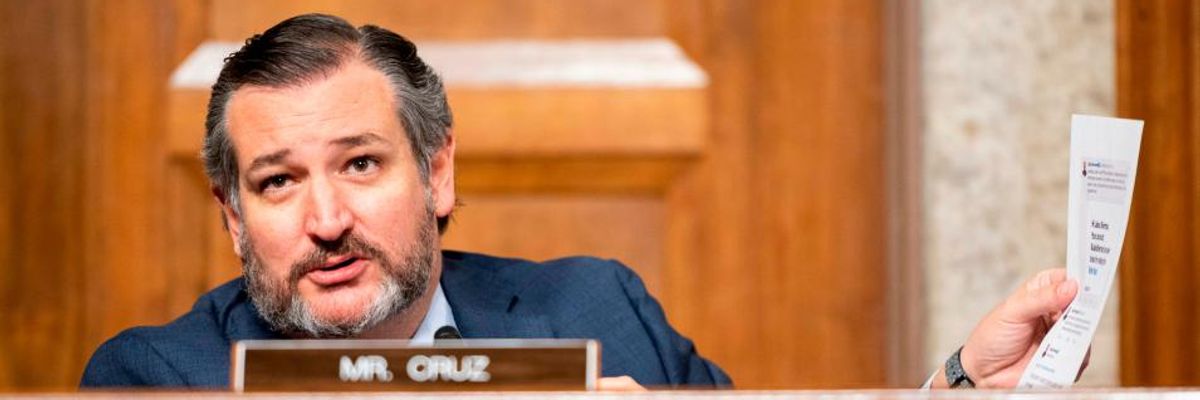
Sen. Ted Cruz (R-Texas) speaks during a Senate Judiciary Committee hearing on Capitol Hill in Washington, D.C. on November 17, 2020. (Photo: Bill Clark/Pool/AFP via Getty Images)
With the Trump operation's legal effort to overturn the November election going nowhere, nearly 20 Republican attorneys general have decided to throw their support behind Texas AG Ken Paxton's desperate--and, according to analysts, doomed-to-fail--Supreme Court lawsuit against four key battleground states that have certified President-elect Joe Biden's victories.
Filed on Tuesday and enthusiastically celebrated in right-wing circles, Paxton's lawsuit (pdf) baselessly alleges "significant and unconstitutional irregularities" in Georgia, Michigan, Pennsylvania, and Wisconsin and pleads with the high court to delay next week's scheduled certification of presidential electors for those four states.
"The president will leave the White House on January 20. The conservative attorneys who have become radicalized under his influence, however, will remain in power across the country."
--Mark Joseph Stern, Slate
That the lawsuit was mocked as "utter garbage" and "factually untethered" by legal experts did not dissuade 18 Republican attorneys general, led by Missouri AG Eric Schmitt, from expressing support for Paxton's effort.
As of this writing, the Republican attorneys general of Alabama, Arkansas, Florida, Indiana, Kansas, Louisiana, Mississippi, Montana, Nebraska, North Dakota, Oklahoma, South Carolina, South Dakota, Tennessee, Utah, and West Virginia have backed Schmitt's amicus brief (pdf) in support of the Texas lawsuit. Arizona Attorney General Mark Brnovich has filed a separate brief (pdf) "respecting" the Texas suit.
The New York Times reported that Trump asked Sen. Ted Cruz (R-Texas) on Tuesday to argue the case if the Supreme Court hears it, and Cruz has agreed.
Late Wednesday, Trump--who has openly pleaded with the Supreme Court to undo Biden's decisive victory--filed a brief with the high court seeking to intervene in support of Paxton's lawsuit. Kristen Clarke, president and executive director of the Lawyers' Committee for Civil Rights Under Law, said the president's filing "reads like a rally speech."
"Were the Supreme Court to agree to hear this meritless suit brought by Texas," Clarke added, "we might as well toss the Constitution."
The Supreme Court--to which Trump successfully appointed three right-wing justices over his four years in office--has not yet decided whether to take up the case, despite viral right-wing social media posts to the contrary.
In a blog post, Richard Hasen, a law professor at the University of California, Irvine, called Paxton's complaint "a press release masquerading as a lawsuit." He elaborated:
Texas doesn't have standing to raise these claims as it has no say over how other states choose electors; it could raise these issues in other cases and does not need to go straight to the Supreme Court; it waited too late to sue; the remedy Texas suggests of disenfranchising tens of millions of voters after the fact is unconstitutional; there's no reason to believe the voting conducted in any of the states was done unconstitutionally; it's too late for the Supreme Court to grant a remedy even if the claims were meritorious (they are not).
While Paxton's lawsuit will almost certainly fail, observers warned that the willingness of so many top state law enforcement officials to back the effort to overturn the presidential election highlights the threat the right will continue to pose to democracy long after Trump leaves office.
"The president will leave the White House on January 20. The conservative attorneys who have become radicalized under his influence, however, will remain in power across the country," Slate's Mark Joseph Stern wrote Wednesday. "Paxton's suit asks the Supreme Court to throw out every vote in four states won by Joe Biden--Georgia, Michigan, Pennsylvania, and Wisconsin--then direct each state's legislature to declare Trump the winner."
"This act would constitute the single biggest incident of voter nullification in American history," Stern continued. "Paxton alleges that all four states illegally expanded mail voting, permitted egregious fraud, then concealed evidence that Democrats stole the election. There is no basis in truth for his factual claims and no basis in law for his legal theories."
Clarke of the Lawyers' Committee for Civil Rights Under Law added on Twitter, "This is what anti-democratic conduct looks like."
Dear Common Dreams reader, It’s been nearly 30 years since I co-founded Common Dreams with my late wife, Lina Newhouser. We had the radical notion that journalism should serve the public good, not corporate profits. It was clear to us from the outset what it would take to build such a project. No paid advertisements. No corporate sponsors. No millionaire publisher telling us what to think or do. Many people said we wouldn't last a year, but we proved those doubters wrong. Together with a tremendous team of journalists and dedicated staff, we built an independent media outlet free from the constraints of profits and corporate control. Our mission has always been simple: To inform. To inspire. To ignite change for the common good. Building Common Dreams was not easy. Our survival was never guaranteed. When you take on the most powerful forces—Wall Street greed, fossil fuel industry destruction, Big Tech lobbyists, and uber-rich oligarchs who have spent billions upon billions rigging the economy and democracy in their favor—the only bulwark you have is supporters who believe in your work. But here’s the urgent message from me today. It's never been this bad out there. And it's never been this hard to keep us going. At the very moment Common Dreams is most needed, the threats we face are intensifying. We need your support now more than ever. We don't accept corporate advertising and never will. We don't have a paywall because we don't think people should be blocked from critical news based on their ability to pay. Everything we do is funded by the donations of readers like you. When everyone does the little they can afford, we are strong. But if that support retreats or dries up, so do we. Will you donate now to make sure Common Dreams not only survives but thrives? —Craig Brown, Co-founder |
With the Trump operation's legal effort to overturn the November election going nowhere, nearly 20 Republican attorneys general have decided to throw their support behind Texas AG Ken Paxton's desperate--and, according to analysts, doomed-to-fail--Supreme Court lawsuit against four key battleground states that have certified President-elect Joe Biden's victories.
Filed on Tuesday and enthusiastically celebrated in right-wing circles, Paxton's lawsuit (pdf) baselessly alleges "significant and unconstitutional irregularities" in Georgia, Michigan, Pennsylvania, and Wisconsin and pleads with the high court to delay next week's scheduled certification of presidential electors for those four states.
"The president will leave the White House on January 20. The conservative attorneys who have become radicalized under his influence, however, will remain in power across the country."
--Mark Joseph Stern, Slate
That the lawsuit was mocked as "utter garbage" and "factually untethered" by legal experts did not dissuade 18 Republican attorneys general, led by Missouri AG Eric Schmitt, from expressing support for Paxton's effort.
As of this writing, the Republican attorneys general of Alabama, Arkansas, Florida, Indiana, Kansas, Louisiana, Mississippi, Montana, Nebraska, North Dakota, Oklahoma, South Carolina, South Dakota, Tennessee, Utah, and West Virginia have backed Schmitt's amicus brief (pdf) in support of the Texas lawsuit. Arizona Attorney General Mark Brnovich has filed a separate brief (pdf) "respecting" the Texas suit.
The New York Times reported that Trump asked Sen. Ted Cruz (R-Texas) on Tuesday to argue the case if the Supreme Court hears it, and Cruz has agreed.
Late Wednesday, Trump--who has openly pleaded with the Supreme Court to undo Biden's decisive victory--filed a brief with the high court seeking to intervene in support of Paxton's lawsuit. Kristen Clarke, president and executive director of the Lawyers' Committee for Civil Rights Under Law, said the president's filing "reads like a rally speech."
"Were the Supreme Court to agree to hear this meritless suit brought by Texas," Clarke added, "we might as well toss the Constitution."
The Supreme Court--to which Trump successfully appointed three right-wing justices over his four years in office--has not yet decided whether to take up the case, despite viral right-wing social media posts to the contrary.
In a blog post, Richard Hasen, a law professor at the University of California, Irvine, called Paxton's complaint "a press release masquerading as a lawsuit." He elaborated:
Texas doesn't have standing to raise these claims as it has no say over how other states choose electors; it could raise these issues in other cases and does not need to go straight to the Supreme Court; it waited too late to sue; the remedy Texas suggests of disenfranchising tens of millions of voters after the fact is unconstitutional; there's no reason to believe the voting conducted in any of the states was done unconstitutionally; it's too late for the Supreme Court to grant a remedy even if the claims were meritorious (they are not).
While Paxton's lawsuit will almost certainly fail, observers warned that the willingness of so many top state law enforcement officials to back the effort to overturn the presidential election highlights the threat the right will continue to pose to democracy long after Trump leaves office.
"The president will leave the White House on January 20. The conservative attorneys who have become radicalized under his influence, however, will remain in power across the country," Slate's Mark Joseph Stern wrote Wednesday. "Paxton's suit asks the Supreme Court to throw out every vote in four states won by Joe Biden--Georgia, Michigan, Pennsylvania, and Wisconsin--then direct each state's legislature to declare Trump the winner."
"This act would constitute the single biggest incident of voter nullification in American history," Stern continued. "Paxton alleges that all four states illegally expanded mail voting, permitted egregious fraud, then concealed evidence that Democrats stole the election. There is no basis in truth for his factual claims and no basis in law for his legal theories."
Clarke of the Lawyers' Committee for Civil Rights Under Law added on Twitter, "This is what anti-democratic conduct looks like."
With the Trump operation's legal effort to overturn the November election going nowhere, nearly 20 Republican attorneys general have decided to throw their support behind Texas AG Ken Paxton's desperate--and, according to analysts, doomed-to-fail--Supreme Court lawsuit against four key battleground states that have certified President-elect Joe Biden's victories.
Filed on Tuesday and enthusiastically celebrated in right-wing circles, Paxton's lawsuit (pdf) baselessly alleges "significant and unconstitutional irregularities" in Georgia, Michigan, Pennsylvania, and Wisconsin and pleads with the high court to delay next week's scheduled certification of presidential electors for those four states.
"The president will leave the White House on January 20. The conservative attorneys who have become radicalized under his influence, however, will remain in power across the country."
--Mark Joseph Stern, Slate
That the lawsuit was mocked as "utter garbage" and "factually untethered" by legal experts did not dissuade 18 Republican attorneys general, led by Missouri AG Eric Schmitt, from expressing support for Paxton's effort.
As of this writing, the Republican attorneys general of Alabama, Arkansas, Florida, Indiana, Kansas, Louisiana, Mississippi, Montana, Nebraska, North Dakota, Oklahoma, South Carolina, South Dakota, Tennessee, Utah, and West Virginia have backed Schmitt's amicus brief (pdf) in support of the Texas lawsuit. Arizona Attorney General Mark Brnovich has filed a separate brief (pdf) "respecting" the Texas suit.
The New York Times reported that Trump asked Sen. Ted Cruz (R-Texas) on Tuesday to argue the case if the Supreme Court hears it, and Cruz has agreed.
Late Wednesday, Trump--who has openly pleaded with the Supreme Court to undo Biden's decisive victory--filed a brief with the high court seeking to intervene in support of Paxton's lawsuit. Kristen Clarke, president and executive director of the Lawyers' Committee for Civil Rights Under Law, said the president's filing "reads like a rally speech."
"Were the Supreme Court to agree to hear this meritless suit brought by Texas," Clarke added, "we might as well toss the Constitution."
The Supreme Court--to which Trump successfully appointed three right-wing justices over his four years in office--has not yet decided whether to take up the case, despite viral right-wing social media posts to the contrary.
In a blog post, Richard Hasen, a law professor at the University of California, Irvine, called Paxton's complaint "a press release masquerading as a lawsuit." He elaborated:
Texas doesn't have standing to raise these claims as it has no say over how other states choose electors; it could raise these issues in other cases and does not need to go straight to the Supreme Court; it waited too late to sue; the remedy Texas suggests of disenfranchising tens of millions of voters after the fact is unconstitutional; there's no reason to believe the voting conducted in any of the states was done unconstitutionally; it's too late for the Supreme Court to grant a remedy even if the claims were meritorious (they are not).
While Paxton's lawsuit will almost certainly fail, observers warned that the willingness of so many top state law enforcement officials to back the effort to overturn the presidential election highlights the threat the right will continue to pose to democracy long after Trump leaves office.
"The president will leave the White House on January 20. The conservative attorneys who have become radicalized under his influence, however, will remain in power across the country," Slate's Mark Joseph Stern wrote Wednesday. "Paxton's suit asks the Supreme Court to throw out every vote in four states won by Joe Biden--Georgia, Michigan, Pennsylvania, and Wisconsin--then direct each state's legislature to declare Trump the winner."
"This act would constitute the single biggest incident of voter nullification in American history," Stern continued. "Paxton alleges that all four states illegally expanded mail voting, permitted egregious fraud, then concealed evidence that Democrats stole the election. There is no basis in truth for his factual claims and no basis in law for his legal theories."
Clarke of the Lawyers' Committee for Civil Rights Under Law added on Twitter, "This is what anti-democratic conduct looks like."