

SUBSCRIBE TO OUR FREE NEWSLETTER
Daily news & progressive opinion—funded by the people, not the corporations—delivered straight to your inbox.
5
#000000
#FFFFFF
To donate by check, phone, or other method, see our More Ways to Give page.
Daily news & progressive opinion—funded by the people, not the corporations—delivered straight to your inbox.
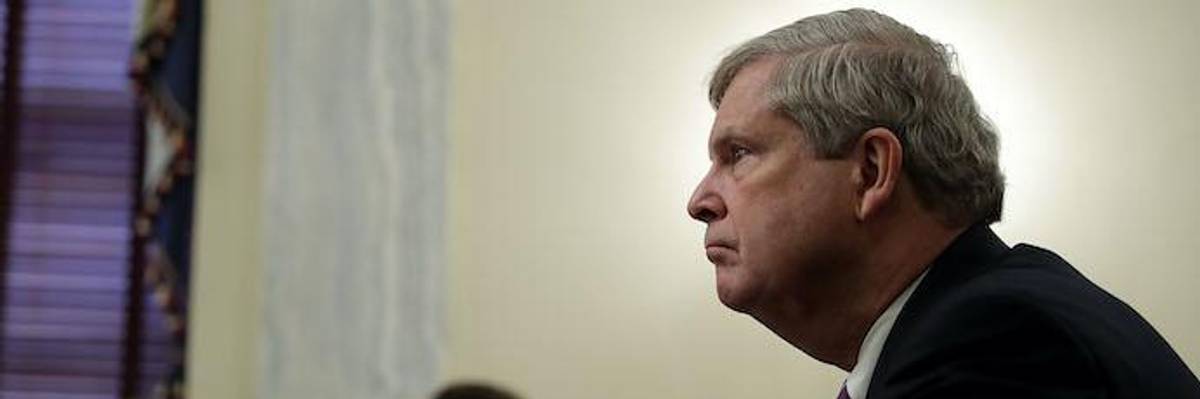
Then-U.S. Agriculture Secretary Tom Vilsack testifies during a hearing before the Senate Agriculture, Nutrition, and Forestry Committee September 21, 2016 on Capitol Hill in Washington, D.C. The committee held a hearing on "The U.S. Department of Agriculture and the Current State of the Farm Economy." (Photo: Alex Wong/Getty Images)
New reporting that President-elect Joe Biden is strongly considering having Tom Vilsack reprise his role as head of the U.S. Department of Agriculture elicited warnings from food safety groups that Vilsack would put the interests of Big Ag over those of a more sustainable and just food system.
"Tom Vilsack has a long and detailed record on food and agriculture--a record that clearly demonstrates why he would be a very bad pick to lead the USDA," Mitch Jones, policy director at Food & Water Watch, said in a statement.
Politico reported Monday that the president-elect "is leaning toward picking" Vilsack, who "was a top rural and agriculture policy adviser to the Biden campaign," for the role.
Vilsack also served as governor of Iowa from 1999 until 2007 and USDA secretary under the Obama administration.
Two other names that have emerged as possibilities for USDA chief are former North Dakota Sen. Heidi Heitkamp and Rep. Marcia Fudge of Ohio. Jennifer Granholm, a former governor and attorney general of Michigan, is also now reported to be in the running.
Bloomberg News also reported Monday on Vilsack being the favored candidate. "He is now president of the U.S. Dairy Export Council, which promotes sales of American dairy products abroad," reported Bloomberg, noting his previous backing of trade deals including the Trans Pacific Partnership and President's Donald Trump's USMCA.
From the outlet:
Some supporters of Vermont Senator Bernie Sanders campaigned against Vilsack when he was under consideration to be [2016 candidate Hillary] Clinton's vice president, branding him "Mr. Monsanto" and citing his role in brokering a compromise on legislation labeling foods containing genetically modified organisms. Sanders opposed the national legislation, which overrode a stricter Vermont state law.
Jaydee Hanson, Center for Food Safety's policy director, called Vilsack's possible selection "a huge step backwards in our urgent need to support agricultural systems that protect public health, the environment, and mitigate the ongoing climate crisis."
Hanson cited as damning evidence Vilsack's previous time at the Cabinet position as well as his post-Obama administration work supporting corporate dairy operations.
"While serving as Secretary under President Obama, Mr. Vilsack supported chemically-dependent industrial agriculture that resulted in millions more pounds of pesticides released into the environment, contaminating our water and soils and harming human health and wildlife. In addition," Hanson continued, "during his tenure the meat industry grew larger and more concentrated, contributing to the climate crisis."
"Mergers in the meat industry grew larger and larger--even when huge Chinese and Brazilian operations bought up U.S. operations," said Hanson, "Vilsack's USDA did not protest."
"Vilsack supported the expansion of pesticide-promoting, genetically engineered crops, and was not a strong supporter of organic agriculture," added Hanson.
Food & Water Watch's Jones, in his statement, likened Vilsack's background with that of Heitkamp, who's seen by progressive groups as advancing corporate agriculture interests.
"Much like Senator Heitkamp, Vilsack has made a career of catering to the whims of corporate agriculture giants--some of whom he has gone to work for--while failing to fight for struggling family farmers at every turn. America needs an Agriculture secretary that will finally prioritize sustainable family farming and national food security over corporate profits," Jones said.
Further staining Vilsack's background is his record on civil rights at the agency. The Counter reported last year that his claims of civil rights accomplishments were "extremely misleading or false."
For over two years, we have investigated USDA's treatment of black farmers under the Obama administration and found a disturbing pattern: Though USDA came to enjoy a reputation among policymakers and the press as a steady force for good in the lives of historically marginalized farmers, Vilsack and others in the department made cosmetic changes, and little else.
Under Vilsack, USDA employees foreclosed on black farmers with outstanding discrimination complaints, many of which were never resolved. At the same time, USDA staff threw out new complaints and misrepresented their frequency, while continuing to discriminate against farmers. The department sent a lower share of loan dollars to black farmers than it had under President Bush, then used census data in misleading ways to burnish its record on civil rights. And although numerous media outlets portrayed the Pigford settlement payments as lavish handouts--a narrative that originated with right-wing publisher Andrew Breitbart--USDA actually failed to adequately compensate black farmers, and many of them lost their farms.
Food & Water Action and Center for Food Safety are among dozens of advocacy groups that have pushed Biden to choose Fudge as Agriculture Secretary, calling her "an ally to farmers, food-chain workers, consumers, and rural communities."
Fudge "is best positioned to help the department navigate today's unprecedented challenges--from the ongoing rural crisis, to climate change, to the pandemic's rupturing of our food system," a joint letter backing the congresswoman states.
Dear Common Dreams reader, It’s been nearly 30 years since I co-founded Common Dreams with my late wife, Lina Newhouser. We had the radical notion that journalism should serve the public good, not corporate profits. It was clear to us from the outset what it would take to build such a project. No paid advertisements. No corporate sponsors. No millionaire publisher telling us what to think or do. Many people said we wouldn't last a year, but we proved those doubters wrong. Together with a tremendous team of journalists and dedicated staff, we built an independent media outlet free from the constraints of profits and corporate control. Our mission has always been simple: To inform. To inspire. To ignite change for the common good. Building Common Dreams was not easy. Our survival was never guaranteed. When you take on the most powerful forces—Wall Street greed, fossil fuel industry destruction, Big Tech lobbyists, and uber-rich oligarchs who have spent billions upon billions rigging the economy and democracy in their favor—the only bulwark you have is supporters who believe in your work. But here’s the urgent message from me today. It's never been this bad out there. And it's never been this hard to keep us going. At the very moment Common Dreams is most needed, the threats we face are intensifying. We need your support now more than ever. We don't accept corporate advertising and never will. We don't have a paywall because we don't think people should be blocked from critical news based on their ability to pay. Everything we do is funded by the donations of readers like you. When everyone does the little they can afford, we are strong. But if that support retreats or dries up, so do we. Will you donate now to make sure Common Dreams not only survives but thrives? —Craig Brown, Co-founder |
New reporting that President-elect Joe Biden is strongly considering having Tom Vilsack reprise his role as head of the U.S. Department of Agriculture elicited warnings from food safety groups that Vilsack would put the interests of Big Ag over those of a more sustainable and just food system.
"Tom Vilsack has a long and detailed record on food and agriculture--a record that clearly demonstrates why he would be a very bad pick to lead the USDA," Mitch Jones, policy director at Food & Water Watch, said in a statement.
Politico reported Monday that the president-elect "is leaning toward picking" Vilsack, who "was a top rural and agriculture policy adviser to the Biden campaign," for the role.
Vilsack also served as governor of Iowa from 1999 until 2007 and USDA secretary under the Obama administration.
Two other names that have emerged as possibilities for USDA chief are former North Dakota Sen. Heidi Heitkamp and Rep. Marcia Fudge of Ohio. Jennifer Granholm, a former governor and attorney general of Michigan, is also now reported to be in the running.
Bloomberg News also reported Monday on Vilsack being the favored candidate. "He is now president of the U.S. Dairy Export Council, which promotes sales of American dairy products abroad," reported Bloomberg, noting his previous backing of trade deals including the Trans Pacific Partnership and President's Donald Trump's USMCA.
From the outlet:
Some supporters of Vermont Senator Bernie Sanders campaigned against Vilsack when he was under consideration to be [2016 candidate Hillary] Clinton's vice president, branding him "Mr. Monsanto" and citing his role in brokering a compromise on legislation labeling foods containing genetically modified organisms. Sanders opposed the national legislation, which overrode a stricter Vermont state law.
Jaydee Hanson, Center for Food Safety's policy director, called Vilsack's possible selection "a huge step backwards in our urgent need to support agricultural systems that protect public health, the environment, and mitigate the ongoing climate crisis."
Hanson cited as damning evidence Vilsack's previous time at the Cabinet position as well as his post-Obama administration work supporting corporate dairy operations.
"While serving as Secretary under President Obama, Mr. Vilsack supported chemically-dependent industrial agriculture that resulted in millions more pounds of pesticides released into the environment, contaminating our water and soils and harming human health and wildlife. In addition," Hanson continued, "during his tenure the meat industry grew larger and more concentrated, contributing to the climate crisis."
"Mergers in the meat industry grew larger and larger--even when huge Chinese and Brazilian operations bought up U.S. operations," said Hanson, "Vilsack's USDA did not protest."
"Vilsack supported the expansion of pesticide-promoting, genetically engineered crops, and was not a strong supporter of organic agriculture," added Hanson.
Food & Water Watch's Jones, in his statement, likened Vilsack's background with that of Heitkamp, who's seen by progressive groups as advancing corporate agriculture interests.
"Much like Senator Heitkamp, Vilsack has made a career of catering to the whims of corporate agriculture giants--some of whom he has gone to work for--while failing to fight for struggling family farmers at every turn. America needs an Agriculture secretary that will finally prioritize sustainable family farming and national food security over corporate profits," Jones said.
Further staining Vilsack's background is his record on civil rights at the agency. The Counter reported last year that his claims of civil rights accomplishments were "extremely misleading or false."
For over two years, we have investigated USDA's treatment of black farmers under the Obama administration and found a disturbing pattern: Though USDA came to enjoy a reputation among policymakers and the press as a steady force for good in the lives of historically marginalized farmers, Vilsack and others in the department made cosmetic changes, and little else.
Under Vilsack, USDA employees foreclosed on black farmers with outstanding discrimination complaints, many of which were never resolved. At the same time, USDA staff threw out new complaints and misrepresented their frequency, while continuing to discriminate against farmers. The department sent a lower share of loan dollars to black farmers than it had under President Bush, then used census data in misleading ways to burnish its record on civil rights. And although numerous media outlets portrayed the Pigford settlement payments as lavish handouts--a narrative that originated with right-wing publisher Andrew Breitbart--USDA actually failed to adequately compensate black farmers, and many of them lost their farms.
Food & Water Action and Center for Food Safety are among dozens of advocacy groups that have pushed Biden to choose Fudge as Agriculture Secretary, calling her "an ally to farmers, food-chain workers, consumers, and rural communities."
Fudge "is best positioned to help the department navigate today's unprecedented challenges--from the ongoing rural crisis, to climate change, to the pandemic's rupturing of our food system," a joint letter backing the congresswoman states.
New reporting that President-elect Joe Biden is strongly considering having Tom Vilsack reprise his role as head of the U.S. Department of Agriculture elicited warnings from food safety groups that Vilsack would put the interests of Big Ag over those of a more sustainable and just food system.
"Tom Vilsack has a long and detailed record on food and agriculture--a record that clearly demonstrates why he would be a very bad pick to lead the USDA," Mitch Jones, policy director at Food & Water Watch, said in a statement.
Politico reported Monday that the president-elect "is leaning toward picking" Vilsack, who "was a top rural and agriculture policy adviser to the Biden campaign," for the role.
Vilsack also served as governor of Iowa from 1999 until 2007 and USDA secretary under the Obama administration.
Two other names that have emerged as possibilities for USDA chief are former North Dakota Sen. Heidi Heitkamp and Rep. Marcia Fudge of Ohio. Jennifer Granholm, a former governor and attorney general of Michigan, is also now reported to be in the running.
Bloomberg News also reported Monday on Vilsack being the favored candidate. "He is now president of the U.S. Dairy Export Council, which promotes sales of American dairy products abroad," reported Bloomberg, noting his previous backing of trade deals including the Trans Pacific Partnership and President's Donald Trump's USMCA.
From the outlet:
Some supporters of Vermont Senator Bernie Sanders campaigned against Vilsack when he was under consideration to be [2016 candidate Hillary] Clinton's vice president, branding him "Mr. Monsanto" and citing his role in brokering a compromise on legislation labeling foods containing genetically modified organisms. Sanders opposed the national legislation, which overrode a stricter Vermont state law.
Jaydee Hanson, Center for Food Safety's policy director, called Vilsack's possible selection "a huge step backwards in our urgent need to support agricultural systems that protect public health, the environment, and mitigate the ongoing climate crisis."
Hanson cited as damning evidence Vilsack's previous time at the Cabinet position as well as his post-Obama administration work supporting corporate dairy operations.
"While serving as Secretary under President Obama, Mr. Vilsack supported chemically-dependent industrial agriculture that resulted in millions more pounds of pesticides released into the environment, contaminating our water and soils and harming human health and wildlife. In addition," Hanson continued, "during his tenure the meat industry grew larger and more concentrated, contributing to the climate crisis."
"Mergers in the meat industry grew larger and larger--even when huge Chinese and Brazilian operations bought up U.S. operations," said Hanson, "Vilsack's USDA did not protest."
"Vilsack supported the expansion of pesticide-promoting, genetically engineered crops, and was not a strong supporter of organic agriculture," added Hanson.
Food & Water Watch's Jones, in his statement, likened Vilsack's background with that of Heitkamp, who's seen by progressive groups as advancing corporate agriculture interests.
"Much like Senator Heitkamp, Vilsack has made a career of catering to the whims of corporate agriculture giants--some of whom he has gone to work for--while failing to fight for struggling family farmers at every turn. America needs an Agriculture secretary that will finally prioritize sustainable family farming and national food security over corporate profits," Jones said.
Further staining Vilsack's background is his record on civil rights at the agency. The Counter reported last year that his claims of civil rights accomplishments were "extremely misleading or false."
For over two years, we have investigated USDA's treatment of black farmers under the Obama administration and found a disturbing pattern: Though USDA came to enjoy a reputation among policymakers and the press as a steady force for good in the lives of historically marginalized farmers, Vilsack and others in the department made cosmetic changes, and little else.
Under Vilsack, USDA employees foreclosed on black farmers with outstanding discrimination complaints, many of which were never resolved. At the same time, USDA staff threw out new complaints and misrepresented their frequency, while continuing to discriminate against farmers. The department sent a lower share of loan dollars to black farmers than it had under President Bush, then used census data in misleading ways to burnish its record on civil rights. And although numerous media outlets portrayed the Pigford settlement payments as lavish handouts--a narrative that originated with right-wing publisher Andrew Breitbart--USDA actually failed to adequately compensate black farmers, and many of them lost their farms.
Food & Water Action and Center for Food Safety are among dozens of advocacy groups that have pushed Biden to choose Fudge as Agriculture Secretary, calling her "an ally to farmers, food-chain workers, consumers, and rural communities."
Fudge "is best positioned to help the department navigate today's unprecedented challenges--from the ongoing rural crisis, to climate change, to the pandemic's rupturing of our food system," a joint letter backing the congresswoman states.

