SUBSCRIBE TO OUR FREE NEWSLETTER
Daily news & progressive opinion—funded by the people, not the corporations—delivered straight to your inbox.
5
#000000
#FFFFFF
To donate by check, phone, or other method, see our More Ways to Give page.
Daily news & progressive opinion—funded by the people, not the corporations—delivered straight to your inbox.
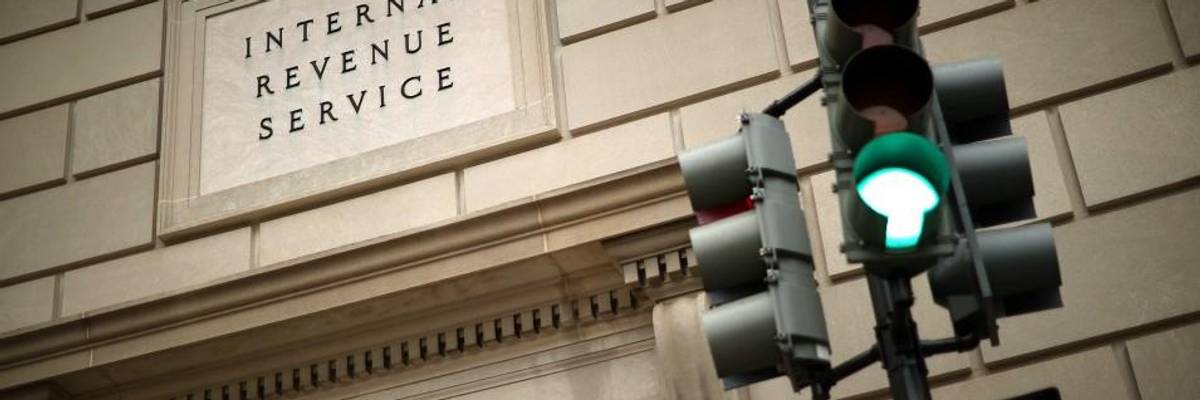
The Internal Revenue Service headquarters in Washington, D.C. on April 27, 2020. (Photo: Chip Somodevilla/Getty Images)
How exactly does President Donald Trump get away with paying such low--or no--taxes?
It's a question many people are asking in the wake of bombshell New York Times reporting showing the president paid just $750 in annual federal income tax in two recent years, and in a stunning new report published Friday, DCReport editor-in-chief David Cay Johnston examined Internal Revenue Service audits of the very richest Americans to find out how people like Trump manage to keep tax collectors at bay.
Johnston looked at 2018 IRS audits of the wealthiest 23,400 U.S. households--their average income was about $30 million--and found that the administration audited just seven of them. Not 7%, but seven households. That's an audit rate of 0.03%.
"There's no question Trump is a tax cheat because he has done it again and again."
--David Cay Johnston, DCReport
"If American police detected murders at the same rate it would mean that they would become aware of just five of the 16,214 reported homicides that year," writes Johnston.
In contrast, in 2015 under President Barack Obama, the wealthiest Americans were 270 times more likely to be audited than they were in 2018 under Trump.
It doesn't bode well for tax enforcement when the president himself is a known tax cheat, according to Johnston. He writes:
There's no question Trump is a tax cheat because he has done it again and again. He cheated on New York City sales taxes in 1983, for which Mayor Ed Koch said Trump should have served 15 days in jail. He went to extreme, even farcical lengths to evade $3 million of payments he owed in lieu of taxes to New York City.
Trump has been tried twice for civil tax fraud. He lost both times, a story I broke four years ago but you may not know about because America's major news organizations have not reported it except for one passing mention in the wedding announcement section of The New York Times. Two years ago, however, that newspaper did an exhaustive report showing years of calculated gift tax cheating by two generations of Trumps. In recent weeks income tax information that newspaper reported revealed many badges of tax fraud.
So why hasn't Trump been held accountable for his expansive tax cheating? It has to do with who the IRS audits, says Johnston. He notes that the working poor--defined as people earning less than $25,000 annually--were the target of one-third of all IRS audits in 2018, even thought their average income was just $12,600. The audit rate for poor households was 0.28%, or nine times that of the richest households.
"The cold hard truth is that the richest Americans today face a teensy-weensy risk of being detected if they cheat."
--Johnston
"The cold hard truth," writes Johnston, "is that the richest Americans today face a teensy-weensy risk of being detected if they cheat," mostly due to the dizzying complexity and intricacies of their business operations and property holdings.
"Now add to all this Trump's powers as president," writes Johnston, which include being able to appoint--and fire--the heads of the Treasury Department, IRS, Justice Department, and other important posts.
Over the past 13 months of the Trump administration, the IRS has referred just 231 cases for prosecution. In 2016, Obama's final year in office, there were 2,744 referrals for prosecution--over 1,100% more than Trump during a similar period. Additionally, around 70% of those cases under Trump were dismissed due to "insufficient evidence."
In the end, "the costs of these favor-the-rich policies even when they cheat are borne by the other 99% of taxpayers," writes Johnston.
Dear Common Dreams reader, It’s been nearly 30 years since I co-founded Common Dreams with my late wife, Lina Newhouser. We had the radical notion that journalism should serve the public good, not corporate profits. It was clear to us from the outset what it would take to build such a project. No paid advertisements. No corporate sponsors. No millionaire publisher telling us what to think or do. Many people said we wouldn't last a year, but we proved those doubters wrong. Together with a tremendous team of journalists and dedicated staff, we built an independent media outlet free from the constraints of profits and corporate control. Our mission has always been simple: To inform. To inspire. To ignite change for the common good. Building Common Dreams was not easy. Our survival was never guaranteed. When you take on the most powerful forces—Wall Street greed, fossil fuel industry destruction, Big Tech lobbyists, and uber-rich oligarchs who have spent billions upon billions rigging the economy and democracy in their favor—the only bulwark you have is supporters who believe in your work. But here’s the urgent message from me today. It's never been this bad out there. And it's never been this hard to keep us going. At the very moment Common Dreams is most needed, the threats we face are intensifying. We need your support now more than ever. We don't accept corporate advertising and never will. We don't have a paywall because we don't think people should be blocked from critical news based on their ability to pay. Everything we do is funded by the donations of readers like you. When everyone does the little they can afford, we are strong. But if that support retreats or dries up, so do we. Will you donate now to make sure Common Dreams not only survives but thrives? —Craig Brown, Co-founder |
How exactly does President Donald Trump get away with paying such low--or no--taxes?
It's a question many people are asking in the wake of bombshell New York Times reporting showing the president paid just $750 in annual federal income tax in two recent years, and in a stunning new report published Friday, DCReport editor-in-chief David Cay Johnston examined Internal Revenue Service audits of the very richest Americans to find out how people like Trump manage to keep tax collectors at bay.
Johnston looked at 2018 IRS audits of the wealthiest 23,400 U.S. households--their average income was about $30 million--and found that the administration audited just seven of them. Not 7%, but seven households. That's an audit rate of 0.03%.
"There's no question Trump is a tax cheat because he has done it again and again."
--David Cay Johnston, DCReport
"If American police detected murders at the same rate it would mean that they would become aware of just five of the 16,214 reported homicides that year," writes Johnston.
In contrast, in 2015 under President Barack Obama, the wealthiest Americans were 270 times more likely to be audited than they were in 2018 under Trump.
It doesn't bode well for tax enforcement when the president himself is a known tax cheat, according to Johnston. He writes:
There's no question Trump is a tax cheat because he has done it again and again. He cheated on New York City sales taxes in 1983, for which Mayor Ed Koch said Trump should have served 15 days in jail. He went to extreme, even farcical lengths to evade $3 million of payments he owed in lieu of taxes to New York City.
Trump has been tried twice for civil tax fraud. He lost both times, a story I broke four years ago but you may not know about because America's major news organizations have not reported it except for one passing mention in the wedding announcement section of The New York Times. Two years ago, however, that newspaper did an exhaustive report showing years of calculated gift tax cheating by two generations of Trumps. In recent weeks income tax information that newspaper reported revealed many badges of tax fraud.
So why hasn't Trump been held accountable for his expansive tax cheating? It has to do with who the IRS audits, says Johnston. He notes that the working poor--defined as people earning less than $25,000 annually--were the target of one-third of all IRS audits in 2018, even thought their average income was just $12,600. The audit rate for poor households was 0.28%, or nine times that of the richest households.
"The cold hard truth is that the richest Americans today face a teensy-weensy risk of being detected if they cheat."
--Johnston
"The cold hard truth," writes Johnston, "is that the richest Americans today face a teensy-weensy risk of being detected if they cheat," mostly due to the dizzying complexity and intricacies of their business operations and property holdings.
"Now add to all this Trump's powers as president," writes Johnston, which include being able to appoint--and fire--the heads of the Treasury Department, IRS, Justice Department, and other important posts.
Over the past 13 months of the Trump administration, the IRS has referred just 231 cases for prosecution. In 2016, Obama's final year in office, there were 2,744 referrals for prosecution--over 1,100% more than Trump during a similar period. Additionally, around 70% of those cases under Trump were dismissed due to "insufficient evidence."
In the end, "the costs of these favor-the-rich policies even when they cheat are borne by the other 99% of taxpayers," writes Johnston.
How exactly does President Donald Trump get away with paying such low--or no--taxes?
It's a question many people are asking in the wake of bombshell New York Times reporting showing the president paid just $750 in annual federal income tax in two recent years, and in a stunning new report published Friday, DCReport editor-in-chief David Cay Johnston examined Internal Revenue Service audits of the very richest Americans to find out how people like Trump manage to keep tax collectors at bay.
Johnston looked at 2018 IRS audits of the wealthiest 23,400 U.S. households--their average income was about $30 million--and found that the administration audited just seven of them. Not 7%, but seven households. That's an audit rate of 0.03%.
"There's no question Trump is a tax cheat because he has done it again and again."
--David Cay Johnston, DCReport
"If American police detected murders at the same rate it would mean that they would become aware of just five of the 16,214 reported homicides that year," writes Johnston.
In contrast, in 2015 under President Barack Obama, the wealthiest Americans were 270 times more likely to be audited than they were in 2018 under Trump.
It doesn't bode well for tax enforcement when the president himself is a known tax cheat, according to Johnston. He writes:
There's no question Trump is a tax cheat because he has done it again and again. He cheated on New York City sales taxes in 1983, for which Mayor Ed Koch said Trump should have served 15 days in jail. He went to extreme, even farcical lengths to evade $3 million of payments he owed in lieu of taxes to New York City.
Trump has been tried twice for civil tax fraud. He lost both times, a story I broke four years ago but you may not know about because America's major news organizations have not reported it except for one passing mention in the wedding announcement section of The New York Times. Two years ago, however, that newspaper did an exhaustive report showing years of calculated gift tax cheating by two generations of Trumps. In recent weeks income tax information that newspaper reported revealed many badges of tax fraud.
So why hasn't Trump been held accountable for his expansive tax cheating? It has to do with who the IRS audits, says Johnston. He notes that the working poor--defined as people earning less than $25,000 annually--were the target of one-third of all IRS audits in 2018, even thought their average income was just $12,600. The audit rate for poor households was 0.28%, or nine times that of the richest households.
"The cold hard truth is that the richest Americans today face a teensy-weensy risk of being detected if they cheat."
--Johnston
"The cold hard truth," writes Johnston, "is that the richest Americans today face a teensy-weensy risk of being detected if they cheat," mostly due to the dizzying complexity and intricacies of their business operations and property holdings.
"Now add to all this Trump's powers as president," writes Johnston, which include being able to appoint--and fire--the heads of the Treasury Department, IRS, Justice Department, and other important posts.
Over the past 13 months of the Trump administration, the IRS has referred just 231 cases for prosecution. In 2016, Obama's final year in office, there were 2,744 referrals for prosecution--over 1,100% more than Trump during a similar period. Additionally, around 70% of those cases under Trump were dismissed due to "insufficient evidence."
In the end, "the costs of these favor-the-rich policies even when they cheat are borne by the other 99% of taxpayers," writes Johnston.