SUBSCRIBE TO OUR FREE NEWSLETTER
Daily news & progressive opinion—funded by the people, not the corporations—delivered straight to your inbox.
5
#000000
#FFFFFF
To donate by check, phone, or other method, see our More Ways to Give page.
Daily news & progressive opinion—funded by the people, not the corporations—delivered straight to your inbox.
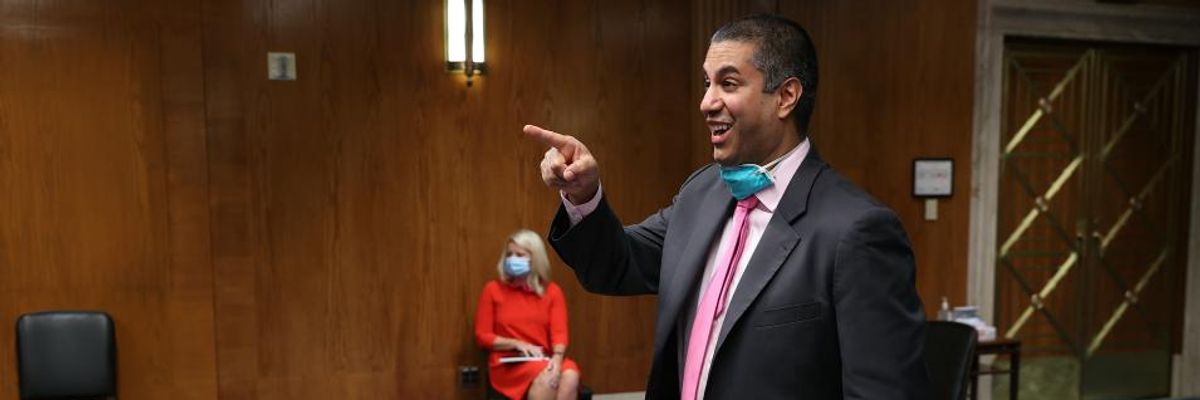
FCC Chairman Ajit Pai says goodby to members of a Senate Appropriations Subcommittee afters testifying during a hearing on June 16, 2020. (Photo: Chip Somodevilla/Getty Images)
Ignoring arguments that the coronavirus pandemic has bolstered the case for net neutrality protections, the Federal Communications Commission's Republican majority, led by Chairman Ajit Pai, voted Tuesday to uphold its repeal of Obama-era rules that were popular with the American public but long opposed by powerful corporate interests.
"We're in the middle of a deadly pandemic where people are more vulnerable to Big Telecom's abuses than ever before, and the FCC is voting against internet freedom once again."
--Evan Greer, Fight for the Future
"Ajit Pai's corruption and cruelty know no limits," declared Evan Greer, deputy director of the digital rights group Fight for the Future, in a statement. "We're in the middle of a deadly pandemic where people are more vulnerable to Big Telecom's abuses than ever before, and the FCC is voting against internet freedom once again."
"They're ignoring a mountain of evidence and the voices of the overwhelming majority of people from across the political spectrum," she said of the agency's GOP commissioners. "And they're spitting in the face of our nation's medical professionals and first responders by specifically ignoring a court order to address the serious public safety issues surrounding their repeal of net neutrality."
The Obama administration had enacted net neutrality rules requiring internet service providers to treat all online content equally and restored the FCC's authority over the broadband industry under Title II of the Communications Act. However, under Pai--who was appointed by President Donald Trump--the agency reversed course.
On Tuesday, Pai and the FCC's other two Republican commissioners doubled down on their December 2017 decision to repeal the rules--which took effect in June 2018--with an Order on Remand responding to questions raised last fall by the U.S. Court of Appeals for the D.C. Circuit.
The court "largely upheld the FCC's repeal of the rules, but ordered the agency to reconsider the repeal's impact on public safety; regulations on attachments to utility poles; and the FCC's ability to provide subsidies for broadband service," Reuters detailed Tuesday. "The FCC majority opted to leave the order unchanged."
FCC Commissioner Jessica Rosenworcel, a Democrat who voted against the repeal, said Tuesday that "this agency is not interested in getting it right. Instead, it doubles down, rather than recognizing the realities of the world around us."
Sens. Ed Markey (D-Mass.) and Mazie Hirono (D-Hawaii), who have both called for the restoration of net neutrality rules, took to Twitter to criticize the FCC's latest move:
Former FCC Commissioner Michael Copps, now a special adviser to the group Common Cause, also condemned the agency's GOP majority in a statement Tuesday.
"With this decision, the FCC continues to put the interests of a handful of monopoly internet service providers over the needs of the American people," Copps charged. "Net neutrality has always been more than just bright line rules preventing ISPs from discriminating against internet traffic. It's about ensuring consumers have adequate protections and affordable and competitive broadband services when going online."
"The FCC's failure to consider all aspects of its net neutrality repeal only highlights the need for strong rules that ensure the agency has adequate authority to act as a cop on the beat to protect consumers in an uncompetitive broadband marketplace," he continued, calling the vote part of a "troubling pattern of the FCC turning a blind eye to court decisions."
The ex-commissioner emphasized that "broadband has never been more critical to our democracy and everyday life than it is now during a global pandemic." However, he added, "Americans are continuing to suffer the consequences of the FCC's abdication of authority with so many still struggling to afford connectivity or choose from more than one broadband provider."
"Without adequate authority," Copps concluded, "the FCC has weakened its ability to ensure that ISPs maintain robust connections let alone fully address the broadband connectivity needs of all Americans during the pandemic."
Matt Wood, vice president of policy and general counsel at the advocacy group Free Press, addressed the FCC's actions in a series of tweets Tuesday:
In a statement, Free Press policy manager Dana Floberg took direct aim at Pai. The court gave the former Verizon lawyer "yet another opportunity to reverse course on his tremendously unpopular and statutorily suspect decisions," she said. "But like a child caught in a lie, this chairman has instead doubled down."
"This remand order callously dismisses the valid concerns of public-safety officials, competitive broadband providers, and millions of disconnected low-income families who can't afford to get online," Floberg added. "But Pai goes even further, insisting that if the agency's decisions on these issues harm these constituencies, that harm is justified by the supposed benefits of repealing Title II."
"Let's be really clear about this: Chairman Pai has admitted that he would rather deny low-income families support for broadband access through the Lifeline program than give up his ideological quest to stomp out the imaginary harms to industry from Title II," she said. "This is his agency's response to a global pandemic that has exposed the digital divide with brutal clarity as tens of millions of people struggle without adequate broadband access to connect safely to remote learning, jobs, and healthcare."
Dear Common Dreams reader, It’s been nearly 30 years since I co-founded Common Dreams with my late wife, Lina Newhouser. We had the radical notion that journalism should serve the public good, not corporate profits. It was clear to us from the outset what it would take to build such a project. No paid advertisements. No corporate sponsors. No millionaire publisher telling us what to think or do. Many people said we wouldn't last a year, but we proved those doubters wrong. Together with a tremendous team of journalists and dedicated staff, we built an independent media outlet free from the constraints of profits and corporate control. Our mission has always been simple: To inform. To inspire. To ignite change for the common good. Building Common Dreams was not easy. Our survival was never guaranteed. When you take on the most powerful forces—Wall Street greed, fossil fuel industry destruction, Big Tech lobbyists, and uber-rich oligarchs who have spent billions upon billions rigging the economy and democracy in their favor—the only bulwark you have is supporters who believe in your work. But here’s the urgent message from me today. It's never been this bad out there. And it's never been this hard to keep us going. At the very moment Common Dreams is most needed, the threats we face are intensifying. We need your support now more than ever. We don't accept corporate advertising and never will. We don't have a paywall because we don't think people should be blocked from critical news based on their ability to pay. Everything we do is funded by the donations of readers like you. When everyone does the little they can afford, we are strong. But if that support retreats or dries up, so do we. Will you donate now to make sure Common Dreams not only survives but thrives? —Craig Brown, Co-founder |
Ignoring arguments that the coronavirus pandemic has bolstered the case for net neutrality protections, the Federal Communications Commission's Republican majority, led by Chairman Ajit Pai, voted Tuesday to uphold its repeal of Obama-era rules that were popular with the American public but long opposed by powerful corporate interests.
"We're in the middle of a deadly pandemic where people are more vulnerable to Big Telecom's abuses than ever before, and the FCC is voting against internet freedom once again."
--Evan Greer, Fight for the Future
"Ajit Pai's corruption and cruelty know no limits," declared Evan Greer, deputy director of the digital rights group Fight for the Future, in a statement. "We're in the middle of a deadly pandemic where people are more vulnerable to Big Telecom's abuses than ever before, and the FCC is voting against internet freedom once again."
"They're ignoring a mountain of evidence and the voices of the overwhelming majority of people from across the political spectrum," she said of the agency's GOP commissioners. "And they're spitting in the face of our nation's medical professionals and first responders by specifically ignoring a court order to address the serious public safety issues surrounding their repeal of net neutrality."
The Obama administration had enacted net neutrality rules requiring internet service providers to treat all online content equally and restored the FCC's authority over the broadband industry under Title II of the Communications Act. However, under Pai--who was appointed by President Donald Trump--the agency reversed course.
On Tuesday, Pai and the FCC's other two Republican commissioners doubled down on their December 2017 decision to repeal the rules--which took effect in June 2018--with an Order on Remand responding to questions raised last fall by the U.S. Court of Appeals for the D.C. Circuit.
The court "largely upheld the FCC's repeal of the rules, but ordered the agency to reconsider the repeal's impact on public safety; regulations on attachments to utility poles; and the FCC's ability to provide subsidies for broadband service," Reuters detailed Tuesday. "The FCC majority opted to leave the order unchanged."
FCC Commissioner Jessica Rosenworcel, a Democrat who voted against the repeal, said Tuesday that "this agency is not interested in getting it right. Instead, it doubles down, rather than recognizing the realities of the world around us."
Sens. Ed Markey (D-Mass.) and Mazie Hirono (D-Hawaii), who have both called for the restoration of net neutrality rules, took to Twitter to criticize the FCC's latest move:
Former FCC Commissioner Michael Copps, now a special adviser to the group Common Cause, also condemned the agency's GOP majority in a statement Tuesday.
"With this decision, the FCC continues to put the interests of a handful of monopoly internet service providers over the needs of the American people," Copps charged. "Net neutrality has always been more than just bright line rules preventing ISPs from discriminating against internet traffic. It's about ensuring consumers have adequate protections and affordable and competitive broadband services when going online."
"The FCC's failure to consider all aspects of its net neutrality repeal only highlights the need for strong rules that ensure the agency has adequate authority to act as a cop on the beat to protect consumers in an uncompetitive broadband marketplace," he continued, calling the vote part of a "troubling pattern of the FCC turning a blind eye to court decisions."
The ex-commissioner emphasized that "broadband has never been more critical to our democracy and everyday life than it is now during a global pandemic." However, he added, "Americans are continuing to suffer the consequences of the FCC's abdication of authority with so many still struggling to afford connectivity or choose from more than one broadband provider."
"Without adequate authority," Copps concluded, "the FCC has weakened its ability to ensure that ISPs maintain robust connections let alone fully address the broadband connectivity needs of all Americans during the pandemic."
Matt Wood, vice president of policy and general counsel at the advocacy group Free Press, addressed the FCC's actions in a series of tweets Tuesday:
In a statement, Free Press policy manager Dana Floberg took direct aim at Pai. The court gave the former Verizon lawyer "yet another opportunity to reverse course on his tremendously unpopular and statutorily suspect decisions," she said. "But like a child caught in a lie, this chairman has instead doubled down."
"This remand order callously dismisses the valid concerns of public-safety officials, competitive broadband providers, and millions of disconnected low-income families who can't afford to get online," Floberg added. "But Pai goes even further, insisting that if the agency's decisions on these issues harm these constituencies, that harm is justified by the supposed benefits of repealing Title II."
"Let's be really clear about this: Chairman Pai has admitted that he would rather deny low-income families support for broadband access through the Lifeline program than give up his ideological quest to stomp out the imaginary harms to industry from Title II," she said. "This is his agency's response to a global pandemic that has exposed the digital divide with brutal clarity as tens of millions of people struggle without adequate broadband access to connect safely to remote learning, jobs, and healthcare."
Ignoring arguments that the coronavirus pandemic has bolstered the case for net neutrality protections, the Federal Communications Commission's Republican majority, led by Chairman Ajit Pai, voted Tuesday to uphold its repeal of Obama-era rules that were popular with the American public but long opposed by powerful corporate interests.
"We're in the middle of a deadly pandemic where people are more vulnerable to Big Telecom's abuses than ever before, and the FCC is voting against internet freedom once again."
--Evan Greer, Fight for the Future
"Ajit Pai's corruption and cruelty know no limits," declared Evan Greer, deputy director of the digital rights group Fight for the Future, in a statement. "We're in the middle of a deadly pandemic where people are more vulnerable to Big Telecom's abuses than ever before, and the FCC is voting against internet freedom once again."
"They're ignoring a mountain of evidence and the voices of the overwhelming majority of people from across the political spectrum," she said of the agency's GOP commissioners. "And they're spitting in the face of our nation's medical professionals and first responders by specifically ignoring a court order to address the serious public safety issues surrounding their repeal of net neutrality."
The Obama administration had enacted net neutrality rules requiring internet service providers to treat all online content equally and restored the FCC's authority over the broadband industry under Title II of the Communications Act. However, under Pai--who was appointed by President Donald Trump--the agency reversed course.
On Tuesday, Pai and the FCC's other two Republican commissioners doubled down on their December 2017 decision to repeal the rules--which took effect in June 2018--with an Order on Remand responding to questions raised last fall by the U.S. Court of Appeals for the D.C. Circuit.
The court "largely upheld the FCC's repeal of the rules, but ordered the agency to reconsider the repeal's impact on public safety; regulations on attachments to utility poles; and the FCC's ability to provide subsidies for broadband service," Reuters detailed Tuesday. "The FCC majority opted to leave the order unchanged."
FCC Commissioner Jessica Rosenworcel, a Democrat who voted against the repeal, said Tuesday that "this agency is not interested in getting it right. Instead, it doubles down, rather than recognizing the realities of the world around us."
Sens. Ed Markey (D-Mass.) and Mazie Hirono (D-Hawaii), who have both called for the restoration of net neutrality rules, took to Twitter to criticize the FCC's latest move:
Former FCC Commissioner Michael Copps, now a special adviser to the group Common Cause, also condemned the agency's GOP majority in a statement Tuesday.
"With this decision, the FCC continues to put the interests of a handful of monopoly internet service providers over the needs of the American people," Copps charged. "Net neutrality has always been more than just bright line rules preventing ISPs from discriminating against internet traffic. It's about ensuring consumers have adequate protections and affordable and competitive broadband services when going online."
"The FCC's failure to consider all aspects of its net neutrality repeal only highlights the need for strong rules that ensure the agency has adequate authority to act as a cop on the beat to protect consumers in an uncompetitive broadband marketplace," he continued, calling the vote part of a "troubling pattern of the FCC turning a blind eye to court decisions."
The ex-commissioner emphasized that "broadband has never been more critical to our democracy and everyday life than it is now during a global pandemic." However, he added, "Americans are continuing to suffer the consequences of the FCC's abdication of authority with so many still struggling to afford connectivity or choose from more than one broadband provider."
"Without adequate authority," Copps concluded, "the FCC has weakened its ability to ensure that ISPs maintain robust connections let alone fully address the broadband connectivity needs of all Americans during the pandemic."
Matt Wood, vice president of policy and general counsel at the advocacy group Free Press, addressed the FCC's actions in a series of tweets Tuesday:
In a statement, Free Press policy manager Dana Floberg took direct aim at Pai. The court gave the former Verizon lawyer "yet another opportunity to reverse course on his tremendously unpopular and statutorily suspect decisions," she said. "But like a child caught in a lie, this chairman has instead doubled down."
"This remand order callously dismisses the valid concerns of public-safety officials, competitive broadband providers, and millions of disconnected low-income families who can't afford to get online," Floberg added. "But Pai goes even further, insisting that if the agency's decisions on these issues harm these constituencies, that harm is justified by the supposed benefits of repealing Title II."
"Let's be really clear about this: Chairman Pai has admitted that he would rather deny low-income families support for broadband access through the Lifeline program than give up his ideological quest to stomp out the imaginary harms to industry from Title II," she said. "This is his agency's response to a global pandemic that has exposed the digital divide with brutal clarity as tens of millions of people struggle without adequate broadband access to connect safely to remote learning, jobs, and healthcare."