SUBSCRIBE TO OUR FREE NEWSLETTER
Daily news & progressive opinion—funded by the people, not the corporations—delivered straight to your inbox.
5
#000000
#FFFFFF
To donate by check, phone, or other method, see our More Ways to Give page.
Daily news & progressive opinion—funded by the people, not the corporations—delivered straight to your inbox.
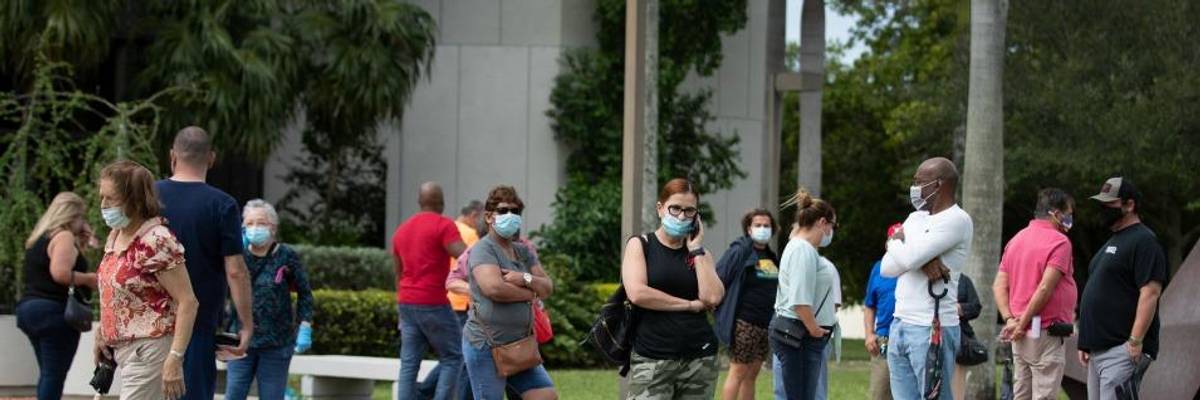
Voters wait in line, socially distanced from each other, to cast their early ballots at the Westchester Regional Library polling station on October 19, 2020 in Westchester, Florida. (Photo: Joe Raedle/Getty Images)
A motivated electorate in Florida weathered downpours Monday to shatter the state's first-day early voting record, with 350,000 people casting ballots, including some of the more than 67,000 former felons who have registered to vote in the two years since the approval of a constitutional amendment restoring their voting rights.
Sixty-seven thousand is a small fraction of the 1.4 million Floridians who regained voting eligibility in 2018, a reflection of the extent to which a 2019 law passed by the state's Republican lawmakers that requires residents with past felony convictions to pay off all court fines and fees before they are allowed to register to vote--a "modern-day poll tax" upheld in September 2020 by right-wing federal judges--has reproduced disenfranchisement.
Nonetheless, voting rights advocates called Monday's turnout, which included the first-time participation of some residents with past felony convictions, an "exciting and historical moment," particularly "for those who have gotten their voting rights back."
Desmond Meade describes himself as "a formerly homeless returning citizen who overcame many obstacles to eventually become the president of the Florida Rights Restoration Coalition (FRRC), chair of Floridians for a Fair Democracy, and a graduate of Florida International University College of Law."
The 53-year-old activist lawyer told Politico reporter Gary Fineout that "this will be the first time he has ever voted in a presidential election."
Meade caught up with a 65-year-old man named Don who voted for the first time Monday and shared their encounter on Twitter:
"There is no doubt in my mind that there are thousands upon thousands of energized and inspired returning citizens throughout the state that will not be denied, that will be a voice, and will have an impact in determining who wins Florida," Meade told reporters Monday.
According to reporting from Politico, Florida's election officials continued "to count statewide late into the night" Monday after at least 350,000 people turned out to vote, adding to the 2.5 million mail-in ballots that have already been cast in the Sunshine State.
In 2016, by comparison, 291,000 voters showed up on the first day of early voting, and 1.2 million had mailed ballots by mid-October of that year.
Early voting in Florida in 2020 has not unfolded without controversy. According to a photo shared Tuesday on Twitter by Steve Simeonidis, chair of the Miami-Dade Democrats, an armed and uniformed member of the Miami Police Department wore a mask supporting President Donald Trump at a polling location.
"This is city funded voter intimidation," Simeonidis said, calling for the officer's suspension.
This country and this world are at a monumental crossroads. US voters have an opportunity to beat back the forces of fascism and confront the billionaires who are rigging the economy, our media system, and our democracy, making it increasingly impossible for ordinary people to get by. We’re not just talking about the election. We’re talking about what must be done once these fascist elements are vanquished from power. We need a bolder set of solutions than what either major party has so far been willing to offer and a working-class movement ready to fight like hell for it. Trump didn't emerge from nowhere. The conditions that fueled MAGA authoritarianism were created by decades of radical neoliberal economic policies and a corrupt political system dominated by corporate interests. They slashed taxes on the super-rich, promising that the benefits would trickle down. They said giveaways to the corporate titans would make life more affordable for the rest of us. It was all bullshit. And when a bitter, betrayed populace searches for someone to blame, right-wing demagogues have little trouble finding scapegoats. People know when they're being lied to, but you won't hear any of this from the corporate media. Only independent journalism—powered and funded by people who believe in building a better world—can deliver truly trustworthy daily news. If you share our vision, please contribute whatever you can to sustain our work. |
A motivated electorate in Florida weathered downpours Monday to shatter the state's first-day early voting record, with 350,000 people casting ballots, including some of the more than 67,000 former felons who have registered to vote in the two years since the approval of a constitutional amendment restoring their voting rights.
Sixty-seven thousand is a small fraction of the 1.4 million Floridians who regained voting eligibility in 2018, a reflection of the extent to which a 2019 law passed by the state's Republican lawmakers that requires residents with past felony convictions to pay off all court fines and fees before they are allowed to register to vote--a "modern-day poll tax" upheld in September 2020 by right-wing federal judges--has reproduced disenfranchisement.
Nonetheless, voting rights advocates called Monday's turnout, which included the first-time participation of some residents with past felony convictions, an "exciting and historical moment," particularly "for those who have gotten their voting rights back."
Desmond Meade describes himself as "a formerly homeless returning citizen who overcame many obstacles to eventually become the president of the Florida Rights Restoration Coalition (FRRC), chair of Floridians for a Fair Democracy, and a graduate of Florida International University College of Law."
The 53-year-old activist lawyer told Politico reporter Gary Fineout that "this will be the first time he has ever voted in a presidential election."
Meade caught up with a 65-year-old man named Don who voted for the first time Monday and shared their encounter on Twitter:
"There is no doubt in my mind that there are thousands upon thousands of energized and inspired returning citizens throughout the state that will not be denied, that will be a voice, and will have an impact in determining who wins Florida," Meade told reporters Monday.
According to reporting from Politico, Florida's election officials continued "to count statewide late into the night" Monday after at least 350,000 people turned out to vote, adding to the 2.5 million mail-in ballots that have already been cast in the Sunshine State.
In 2016, by comparison, 291,000 voters showed up on the first day of early voting, and 1.2 million had mailed ballots by mid-October of that year.
Early voting in Florida in 2020 has not unfolded without controversy. According to a photo shared Tuesday on Twitter by Steve Simeonidis, chair of the Miami-Dade Democrats, an armed and uniformed member of the Miami Police Department wore a mask supporting President Donald Trump at a polling location.
"This is city funded voter intimidation," Simeonidis said, calling for the officer's suspension.