SUBSCRIBE TO OUR FREE NEWSLETTER
Daily news & progressive opinion—funded by the people, not the corporations—delivered straight to your inbox.
5
#000000
#FFFFFF
To donate by check, phone, or other method, see our More Ways to Give page.
Daily news & progressive opinion—funded by the people, not the corporations—delivered straight to your inbox.
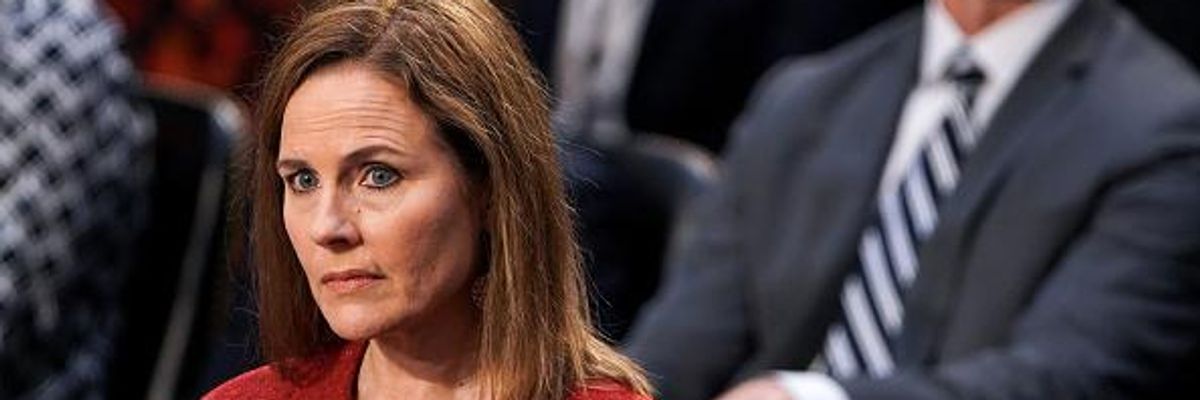
Supreme Court nominee Judge Amy Coney Barrett listens during the second day of her confirmation hearings on Capitol Hill on October 13, 2020 in Washington, D.C. (Photo: Greg Nash via Pool/Getty Images)
When Judge Amy Coney Barrett was asked Tuesday during her second day of confirmation hearings if it would be constitutional for the president of the United States to "unilaterally delay an election," the right-wing Supreme Court nominee refused to answer the question except in vague terms, saying that judges should "approach cases with an open mind."
"Holy smokes. We are in danger," said Genevieve Guenther, founder and director of End Climate Silence, in response to Barrett's apparent openness to allowing President Donald Trump--who recently nominated her to replace the late Justice Ruth Bader Ginsburg on the U.S. Supreme Court--to unilaterally postpone the 2020 election.
"This shouldn't be a hard question," tweeted Demand Justice, a progressive organization opposed to the Republican Party's anti-democratic court-packing efforts. "The fact that she would not answer it is deeply troubling."
Rep. Mark Pocan (D-Wis.) highlighted the hypocrisy of Barrett's equivocation, saying that anyone with a so-called "originalist" interpretation of the U.S. Constitution should have been able to answer with a definitive "No."
In addition to Barrett's ambiguous and legally dubious response to Sen. Dianne Feinstein's (D-Calif.) question about the constitutionality of a unilateral presidential postponement of Election Day, Trump's pro-corporate Supreme Court nominee also refused to commit to recusing herself from any cases arising from election disputes.
Republicans, including Texas Sen. Ted Cruz and Trump, have explicitly stated their desire to expedite Barrett's confirmation in order to ensure that a solidly conservative judiciary is in place to assist the GOP in the case of a contested election, as Common Dreams reported last month.
"There's really no need for 'an open mind' when it comes to questions about whether Trump or any other president can delay the election," explained Vox journalist Aaron Rupar, "because the law is clear: the president doesn't have this power."
"Barrett's refusal to say so," Rupar added, "doesn't speak well for her willingness to stand up to the president in the event that the Supreme Court ends up hearing a challenge to the results of an election that it looks like Trump is increasingly unlikely to win at the ballot box."
Dear Common Dreams reader, It’s been nearly 30 years since I co-founded Common Dreams with my late wife, Lina Newhouser. We had the radical notion that journalism should serve the public good, not corporate profits. It was clear to us from the outset what it would take to build such a project. No paid advertisements. No corporate sponsors. No millionaire publisher telling us what to think or do. Many people said we wouldn't last a year, but we proved those doubters wrong. Together with a tremendous team of journalists and dedicated staff, we built an independent media outlet free from the constraints of profits and corporate control. Our mission has always been simple: To inform. To inspire. To ignite change for the common good. Building Common Dreams was not easy. Our survival was never guaranteed. When you take on the most powerful forces—Wall Street greed, fossil fuel industry destruction, Big Tech lobbyists, and uber-rich oligarchs who have spent billions upon billions rigging the economy and democracy in their favor—the only bulwark you have is supporters who believe in your work. But here’s the urgent message from me today. It's never been this bad out there. And it's never been this hard to keep us going. At the very moment Common Dreams is most needed, the threats we face are intensifying. We need your support now more than ever. We don't accept corporate advertising and never will. We don't have a paywall because we don't think people should be blocked from critical news based on their ability to pay. Everything we do is funded by the donations of readers like you. When everyone does the little they can afford, we are strong. But if that support retreats or dries up, so do we. Will you donate now to make sure Common Dreams not only survives but thrives? —Craig Brown, Co-founder |
When Judge Amy Coney Barrett was asked Tuesday during her second day of confirmation hearings if it would be constitutional for the president of the United States to "unilaterally delay an election," the right-wing Supreme Court nominee refused to answer the question except in vague terms, saying that judges should "approach cases with an open mind."
"Holy smokes. We are in danger," said Genevieve Guenther, founder and director of End Climate Silence, in response to Barrett's apparent openness to allowing President Donald Trump--who recently nominated her to replace the late Justice Ruth Bader Ginsburg on the U.S. Supreme Court--to unilaterally postpone the 2020 election.
"This shouldn't be a hard question," tweeted Demand Justice, a progressive organization opposed to the Republican Party's anti-democratic court-packing efforts. "The fact that she would not answer it is deeply troubling."
Rep. Mark Pocan (D-Wis.) highlighted the hypocrisy of Barrett's equivocation, saying that anyone with a so-called "originalist" interpretation of the U.S. Constitution should have been able to answer with a definitive "No."
In addition to Barrett's ambiguous and legally dubious response to Sen. Dianne Feinstein's (D-Calif.) question about the constitutionality of a unilateral presidential postponement of Election Day, Trump's pro-corporate Supreme Court nominee also refused to commit to recusing herself from any cases arising from election disputes.
Republicans, including Texas Sen. Ted Cruz and Trump, have explicitly stated their desire to expedite Barrett's confirmation in order to ensure that a solidly conservative judiciary is in place to assist the GOP in the case of a contested election, as Common Dreams reported last month.
"There's really no need for 'an open mind' when it comes to questions about whether Trump or any other president can delay the election," explained Vox journalist Aaron Rupar, "because the law is clear: the president doesn't have this power."
"Barrett's refusal to say so," Rupar added, "doesn't speak well for her willingness to stand up to the president in the event that the Supreme Court ends up hearing a challenge to the results of an election that it looks like Trump is increasingly unlikely to win at the ballot box."
When Judge Amy Coney Barrett was asked Tuesday during her second day of confirmation hearings if it would be constitutional for the president of the United States to "unilaterally delay an election," the right-wing Supreme Court nominee refused to answer the question except in vague terms, saying that judges should "approach cases with an open mind."
"Holy smokes. We are in danger," said Genevieve Guenther, founder and director of End Climate Silence, in response to Barrett's apparent openness to allowing President Donald Trump--who recently nominated her to replace the late Justice Ruth Bader Ginsburg on the U.S. Supreme Court--to unilaterally postpone the 2020 election.
"This shouldn't be a hard question," tweeted Demand Justice, a progressive organization opposed to the Republican Party's anti-democratic court-packing efforts. "The fact that she would not answer it is deeply troubling."
Rep. Mark Pocan (D-Wis.) highlighted the hypocrisy of Barrett's equivocation, saying that anyone with a so-called "originalist" interpretation of the U.S. Constitution should have been able to answer with a definitive "No."
In addition to Barrett's ambiguous and legally dubious response to Sen. Dianne Feinstein's (D-Calif.) question about the constitutionality of a unilateral presidential postponement of Election Day, Trump's pro-corporate Supreme Court nominee also refused to commit to recusing herself from any cases arising from election disputes.
Republicans, including Texas Sen. Ted Cruz and Trump, have explicitly stated their desire to expedite Barrett's confirmation in order to ensure that a solidly conservative judiciary is in place to assist the GOP in the case of a contested election, as Common Dreams reported last month.
"There's really no need for 'an open mind' when it comes to questions about whether Trump or any other president can delay the election," explained Vox journalist Aaron Rupar, "because the law is clear: the president doesn't have this power."
"Barrett's refusal to say so," Rupar added, "doesn't speak well for her willingness to stand up to the president in the event that the Supreme Court ends up hearing a challenge to the results of an election that it looks like Trump is increasingly unlikely to win at the ballot box."