SUBSCRIBE TO OUR FREE NEWSLETTER
Daily news & progressive opinion—funded by the people, not the corporations—delivered straight to your inbox.
5
#000000
#FFFFFF
To donate by check, phone, or other method, see our More Ways to Give page.
Daily news & progressive opinion—funded by the people, not the corporations—delivered straight to your inbox.
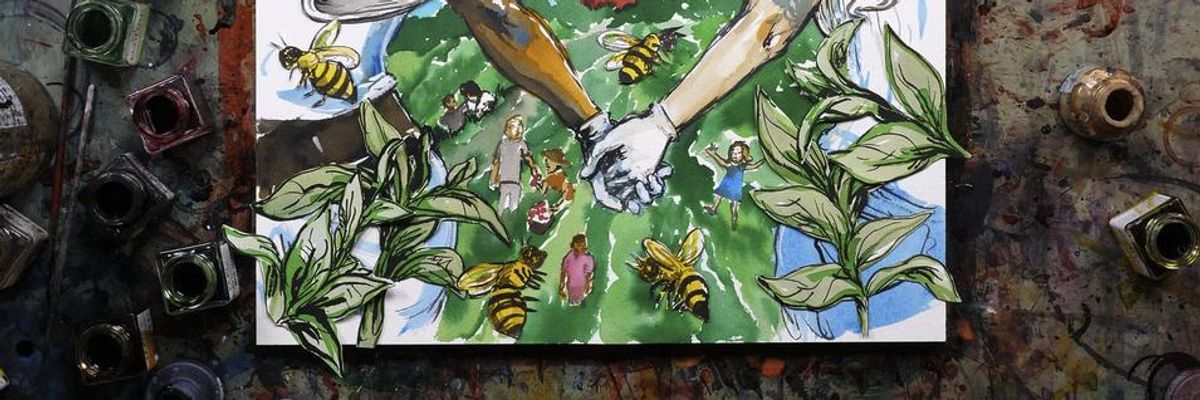
The film-- entitled "Message from the Future II: The Years of Repair"-- is a sequel to last year's "A Message from the Future with Alexandria Ocasio-Cortez" and runs with the idea that the year 2020 became an "historic turning point" for the world, one in which "the lessons of the COVID-19 pandemic and global uprisings against racism drive us to build back a better society in which no one is sacrificed, and everyone is essential." (Image: The Leap/The Intercept/Illustration by Moll Crabapple)
To imagine a future in which humanity and global communities finally escaped the grip of neoliberal capitalism and the despair which stems from the interconnected crises of climate destruction, economic inequality, and the ravages of a pandemic that exposed entrenched injustices worldwide, a new animated short film released Wednesday features storytelling and perspectives from a range of frontline organizations and activists explaining to viewers--especially in the shadow of Covid-19 and extreme weather disasters--that another world is not only possible, but represents a beautiful alternative worth fighting for.
The film--entitled "Message from the Future II: The Years of Repair"-- is a sequel to last year's "A Message from the Future with Alexandria Ocasio-Cortez" and runs with the idea that the year 2020 became an "historic turning point" for the world, one in which "the lessons of the Covid-19 pandemic and global uprisings against racism drive us to build back a better society in which no one is sacrificed, and everyone is essential."
According to the filmmakers:
People need a story about what they're fighting for, and what they're demanding from their governments. Not a laundry list of political demands--a vibrant story of how we win a safer, fairer world for all - and specifically, what that looks like. This is a group of artists and thinkers coming together to put forward a narrative and a vision that does just that--describes how this moment could be a turning point for the better.
The struggle ahead, they continue, "is going to be a long one, but its goal is simple: a world in which no one is sacrificed, and everyone is essential. And in these challenging times holding to hope is in itself a form of resistance."
The 9-minute film--featuring a high-profile cast of narrators from around the world, including Emma Thompson, Gael Garcia Bernal, Black Lives Matter co-founder Opal Tometi, and the Nigerian poet and activist Nnimmo Bassey--was streamed live in a global online premiere beginning at 8:00am ET.
Watch:
Illustrated by artist and activist Molly Crabapple and written by Avi Lewis and Tometi, the film was created by The Leap and The Intercept and executive produced by author and journalist Naomi Klein. It was the product of a collaborative effort by groups from around the world which included: The Movement for Black Lives, Public Services International, La Via Campesina, The Sunrise Movement, The NDN Collective, Global Nurses United, Amazon Watch, Greenpeace International, The Dream Defenders, Haymarket Books, and the Institute for Policy Studies.
In a piece authored for The Intercept to explain the origin and purpose of the film, Klein wrote that she and her co-creators "searched for a unifying principle that could animate a future worth fighting for, we settled on 'The Years of Repair.' The call to repair a deep brokenness has roots in many radical and religious traditions. And it provides a framework expansive enough to connect the interlocking crises in our social, economic, political, informational, and ecological spheres."
While no future can be accurately predicted or assured, writes Klein, the necessity of hope and vision remains a vital imperative.
"The true power and possibility of this project is not onscreen," she wrote. "That resides in the movement of movements that is fighting for this vision of radical repair every day. If any of us still have the right to be hopeful, it is because of them."
Dear Common Dreams reader, It’s been nearly 30 years since I co-founded Common Dreams with my late wife, Lina Newhouser. We had the radical notion that journalism should serve the public good, not corporate profits. It was clear to us from the outset what it would take to build such a project. No paid advertisements. No corporate sponsors. No millionaire publisher telling us what to think or do. Many people said we wouldn't last a year, but we proved those doubters wrong. Together with a tremendous team of journalists and dedicated staff, we built an independent media outlet free from the constraints of profits and corporate control. Our mission has always been simple: To inform. To inspire. To ignite change for the common good. Building Common Dreams was not easy. Our survival was never guaranteed. When you take on the most powerful forces—Wall Street greed, fossil fuel industry destruction, Big Tech lobbyists, and uber-rich oligarchs who have spent billions upon billions rigging the economy and democracy in their favor—the only bulwark you have is supporters who believe in your work. But here’s the urgent message from me today. It's never been this bad out there. And it's never been this hard to keep us going. At the very moment Common Dreams is most needed, the threats we face are intensifying. We need your support now more than ever. We don't accept corporate advertising and never will. We don't have a paywall because we don't think people should be blocked from critical news based on their ability to pay. Everything we do is funded by the donations of readers like you. When everyone does the little they can afford, we are strong. But if that support retreats or dries up, so do we. Will you donate now to make sure Common Dreams not only survives but thrives? —Craig Brown, Co-founder |
To imagine a future in which humanity and global communities finally escaped the grip of neoliberal capitalism and the despair which stems from the interconnected crises of climate destruction, economic inequality, and the ravages of a pandemic that exposed entrenched injustices worldwide, a new animated short film released Wednesday features storytelling and perspectives from a range of frontline organizations and activists explaining to viewers--especially in the shadow of Covid-19 and extreme weather disasters--that another world is not only possible, but represents a beautiful alternative worth fighting for.
The film--entitled "Message from the Future II: The Years of Repair"-- is a sequel to last year's "A Message from the Future with Alexandria Ocasio-Cortez" and runs with the idea that the year 2020 became an "historic turning point" for the world, one in which "the lessons of the Covid-19 pandemic and global uprisings against racism drive us to build back a better society in which no one is sacrificed, and everyone is essential."
According to the filmmakers:
People need a story about what they're fighting for, and what they're demanding from their governments. Not a laundry list of political demands--a vibrant story of how we win a safer, fairer world for all - and specifically, what that looks like. This is a group of artists and thinkers coming together to put forward a narrative and a vision that does just that--describes how this moment could be a turning point for the better.
The struggle ahead, they continue, "is going to be a long one, but its goal is simple: a world in which no one is sacrificed, and everyone is essential. And in these challenging times holding to hope is in itself a form of resistance."
The 9-minute film--featuring a high-profile cast of narrators from around the world, including Emma Thompson, Gael Garcia Bernal, Black Lives Matter co-founder Opal Tometi, and the Nigerian poet and activist Nnimmo Bassey--was streamed live in a global online premiere beginning at 8:00am ET.
Watch:
Illustrated by artist and activist Molly Crabapple and written by Avi Lewis and Tometi, the film was created by The Leap and The Intercept and executive produced by author and journalist Naomi Klein. It was the product of a collaborative effort by groups from around the world which included: The Movement for Black Lives, Public Services International, La Via Campesina, The Sunrise Movement, The NDN Collective, Global Nurses United, Amazon Watch, Greenpeace International, The Dream Defenders, Haymarket Books, and the Institute for Policy Studies.
In a piece authored for The Intercept to explain the origin and purpose of the film, Klein wrote that she and her co-creators "searched for a unifying principle that could animate a future worth fighting for, we settled on 'The Years of Repair.' The call to repair a deep brokenness has roots in many radical and religious traditions. And it provides a framework expansive enough to connect the interlocking crises in our social, economic, political, informational, and ecological spheres."
While no future can be accurately predicted or assured, writes Klein, the necessity of hope and vision remains a vital imperative.
"The true power and possibility of this project is not onscreen," she wrote. "That resides in the movement of movements that is fighting for this vision of radical repair every day. If any of us still have the right to be hopeful, it is because of them."
To imagine a future in which humanity and global communities finally escaped the grip of neoliberal capitalism and the despair which stems from the interconnected crises of climate destruction, economic inequality, and the ravages of a pandemic that exposed entrenched injustices worldwide, a new animated short film released Wednesday features storytelling and perspectives from a range of frontline organizations and activists explaining to viewers--especially in the shadow of Covid-19 and extreme weather disasters--that another world is not only possible, but represents a beautiful alternative worth fighting for.
The film--entitled "Message from the Future II: The Years of Repair"-- is a sequel to last year's "A Message from the Future with Alexandria Ocasio-Cortez" and runs with the idea that the year 2020 became an "historic turning point" for the world, one in which "the lessons of the Covid-19 pandemic and global uprisings against racism drive us to build back a better society in which no one is sacrificed, and everyone is essential."
According to the filmmakers:
People need a story about what they're fighting for, and what they're demanding from their governments. Not a laundry list of political demands--a vibrant story of how we win a safer, fairer world for all - and specifically, what that looks like. This is a group of artists and thinkers coming together to put forward a narrative and a vision that does just that--describes how this moment could be a turning point for the better.
The struggle ahead, they continue, "is going to be a long one, but its goal is simple: a world in which no one is sacrificed, and everyone is essential. And in these challenging times holding to hope is in itself a form of resistance."
The 9-minute film--featuring a high-profile cast of narrators from around the world, including Emma Thompson, Gael Garcia Bernal, Black Lives Matter co-founder Opal Tometi, and the Nigerian poet and activist Nnimmo Bassey--was streamed live in a global online premiere beginning at 8:00am ET.
Watch:
Illustrated by artist and activist Molly Crabapple and written by Avi Lewis and Tometi, the film was created by The Leap and The Intercept and executive produced by author and journalist Naomi Klein. It was the product of a collaborative effort by groups from around the world which included: The Movement for Black Lives, Public Services International, La Via Campesina, The Sunrise Movement, The NDN Collective, Global Nurses United, Amazon Watch, Greenpeace International, The Dream Defenders, Haymarket Books, and the Institute for Policy Studies.
In a piece authored for The Intercept to explain the origin and purpose of the film, Klein wrote that she and her co-creators "searched for a unifying principle that could animate a future worth fighting for, we settled on 'The Years of Repair.' The call to repair a deep brokenness has roots in many radical and religious traditions. And it provides a framework expansive enough to connect the interlocking crises in our social, economic, political, informational, and ecological spheres."
While no future can be accurately predicted or assured, writes Klein, the necessity of hope and vision remains a vital imperative.
"The true power and possibility of this project is not onscreen," she wrote. "That resides in the movement of movements that is fighting for this vision of radical repair every day. If any of us still have the right to be hopeful, it is because of them."