SUBSCRIBE TO OUR FREE NEWSLETTER
Daily news & progressive opinion—funded by the people, not the corporations—delivered straight to your inbox.
5
#000000
#FFFFFF
To donate by check, phone, or other method, see our More Ways to Give page.
Daily news & progressive opinion—funded by the people, not the corporations—delivered straight to your inbox.
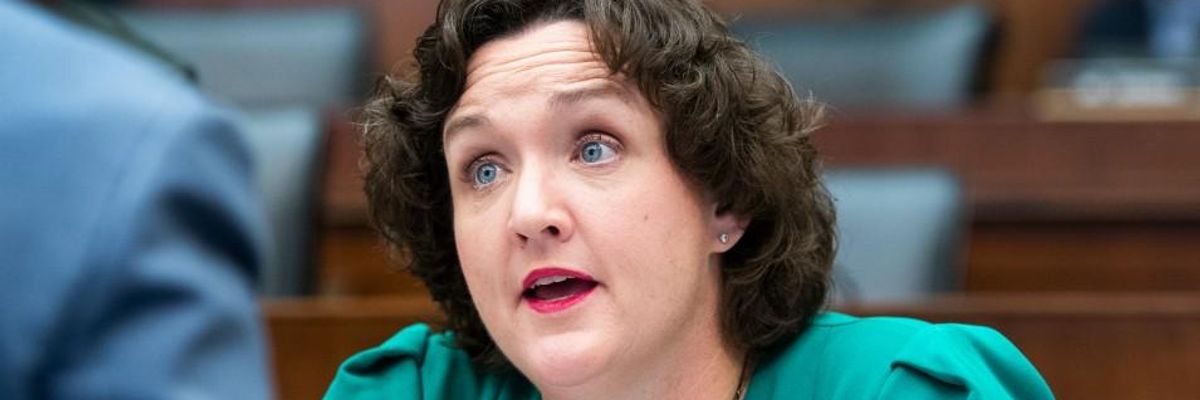
Rep. Katie Porter (D-Calif.) speaks during a House Financial Services Committee hearing on Tuesday, October 22, 2019. (Photo: Tom Williams/CQ-Roll Call, Inc. via Getty Images)
House Democrats--including three Squad members--tore into pharmaceutical industry chief executives during a Wednesday congressional hearing on Big Pharma profiteering, with Rep. Katie Porter verbally eviscerating one CEO for more than tripling the price of a critical cancer drug.
Wednesday marked the first day of a two-day House Oversight Committee hearing titled "Unsustainable Drug Prices: Testimony from the CEOs." Bristol Myers Squibb CEO Giovanni Caforio, Teva Pharmaceuticals CEO Kare Schultz, and former Celgene CEO Mark Alles all endured nearly four hours of grilling over the price of prescription drugs--which are almost always far more expensive in the United States than anywhere else in the world.
Porter (D-Calif.), a former consumer protection attorney, was the most ferocious committee member to address the CEOs. Bringing out her infamous white board, she attacked Celgene's repeated price hikes for the cancer drug Revlimid, which now costs $763 per dose--in 2005 it cost $215. When Alles attempted to explain that the drug has been approved for new uses, Porter hit back, and hard.
"Did the drug start to work faster? Were there fewer side effects? How did you change the formula or production of Revlimid to justify this price increase?" Porter asked. "To recap here: The drug didn't get any better, the cancer patients didn't get any better, you just got better at making money--you just refined your skills at price gouging."
Porter has built a reputation for speaking tough truth to power, on issues ranging from defending access to crucial public benefits, to challenging mega-bank CEOs on income inequality, to exposing the pernicious influence of dark money in politics.
Toward the end of Wednesday's nearly four-hour session, three of the four members of the so-called Squad--Reps. Rashida Tlaib (D-Mich.), Ayanna Pressley (D-Mass.), and Alexandria Ocasio-Cortez (D-N.Y.)--slammed the CEOs over what Ocasio-Cortez called the "exorbitant cost" of life-saving medications.
Armed with a chart showing the cost of 40 milligrams of Teva's multiple sclerosis drug Copaxone is more than five times as high in the U.S. as in Britain, Ocasio-Cortez refuted an assertion by Schultz that medications cost more in the United States because American patients have "very broad, and very early access" to new drugs.
Citing Teva's own internal documents, Ocasio-Cortez showed the company was forced to lower prices by European governments--which unlike the U.S. have instituted spending controls--even as it raised prices for American patients.
Pressley asserted that "the lack of access to affordable life-saving medicine is an injustice [that] represents an act of economic violence and an attack on the basic principle that healthcare is a fundamental human right," while Tlaib ripped Schultz for using charitable donations like "a side hustle."
"Your pharmaceutical company makes these so-called charitable donations so you look like you give a shit about sick people," said Tlaib. "But in reality these are just another scheme by your corporation to make money off of sick people."
Dear Common Dreams reader, It’s been nearly 30 years since I co-founded Common Dreams with my late wife, Lina Newhouser. We had the radical notion that journalism should serve the public good, not corporate profits. It was clear to us from the outset what it would take to build such a project. No paid advertisements. No corporate sponsors. No millionaire publisher telling us what to think or do. Many people said we wouldn't last a year, but we proved those doubters wrong. Together with a tremendous team of journalists and dedicated staff, we built an independent media outlet free from the constraints of profits and corporate control. Our mission has always been simple: To inform. To inspire. To ignite change for the common good. Building Common Dreams was not easy. Our survival was never guaranteed. When you take on the most powerful forces—Wall Street greed, fossil fuel industry destruction, Big Tech lobbyists, and uber-rich oligarchs who have spent billions upon billions rigging the economy and democracy in their favor—the only bulwark you have is supporters who believe in your work. But here’s the urgent message from me today. It's never been this bad out there. And it's never been this hard to keep us going. At the very moment Common Dreams is most needed, the threats we face are intensifying. We need your support now more than ever. We don't accept corporate advertising and never will. We don't have a paywall because we don't think people should be blocked from critical news based on their ability to pay. Everything we do is funded by the donations of readers like you. When everyone does the little they can afford, we are strong. But if that support retreats or dries up, so do we. Will you donate now to make sure Common Dreams not only survives but thrives? —Craig Brown, Co-founder |
House Democrats--including three Squad members--tore into pharmaceutical industry chief executives during a Wednesday congressional hearing on Big Pharma profiteering, with Rep. Katie Porter verbally eviscerating one CEO for more than tripling the price of a critical cancer drug.
Wednesday marked the first day of a two-day House Oversight Committee hearing titled "Unsustainable Drug Prices: Testimony from the CEOs." Bristol Myers Squibb CEO Giovanni Caforio, Teva Pharmaceuticals CEO Kare Schultz, and former Celgene CEO Mark Alles all endured nearly four hours of grilling over the price of prescription drugs--which are almost always far more expensive in the United States than anywhere else in the world.
Porter (D-Calif.), a former consumer protection attorney, was the most ferocious committee member to address the CEOs. Bringing out her infamous white board, she attacked Celgene's repeated price hikes for the cancer drug Revlimid, which now costs $763 per dose--in 2005 it cost $215. When Alles attempted to explain that the drug has been approved for new uses, Porter hit back, and hard.
"Did the drug start to work faster? Were there fewer side effects? How did you change the formula or production of Revlimid to justify this price increase?" Porter asked. "To recap here: The drug didn't get any better, the cancer patients didn't get any better, you just got better at making money--you just refined your skills at price gouging."
Porter has built a reputation for speaking tough truth to power, on issues ranging from defending access to crucial public benefits, to challenging mega-bank CEOs on income inequality, to exposing the pernicious influence of dark money in politics.
Toward the end of Wednesday's nearly four-hour session, three of the four members of the so-called Squad--Reps. Rashida Tlaib (D-Mich.), Ayanna Pressley (D-Mass.), and Alexandria Ocasio-Cortez (D-N.Y.)--slammed the CEOs over what Ocasio-Cortez called the "exorbitant cost" of life-saving medications.
Armed with a chart showing the cost of 40 milligrams of Teva's multiple sclerosis drug Copaxone is more than five times as high in the U.S. as in Britain, Ocasio-Cortez refuted an assertion by Schultz that medications cost more in the United States because American patients have "very broad, and very early access" to new drugs.
Citing Teva's own internal documents, Ocasio-Cortez showed the company was forced to lower prices by European governments--which unlike the U.S. have instituted spending controls--even as it raised prices for American patients.
Pressley asserted that "the lack of access to affordable life-saving medicine is an injustice [that] represents an act of economic violence and an attack on the basic principle that healthcare is a fundamental human right," while Tlaib ripped Schultz for using charitable donations like "a side hustle."
"Your pharmaceutical company makes these so-called charitable donations so you look like you give a shit about sick people," said Tlaib. "But in reality these are just another scheme by your corporation to make money off of sick people."
House Democrats--including three Squad members--tore into pharmaceutical industry chief executives during a Wednesday congressional hearing on Big Pharma profiteering, with Rep. Katie Porter verbally eviscerating one CEO for more than tripling the price of a critical cancer drug.
Wednesday marked the first day of a two-day House Oversight Committee hearing titled "Unsustainable Drug Prices: Testimony from the CEOs." Bristol Myers Squibb CEO Giovanni Caforio, Teva Pharmaceuticals CEO Kare Schultz, and former Celgene CEO Mark Alles all endured nearly four hours of grilling over the price of prescription drugs--which are almost always far more expensive in the United States than anywhere else in the world.
Porter (D-Calif.), a former consumer protection attorney, was the most ferocious committee member to address the CEOs. Bringing out her infamous white board, she attacked Celgene's repeated price hikes for the cancer drug Revlimid, which now costs $763 per dose--in 2005 it cost $215. When Alles attempted to explain that the drug has been approved for new uses, Porter hit back, and hard.
"Did the drug start to work faster? Were there fewer side effects? How did you change the formula or production of Revlimid to justify this price increase?" Porter asked. "To recap here: The drug didn't get any better, the cancer patients didn't get any better, you just got better at making money--you just refined your skills at price gouging."
Porter has built a reputation for speaking tough truth to power, on issues ranging from defending access to crucial public benefits, to challenging mega-bank CEOs on income inequality, to exposing the pernicious influence of dark money in politics.
Toward the end of Wednesday's nearly four-hour session, three of the four members of the so-called Squad--Reps. Rashida Tlaib (D-Mich.), Ayanna Pressley (D-Mass.), and Alexandria Ocasio-Cortez (D-N.Y.)--slammed the CEOs over what Ocasio-Cortez called the "exorbitant cost" of life-saving medications.
Armed with a chart showing the cost of 40 milligrams of Teva's multiple sclerosis drug Copaxone is more than five times as high in the U.S. as in Britain, Ocasio-Cortez refuted an assertion by Schultz that medications cost more in the United States because American patients have "very broad, and very early access" to new drugs.
Citing Teva's own internal documents, Ocasio-Cortez showed the company was forced to lower prices by European governments--which unlike the U.S. have instituted spending controls--even as it raised prices for American patients.
Pressley asserted that "the lack of access to affordable life-saving medicine is an injustice [that] represents an act of economic violence and an attack on the basic principle that healthcare is a fundamental human right," while Tlaib ripped Schultz for using charitable donations like "a side hustle."
"Your pharmaceutical company makes these so-called charitable donations so you look like you give a shit about sick people," said Tlaib. "But in reality these are just another scheme by your corporation to make money off of sick people."