SUBSCRIBE TO OUR FREE NEWSLETTER
Daily news & progressive opinion—funded by the people, not the corporations—delivered straight to your inbox.
5
#000000
#FFFFFF
To donate by check, phone, or other method, see our More Ways to Give page.
Daily news & progressive opinion—funded by the people, not the corporations—delivered straight to your inbox.
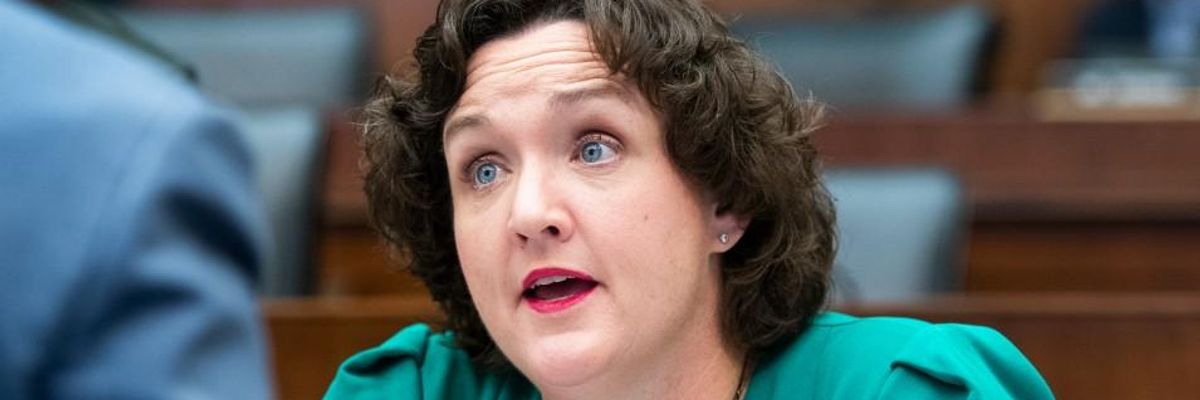
Rep. Katie Porter (D-Calif.) speaks during a House Financial Services Committee hearing on Tuesday, October 22, 2019. (Photo: Tom Williams/CQ-Roll Call, Inc. via Getty Images)
House Democrats--including three Squad members--tore into pharmaceutical industry chief executives during a Wednesday congressional hearing on Big Pharma profiteering, with Rep. Katie Porter verbally eviscerating one CEO for more than tripling the price of a critical cancer drug.
Wednesday marked the first day of a two-day House Oversight Committee hearing titled "Unsustainable Drug Prices: Testimony from the CEOs." Bristol Myers Squibb CEO Giovanni Caforio, Teva Pharmaceuticals CEO Kare Schultz, and former Celgene CEO Mark Alles all endured nearly four hours of grilling over the price of prescription drugs--which are almost always far more expensive in the United States than anywhere else in the world.
Porter (D-Calif.), a former consumer protection attorney, was the most ferocious committee member to address the CEOs. Bringing out her infamous white board, she attacked Celgene's repeated price hikes for the cancer drug Revlimid, which now costs $763 per dose--in 2005 it cost $215. When Alles attempted to explain that the drug has been approved for new uses, Porter hit back, and hard.
"Did the drug start to work faster? Were there fewer side effects? How did you change the formula or production of Revlimid to justify this price increase?" Porter asked. "To recap here: The drug didn't get any better, the cancer patients didn't get any better, you just got better at making money--you just refined your skills at price gouging."
Porter has built a reputation for speaking tough truth to power, on issues ranging from defending access to crucial public benefits, to challenging mega-bank CEOs on income inequality, to exposing the pernicious influence of dark money in politics.
Toward the end of Wednesday's nearly four-hour session, three of the four members of the so-called Squad--Reps. Rashida Tlaib (D-Mich.), Ayanna Pressley (D-Mass.), and Alexandria Ocasio-Cortez (D-N.Y.)--slammed the CEOs over what Ocasio-Cortez called the "exorbitant cost" of life-saving medications.
Armed with a chart showing the cost of 40 milligrams of Teva's multiple sclerosis drug Copaxone is more than five times as high in the U.S. as in Britain, Ocasio-Cortez refuted an assertion by Schultz that medications cost more in the United States because American patients have "very broad, and very early access" to new drugs.
Citing Teva's own internal documents, Ocasio-Cortez showed the company was forced to lower prices by European governments--which unlike the U.S. have instituted spending controls--even as it raised prices for American patients.
Pressley asserted that "the lack of access to affordable life-saving medicine is an injustice [that] represents an act of economic violence and an attack on the basic principle that healthcare is a fundamental human right," while Tlaib ripped Schultz for using charitable donations like "a side hustle."
"Your pharmaceutical company makes these so-called charitable donations so you look like you give a shit about sick people," said Tlaib. "But in reality these are just another scheme by your corporation to make money off of sick people."
This country and this world are at a monumental crossroads. US voters have an opportunity to beat back the forces of fascism and confront the billionaires who are rigging the economy, our media system, and our democracy, making it increasingly impossible for ordinary people to get by. We’re not just talking about the election. We’re talking about what must be done once these fascist elements are vanquished from power. We need a bolder set of solutions than what either major party has so far been willing to offer and a working-class movement ready to fight like hell for it. Trump didn't emerge from nowhere. The conditions that fueled MAGA authoritarianism were created by decades of radical neoliberal economic policies and a corrupt political system dominated by corporate interests. They slashed taxes on the super-rich, promising that the benefits would trickle down. They said giveaways to the corporate titans would make life more affordable for the rest of us. It was all bullshit. And when a bitter, betrayed populace searches for someone to blame, right-wing demagogues have little trouble finding scapegoats. People know when they're being lied to, but you won't hear any of this from the corporate media. Only independent journalism—powered and funded by people who believe in building a better world—can deliver truly trustworthy daily news. If you share our vision, please contribute whatever you can to sustain our work. |
House Democrats--including three Squad members--tore into pharmaceutical industry chief executives during a Wednesday congressional hearing on Big Pharma profiteering, with Rep. Katie Porter verbally eviscerating one CEO for more than tripling the price of a critical cancer drug.
Wednesday marked the first day of a two-day House Oversight Committee hearing titled "Unsustainable Drug Prices: Testimony from the CEOs." Bristol Myers Squibb CEO Giovanni Caforio, Teva Pharmaceuticals CEO Kare Schultz, and former Celgene CEO Mark Alles all endured nearly four hours of grilling over the price of prescription drugs--which are almost always far more expensive in the United States than anywhere else in the world.
Porter (D-Calif.), a former consumer protection attorney, was the most ferocious committee member to address the CEOs. Bringing out her infamous white board, she attacked Celgene's repeated price hikes for the cancer drug Revlimid, which now costs $763 per dose--in 2005 it cost $215. When Alles attempted to explain that the drug has been approved for new uses, Porter hit back, and hard.
"Did the drug start to work faster? Were there fewer side effects? How did you change the formula or production of Revlimid to justify this price increase?" Porter asked. "To recap here: The drug didn't get any better, the cancer patients didn't get any better, you just got better at making money--you just refined your skills at price gouging."
Porter has built a reputation for speaking tough truth to power, on issues ranging from defending access to crucial public benefits, to challenging mega-bank CEOs on income inequality, to exposing the pernicious influence of dark money in politics.
Toward the end of Wednesday's nearly four-hour session, three of the four members of the so-called Squad--Reps. Rashida Tlaib (D-Mich.), Ayanna Pressley (D-Mass.), and Alexandria Ocasio-Cortez (D-N.Y.)--slammed the CEOs over what Ocasio-Cortez called the "exorbitant cost" of life-saving medications.
Armed with a chart showing the cost of 40 milligrams of Teva's multiple sclerosis drug Copaxone is more than five times as high in the U.S. as in Britain, Ocasio-Cortez refuted an assertion by Schultz that medications cost more in the United States because American patients have "very broad, and very early access" to new drugs.
Citing Teva's own internal documents, Ocasio-Cortez showed the company was forced to lower prices by European governments--which unlike the U.S. have instituted spending controls--even as it raised prices for American patients.
Pressley asserted that "the lack of access to affordable life-saving medicine is an injustice [that] represents an act of economic violence and an attack on the basic principle that healthcare is a fundamental human right," while Tlaib ripped Schultz for using charitable donations like "a side hustle."
"Your pharmaceutical company makes these so-called charitable donations so you look like you give a shit about sick people," said Tlaib. "But in reality these are just another scheme by your corporation to make money off of sick people."