

SUBSCRIBE TO OUR FREE NEWSLETTER
Daily news & progressive opinion—funded by the people, not the corporations—delivered straight to your inbox.
5
#000000
#FFFFFF
To donate by check, phone, or other method, see our More Ways to Give page.
Daily news & progressive opinion—funded by the people, not the corporations—delivered straight to your inbox.
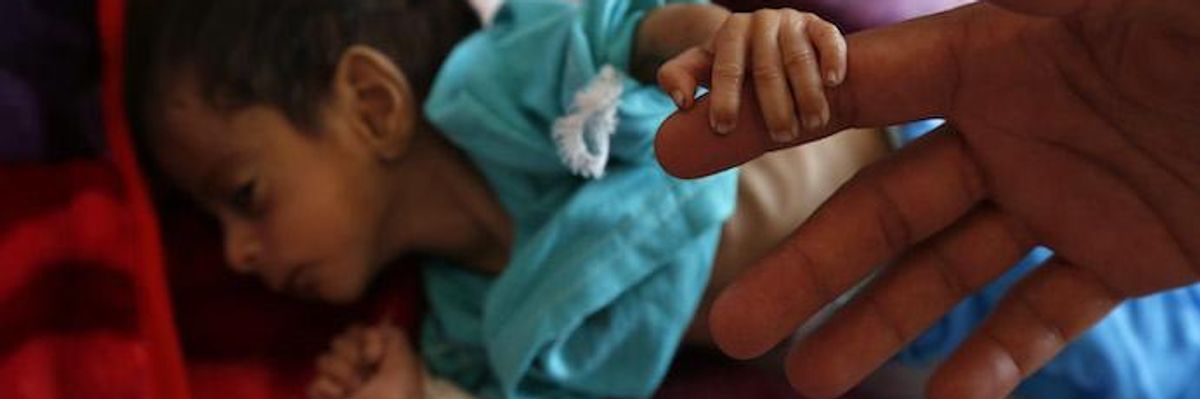
A malnourished child holds the finger of his father as he receives treatment at a hospital on June 30, 2020 in Sana'a, Yemen. Buffeted by five years of devastating conflict and by the coronavirus pandemic sweeping every corner of the globe, millions of children stand on the brink of starvation in Yemen. (Photo: Mohammed Hamoud/Getty Images)
The head of the United Nations World Food Programme warned Thursday of a potential "wave of hunger and famine" that could "sweep across the globe" amid ongoing violence and economic impact from the coronavirus pandemic and urged the world's billionaires to pony up some of their riches to help prevent 30 million people from starving to death.
The "global hunger crisis caused by conflict, and now compounded by Covid-19, is moving into a new and dangerous phase."
--David Beasley, World Food Programme In his remarks at a U.N. Security Council virtual meeting, WFP executive director David Beasley welcomed important measures by donors back in April to help stave off humanitarian disaster. Yet the "fight is far, far, far from over," said Beasley, sounding alarm about "the 270 million people marching toward the brink of starvation."
The "global hunger crisis caused by conflict, and now compounded by Covid-19, is moving into a new and dangerous phase," Beasley said, "especially in nations already scarred by violence."
Among the countries he singled out was Yemen, which is "the world's worst catastrophe, worst human disaster."
In that country, "20 million people are already in crisis due to war, a collapsed economy, and currency devaluation, crippling food prices, and the destruction of public infrastructure," Beasley lamented. "We believe a further 3 million may now face starvation due to the virus."
"The alarm bells in Yemen are ringing loud and clear, and the world needs to open its eyes to the Yemeni people's desperate plight before famine takes hold. And that famine is knocking on the door right before our eyes," he continued.
Unfortunately, said Beasley, "we have seen this story play out too many times before. The world stands by until it is too late, while hunger kills, it stokes community tensions, fuels conflict and instability, and forces families from their homes."
"It's time for the private sector to step up," he said, putting the figure at "$4.9 billion to feed, for one year, all 30 million people who will die without WFP's assistance."
For a small handful of the planet's inhabitants, that should be an easy ask.
The U.N. program chief drew attention to the stark global inequality that has tightened its grip. "Worldwide, there are over 2,000 billionaires with a net worth of $8 trillion," he said. "In my home country, the USA, there are 12 individuals alone worth $1 trillion."
Further as Beasley noted, in the months since the pandemic began to spread--and while millions were burdened with increasing economic pain--some billionaires saw their wealth soar. One analysis this week found that the wealth of 643 billionaires soard $845 billion, representing a 29% increase in their collective wealth since mid-March.
"It's time for those who have the most to step up, to help those who have the least in this extraordinary time in world history," Beasley said, as he warned, "Humanity is facing the greatest crisis any of us have seen in our lifetimes."
"The world needs you right now," he added, "and it's time to do the right thing."
Dear Common Dreams reader, It’s been nearly 30 years since I co-founded Common Dreams with my late wife, Lina Newhouser. We had the radical notion that journalism should serve the public good, not corporate profits. It was clear to us from the outset what it would take to build such a project. No paid advertisements. No corporate sponsors. No millionaire publisher telling us what to think or do. Many people said we wouldn't last a year, but we proved those doubters wrong. Together with a tremendous team of journalists and dedicated staff, we built an independent media outlet free from the constraints of profits and corporate control. Our mission has always been simple: To inform. To inspire. To ignite change for the common good. Building Common Dreams was not easy. Our survival was never guaranteed. When you take on the most powerful forces—Wall Street greed, fossil fuel industry destruction, Big Tech lobbyists, and uber-rich oligarchs who have spent billions upon billions rigging the economy and democracy in their favor—the only bulwark you have is supporters who believe in your work. But here’s the urgent message from me today. It's never been this bad out there. And it's never been this hard to keep us going. At the very moment Common Dreams is most needed, the threats we face are intensifying. We need your support now more than ever. We don't accept corporate advertising and never will. We don't have a paywall because we don't think people should be blocked from critical news based on their ability to pay. Everything we do is funded by the donations of readers like you. When everyone does the little they can afford, we are strong. But if that support retreats or dries up, so do we. Will you donate now to make sure Common Dreams not only survives but thrives? —Craig Brown, Co-founder |
The head of the United Nations World Food Programme warned Thursday of a potential "wave of hunger and famine" that could "sweep across the globe" amid ongoing violence and economic impact from the coronavirus pandemic and urged the world's billionaires to pony up some of their riches to help prevent 30 million people from starving to death.
The "global hunger crisis caused by conflict, and now compounded by Covid-19, is moving into a new and dangerous phase."
--David Beasley, World Food Programme In his remarks at a U.N. Security Council virtual meeting, WFP executive director David Beasley welcomed important measures by donors back in April to help stave off humanitarian disaster. Yet the "fight is far, far, far from over," said Beasley, sounding alarm about "the 270 million people marching toward the brink of starvation."
The "global hunger crisis caused by conflict, and now compounded by Covid-19, is moving into a new and dangerous phase," Beasley said, "especially in nations already scarred by violence."
Among the countries he singled out was Yemen, which is "the world's worst catastrophe, worst human disaster."
In that country, "20 million people are already in crisis due to war, a collapsed economy, and currency devaluation, crippling food prices, and the destruction of public infrastructure," Beasley lamented. "We believe a further 3 million may now face starvation due to the virus."
"The alarm bells in Yemen are ringing loud and clear, and the world needs to open its eyes to the Yemeni people's desperate plight before famine takes hold. And that famine is knocking on the door right before our eyes," he continued.
Unfortunately, said Beasley, "we have seen this story play out too many times before. The world stands by until it is too late, while hunger kills, it stokes community tensions, fuels conflict and instability, and forces families from their homes."
"It's time for the private sector to step up," he said, putting the figure at "$4.9 billion to feed, for one year, all 30 million people who will die without WFP's assistance."
For a small handful of the planet's inhabitants, that should be an easy ask.
The U.N. program chief drew attention to the stark global inequality that has tightened its grip. "Worldwide, there are over 2,000 billionaires with a net worth of $8 trillion," he said. "In my home country, the USA, there are 12 individuals alone worth $1 trillion."
Further as Beasley noted, in the months since the pandemic began to spread--and while millions were burdened with increasing economic pain--some billionaires saw their wealth soar. One analysis this week found that the wealth of 643 billionaires soard $845 billion, representing a 29% increase in their collective wealth since mid-March.
"It's time for those who have the most to step up, to help those who have the least in this extraordinary time in world history," Beasley said, as he warned, "Humanity is facing the greatest crisis any of us have seen in our lifetimes."
"The world needs you right now," he added, "and it's time to do the right thing."
The head of the United Nations World Food Programme warned Thursday of a potential "wave of hunger and famine" that could "sweep across the globe" amid ongoing violence and economic impact from the coronavirus pandemic and urged the world's billionaires to pony up some of their riches to help prevent 30 million people from starving to death.
The "global hunger crisis caused by conflict, and now compounded by Covid-19, is moving into a new and dangerous phase."
--David Beasley, World Food Programme In his remarks at a U.N. Security Council virtual meeting, WFP executive director David Beasley welcomed important measures by donors back in April to help stave off humanitarian disaster. Yet the "fight is far, far, far from over," said Beasley, sounding alarm about "the 270 million people marching toward the brink of starvation."
The "global hunger crisis caused by conflict, and now compounded by Covid-19, is moving into a new and dangerous phase," Beasley said, "especially in nations already scarred by violence."
Among the countries he singled out was Yemen, which is "the world's worst catastrophe, worst human disaster."
In that country, "20 million people are already in crisis due to war, a collapsed economy, and currency devaluation, crippling food prices, and the destruction of public infrastructure," Beasley lamented. "We believe a further 3 million may now face starvation due to the virus."
"The alarm bells in Yemen are ringing loud and clear, and the world needs to open its eyes to the Yemeni people's desperate plight before famine takes hold. And that famine is knocking on the door right before our eyes," he continued.
Unfortunately, said Beasley, "we have seen this story play out too many times before. The world stands by until it is too late, while hunger kills, it stokes community tensions, fuels conflict and instability, and forces families from their homes."
"It's time for the private sector to step up," he said, putting the figure at "$4.9 billion to feed, for one year, all 30 million people who will die without WFP's assistance."
For a small handful of the planet's inhabitants, that should be an easy ask.
The U.N. program chief drew attention to the stark global inequality that has tightened its grip. "Worldwide, there are over 2,000 billionaires with a net worth of $8 trillion," he said. "In my home country, the USA, there are 12 individuals alone worth $1 trillion."
Further as Beasley noted, in the months since the pandemic began to spread--and while millions were burdened with increasing economic pain--some billionaires saw their wealth soar. One analysis this week found that the wealth of 643 billionaires soard $845 billion, representing a 29% increase in their collective wealth since mid-March.
"It's time for those who have the most to step up, to help those who have the least in this extraordinary time in world history," Beasley said, as he warned, "Humanity is facing the greatest crisis any of us have seen in our lifetimes."
"The world needs you right now," he added, "and it's time to do the right thing."

