SUBSCRIBE TO OUR FREE NEWSLETTER
Daily news & progressive opinion—funded by the people, not the corporations—delivered straight to your inbox.
5
#000000
#FFFFFF
To donate by check, phone, or other method, see our More Ways to Give page.
Daily news & progressive opinion—funded by the people, not the corporations—delivered straight to your inbox.
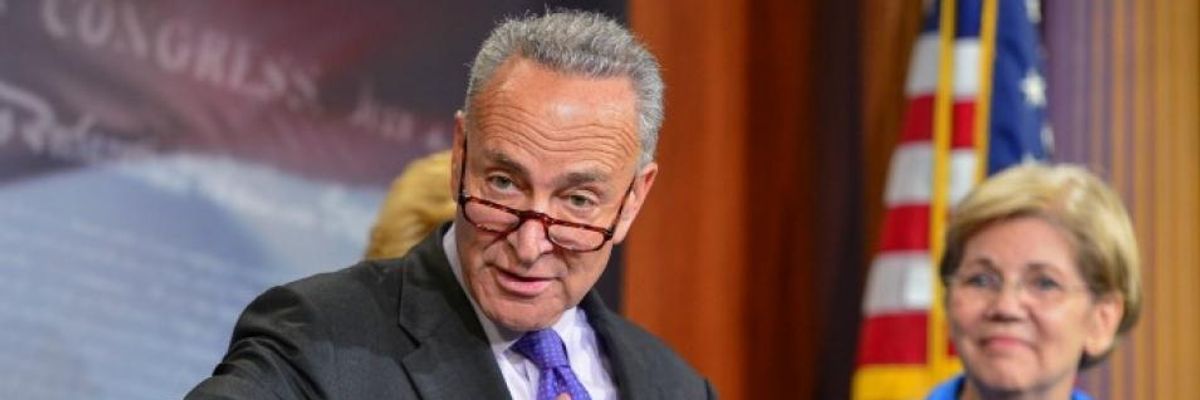
Sens. Chuck Schumer (N.Y.) and Elizabeth Warren (D-Mass.) led a group of Democrats in introducing a resolution on student loan cancellation. (Photo: Senate Democrats/flickr/cc)
As Americans face the economic fallout of the coronavirus pandemic and prepare for an incredibly consequential presidential election, over a dozen Democrats--led by Sen. Elizabeth Warren and Senate Minority Leader Chuck Schumer--came together Thursday to unveil a "visionary" student loan cancellation plan for the next administration.
The introduced resolution urges the next president to use existing authority under the Higher Education Act to cancel up to $50,000 in federal student loan debt and ensure there is no resulting tax liability for borrowers.
Neither the resolution nor the joint statement announcing it directly mentioned Democratic presidential nominee Joe Biden and his running mate, Sen. Kamala Harris (D-Calif.), but their campaign is clearly the intended target. The statement calls out President Donald Trump and congressional Republicans for refusing "to provide any immediate student debt cancellation for tens of millions of Americans" while vowing that "Democrats will be ready to act starting in 2021."
Warren (D-Mass.) repeated that promise on Twitter Thursday, also taking aim at Education Secretary Betsy DeVos, who has been widely condemned for everything from her privatization plans and revisions to Title IX rules to her positions on school reopenings and tax return seizures for student loan payments during the pandemic.
In addition to Warren, two other former Biden rivals--Sens. Bernie Sanders (I-Vt.) and Cory Booker (D-N.J.)--are backing the plan, along with Sens. Sherrod Brown (D-Ohio), Dick Durbin (D-Ill.), Tammy Duckworth (D-Ill.), Richard Blumenthal (D-Conn.), Chris Van Hollen (D-Md.), Jeff Merkley (D-Ore.), Ed Markey (D-Mass.), Rob Menendez (D-N.J.), and Ron Wyden (D-Ore.).
"Even before the coronavirus pandemic plunged our economy into chaos, student loan borrowers were already in crisis," said Warren. "The president of the United States has the power to broadly cancel student loan debt, help close the racial wealth gap, and give a big boost to families and our economy. It's time to use this existing authority and permanently improve the lives of tens of millions of Americans."
A former law professor and bankruptcy expert, Warren is a member of the Senate Health, Education, Labor, and Pensions (HELP) Committee. She became known nationally during the primary race for her detailed progressive plans, including a "really exciting proposal" to overhaul education that included canceling part or all student loan debt for 95% of Americans and making public college free for everyone.
The debt cancellation resolution differs from the higher education plan outlined on Biden's campaign website. In addition to cracking down on private lenders, offering $10,000 of relief for every year of community service for up to five years, and reforming the existing Public Service Loan Forgiveness program, Biden proposes an income-based federal repayment program that would fully forgive the remainder of the loans for borrowers who have made payments for 20 years.
"Education is supposed to be a ladder up, but for too many the burden of student debt has become an anchor holding them down," Schumer (D-N.Y.) declared Thursday.
"Massive student loan debt is exacerbating the historic and overlapping crises our country is facing, especially for communities of color, which have been hit hardest by the health and economic consequences of Covid-19," the Senate minority leader said. "Our resolution lays out a way for the president to change that. Canceling student loan debt would help boost our struggling economy and close the racial wealth gap that has persisted for far too long."
Economist Stephanie Kelton--who served as chief economist on the Senate Budget Committee in 2015 then advised Sanders' 2016 and 2020 presidential campaigns--has conducted research on the impact of canceling student loan debt, which she highlighted in response to the new plan on social media Thursday afternoon.
Kelton was part of a team that modeled (pdf) the macroeconomic effects of canceling all student loan debt in the United States. It is "amazing to see how much traction the idea has gained since then," she said. "It should go without saying, but obviously the more you cancel, the bigger the stimulus."
The Democratic resolution was also welcomed by leaders of the two largest education unions in the country--American Federation of Teachers (AFT) president Randi Weingarten and National Education Association (NEA) president Becky Pringle.
The country's economic crisis has left "many choosing between paying their student loan payment or putting food on the table for their family," said Pringle. "Canceling student debt will provide some much-needed relief to millions of people who desperately need this lifeline from this massive burden."
Echoing that message, Weingarten noted that "before the Covid-19 pandemic, millions of Americans were already confronting burdensome student loans, with the national student loan debt at a record $1.5 trillion. Now, as the country confronts sky-high unemployment, and crippling state, school, and local budget cuts have further depressed employment prospects, that debt burden is an economic death sentence."
"As the country grapples with unprecedented health, economic, and racial crises, our government must do everything it can to ease that burden," added the AFT leader. "Broadly canceling student loan debt would be a game-changer for millions of people in this country and a lifeline when they desperately need it."
Dear Common Dreams reader, It’s been nearly 30 years since I co-founded Common Dreams with my late wife, Lina Newhouser. We had the radical notion that journalism should serve the public good, not corporate profits. It was clear to us from the outset what it would take to build such a project. No paid advertisements. No corporate sponsors. No millionaire publisher telling us what to think or do. Many people said we wouldn't last a year, but we proved those doubters wrong. Together with a tremendous team of journalists and dedicated staff, we built an independent media outlet free from the constraints of profits and corporate control. Our mission has always been simple: To inform. To inspire. To ignite change for the common good. Building Common Dreams was not easy. Our survival was never guaranteed. When you take on the most powerful forces—Wall Street greed, fossil fuel industry destruction, Big Tech lobbyists, and uber-rich oligarchs who have spent billions upon billions rigging the economy and democracy in their favor—the only bulwark you have is supporters who believe in your work. But here’s the urgent message from me today. It's never been this bad out there. And it's never been this hard to keep us going. At the very moment Common Dreams is most needed, the threats we face are intensifying. We need your support now more than ever. We don't accept corporate advertising and never will. We don't have a paywall because we don't think people should be blocked from critical news based on their ability to pay. Everything we do is funded by the donations of readers like you. When everyone does the little they can afford, we are strong. But if that support retreats or dries up, so do we. Will you donate now to make sure Common Dreams not only survives but thrives? —Craig Brown, Co-founder |
As Americans face the economic fallout of the coronavirus pandemic and prepare for an incredibly consequential presidential election, over a dozen Democrats--led by Sen. Elizabeth Warren and Senate Minority Leader Chuck Schumer--came together Thursday to unveil a "visionary" student loan cancellation plan for the next administration.
The introduced resolution urges the next president to use existing authority under the Higher Education Act to cancel up to $50,000 in federal student loan debt and ensure there is no resulting tax liability for borrowers.
Neither the resolution nor the joint statement announcing it directly mentioned Democratic presidential nominee Joe Biden and his running mate, Sen. Kamala Harris (D-Calif.), but their campaign is clearly the intended target. The statement calls out President Donald Trump and congressional Republicans for refusing "to provide any immediate student debt cancellation for tens of millions of Americans" while vowing that "Democrats will be ready to act starting in 2021."
Warren (D-Mass.) repeated that promise on Twitter Thursday, also taking aim at Education Secretary Betsy DeVos, who has been widely condemned for everything from her privatization plans and revisions to Title IX rules to her positions on school reopenings and tax return seizures for student loan payments during the pandemic.
In addition to Warren, two other former Biden rivals--Sens. Bernie Sanders (I-Vt.) and Cory Booker (D-N.J.)--are backing the plan, along with Sens. Sherrod Brown (D-Ohio), Dick Durbin (D-Ill.), Tammy Duckworth (D-Ill.), Richard Blumenthal (D-Conn.), Chris Van Hollen (D-Md.), Jeff Merkley (D-Ore.), Ed Markey (D-Mass.), Rob Menendez (D-N.J.), and Ron Wyden (D-Ore.).
"Even before the coronavirus pandemic plunged our economy into chaos, student loan borrowers were already in crisis," said Warren. "The president of the United States has the power to broadly cancel student loan debt, help close the racial wealth gap, and give a big boost to families and our economy. It's time to use this existing authority and permanently improve the lives of tens of millions of Americans."
A former law professor and bankruptcy expert, Warren is a member of the Senate Health, Education, Labor, and Pensions (HELP) Committee. She became known nationally during the primary race for her detailed progressive plans, including a "really exciting proposal" to overhaul education that included canceling part or all student loan debt for 95% of Americans and making public college free for everyone.
The debt cancellation resolution differs from the higher education plan outlined on Biden's campaign website. In addition to cracking down on private lenders, offering $10,000 of relief for every year of community service for up to five years, and reforming the existing Public Service Loan Forgiveness program, Biden proposes an income-based federal repayment program that would fully forgive the remainder of the loans for borrowers who have made payments for 20 years.
"Education is supposed to be a ladder up, but for too many the burden of student debt has become an anchor holding them down," Schumer (D-N.Y.) declared Thursday.
"Massive student loan debt is exacerbating the historic and overlapping crises our country is facing, especially for communities of color, which have been hit hardest by the health and economic consequences of Covid-19," the Senate minority leader said. "Our resolution lays out a way for the president to change that. Canceling student loan debt would help boost our struggling economy and close the racial wealth gap that has persisted for far too long."
Economist Stephanie Kelton--who served as chief economist on the Senate Budget Committee in 2015 then advised Sanders' 2016 and 2020 presidential campaigns--has conducted research on the impact of canceling student loan debt, which she highlighted in response to the new plan on social media Thursday afternoon.
Kelton was part of a team that modeled (pdf) the macroeconomic effects of canceling all student loan debt in the United States. It is "amazing to see how much traction the idea has gained since then," she said. "It should go without saying, but obviously the more you cancel, the bigger the stimulus."
The Democratic resolution was also welcomed by leaders of the two largest education unions in the country--American Federation of Teachers (AFT) president Randi Weingarten and National Education Association (NEA) president Becky Pringle.
The country's economic crisis has left "many choosing between paying their student loan payment or putting food on the table for their family," said Pringle. "Canceling student debt will provide some much-needed relief to millions of people who desperately need this lifeline from this massive burden."
Echoing that message, Weingarten noted that "before the Covid-19 pandemic, millions of Americans were already confronting burdensome student loans, with the national student loan debt at a record $1.5 trillion. Now, as the country confronts sky-high unemployment, and crippling state, school, and local budget cuts have further depressed employment prospects, that debt burden is an economic death sentence."
"As the country grapples with unprecedented health, economic, and racial crises, our government must do everything it can to ease that burden," added the AFT leader. "Broadly canceling student loan debt would be a game-changer for millions of people in this country and a lifeline when they desperately need it."
As Americans face the economic fallout of the coronavirus pandemic and prepare for an incredibly consequential presidential election, over a dozen Democrats--led by Sen. Elizabeth Warren and Senate Minority Leader Chuck Schumer--came together Thursday to unveil a "visionary" student loan cancellation plan for the next administration.
The introduced resolution urges the next president to use existing authority under the Higher Education Act to cancel up to $50,000 in federal student loan debt and ensure there is no resulting tax liability for borrowers.
Neither the resolution nor the joint statement announcing it directly mentioned Democratic presidential nominee Joe Biden and his running mate, Sen. Kamala Harris (D-Calif.), but their campaign is clearly the intended target. The statement calls out President Donald Trump and congressional Republicans for refusing "to provide any immediate student debt cancellation for tens of millions of Americans" while vowing that "Democrats will be ready to act starting in 2021."
Warren (D-Mass.) repeated that promise on Twitter Thursday, also taking aim at Education Secretary Betsy DeVos, who has been widely condemned for everything from her privatization plans and revisions to Title IX rules to her positions on school reopenings and tax return seizures for student loan payments during the pandemic.
In addition to Warren, two other former Biden rivals--Sens. Bernie Sanders (I-Vt.) and Cory Booker (D-N.J.)--are backing the plan, along with Sens. Sherrod Brown (D-Ohio), Dick Durbin (D-Ill.), Tammy Duckworth (D-Ill.), Richard Blumenthal (D-Conn.), Chris Van Hollen (D-Md.), Jeff Merkley (D-Ore.), Ed Markey (D-Mass.), Rob Menendez (D-N.J.), and Ron Wyden (D-Ore.).
"Even before the coronavirus pandemic plunged our economy into chaos, student loan borrowers were already in crisis," said Warren. "The president of the United States has the power to broadly cancel student loan debt, help close the racial wealth gap, and give a big boost to families and our economy. It's time to use this existing authority and permanently improve the lives of tens of millions of Americans."
A former law professor and bankruptcy expert, Warren is a member of the Senate Health, Education, Labor, and Pensions (HELP) Committee. She became known nationally during the primary race for her detailed progressive plans, including a "really exciting proposal" to overhaul education that included canceling part or all student loan debt for 95% of Americans and making public college free for everyone.
The debt cancellation resolution differs from the higher education plan outlined on Biden's campaign website. In addition to cracking down on private lenders, offering $10,000 of relief for every year of community service for up to five years, and reforming the existing Public Service Loan Forgiveness program, Biden proposes an income-based federal repayment program that would fully forgive the remainder of the loans for borrowers who have made payments for 20 years.
"Education is supposed to be a ladder up, but for too many the burden of student debt has become an anchor holding them down," Schumer (D-N.Y.) declared Thursday.
"Massive student loan debt is exacerbating the historic and overlapping crises our country is facing, especially for communities of color, which have been hit hardest by the health and economic consequences of Covid-19," the Senate minority leader said. "Our resolution lays out a way for the president to change that. Canceling student loan debt would help boost our struggling economy and close the racial wealth gap that has persisted for far too long."
Economist Stephanie Kelton--who served as chief economist on the Senate Budget Committee in 2015 then advised Sanders' 2016 and 2020 presidential campaigns--has conducted research on the impact of canceling student loan debt, which she highlighted in response to the new plan on social media Thursday afternoon.
Kelton was part of a team that modeled (pdf) the macroeconomic effects of canceling all student loan debt in the United States. It is "amazing to see how much traction the idea has gained since then," she said. "It should go without saying, but obviously the more you cancel, the bigger the stimulus."
The Democratic resolution was also welcomed by leaders of the two largest education unions in the country--American Federation of Teachers (AFT) president Randi Weingarten and National Education Association (NEA) president Becky Pringle.
The country's economic crisis has left "many choosing between paying their student loan payment or putting food on the table for their family," said Pringle. "Canceling student debt will provide some much-needed relief to millions of people who desperately need this lifeline from this massive burden."
Echoing that message, Weingarten noted that "before the Covid-19 pandemic, millions of Americans were already confronting burdensome student loans, with the national student loan debt at a record $1.5 trillion. Now, as the country confronts sky-high unemployment, and crippling state, school, and local budget cuts have further depressed employment prospects, that debt burden is an economic death sentence."
"As the country grapples with unprecedented health, economic, and racial crises, our government must do everything it can to ease that burden," added the AFT leader. "Broadly canceling student loan debt would be a game-changer for millions of people in this country and a lifeline when they desperately need it."