SUBSCRIBE TO OUR FREE NEWSLETTER
Daily news & progressive opinion—funded by the people, not the corporations—delivered straight to your inbox.
5
#000000
#FFFFFF
To donate by check, phone, or other method, see our More Ways to Give page.
Daily news & progressive opinion—funded by the people, not the corporations—delivered straight to your inbox.
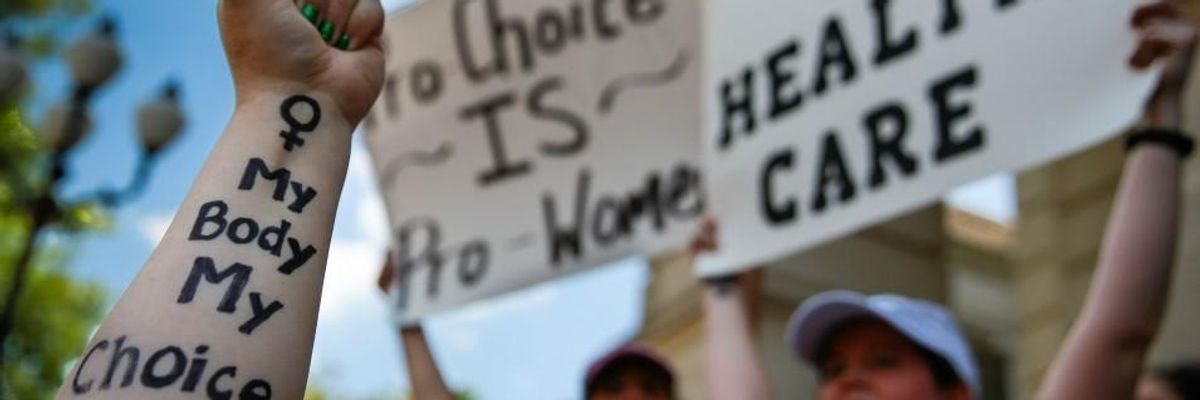
Melissa Simpson holds up her arm with "My Body My Choice" written on it during a protest against recently passed abortion ban bills at the Georgia State Capitol building, on May 21, 2019 in Atlanta. (Photo: Elijah Nouvelage/Getty Images)
While Vice President Mike Pence visited North Carolina on Thursday to tout the Trump administration's hostile track record on reproductive rights ahead of the November presidential election, healthcare providers and advocacy groups filed a sweeping legal challenge to several of the state's anti-choice laws designed to limit abortion access.
"Our patients deserve to access abortion without having to jump through the many hoops state legislators have implemented."
--Kelly Flynn, A Woman's Choice clinics
"For decades, the reproductive rights of North Carolinians have been relentlessly attacked by politicians in the state legislature who have created a complex web of medically unnecessary requirements designed to push abortion access out of reach," said Alexis McGill Johnson, president and CEO of Planned Parenthood Federation of America (PPFA), one of the groups behind the case.
"Today, our nation is also facing dueling, emergent public health crises: state-sanctioned racist violence against people of color and Covid-19," she said in a joint statement. "The lawsuit filed today in North Carolina is one piece of our fight to ensure patients can access essential healthcare, including vital family planning services--regardless of who they are or where they live."
The lawsuit (pdf), filed in state court, names as defendants North Carolina's top lawmakers and various other state officials. The plaintiffs--Planned Parenthood South Atlantic, SisterSong Women of Color Reproductive Justice Collective, three A Woman's Choice clinics, and four individual health professionals--are represented by PPFA, the national and state arms of the ACLU, and the Center for Reproductive Rights (CCR).
In a series of tweets Thursday, CCR explained the suit is challenging restrictions known as TRAP ("targeted restrictions on abortion providers") laws that "disproportionately impact [North Carolina] Black communities and those living in rural areas, making it even harder to access care in the state." Specifically, as the joint statement details, the groups are taking on:
"These laws do nothing but make it harder to access abortion and should be struck down," said CCR president and CEO Nancy Northup. "North Carolina legislators should be expanding access to healthcare, not restricting it. This is particularly important during a pandemic. That means expanding the use of telehealth and getting rid of needless barriers that serve no medical purpose."
Anjali Dalal, senior staff attorney at the ACLU Reproductive Freedom Project, noted that the restrictions on abortion enacted in North Carolina are part of a national trend of TRAP laws passed by anti-choice policymakers over the past decade, particularly in states where legislatures and gubernatorial positions have been held by Republicans.
"Since 2011, politicians have passed more than 460 medically unnecessary laws to push abortion out of reach," according to Dalal. "The laws we are challenging today create a web of restrictions that limit whether, when, and under what circumstances people may obtain an abortion. They serve only as obstacles in the way of needed medical care, and should be struck down to ensure North Carolinians can access abortion care, and to ensure that others from surrounding states, that are increasingly hostile to abortion, can do the same."
"Our patients deserve to access abortion without having to jump through the many hoops state legislators have implemented," asserted Kelly Flynn, president and CEO of the A Woman's Choice clinics. "These restrictions force our patients to travel long distances and delay their care, and they force us, the providers, to give them medically unnecessary, biased information about abortion. We're ready to fight in court to strike down these harmful restrictions."
Monica Simpson, executive director of SisterSong, said that "as a North Carolina native, I've seen firsthand how these laws insult the dignity and humanity of Black and brown women, trans, and non-binary folks; we have been denied full access to reproductive justice for far too long."
"For true reproductive freedom, we need far more than the legal right to abortion. If we are not able to get reproductive healthcare when we need it, from providers we trust, in spaces that are accessible and affirming to our communities and our needs, then we are not actually free," Simpson added, denouncing the state's abortion restrictions as racist and misogynist.
The groups collectively declared that "access to abortion is limited in North Carolina as a result of decades of political attacks that reached a fever pitch" under former Gov. Pat McCrory, a Republican who held the post from 2013 to 2017. They also called out GOP U.S. Sen. Thom Tillis, who as speaker of the North Carolina state House "infamously added numerous abortion restrictions into a motorcycle safety bill as a backdoor attempt to quietly erode reproductive rights on the final day of the 2013 legislative session."
Tillis, who is up for reelection this year, joined Pence Thursday at the anti-choice event in Raleigh, hosted by the Susan B. Anthony List. Republican Lt. Gov. Dan Forest also made an appearance. Forest--who has held his position since 2013, under both McCrory and current Democratic Gov. Roy Cooper--is running for governor.
Ahead of that event, Pence and others visited Gateway Women's Care, a pregnancy and sexual health center in Raleigh that opposes abortion rights, according to CNN. While the vice president was at that clinic, members of the Triangle Abortion Access Coalition organized a rolling protest with drivers honking their horns outside.
"While he is here to kind of rally the anti-abortion vote, we're letting him know that pro-choice folks do vote and we vote in support of abortion rights and access," Kelsea McLain of the Triangle Abortion Access Coalition told a local ABC affiliate. "Women vote and we know and we're aware when you're attacking our essential freedoms."
Dear Common Dreams reader, It’s been nearly 30 years since I co-founded Common Dreams with my late wife, Lina Newhouser. We had the radical notion that journalism should serve the public good, not corporate profits. It was clear to us from the outset what it would take to build such a project. No paid advertisements. No corporate sponsors. No millionaire publisher telling us what to think or do. Many people said we wouldn't last a year, but we proved those doubters wrong. Together with a tremendous team of journalists and dedicated staff, we built an independent media outlet free from the constraints of profits and corporate control. Our mission has always been simple: To inform. To inspire. To ignite change for the common good. Building Common Dreams was not easy. Our survival was never guaranteed. When you take on the most powerful forces—Wall Street greed, fossil fuel industry destruction, Big Tech lobbyists, and uber-rich oligarchs who have spent billions upon billions rigging the economy and democracy in their favor—the only bulwark you have is supporters who believe in your work. But here’s the urgent message from me today. It's never been this bad out there. And it's never been this hard to keep us going. At the very moment Common Dreams is most needed, the threats we face are intensifying. We need your support now more than ever. We don't accept corporate advertising and never will. We don't have a paywall because we don't think people should be blocked from critical news based on their ability to pay. Everything we do is funded by the donations of readers like you. When everyone does the little they can afford, we are strong. But if that support retreats or dries up, so do we. Will you donate now to make sure Common Dreams not only survives but thrives? —Craig Brown, Co-founder |
While Vice President Mike Pence visited North Carolina on Thursday to tout the Trump administration's hostile track record on reproductive rights ahead of the November presidential election, healthcare providers and advocacy groups filed a sweeping legal challenge to several of the state's anti-choice laws designed to limit abortion access.
"Our patients deserve to access abortion without having to jump through the many hoops state legislators have implemented."
--Kelly Flynn, A Woman's Choice clinics
"For decades, the reproductive rights of North Carolinians have been relentlessly attacked by politicians in the state legislature who have created a complex web of medically unnecessary requirements designed to push abortion access out of reach," said Alexis McGill Johnson, president and CEO of Planned Parenthood Federation of America (PPFA), one of the groups behind the case.
"Today, our nation is also facing dueling, emergent public health crises: state-sanctioned racist violence against people of color and Covid-19," she said in a joint statement. "The lawsuit filed today in North Carolina is one piece of our fight to ensure patients can access essential healthcare, including vital family planning services--regardless of who they are or where they live."
The lawsuit (pdf), filed in state court, names as defendants North Carolina's top lawmakers and various other state officials. The plaintiffs--Planned Parenthood South Atlantic, SisterSong Women of Color Reproductive Justice Collective, three A Woman's Choice clinics, and four individual health professionals--are represented by PPFA, the national and state arms of the ACLU, and the Center for Reproductive Rights (CCR).
In a series of tweets Thursday, CCR explained the suit is challenging restrictions known as TRAP ("targeted restrictions on abortion providers") laws that "disproportionately impact [North Carolina] Black communities and those living in rural areas, making it even harder to access care in the state." Specifically, as the joint statement details, the groups are taking on:
"These laws do nothing but make it harder to access abortion and should be struck down," said CCR president and CEO Nancy Northup. "North Carolina legislators should be expanding access to healthcare, not restricting it. This is particularly important during a pandemic. That means expanding the use of telehealth and getting rid of needless barriers that serve no medical purpose."
Anjali Dalal, senior staff attorney at the ACLU Reproductive Freedom Project, noted that the restrictions on abortion enacted in North Carolina are part of a national trend of TRAP laws passed by anti-choice policymakers over the past decade, particularly in states where legislatures and gubernatorial positions have been held by Republicans.
"Since 2011, politicians have passed more than 460 medically unnecessary laws to push abortion out of reach," according to Dalal. "The laws we are challenging today create a web of restrictions that limit whether, when, and under what circumstances people may obtain an abortion. They serve only as obstacles in the way of needed medical care, and should be struck down to ensure North Carolinians can access abortion care, and to ensure that others from surrounding states, that are increasingly hostile to abortion, can do the same."
"Our patients deserve to access abortion without having to jump through the many hoops state legislators have implemented," asserted Kelly Flynn, president and CEO of the A Woman's Choice clinics. "These restrictions force our patients to travel long distances and delay their care, and they force us, the providers, to give them medically unnecessary, biased information about abortion. We're ready to fight in court to strike down these harmful restrictions."
Monica Simpson, executive director of SisterSong, said that "as a North Carolina native, I've seen firsthand how these laws insult the dignity and humanity of Black and brown women, trans, and non-binary folks; we have been denied full access to reproductive justice for far too long."
"For true reproductive freedom, we need far more than the legal right to abortion. If we are not able to get reproductive healthcare when we need it, from providers we trust, in spaces that are accessible and affirming to our communities and our needs, then we are not actually free," Simpson added, denouncing the state's abortion restrictions as racist and misogynist.
The groups collectively declared that "access to abortion is limited in North Carolina as a result of decades of political attacks that reached a fever pitch" under former Gov. Pat McCrory, a Republican who held the post from 2013 to 2017. They also called out GOP U.S. Sen. Thom Tillis, who as speaker of the North Carolina state House "infamously added numerous abortion restrictions into a motorcycle safety bill as a backdoor attempt to quietly erode reproductive rights on the final day of the 2013 legislative session."
Tillis, who is up for reelection this year, joined Pence Thursday at the anti-choice event in Raleigh, hosted by the Susan B. Anthony List. Republican Lt. Gov. Dan Forest also made an appearance. Forest--who has held his position since 2013, under both McCrory and current Democratic Gov. Roy Cooper--is running for governor.
Ahead of that event, Pence and others visited Gateway Women's Care, a pregnancy and sexual health center in Raleigh that opposes abortion rights, according to CNN. While the vice president was at that clinic, members of the Triangle Abortion Access Coalition organized a rolling protest with drivers honking their horns outside.
"While he is here to kind of rally the anti-abortion vote, we're letting him know that pro-choice folks do vote and we vote in support of abortion rights and access," Kelsea McLain of the Triangle Abortion Access Coalition told a local ABC affiliate. "Women vote and we know and we're aware when you're attacking our essential freedoms."
While Vice President Mike Pence visited North Carolina on Thursday to tout the Trump administration's hostile track record on reproductive rights ahead of the November presidential election, healthcare providers and advocacy groups filed a sweeping legal challenge to several of the state's anti-choice laws designed to limit abortion access.
"Our patients deserve to access abortion without having to jump through the many hoops state legislators have implemented."
--Kelly Flynn, A Woman's Choice clinics
"For decades, the reproductive rights of North Carolinians have been relentlessly attacked by politicians in the state legislature who have created a complex web of medically unnecessary requirements designed to push abortion access out of reach," said Alexis McGill Johnson, president and CEO of Planned Parenthood Federation of America (PPFA), one of the groups behind the case.
"Today, our nation is also facing dueling, emergent public health crises: state-sanctioned racist violence against people of color and Covid-19," she said in a joint statement. "The lawsuit filed today in North Carolina is one piece of our fight to ensure patients can access essential healthcare, including vital family planning services--regardless of who they are or where they live."
The lawsuit (pdf), filed in state court, names as defendants North Carolina's top lawmakers and various other state officials. The plaintiffs--Planned Parenthood South Atlantic, SisterSong Women of Color Reproductive Justice Collective, three A Woman's Choice clinics, and four individual health professionals--are represented by PPFA, the national and state arms of the ACLU, and the Center for Reproductive Rights (CCR).
In a series of tweets Thursday, CCR explained the suit is challenging restrictions known as TRAP ("targeted restrictions on abortion providers") laws that "disproportionately impact [North Carolina] Black communities and those living in rural areas, making it even harder to access care in the state." Specifically, as the joint statement details, the groups are taking on:
"These laws do nothing but make it harder to access abortion and should be struck down," said CCR president and CEO Nancy Northup. "North Carolina legislators should be expanding access to healthcare, not restricting it. This is particularly important during a pandemic. That means expanding the use of telehealth and getting rid of needless barriers that serve no medical purpose."
Anjali Dalal, senior staff attorney at the ACLU Reproductive Freedom Project, noted that the restrictions on abortion enacted in North Carolina are part of a national trend of TRAP laws passed by anti-choice policymakers over the past decade, particularly in states where legislatures and gubernatorial positions have been held by Republicans.
"Since 2011, politicians have passed more than 460 medically unnecessary laws to push abortion out of reach," according to Dalal. "The laws we are challenging today create a web of restrictions that limit whether, when, and under what circumstances people may obtain an abortion. They serve only as obstacles in the way of needed medical care, and should be struck down to ensure North Carolinians can access abortion care, and to ensure that others from surrounding states, that are increasingly hostile to abortion, can do the same."
"Our patients deserve to access abortion without having to jump through the many hoops state legislators have implemented," asserted Kelly Flynn, president and CEO of the A Woman's Choice clinics. "These restrictions force our patients to travel long distances and delay their care, and they force us, the providers, to give them medically unnecessary, biased information about abortion. We're ready to fight in court to strike down these harmful restrictions."
Monica Simpson, executive director of SisterSong, said that "as a North Carolina native, I've seen firsthand how these laws insult the dignity and humanity of Black and brown women, trans, and non-binary folks; we have been denied full access to reproductive justice for far too long."
"For true reproductive freedom, we need far more than the legal right to abortion. If we are not able to get reproductive healthcare when we need it, from providers we trust, in spaces that are accessible and affirming to our communities and our needs, then we are not actually free," Simpson added, denouncing the state's abortion restrictions as racist and misogynist.
The groups collectively declared that "access to abortion is limited in North Carolina as a result of decades of political attacks that reached a fever pitch" under former Gov. Pat McCrory, a Republican who held the post from 2013 to 2017. They also called out GOP U.S. Sen. Thom Tillis, who as speaker of the North Carolina state House "infamously added numerous abortion restrictions into a motorcycle safety bill as a backdoor attempt to quietly erode reproductive rights on the final day of the 2013 legislative session."
Tillis, who is up for reelection this year, joined Pence Thursday at the anti-choice event in Raleigh, hosted by the Susan B. Anthony List. Republican Lt. Gov. Dan Forest also made an appearance. Forest--who has held his position since 2013, under both McCrory and current Democratic Gov. Roy Cooper--is running for governor.
Ahead of that event, Pence and others visited Gateway Women's Care, a pregnancy and sexual health center in Raleigh that opposes abortion rights, according to CNN. While the vice president was at that clinic, members of the Triangle Abortion Access Coalition organized a rolling protest with drivers honking their horns outside.
"While he is here to kind of rally the anti-abortion vote, we're letting him know that pro-choice folks do vote and we vote in support of abortion rights and access," Kelsea McLain of the Triangle Abortion Access Coalition told a local ABC affiliate. "Women vote and we know and we're aware when you're attacking our essential freedoms."