SUBSCRIBE TO OUR FREE NEWSLETTER
Daily news & progressive opinion—funded by the people, not the corporations—delivered straight to your inbox.
5
#000000
#FFFFFF
To donate by check, phone, or other method, see our More Ways to Give page.
Daily news & progressive opinion—funded by the people, not the corporations—delivered straight to your inbox.
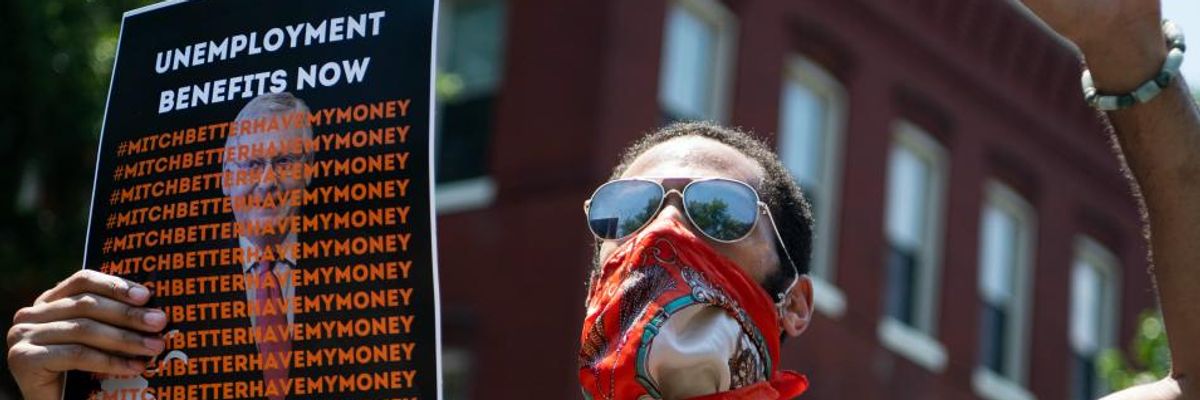
Demonstrators rally near the Capitol Hill residence of Senate Majority Leader Mitch McConnell (R-Ky.) to call for the extension of unemployment benefits on Wednesday, July 22, 2020. The benefit, created by the CARES Act, is set to expire on July 31. (Photo By Tom Williams/CQ-Roll Call, Inc via Getty Images)
With the final boosted unemployment check set to go out in just three days barring an unlikely last-minute extension by Congress, Senate Republicans are reportedly considering a proposal to slash the $600-per-week benefit boost to $100--a cut that would drastically reduce the incomes of 30 million Americans and potentially cause massive job loss.
First reported by CNBC Wednesday, the Republican proposal comes as progressive advocacy groups, Democratic lawmakers, and economists are warning of the devastating consequences of letting the enhanced unemployment payments expire at the end of the month. The Republican plan would pay out the $100-per-week boost through the end of the year.
The $600 weekly benefit increase technically expires on July 31, a Friday, but because states pay unemployment benefits on Saturdays or Sundays, the last enhanced payments are set to go out on July 25 and 26. Talks over the next Covid-19 stimulus package are expected to stretch into August, meaning unemployment benefits will likely revert to pre-pandemic levels--which averaged around $370 per week nationwide--for at least one payment cycle.
Sparking warnings of a major housing crisis, expiration of the supercharged unemployment benefits is set to coincide with the end of an eviction moratorium shielding more than 12 million people who live in homes with federally backed mortgages.
Rep. Don Beyer (D-Va.) said the $100-per-week proposal shows "Senate Republicans are wildly out of touch with reality." If adopted, the GOP proposal would reduce the monthly payments to millions of out-of-work Americans from $2,400 to $400.
"Seriously, just $400 a month?" Beyer tweeted late Wednesday. "Cutting monthly income for 30 million families by $2,000 would cost the country millions of jobs. This wouldn't just be horrible governance, it would show contempt for the American people."
Economic Policy Institute research director Josh Bivens estimated that reducing the weekly unemployment insurance (UI) boost from $600 to $100 would cost the U.S. more than four million jobs over the next year.
"Both cruel and stupid," Bivens said.
Negotiations over the next coronavirus stimulus package are still in flux as Republicans, Democrats, and the White House remain miles apart on key issues, including the unemployment benefit boost. According to the Associated Press, Senate Republicans appear to be leaning toward cutting the $600 weekly payment to $200--still a sharp income cut for tens of millions of people.
Politico reported late Wednesday that "many rank-and-file Democrats say they are willing to compromise on the extra $600 per week, saying they would be open to less money as long as there is no lapse in benefits. Others say they won't back down on that number."
Senate Majority Leader Mitch McConnell (R-Ky.) is expected to roll out the GOP package on Thursday, two days after laughing off the possibility that any Covid-19 legislation will pass by the end of next week.
On Wednesday afternoon, protesters marched to McConnell's home in Washington, D.C. demanding an extension of the $600-per-week UI boost.
"Without the $600, we would be in dire straits," one protester told a local ABC affiliate. "With the kids being home during the pandemic, it helps an awful lot, because there's always something needed, there's always something that has to be done."
Dear Common Dreams reader, It’s been nearly 30 years since I co-founded Common Dreams with my late wife, Lina Newhouser. We had the radical notion that journalism should serve the public good, not corporate profits. It was clear to us from the outset what it would take to build such a project. No paid advertisements. No corporate sponsors. No millionaire publisher telling us what to think or do. Many people said we wouldn't last a year, but we proved those doubters wrong. Together with a tremendous team of journalists and dedicated staff, we built an independent media outlet free from the constraints of profits and corporate control. Our mission has always been simple: To inform. To inspire. To ignite change for the common good. Building Common Dreams was not easy. Our survival was never guaranteed. When you take on the most powerful forces—Wall Street greed, fossil fuel industry destruction, Big Tech lobbyists, and uber-rich oligarchs who have spent billions upon billions rigging the economy and democracy in their favor—the only bulwark you have is supporters who believe in your work. But here’s the urgent message from me today. It's never been this bad out there. And it's never been this hard to keep us going. At the very moment Common Dreams is most needed, the threats we face are intensifying. We need your support now more than ever. We don't accept corporate advertising and never will. We don't have a paywall because we don't think people should be blocked from critical news based on their ability to pay. Everything we do is funded by the donations of readers like you. When everyone does the little they can afford, we are strong. But if that support retreats or dries up, so do we. Will you donate now to make sure Common Dreams not only survives but thrives? —Craig Brown, Co-founder |
With the final boosted unemployment check set to go out in just three days barring an unlikely last-minute extension by Congress, Senate Republicans are reportedly considering a proposal to slash the $600-per-week benefit boost to $100--a cut that would drastically reduce the incomes of 30 million Americans and potentially cause massive job loss.
First reported by CNBC Wednesday, the Republican proposal comes as progressive advocacy groups, Democratic lawmakers, and economists are warning of the devastating consequences of letting the enhanced unemployment payments expire at the end of the month. The Republican plan would pay out the $100-per-week boost through the end of the year.
The $600 weekly benefit increase technically expires on July 31, a Friday, but because states pay unemployment benefits on Saturdays or Sundays, the last enhanced payments are set to go out on July 25 and 26. Talks over the next Covid-19 stimulus package are expected to stretch into August, meaning unemployment benefits will likely revert to pre-pandemic levels--which averaged around $370 per week nationwide--for at least one payment cycle.
Sparking warnings of a major housing crisis, expiration of the supercharged unemployment benefits is set to coincide with the end of an eviction moratorium shielding more than 12 million people who live in homes with federally backed mortgages.
Rep. Don Beyer (D-Va.) said the $100-per-week proposal shows "Senate Republicans are wildly out of touch with reality." If adopted, the GOP proposal would reduce the monthly payments to millions of out-of-work Americans from $2,400 to $400.
"Seriously, just $400 a month?" Beyer tweeted late Wednesday. "Cutting monthly income for 30 million families by $2,000 would cost the country millions of jobs. This wouldn't just be horrible governance, it would show contempt for the American people."
Economic Policy Institute research director Josh Bivens estimated that reducing the weekly unemployment insurance (UI) boost from $600 to $100 would cost the U.S. more than four million jobs over the next year.
"Both cruel and stupid," Bivens said.
Negotiations over the next coronavirus stimulus package are still in flux as Republicans, Democrats, and the White House remain miles apart on key issues, including the unemployment benefit boost. According to the Associated Press, Senate Republicans appear to be leaning toward cutting the $600 weekly payment to $200--still a sharp income cut for tens of millions of people.
Politico reported late Wednesday that "many rank-and-file Democrats say they are willing to compromise on the extra $600 per week, saying they would be open to less money as long as there is no lapse in benefits. Others say they won't back down on that number."
Senate Majority Leader Mitch McConnell (R-Ky.) is expected to roll out the GOP package on Thursday, two days after laughing off the possibility that any Covid-19 legislation will pass by the end of next week.
On Wednesday afternoon, protesters marched to McConnell's home in Washington, D.C. demanding an extension of the $600-per-week UI boost.
"Without the $600, we would be in dire straits," one protester told a local ABC affiliate. "With the kids being home during the pandemic, it helps an awful lot, because there's always something needed, there's always something that has to be done."
With the final boosted unemployment check set to go out in just three days barring an unlikely last-minute extension by Congress, Senate Republicans are reportedly considering a proposal to slash the $600-per-week benefit boost to $100--a cut that would drastically reduce the incomes of 30 million Americans and potentially cause massive job loss.
First reported by CNBC Wednesday, the Republican proposal comes as progressive advocacy groups, Democratic lawmakers, and economists are warning of the devastating consequences of letting the enhanced unemployment payments expire at the end of the month. The Republican plan would pay out the $100-per-week boost through the end of the year.
The $600 weekly benefit increase technically expires on July 31, a Friday, but because states pay unemployment benefits on Saturdays or Sundays, the last enhanced payments are set to go out on July 25 and 26. Talks over the next Covid-19 stimulus package are expected to stretch into August, meaning unemployment benefits will likely revert to pre-pandemic levels--which averaged around $370 per week nationwide--for at least one payment cycle.
Sparking warnings of a major housing crisis, expiration of the supercharged unemployment benefits is set to coincide with the end of an eviction moratorium shielding more than 12 million people who live in homes with federally backed mortgages.
Rep. Don Beyer (D-Va.) said the $100-per-week proposal shows "Senate Republicans are wildly out of touch with reality." If adopted, the GOP proposal would reduce the monthly payments to millions of out-of-work Americans from $2,400 to $400.
"Seriously, just $400 a month?" Beyer tweeted late Wednesday. "Cutting monthly income for 30 million families by $2,000 would cost the country millions of jobs. This wouldn't just be horrible governance, it would show contempt for the American people."
Economic Policy Institute research director Josh Bivens estimated that reducing the weekly unemployment insurance (UI) boost from $600 to $100 would cost the U.S. more than four million jobs over the next year.
"Both cruel and stupid," Bivens said.
Negotiations over the next coronavirus stimulus package are still in flux as Republicans, Democrats, and the White House remain miles apart on key issues, including the unemployment benefit boost. According to the Associated Press, Senate Republicans appear to be leaning toward cutting the $600 weekly payment to $200--still a sharp income cut for tens of millions of people.
Politico reported late Wednesday that "many rank-and-file Democrats say they are willing to compromise on the extra $600 per week, saying they would be open to less money as long as there is no lapse in benefits. Others say they won't back down on that number."
Senate Majority Leader Mitch McConnell (R-Ky.) is expected to roll out the GOP package on Thursday, two days after laughing off the possibility that any Covid-19 legislation will pass by the end of next week.
On Wednesday afternoon, protesters marched to McConnell's home in Washington, D.C. demanding an extension of the $600-per-week UI boost.
"Without the $600, we would be in dire straits," one protester told a local ABC affiliate. "With the kids being home during the pandemic, it helps an awful lot, because there's always something needed, there's always something that has to be done."