SUBSCRIBE TO OUR FREE NEWSLETTER
Daily news & progressive opinion—funded by the people, not the corporations—delivered straight to your inbox.
5
#000000
#FFFFFF
To donate by check, phone, or other method, see our More Ways to Give page.
Daily news & progressive opinion—funded by the people, not the corporations—delivered straight to your inbox.
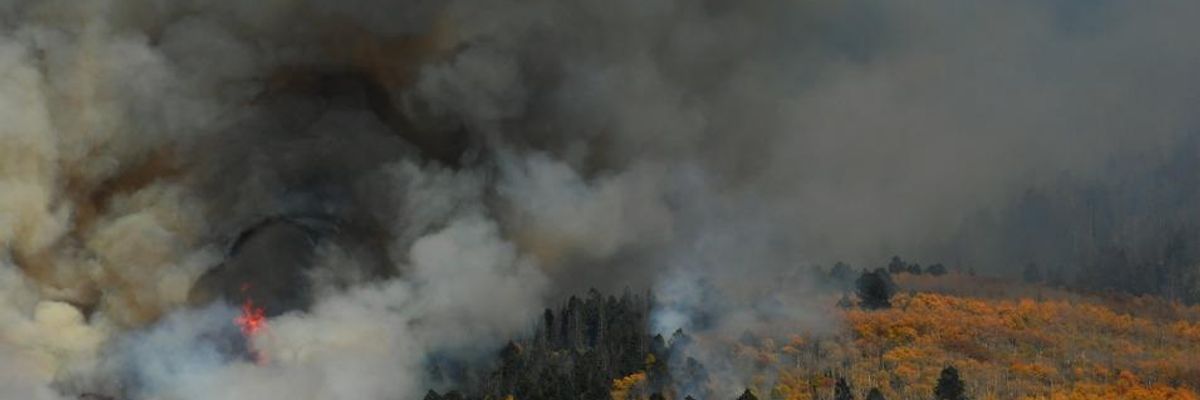
The Decker fire burns in the Sangre de Cristo Wilderness on October 8, 2019 in Salida, Colorado. (Photo: RJ Sangosti/MediaNews Group/The Denver Post via Getty Images)
The U.S. Court of Appeals for the Tenth Circuit ruled late Tuesday that a lawsuit filed by three Colorado municipalities against two powerful fossil fuel companies will proceed in state rather than federal court in what was a blow to the oil giants.
Boulder County, San Miguel County, and the City of Boulder sued ExxonMobil and Suncor Energy in 2018 over the corporations' decades of contributing to the climate crisis via fossil fuel extraction.
The crisis is affecting communities across the U.S., the plaintiffs argued, and not just in coastal areas where sea level rise is a concern. Representing the counties and city, advocacy group EarthRights International (ERI) argued that the communities are facing intensifying heat waves, wildfires, droughts, and floods which threaten local economies and public health and safety.
"Exxon and Suncor are disproportionately responsible for the crisis that our clients now face. Their reckless behavior has caused part of the damages that these communities are contending with and they should be held accountable for those damages."
--Marco Simons, ERI
"Exxon and Suncor are disproportionately responsible for the crisis that our clients now face," Marco Simons, general counsel for ERI, said Tuesday. "Their reckless behavior has caused part of the damages that these communities are contending with and they should be held accountable for those damages."
The organization hailed the appeals court decision as a victory, as the case will now be decided within Colorado, where the effects of ExxonMobil and Suncor's actions are readily apparent.
"Federal courts have consistently ruled that these climate cases belong in state courts--which makes sense because these cases are about harms experienced at the local level," said Simons.
"Colorado is one of the top fossil fuel-producing states in the U.S.," he added. "The oil and gas industry has spent millions of dollars over the past several decades on lobbying and deceptive advertising to spread its destructive message there and to block meaningful climate action. This has led to rampant fossil fuel extraction that is connected to more air pollution, increased risk of wildfires and droughts, and reduced snowpack. These clear indicators of climate change are also undermining public health, local economies, and essential infrastructure systems like roads."
The fossil fuel industry has fought consistently to have environmental cases adjudicated in federal courts, counting on the courts to rule that climate issues should be left up to the Environmental Protection Agency to oversee and are not legal matters.
In May, the U.S. Circuit Court of Appeals for the Ninth Circuit in California sent cases filed by three counties and five cities back to state courts as well, in another setback for Exxon as well as Chevron, BP, ConocoPhillips, and Shell.
The same court also ruled that previously-dismissed climate lawsuits should be sent back to a district court to consider the proper jurisdiction.
"That's now three federal appeals courts that have rejected fossil fuel companies' bids to punt climate liability lawsuits to federal courts," tweeted environmental journalist Dana Drugmand.
The decision came on the heels of a U.S. district court ruling requiring the Dakota Access Pipeline to be shut down and emptied of oil by Aug. 5 and a decision by two oil companies to cancel the Atlantic Coast Pipeline due to "ongoing delays and increasing cost uncertainty." Both developments were announced Monday.
"It's been a tough week for the oil industry," tweeted Keith Slack, director of strategic impact and campaigns for EarthRights.
Dear Common Dreams reader, It’s been nearly 30 years since I co-founded Common Dreams with my late wife, Lina Newhouser. We had the radical notion that journalism should serve the public good, not corporate profits. It was clear to us from the outset what it would take to build such a project. No paid advertisements. No corporate sponsors. No millionaire publisher telling us what to think or do. Many people said we wouldn't last a year, but we proved those doubters wrong. Together with a tremendous team of journalists and dedicated staff, we built an independent media outlet free from the constraints of profits and corporate control. Our mission has always been simple: To inform. To inspire. To ignite change for the common good. Building Common Dreams was not easy. Our survival was never guaranteed. When you take on the most powerful forces—Wall Street greed, fossil fuel industry destruction, Big Tech lobbyists, and uber-rich oligarchs who have spent billions upon billions rigging the economy and democracy in their favor—the only bulwark you have is supporters who believe in your work. But here’s the urgent message from me today. It's never been this bad out there. And it's never been this hard to keep us going. At the very moment Common Dreams is most needed, the threats we face are intensifying. We need your support now more than ever. We don't accept corporate advertising and never will. We don't have a paywall because we don't think people should be blocked from critical news based on their ability to pay. Everything we do is funded by the donations of readers like you. When everyone does the little they can afford, we are strong. But if that support retreats or dries up, so do we. Will you donate now to make sure Common Dreams not only survives but thrives? —Craig Brown, Co-founder |
The U.S. Court of Appeals for the Tenth Circuit ruled late Tuesday that a lawsuit filed by three Colorado municipalities against two powerful fossil fuel companies will proceed in state rather than federal court in what was a blow to the oil giants.
Boulder County, San Miguel County, and the City of Boulder sued ExxonMobil and Suncor Energy in 2018 over the corporations' decades of contributing to the climate crisis via fossil fuel extraction.
The crisis is affecting communities across the U.S., the plaintiffs argued, and not just in coastal areas where sea level rise is a concern. Representing the counties and city, advocacy group EarthRights International (ERI) argued that the communities are facing intensifying heat waves, wildfires, droughts, and floods which threaten local economies and public health and safety.
"Exxon and Suncor are disproportionately responsible for the crisis that our clients now face. Their reckless behavior has caused part of the damages that these communities are contending with and they should be held accountable for those damages."
--Marco Simons, ERI
"Exxon and Suncor are disproportionately responsible for the crisis that our clients now face," Marco Simons, general counsel for ERI, said Tuesday. "Their reckless behavior has caused part of the damages that these communities are contending with and they should be held accountable for those damages."
The organization hailed the appeals court decision as a victory, as the case will now be decided within Colorado, where the effects of ExxonMobil and Suncor's actions are readily apparent.
"Federal courts have consistently ruled that these climate cases belong in state courts--which makes sense because these cases are about harms experienced at the local level," said Simons.
"Colorado is one of the top fossil fuel-producing states in the U.S.," he added. "The oil and gas industry has spent millions of dollars over the past several decades on lobbying and deceptive advertising to spread its destructive message there and to block meaningful climate action. This has led to rampant fossil fuel extraction that is connected to more air pollution, increased risk of wildfires and droughts, and reduced snowpack. These clear indicators of climate change are also undermining public health, local economies, and essential infrastructure systems like roads."
The fossil fuel industry has fought consistently to have environmental cases adjudicated in federal courts, counting on the courts to rule that climate issues should be left up to the Environmental Protection Agency to oversee and are not legal matters.
In May, the U.S. Circuit Court of Appeals for the Ninth Circuit in California sent cases filed by three counties and five cities back to state courts as well, in another setback for Exxon as well as Chevron, BP, ConocoPhillips, and Shell.
The same court also ruled that previously-dismissed climate lawsuits should be sent back to a district court to consider the proper jurisdiction.
"That's now three federal appeals courts that have rejected fossil fuel companies' bids to punt climate liability lawsuits to federal courts," tweeted environmental journalist Dana Drugmand.
The decision came on the heels of a U.S. district court ruling requiring the Dakota Access Pipeline to be shut down and emptied of oil by Aug. 5 and a decision by two oil companies to cancel the Atlantic Coast Pipeline due to "ongoing delays and increasing cost uncertainty." Both developments were announced Monday.
"It's been a tough week for the oil industry," tweeted Keith Slack, director of strategic impact and campaigns for EarthRights.
The U.S. Court of Appeals for the Tenth Circuit ruled late Tuesday that a lawsuit filed by three Colorado municipalities against two powerful fossil fuel companies will proceed in state rather than federal court in what was a blow to the oil giants.
Boulder County, San Miguel County, and the City of Boulder sued ExxonMobil and Suncor Energy in 2018 over the corporations' decades of contributing to the climate crisis via fossil fuel extraction.
The crisis is affecting communities across the U.S., the plaintiffs argued, and not just in coastal areas where sea level rise is a concern. Representing the counties and city, advocacy group EarthRights International (ERI) argued that the communities are facing intensifying heat waves, wildfires, droughts, and floods which threaten local economies and public health and safety.
"Exxon and Suncor are disproportionately responsible for the crisis that our clients now face. Their reckless behavior has caused part of the damages that these communities are contending with and they should be held accountable for those damages."
--Marco Simons, ERI
"Exxon and Suncor are disproportionately responsible for the crisis that our clients now face," Marco Simons, general counsel for ERI, said Tuesday. "Their reckless behavior has caused part of the damages that these communities are contending with and they should be held accountable for those damages."
The organization hailed the appeals court decision as a victory, as the case will now be decided within Colorado, where the effects of ExxonMobil and Suncor's actions are readily apparent.
"Federal courts have consistently ruled that these climate cases belong in state courts--which makes sense because these cases are about harms experienced at the local level," said Simons.
"Colorado is one of the top fossil fuel-producing states in the U.S.," he added. "The oil and gas industry has spent millions of dollars over the past several decades on lobbying and deceptive advertising to spread its destructive message there and to block meaningful climate action. This has led to rampant fossil fuel extraction that is connected to more air pollution, increased risk of wildfires and droughts, and reduced snowpack. These clear indicators of climate change are also undermining public health, local economies, and essential infrastructure systems like roads."
The fossil fuel industry has fought consistently to have environmental cases adjudicated in federal courts, counting on the courts to rule that climate issues should be left up to the Environmental Protection Agency to oversee and are not legal matters.
In May, the U.S. Circuit Court of Appeals for the Ninth Circuit in California sent cases filed by three counties and five cities back to state courts as well, in another setback for Exxon as well as Chevron, BP, ConocoPhillips, and Shell.
The same court also ruled that previously-dismissed climate lawsuits should be sent back to a district court to consider the proper jurisdiction.
"That's now three federal appeals courts that have rejected fossil fuel companies' bids to punt climate liability lawsuits to federal courts," tweeted environmental journalist Dana Drugmand.
The decision came on the heels of a U.S. district court ruling requiring the Dakota Access Pipeline to be shut down and emptied of oil by Aug. 5 and a decision by two oil companies to cancel the Atlantic Coast Pipeline due to "ongoing delays and increasing cost uncertainty." Both developments were announced Monday.
"It's been a tough week for the oil industry," tweeted Keith Slack, director of strategic impact and campaigns for EarthRights.