SUBSCRIBE TO OUR FREE NEWSLETTER
Daily news & progressive opinion—funded by the people, not the corporations—delivered straight to your inbox.
5
#000000
#FFFFFF
To donate by check, phone, or other method, see our More Ways to Give page.
Daily news & progressive opinion—funded by the people, not the corporations—delivered straight to your inbox.
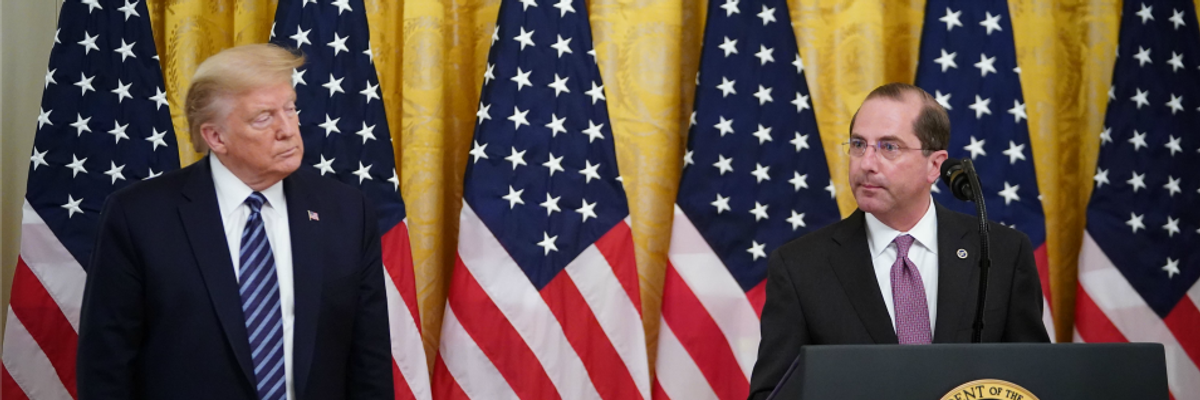
President Donald Trump listens as Secretary of Health and Human Services Alex Azar speaks in the East Room of the White House in Washington, D.C. on April 30, 2020. (Photo: Mandel Ngan/AFP via Getty Images)
Most of the world will not be able to make use of a modestly effective Covid-19 treatment for at least the next three months because the Trump administration this week bought up nearly the entire supply of the drug, a move critics said exposes the potentially deadly consequences of the U.S. president's so-called "America First" approach in the context of a pandemic that has swept the globe.
The Trump administration's decision to purchase almost all of California-based Gilead Sciences' projected stock of remdesivir through September was also viewed by observers as a glaring example of the "dysfunctional character" of a patent system that gives pharmaceutical giants decades of monopoly control over a drug that could save lives in the near-term.
"We knew Trump was Mr. 'America first,' but this is still a deplorable act in the face of a global crisis."
--Michael Smith, University of Aberdeen
"This is what happens when the world relies on a broken system driven by greed and profit during a pandemic," tweeted U.K.-based advocacy group Global Justice Now, which is urging governments to override Gilead's patent through compulsory licensing.
"Governments have a right to override this ludicrous patent system under international law, and they should take the opportunity to do that now, saving the [National Health Service] and patients around the world from the profiteering of these dysfunctional corporations," Nick Dearden, director of Global Justice Now, said in a statement.
On Monday--the same day Gilead unveiled its pricing plan for remdesivir--the U.S. Health and Human Services Department (HHS) announced it "has secured more than 500,000 treatment courses of the drug for American hospitals through September." The company said it will charge U.S. hospitals around $3,120 per privately insured patient for a treatment course of remdesivir, a price consumer advocacy group Public Citizen condemned as "offensive" given that U.S. taxpayers poured more than $70 million into developing the drug.
HHS said its purchase "represents 100 percent of Gilead's projected production for July (94,200 treatment courses), 90 percent of production in August (174,900 treatment courses), and 90 percent of production in September (232,800 treatment courses), in addition to an allocation for clinical trials."
HHS Secretary Alex Azar gushed in a statement that President Donald Trump "has struck an amazing deal to ensure Americans have access to the first authorized therapeutic for Covid-19" as infections continue to surge in dozens of states across the U.S.
But as The Guardian reported Tuesday, "experts and campaigners are alarmed both by the U.S. unilateral action on remdesivir and the wider implications, for instance in the event of a vaccine becoming available. The Trump administration has already shown that it is prepared to outbid and outmaneuver all other countries to secure the medical supplies it needs for the U.S."
Michael Smith, head of politics and international relations at the University of Aberdeen in Scotland, tweeted Wednesday that "we knew Trump was Mr. 'America first,' but this is still a deplorable act in the face of a global crisis."
"With a pandemic like Covid-19, the problem won't be solved until it's sold for the whole world."
--Dr. Deborah Gleeson, La Trobe University
The Guardian noted that the U.K. and other nations still have the option of purchasing the drug through "generic companies in Bangladesh or India, where Gilead's patent is not recognized."
Gilead ignored calls from civil society organizations around the world to relinquish its exclusive control over remdesivir and take steps to ensure that the treatment is widely available to those in need regardless of where they live or their ability to pay.
"An exclusivity and monopoly-based approach will fail the world in combating the Covid-19 pandemic," more than 150 organizations and experts warned in an open letter in March. "Gilead must act in the public interest now."
Dr. Deborah Gleeson, a senior public health lecturer at La Trobe University in Australia, told a local news outlet Wednesday that "it's quite outrageous that the U.S. government has bought up almost the entire next three months supply of remdesivir."
"It's a very concerning precedent because if we see the vaccine coming from a U.S. company, we're likely to see the same type of behavior and hoarding by the U.S. and other developed countries," said Gleeson. "With a pandemic like Covid-19, the problem won't be solved until it's sold for the whole world."
Dear Common Dreams reader, It’s been nearly 30 years since I co-founded Common Dreams with my late wife, Lina Newhouser. We had the radical notion that journalism should serve the public good, not corporate profits. It was clear to us from the outset what it would take to build such a project. No paid advertisements. No corporate sponsors. No millionaire publisher telling us what to think or do. Many people said we wouldn't last a year, but we proved those doubters wrong. Together with a tremendous team of journalists and dedicated staff, we built an independent media outlet free from the constraints of profits and corporate control. Our mission has always been simple: To inform. To inspire. To ignite change for the common good. Building Common Dreams was not easy. Our survival was never guaranteed. When you take on the most powerful forces—Wall Street greed, fossil fuel industry destruction, Big Tech lobbyists, and uber-rich oligarchs who have spent billions upon billions rigging the economy and democracy in their favor—the only bulwark you have is supporters who believe in your work. But here’s the urgent message from me today. It's never been this bad out there. And it's never been this hard to keep us going. At the very moment Common Dreams is most needed, the threats we face are intensifying. We need your support now more than ever. We don't accept corporate advertising and never will. We don't have a paywall because we don't think people should be blocked from critical news based on their ability to pay. Everything we do is funded by the donations of readers like you. When everyone does the little they can afford, we are strong. But if that support retreats or dries up, so do we. Will you donate now to make sure Common Dreams not only survives but thrives? —Craig Brown, Co-founder |
Most of the world will not be able to make use of a modestly effective Covid-19 treatment for at least the next three months because the Trump administration this week bought up nearly the entire supply of the drug, a move critics said exposes the potentially deadly consequences of the U.S. president's so-called "America First" approach in the context of a pandemic that has swept the globe.
The Trump administration's decision to purchase almost all of California-based Gilead Sciences' projected stock of remdesivir through September was also viewed by observers as a glaring example of the "dysfunctional character" of a patent system that gives pharmaceutical giants decades of monopoly control over a drug that could save lives in the near-term.
"We knew Trump was Mr. 'America first,' but this is still a deplorable act in the face of a global crisis."
--Michael Smith, University of Aberdeen
"This is what happens when the world relies on a broken system driven by greed and profit during a pandemic," tweeted U.K.-based advocacy group Global Justice Now, which is urging governments to override Gilead's patent through compulsory licensing.
"Governments have a right to override this ludicrous patent system under international law, and they should take the opportunity to do that now, saving the [National Health Service] and patients around the world from the profiteering of these dysfunctional corporations," Nick Dearden, director of Global Justice Now, said in a statement.
On Monday--the same day Gilead unveiled its pricing plan for remdesivir--the U.S. Health and Human Services Department (HHS) announced it "has secured more than 500,000 treatment courses of the drug for American hospitals through September." The company said it will charge U.S. hospitals around $3,120 per privately insured patient for a treatment course of remdesivir, a price consumer advocacy group Public Citizen condemned as "offensive" given that U.S. taxpayers poured more than $70 million into developing the drug.
HHS said its purchase "represents 100 percent of Gilead's projected production for July (94,200 treatment courses), 90 percent of production in August (174,900 treatment courses), and 90 percent of production in September (232,800 treatment courses), in addition to an allocation for clinical trials."
HHS Secretary Alex Azar gushed in a statement that President Donald Trump "has struck an amazing deal to ensure Americans have access to the first authorized therapeutic for Covid-19" as infections continue to surge in dozens of states across the U.S.
But as The Guardian reported Tuesday, "experts and campaigners are alarmed both by the U.S. unilateral action on remdesivir and the wider implications, for instance in the event of a vaccine becoming available. The Trump administration has already shown that it is prepared to outbid and outmaneuver all other countries to secure the medical supplies it needs for the U.S."
Michael Smith, head of politics and international relations at the University of Aberdeen in Scotland, tweeted Wednesday that "we knew Trump was Mr. 'America first,' but this is still a deplorable act in the face of a global crisis."
"With a pandemic like Covid-19, the problem won't be solved until it's sold for the whole world."
--Dr. Deborah Gleeson, La Trobe University
The Guardian noted that the U.K. and other nations still have the option of purchasing the drug through "generic companies in Bangladesh or India, where Gilead's patent is not recognized."
Gilead ignored calls from civil society organizations around the world to relinquish its exclusive control over remdesivir and take steps to ensure that the treatment is widely available to those in need regardless of where they live or their ability to pay.
"An exclusivity and monopoly-based approach will fail the world in combating the Covid-19 pandemic," more than 150 organizations and experts warned in an open letter in March. "Gilead must act in the public interest now."
Dr. Deborah Gleeson, a senior public health lecturer at La Trobe University in Australia, told a local news outlet Wednesday that "it's quite outrageous that the U.S. government has bought up almost the entire next three months supply of remdesivir."
"It's a very concerning precedent because if we see the vaccine coming from a U.S. company, we're likely to see the same type of behavior and hoarding by the U.S. and other developed countries," said Gleeson. "With a pandemic like Covid-19, the problem won't be solved until it's sold for the whole world."
Most of the world will not be able to make use of a modestly effective Covid-19 treatment for at least the next three months because the Trump administration this week bought up nearly the entire supply of the drug, a move critics said exposes the potentially deadly consequences of the U.S. president's so-called "America First" approach in the context of a pandemic that has swept the globe.
The Trump administration's decision to purchase almost all of California-based Gilead Sciences' projected stock of remdesivir through September was also viewed by observers as a glaring example of the "dysfunctional character" of a patent system that gives pharmaceutical giants decades of monopoly control over a drug that could save lives in the near-term.
"We knew Trump was Mr. 'America first,' but this is still a deplorable act in the face of a global crisis."
--Michael Smith, University of Aberdeen
"This is what happens when the world relies on a broken system driven by greed and profit during a pandemic," tweeted U.K.-based advocacy group Global Justice Now, which is urging governments to override Gilead's patent through compulsory licensing.
"Governments have a right to override this ludicrous patent system under international law, and they should take the opportunity to do that now, saving the [National Health Service] and patients around the world from the profiteering of these dysfunctional corporations," Nick Dearden, director of Global Justice Now, said in a statement.
On Monday--the same day Gilead unveiled its pricing plan for remdesivir--the U.S. Health and Human Services Department (HHS) announced it "has secured more than 500,000 treatment courses of the drug for American hospitals through September." The company said it will charge U.S. hospitals around $3,120 per privately insured patient for a treatment course of remdesivir, a price consumer advocacy group Public Citizen condemned as "offensive" given that U.S. taxpayers poured more than $70 million into developing the drug.
HHS said its purchase "represents 100 percent of Gilead's projected production for July (94,200 treatment courses), 90 percent of production in August (174,900 treatment courses), and 90 percent of production in September (232,800 treatment courses), in addition to an allocation for clinical trials."
HHS Secretary Alex Azar gushed in a statement that President Donald Trump "has struck an amazing deal to ensure Americans have access to the first authorized therapeutic for Covid-19" as infections continue to surge in dozens of states across the U.S.
But as The Guardian reported Tuesday, "experts and campaigners are alarmed both by the U.S. unilateral action on remdesivir and the wider implications, for instance in the event of a vaccine becoming available. The Trump administration has already shown that it is prepared to outbid and outmaneuver all other countries to secure the medical supplies it needs for the U.S."
Michael Smith, head of politics and international relations at the University of Aberdeen in Scotland, tweeted Wednesday that "we knew Trump was Mr. 'America first,' but this is still a deplorable act in the face of a global crisis."
"With a pandemic like Covid-19, the problem won't be solved until it's sold for the whole world."
--Dr. Deborah Gleeson, La Trobe University
The Guardian noted that the U.K. and other nations still have the option of purchasing the drug through "generic companies in Bangladesh or India, where Gilead's patent is not recognized."
Gilead ignored calls from civil society organizations around the world to relinquish its exclusive control over remdesivir and take steps to ensure that the treatment is widely available to those in need regardless of where they live or their ability to pay.
"An exclusivity and monopoly-based approach will fail the world in combating the Covid-19 pandemic," more than 150 organizations and experts warned in an open letter in March. "Gilead must act in the public interest now."
Dr. Deborah Gleeson, a senior public health lecturer at La Trobe University in Australia, told a local news outlet Wednesday that "it's quite outrageous that the U.S. government has bought up almost the entire next three months supply of remdesivir."
"It's a very concerning precedent because if we see the vaccine coming from a U.S. company, we're likely to see the same type of behavior and hoarding by the U.S. and other developed countries," said Gleeson. "With a pandemic like Covid-19, the problem won't be solved until it's sold for the whole world."