SUBSCRIBE TO OUR FREE NEWSLETTER
Daily news & progressive opinion—funded by the people, not the corporations—delivered straight to your inbox.
5
#000000
#FFFFFF
To donate by check, phone, or other method, see our More Ways to Give page.
Daily news & progressive opinion—funded by the people, not the corporations—delivered straight to your inbox.
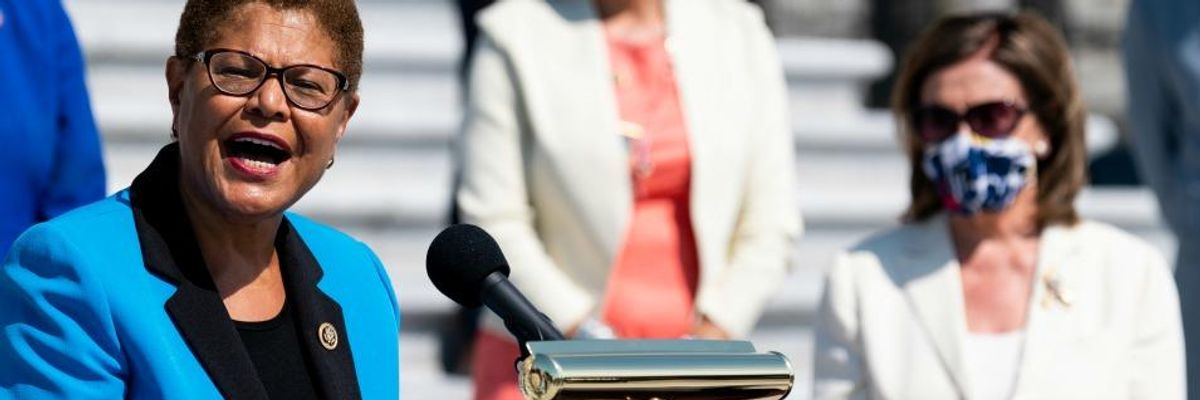
Congressional Black Caucus Chair Rep. Karen Bass (D-Calif.) speaks as Speaker of the House Nancy Pelosi (D-Calif.) and House Democrats gather for a press event on the House steps ahead of the vote on the George Floyd Justice in Policing Act of 2020 on Thursday, June 25, 2020. (Photo: Bill Clark/CQ-Roll Call, Inc via Getty Images)
Civil rights advocates on Friday called on the U.S. Senate to promptly approve the George Floyd Justice in Policing Act, the policing reform legislation which was passed in a bipartisan vote in the House Thursday evening one month after George Floyd was killed by four Minneapolis police officers.
The bill was passed with a vote of 236-181, with three Republicans joining the House Democrats to support the legislation: Brian Fitzpatrick of Pennsylvania, Will Hurd of Texas, and Fred Upton of Michigan.
The legislation:
The bill would also redirect existing law enforcement funds to "transformative, community-based policing programs" that would "help communities to re-imagine and develop concrete, just, and equitable public safety approaches," according to the House Democrats.
Family members of some black Americans killed by police officers in recent years--including Gwen Carr, the mother of Eric Garner; Samaria Rice, the mother of Tamir Rice; and John Crawford, Jr., the father of John Crawford III--endorsed the legislation, calling it a "strong step forward in the right direction."
"The unjust killing of a loved one, especially at the hands of law enforcement, is a pain too many families have been forced to endure," they said in a statement. "We are proud to support this effort because it's the right thing to do... This bill will hold officers accountable to the communities they serve and compel them to have a guardian mentality, not a warrior mentality."
The bill does not go as far as redirecting policing funds to communities by investing in education, public health, and social services, as some progressives including Rep. Alexandria Ocasio-Cortez (D-N.Y.) have called for.
Advocacy group Bend the Arc: Jewish Action rebuked Democrats for not completely eliminating qualified immunity and the transfer of military equipment to police departments.
"In the middle of a pandemic and an economic crisis, it's not enough to reduce the scope and size of policing--legislation should increase spending on education, housing, and health and human services that meet widely and deeply felt community needs," said Rabbi Jason Kimelman-Block, Washington Director of the organization.
But the legislation goes much further than the police reform bill offered by Senate Republicans, which includes little focus on mandating reforms at the federal level.
The GOP bill and President Donald Trump's executive order on policing, introduced earlier this month, do not end or amend qualified immunity for officers, ban chokeholds for federal law enforcement officers or subject state and local officers to federal prosecution for using them, or require deadly force to be used only as a last resort.
Rep. Jerrold Nadler (D-N.Y.), who co-sponsored the bill, called on the Senate Republicans to put partisanship aside and approve the George Floyd Justice in Policing Act immediately.
"The House has done its job today but that is not the end of the story," Nadler said. "This is not the time for half measures. This is not the time for further study. This is not the time for fake reform. If our Republican colleagues truly want to pass bold comprehensive legislation that will change the culture of policing and hold officers accountable, we welcome them to the table. But we will not accept anything less."
Advocacy group Common Cause called on the Senate to "strengthen" the legislation and "set a standard for justice, policing, and safety in America," demanding that lawmakers hear the calls of Americans who have joined anti-police brutality protests across the country over the past month.
"The people-led protests across the nation are a reflection of the pain felt by many, a response to the failure of America to reckon with its racist history, and a demand for an end to state-sanctioned violence against Black people," said Keshia Morris Desir, the group's Census and Mass Incarceration Project Manager. "The Justice in Policing Act of 2020 is an important step in rooting out systemic racism in law enforcement and we commend the House for passing the legislation. More will need to be done, but we must first take this first important step to addressing a national disgrace."
The NAACP, which endorsed the legislation, agreed that the bill is only a first step, but echoed Desir's call.
"This legislation represents the only way forward. If we've learned anything from these past weeks, it's that the American people are demanding systemic change. We need bold, transformative action to rethink policing and reimagine public safety in our communities," said Derrick Johnson, president and CEO of the organization.
"Congress must seize this extraordinary moment in time to push for the elimination of racism in policing and in the criminal justice system writ large, and to rid our society of the structural inequality that has tormented and held back our nation for far too long," he added.
Sens. Cory Booker (D-N.J.) and Kamala Harris (D-Calif.), who introduced the bill along with House co-sponsors on June 8, demanded that their Republican colleagues join "the fight to honor [the] lives" of Floyd, Breonna Taylor, Ahmaud Arbery, and countless other black Americans who have been killed by police, and acknowledged that "the fight continues."
"These are just a handful of solutions...that will move us forward to being a more just and equal society," Booker said.
Dear Common Dreams reader, It’s been nearly 30 years since I co-founded Common Dreams with my late wife, Lina Newhouser. We had the radical notion that journalism should serve the public good, not corporate profits. It was clear to us from the outset what it would take to build such a project. No paid advertisements. No corporate sponsors. No millionaire publisher telling us what to think or do. Many people said we wouldn't last a year, but we proved those doubters wrong. Together with a tremendous team of journalists and dedicated staff, we built an independent media outlet free from the constraints of profits and corporate control. Our mission has always been simple: To inform. To inspire. To ignite change for the common good. Building Common Dreams was not easy. Our survival was never guaranteed. When you take on the most powerful forces—Wall Street greed, fossil fuel industry destruction, Big Tech lobbyists, and uber-rich oligarchs who have spent billions upon billions rigging the economy and democracy in their favor—the only bulwark you have is supporters who believe in your work. But here’s the urgent message from me today. It's never been this bad out there. And it's never been this hard to keep us going. At the very moment Common Dreams is most needed, the threats we face are intensifying. We need your support now more than ever. We don't accept corporate advertising and never will. We don't have a paywall because we don't think people should be blocked from critical news based on their ability to pay. Everything we do is funded by the donations of readers like you. When everyone does the little they can afford, we are strong. But if that support retreats or dries up, so do we. Will you donate now to make sure Common Dreams not only survives but thrives? —Craig Brown, Co-founder |
Civil rights advocates on Friday called on the U.S. Senate to promptly approve the George Floyd Justice in Policing Act, the policing reform legislation which was passed in a bipartisan vote in the House Thursday evening one month after George Floyd was killed by four Minneapolis police officers.
The bill was passed with a vote of 236-181, with three Republicans joining the House Democrats to support the legislation: Brian Fitzpatrick of Pennsylvania, Will Hurd of Texas, and Fred Upton of Michigan.
The legislation:
The bill would also redirect existing law enforcement funds to "transformative, community-based policing programs" that would "help communities to re-imagine and develop concrete, just, and equitable public safety approaches," according to the House Democrats.
Family members of some black Americans killed by police officers in recent years--including Gwen Carr, the mother of Eric Garner; Samaria Rice, the mother of Tamir Rice; and John Crawford, Jr., the father of John Crawford III--endorsed the legislation, calling it a "strong step forward in the right direction."
"The unjust killing of a loved one, especially at the hands of law enforcement, is a pain too many families have been forced to endure," they said in a statement. "We are proud to support this effort because it's the right thing to do... This bill will hold officers accountable to the communities they serve and compel them to have a guardian mentality, not a warrior mentality."
The bill does not go as far as redirecting policing funds to communities by investing in education, public health, and social services, as some progressives including Rep. Alexandria Ocasio-Cortez (D-N.Y.) have called for.
Advocacy group Bend the Arc: Jewish Action rebuked Democrats for not completely eliminating qualified immunity and the transfer of military equipment to police departments.
"In the middle of a pandemic and an economic crisis, it's not enough to reduce the scope and size of policing--legislation should increase spending on education, housing, and health and human services that meet widely and deeply felt community needs," said Rabbi Jason Kimelman-Block, Washington Director of the organization.
But the legislation goes much further than the police reform bill offered by Senate Republicans, which includes little focus on mandating reforms at the federal level.
The GOP bill and President Donald Trump's executive order on policing, introduced earlier this month, do not end or amend qualified immunity for officers, ban chokeholds for federal law enforcement officers or subject state and local officers to federal prosecution for using them, or require deadly force to be used only as a last resort.
Rep. Jerrold Nadler (D-N.Y.), who co-sponsored the bill, called on the Senate Republicans to put partisanship aside and approve the George Floyd Justice in Policing Act immediately.
"The House has done its job today but that is not the end of the story," Nadler said. "This is not the time for half measures. This is not the time for further study. This is not the time for fake reform. If our Republican colleagues truly want to pass bold comprehensive legislation that will change the culture of policing and hold officers accountable, we welcome them to the table. But we will not accept anything less."
Advocacy group Common Cause called on the Senate to "strengthen" the legislation and "set a standard for justice, policing, and safety in America," demanding that lawmakers hear the calls of Americans who have joined anti-police brutality protests across the country over the past month.
"The people-led protests across the nation are a reflection of the pain felt by many, a response to the failure of America to reckon with its racist history, and a demand for an end to state-sanctioned violence against Black people," said Keshia Morris Desir, the group's Census and Mass Incarceration Project Manager. "The Justice in Policing Act of 2020 is an important step in rooting out systemic racism in law enforcement and we commend the House for passing the legislation. More will need to be done, but we must first take this first important step to addressing a national disgrace."
The NAACP, which endorsed the legislation, agreed that the bill is only a first step, but echoed Desir's call.
"This legislation represents the only way forward. If we've learned anything from these past weeks, it's that the American people are demanding systemic change. We need bold, transformative action to rethink policing and reimagine public safety in our communities," said Derrick Johnson, president and CEO of the organization.
"Congress must seize this extraordinary moment in time to push for the elimination of racism in policing and in the criminal justice system writ large, and to rid our society of the structural inequality that has tormented and held back our nation for far too long," he added.
Sens. Cory Booker (D-N.J.) and Kamala Harris (D-Calif.), who introduced the bill along with House co-sponsors on June 8, demanded that their Republican colleagues join "the fight to honor [the] lives" of Floyd, Breonna Taylor, Ahmaud Arbery, and countless other black Americans who have been killed by police, and acknowledged that "the fight continues."
"These are just a handful of solutions...that will move us forward to being a more just and equal society," Booker said.
Civil rights advocates on Friday called on the U.S. Senate to promptly approve the George Floyd Justice in Policing Act, the policing reform legislation which was passed in a bipartisan vote in the House Thursday evening one month after George Floyd was killed by four Minneapolis police officers.
The bill was passed with a vote of 236-181, with three Republicans joining the House Democrats to support the legislation: Brian Fitzpatrick of Pennsylvania, Will Hurd of Texas, and Fred Upton of Michigan.
The legislation:
The bill would also redirect existing law enforcement funds to "transformative, community-based policing programs" that would "help communities to re-imagine and develop concrete, just, and equitable public safety approaches," according to the House Democrats.
Family members of some black Americans killed by police officers in recent years--including Gwen Carr, the mother of Eric Garner; Samaria Rice, the mother of Tamir Rice; and John Crawford, Jr., the father of John Crawford III--endorsed the legislation, calling it a "strong step forward in the right direction."
"The unjust killing of a loved one, especially at the hands of law enforcement, is a pain too many families have been forced to endure," they said in a statement. "We are proud to support this effort because it's the right thing to do... This bill will hold officers accountable to the communities they serve and compel them to have a guardian mentality, not a warrior mentality."
The bill does not go as far as redirecting policing funds to communities by investing in education, public health, and social services, as some progressives including Rep. Alexandria Ocasio-Cortez (D-N.Y.) have called for.
Advocacy group Bend the Arc: Jewish Action rebuked Democrats for not completely eliminating qualified immunity and the transfer of military equipment to police departments.
"In the middle of a pandemic and an economic crisis, it's not enough to reduce the scope and size of policing--legislation should increase spending on education, housing, and health and human services that meet widely and deeply felt community needs," said Rabbi Jason Kimelman-Block, Washington Director of the organization.
But the legislation goes much further than the police reform bill offered by Senate Republicans, which includes little focus on mandating reforms at the federal level.
The GOP bill and President Donald Trump's executive order on policing, introduced earlier this month, do not end or amend qualified immunity for officers, ban chokeholds for federal law enforcement officers or subject state and local officers to federal prosecution for using them, or require deadly force to be used only as a last resort.
Rep. Jerrold Nadler (D-N.Y.), who co-sponsored the bill, called on the Senate Republicans to put partisanship aside and approve the George Floyd Justice in Policing Act immediately.
"The House has done its job today but that is not the end of the story," Nadler said. "This is not the time for half measures. This is not the time for further study. This is not the time for fake reform. If our Republican colleagues truly want to pass bold comprehensive legislation that will change the culture of policing and hold officers accountable, we welcome them to the table. But we will not accept anything less."
Advocacy group Common Cause called on the Senate to "strengthen" the legislation and "set a standard for justice, policing, and safety in America," demanding that lawmakers hear the calls of Americans who have joined anti-police brutality protests across the country over the past month.
"The people-led protests across the nation are a reflection of the pain felt by many, a response to the failure of America to reckon with its racist history, and a demand for an end to state-sanctioned violence against Black people," said Keshia Morris Desir, the group's Census and Mass Incarceration Project Manager. "The Justice in Policing Act of 2020 is an important step in rooting out systemic racism in law enforcement and we commend the House for passing the legislation. More will need to be done, but we must first take this first important step to addressing a national disgrace."
The NAACP, which endorsed the legislation, agreed that the bill is only a first step, but echoed Desir's call.
"This legislation represents the only way forward. If we've learned anything from these past weeks, it's that the American people are demanding systemic change. We need bold, transformative action to rethink policing and reimagine public safety in our communities," said Derrick Johnson, president and CEO of the organization.
"Congress must seize this extraordinary moment in time to push for the elimination of racism in policing and in the criminal justice system writ large, and to rid our society of the structural inequality that has tormented and held back our nation for far too long," he added.
Sens. Cory Booker (D-N.J.) and Kamala Harris (D-Calif.), who introduced the bill along with House co-sponsors on June 8, demanded that their Republican colleagues join "the fight to honor [the] lives" of Floyd, Breonna Taylor, Ahmaud Arbery, and countless other black Americans who have been killed by police, and acknowledged that "the fight continues."
"These are just a handful of solutions...that will move us forward to being a more just and equal society," Booker said.