SUBSCRIBE TO OUR FREE NEWSLETTER
Daily news & progressive opinion—funded by the people, not the corporations—delivered straight to your inbox.
5
#000000
#FFFFFF
To donate by check, phone, or other method, see our More Ways to Give page.
Daily news & progressive opinion—funded by the people, not the corporations—delivered straight to your inbox.
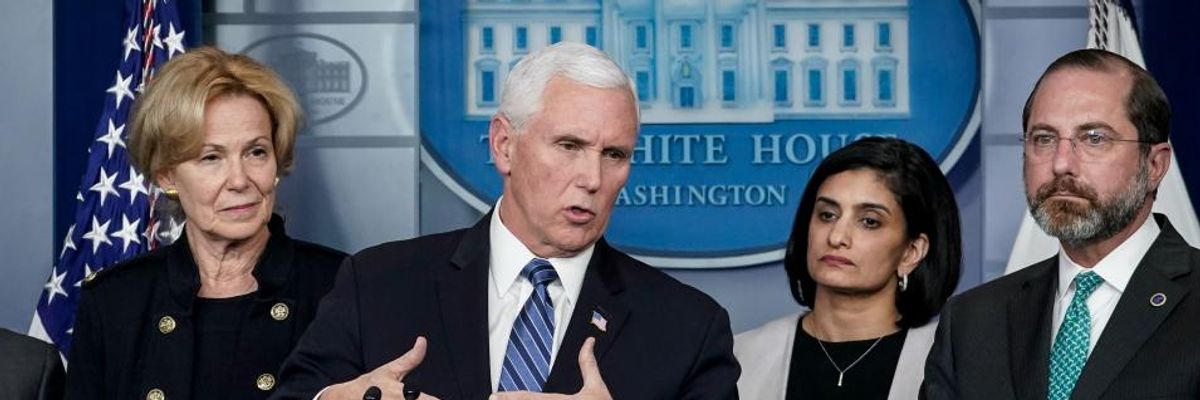
Vice President Mike Pence speaks during a briefing on the administration's coronavirus response in the press briefing room of the White House on March 2, 2020 in Washington, D.C. (Photo: Drew Angerer/Getty Images)
The Trump administration issued policy guidance this week telling health insurance companies that they are not required by law to cover the Covid-19 tests employers may compel workers to undergo as a condition for returning to their jobs.
The announcement (pdf) Tuesday by the Departments of Treasury, Labor, and Health and Human Services alarmed healthcare advocates and lawmakers who warned the move gives profitable insurers a green light to push the costs of potentially expensive coronavirus screenings onto workers.
"Once again, the Trump administration is prioritizing corporate profits over people. I'm deeply concerned that this will disproportionately impact frontline workers."
--Rep. Frank Pallone Jr.
The Families First Coronavirus Response Act, a relief bill President Donald Trump signed into law in March, includes a provision (pdf) mandating that insurers and employer-provided plans cover "Covid-19 testing and related services without cost-sharing."
But the Trump administration says in its guidance that the law only requires insurers to cover "medically appropriate" coronavirus screenings, not tests "conducted to screen for general workplace health and safety (such as employee 'return to work' programs)."
Rep. Frank Pallone Jr. (D-N.J.) blasted the Trump administration's interpretation of the law as a violation of congressional intent and "a free handout to the insurance industry."
"Once again, the Trump administration is prioritizing corporate profits over people," Pallone tweeted Wednesday. "I'm deeply concerned that this will disproportionately impact frontline workers."
In April, the Equal Employment Opportunity Commission--a federal agency tasked with enforcing anti-discrimination laws--said employers are legally permitted to force employees to take Covid-19 viral tests to determine whether it is safe for them to return to the workplace.
New York, New Jersey, and other states currently require nursing homes to test employees to prevent the spread of Covid-19 in their facilities, which have been devastating hot-spots for the virus.
The New York Times reported earlier this month that some nursing homes say they can't afford to pay for the testing and have tried to bill insurance companies for the costs. But not all insurance companies have agreed to cover Covid-19 testing, leaving workers on the hook for the bill.
Shikilia Davis, a nursing home worker in Long Island, told the Times that she was sent home by her employer one day after she refused to hand over her insurance card before getting tested. Davis said she feared being hit with the costs because her insurer has declined to cover coronavirus screenings.
"This is a bill I do not want to get stuck with," said Davis. "I don't have money lying around."
As consumer advocacy group Public Citizen documented in a report last month, "the vast majority of the largest health insurers" in the U.S. have temporarily waived some costs for Covid-19 testing and treatment.
"But these fee waivers contain significant restrictions and most are set to expire long before the pandemic can reasonably be expected to end," the report noted.
"In some cases, the insurers' statements of testing-related benefits appear less sweeping than Congress required," the report continued. "Some of the insurers' statements only promise to cover testing-related costs through certain dates. Other statements suggest a more restrictive universe of covered tests than the legislation calls for. Meanwhile, most of do not clearly warn members that they might be subject to costs if they see out-of-network providers."
Public Citizen argued that the best way to ensure everyone is able to receive the Covid-19 testing and treatment they need is by implementing Medicare for All, which the group describes as "the most sensible way to untangle the thicket of our healthcare system, protect Americans from crushing costs, and create a healthier and more productive society."
"Under Medicare for All," the group said, "nobody would have to worry about falling through the cracks of a broken healthcare system and facing financial ruin."
Dear Common Dreams reader, It’s been nearly 30 years since I co-founded Common Dreams with my late wife, Lina Newhouser. We had the radical notion that journalism should serve the public good, not corporate profits. It was clear to us from the outset what it would take to build such a project. No paid advertisements. No corporate sponsors. No millionaire publisher telling us what to think or do. Many people said we wouldn't last a year, but we proved those doubters wrong. Together with a tremendous team of journalists and dedicated staff, we built an independent media outlet free from the constraints of profits and corporate control. Our mission has always been simple: To inform. To inspire. To ignite change for the common good. Building Common Dreams was not easy. Our survival was never guaranteed. When you take on the most powerful forces—Wall Street greed, fossil fuel industry destruction, Big Tech lobbyists, and uber-rich oligarchs who have spent billions upon billions rigging the economy and democracy in their favor—the only bulwark you have is supporters who believe in your work. But here’s the urgent message from me today. It's never been this bad out there. And it's never been this hard to keep us going. At the very moment Common Dreams is most needed, the threats we face are intensifying. We need your support now more than ever. We don't accept corporate advertising and never will. We don't have a paywall because we don't think people should be blocked from critical news based on their ability to pay. Everything we do is funded by the donations of readers like you. When everyone does the little they can afford, we are strong. But if that support retreats or dries up, so do we. Will you donate now to make sure Common Dreams not only survives but thrives? —Craig Brown, Co-founder |
The Trump administration issued policy guidance this week telling health insurance companies that they are not required by law to cover the Covid-19 tests employers may compel workers to undergo as a condition for returning to their jobs.
The announcement (pdf) Tuesday by the Departments of Treasury, Labor, and Health and Human Services alarmed healthcare advocates and lawmakers who warned the move gives profitable insurers a green light to push the costs of potentially expensive coronavirus screenings onto workers.
"Once again, the Trump administration is prioritizing corporate profits over people. I'm deeply concerned that this will disproportionately impact frontline workers."
--Rep. Frank Pallone Jr.
The Families First Coronavirus Response Act, a relief bill President Donald Trump signed into law in March, includes a provision (pdf) mandating that insurers and employer-provided plans cover "Covid-19 testing and related services without cost-sharing."
But the Trump administration says in its guidance that the law only requires insurers to cover "medically appropriate" coronavirus screenings, not tests "conducted to screen for general workplace health and safety (such as employee 'return to work' programs)."
Rep. Frank Pallone Jr. (D-N.J.) blasted the Trump administration's interpretation of the law as a violation of congressional intent and "a free handout to the insurance industry."
"Once again, the Trump administration is prioritizing corporate profits over people," Pallone tweeted Wednesday. "I'm deeply concerned that this will disproportionately impact frontline workers."
In April, the Equal Employment Opportunity Commission--a federal agency tasked with enforcing anti-discrimination laws--said employers are legally permitted to force employees to take Covid-19 viral tests to determine whether it is safe for them to return to the workplace.
New York, New Jersey, and other states currently require nursing homes to test employees to prevent the spread of Covid-19 in their facilities, which have been devastating hot-spots for the virus.
The New York Times reported earlier this month that some nursing homes say they can't afford to pay for the testing and have tried to bill insurance companies for the costs. But not all insurance companies have agreed to cover Covid-19 testing, leaving workers on the hook for the bill.
Shikilia Davis, a nursing home worker in Long Island, told the Times that she was sent home by her employer one day after she refused to hand over her insurance card before getting tested. Davis said she feared being hit with the costs because her insurer has declined to cover coronavirus screenings.
"This is a bill I do not want to get stuck with," said Davis. "I don't have money lying around."
As consumer advocacy group Public Citizen documented in a report last month, "the vast majority of the largest health insurers" in the U.S. have temporarily waived some costs for Covid-19 testing and treatment.
"But these fee waivers contain significant restrictions and most are set to expire long before the pandemic can reasonably be expected to end," the report noted.
"In some cases, the insurers' statements of testing-related benefits appear less sweeping than Congress required," the report continued. "Some of the insurers' statements only promise to cover testing-related costs through certain dates. Other statements suggest a more restrictive universe of covered tests than the legislation calls for. Meanwhile, most of do not clearly warn members that they might be subject to costs if they see out-of-network providers."
Public Citizen argued that the best way to ensure everyone is able to receive the Covid-19 testing and treatment they need is by implementing Medicare for All, which the group describes as "the most sensible way to untangle the thicket of our healthcare system, protect Americans from crushing costs, and create a healthier and more productive society."
"Under Medicare for All," the group said, "nobody would have to worry about falling through the cracks of a broken healthcare system and facing financial ruin."
The Trump administration issued policy guidance this week telling health insurance companies that they are not required by law to cover the Covid-19 tests employers may compel workers to undergo as a condition for returning to their jobs.
The announcement (pdf) Tuesday by the Departments of Treasury, Labor, and Health and Human Services alarmed healthcare advocates and lawmakers who warned the move gives profitable insurers a green light to push the costs of potentially expensive coronavirus screenings onto workers.
"Once again, the Trump administration is prioritizing corporate profits over people. I'm deeply concerned that this will disproportionately impact frontline workers."
--Rep. Frank Pallone Jr.
The Families First Coronavirus Response Act, a relief bill President Donald Trump signed into law in March, includes a provision (pdf) mandating that insurers and employer-provided plans cover "Covid-19 testing and related services without cost-sharing."
But the Trump administration says in its guidance that the law only requires insurers to cover "medically appropriate" coronavirus screenings, not tests "conducted to screen for general workplace health and safety (such as employee 'return to work' programs)."
Rep. Frank Pallone Jr. (D-N.J.) blasted the Trump administration's interpretation of the law as a violation of congressional intent and "a free handout to the insurance industry."
"Once again, the Trump administration is prioritizing corporate profits over people," Pallone tweeted Wednesday. "I'm deeply concerned that this will disproportionately impact frontline workers."
In April, the Equal Employment Opportunity Commission--a federal agency tasked with enforcing anti-discrimination laws--said employers are legally permitted to force employees to take Covid-19 viral tests to determine whether it is safe for them to return to the workplace.
New York, New Jersey, and other states currently require nursing homes to test employees to prevent the spread of Covid-19 in their facilities, which have been devastating hot-spots for the virus.
The New York Times reported earlier this month that some nursing homes say they can't afford to pay for the testing and have tried to bill insurance companies for the costs. But not all insurance companies have agreed to cover Covid-19 testing, leaving workers on the hook for the bill.
Shikilia Davis, a nursing home worker in Long Island, told the Times that she was sent home by her employer one day after she refused to hand over her insurance card before getting tested. Davis said she feared being hit with the costs because her insurer has declined to cover coronavirus screenings.
"This is a bill I do not want to get stuck with," said Davis. "I don't have money lying around."
As consumer advocacy group Public Citizen documented in a report last month, "the vast majority of the largest health insurers" in the U.S. have temporarily waived some costs for Covid-19 testing and treatment.
"But these fee waivers contain significant restrictions and most are set to expire long before the pandemic can reasonably be expected to end," the report noted.
"In some cases, the insurers' statements of testing-related benefits appear less sweeping than Congress required," the report continued. "Some of the insurers' statements only promise to cover testing-related costs through certain dates. Other statements suggest a more restrictive universe of covered tests than the legislation calls for. Meanwhile, most of do not clearly warn members that they might be subject to costs if they see out-of-network providers."
Public Citizen argued that the best way to ensure everyone is able to receive the Covid-19 testing and treatment they need is by implementing Medicare for All, which the group describes as "the most sensible way to untangle the thicket of our healthcare system, protect Americans from crushing costs, and create a healthier and more productive society."
"Under Medicare for All," the group said, "nobody would have to worry about falling through the cracks of a broken healthcare system and facing financial ruin."