SUBSCRIBE TO OUR FREE NEWSLETTER
Daily news & progressive opinion—funded by the people, not the corporations—delivered straight to your inbox.
5
#000000
#FFFFFF
To donate by check, phone, or other method, see our More Ways to Give page.
Daily news & progressive opinion—funded by the people, not the corporations—delivered straight to your inbox.
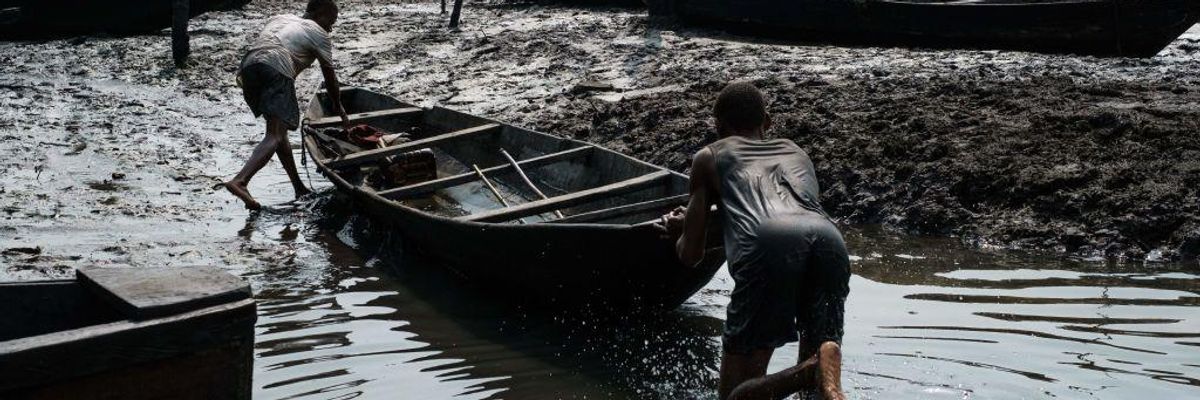
Fisherman push their boat during low tide on oily mud in the river at Ogoniland's village of K-Dere, near Bodo, which is part of the Niger Delta region, on February 20, 2019. -Decades of oil spills has left the Ogoniland region in southern Nigeria an environmental disaster zone. (Photo: should read YASUYOSHI CHIBA/AFP via Getty Images)
In 2011, a ground-breaking report by the UN Environment Programme (UNEP) on oil pollution in Ogoniland highlighted the devastating impact of the oil industry in the Niger Delta and made concrete recommendations for clean-up measures and immediate support for the region's devastated communities.
Now, nearly ten years later, a new report published Thursday by Friends of the Earth Europe, Amnesty International, ERA, and Milieudefensie, details Shell's failure to implement the "emergency measures" laid out by UNEP and says only 11% of contaminated areas in the Niger Delta have begun the clean-up process.
Titled "No Clean-Up, No Justice," the new report explains that for "more than five decades, the people of Ogoniland, in the Niger Delta, have struggled against oil pollution, destruction of the environment and human rights violations."
According to estimates, Shell Oil has dumped an estimated nine to 13 million barrels of crude oil into the Niger Delta since 1958.
"Oil and gas extraction has caused large-scale, continued contamination of the water and soil in Ogoni communities," said Friends of the Earth in a statement. "The continued and systematic failure of oil companies and government to clean up have left hundreds of thousands of Ogoni people facing serious health risks, struggling to access safe drinking water, and unable to earn a living."
As Common Dreams reported earlier this year, the local government has also worked with Shell to suppress the right of people in Ogoniland to fight against pollution.
"The discovery of oil in Ogoniland has brought huge suffering for its people," said Osai Ojigho of Amnesty International Nigeria. "Over many years we have documented how Shell has failed to clean up contamination from spills and it's a scandal that this has not yet happened."
The ecological damage, Ojigho added, "is leading to serious human rights impacts--on people's health and ability to access food and clean water. Shell must not get away with this--we will continue to fight until every last trace of oil is removed from Ogoniland."
Almost a full decade after the UNEP findings, the new report concluded that:
The report also lays out a set of demands for a rapid clean-up and funding for regional recovery, with chief responsibility for that effort aimed at the Nigerian government, Shell, and other governments--mostly in Europe--home to other major oil companies operating in the Niger Delta.
"After nine years of promises without proper action and decades of pollution, the people of Ogoniland are not only sick of dirty drinking water, oil-contaminated fish and toxic fumes," said Godwin Ojo of Environmental Rights Action/Friends of the Earth Nigeria.
"They are sick of waiting for justice," Ojo added. "They are dying by the day."
Dear Common Dreams reader, It’s been nearly 30 years since I co-founded Common Dreams with my late wife, Lina Newhouser. We had the radical notion that journalism should serve the public good, not corporate profits. It was clear to us from the outset what it would take to build such a project. No paid advertisements. No corporate sponsors. No millionaire publisher telling us what to think or do. Many people said we wouldn't last a year, but we proved those doubters wrong. Together with a tremendous team of journalists and dedicated staff, we built an independent media outlet free from the constraints of profits and corporate control. Our mission has always been simple: To inform. To inspire. To ignite change for the common good. Building Common Dreams was not easy. Our survival was never guaranteed. When you take on the most powerful forces—Wall Street greed, fossil fuel industry destruction, Big Tech lobbyists, and uber-rich oligarchs who have spent billions upon billions rigging the economy and democracy in their favor—the only bulwark you have is supporters who believe in your work. But here’s the urgent message from me today. It's never been this bad out there. And it's never been this hard to keep us going. At the very moment Common Dreams is most needed, the threats we face are intensifying. We need your support now more than ever. We don't accept corporate advertising and never will. We don't have a paywall because we don't think people should be blocked from critical news based on their ability to pay. Everything we do is funded by the donations of readers like you. When everyone does the little they can afford, we are strong. But if that support retreats or dries up, so do we. Will you donate now to make sure Common Dreams not only survives but thrives? —Craig Brown, Co-founder |
In 2011, a ground-breaking report by the UN Environment Programme (UNEP) on oil pollution in Ogoniland highlighted the devastating impact of the oil industry in the Niger Delta and made concrete recommendations for clean-up measures and immediate support for the region's devastated communities.
Now, nearly ten years later, a new report published Thursday by Friends of the Earth Europe, Amnesty International, ERA, and Milieudefensie, details Shell's failure to implement the "emergency measures" laid out by UNEP and says only 11% of contaminated areas in the Niger Delta have begun the clean-up process.
Titled "No Clean-Up, No Justice," the new report explains that for "more than five decades, the people of Ogoniland, in the Niger Delta, have struggled against oil pollution, destruction of the environment and human rights violations."
According to estimates, Shell Oil has dumped an estimated nine to 13 million barrels of crude oil into the Niger Delta since 1958.
"Oil and gas extraction has caused large-scale, continued contamination of the water and soil in Ogoni communities," said Friends of the Earth in a statement. "The continued and systematic failure of oil companies and government to clean up have left hundreds of thousands of Ogoni people facing serious health risks, struggling to access safe drinking water, and unable to earn a living."
As Common Dreams reported earlier this year, the local government has also worked with Shell to suppress the right of people in Ogoniland to fight against pollution.
"The discovery of oil in Ogoniland has brought huge suffering for its people," said Osai Ojigho of Amnesty International Nigeria. "Over many years we have documented how Shell has failed to clean up contamination from spills and it's a scandal that this has not yet happened."
The ecological damage, Ojigho added, "is leading to serious human rights impacts--on people's health and ability to access food and clean water. Shell must not get away with this--we will continue to fight until every last trace of oil is removed from Ogoniland."
Almost a full decade after the UNEP findings, the new report concluded that:
The report also lays out a set of demands for a rapid clean-up and funding for regional recovery, with chief responsibility for that effort aimed at the Nigerian government, Shell, and other governments--mostly in Europe--home to other major oil companies operating in the Niger Delta.
"After nine years of promises without proper action and decades of pollution, the people of Ogoniland are not only sick of dirty drinking water, oil-contaminated fish and toxic fumes," said Godwin Ojo of Environmental Rights Action/Friends of the Earth Nigeria.
"They are sick of waiting for justice," Ojo added. "They are dying by the day."
In 2011, a ground-breaking report by the UN Environment Programme (UNEP) on oil pollution in Ogoniland highlighted the devastating impact of the oil industry in the Niger Delta and made concrete recommendations for clean-up measures and immediate support for the region's devastated communities.
Now, nearly ten years later, a new report published Thursday by Friends of the Earth Europe, Amnesty International, ERA, and Milieudefensie, details Shell's failure to implement the "emergency measures" laid out by UNEP and says only 11% of contaminated areas in the Niger Delta have begun the clean-up process.
Titled "No Clean-Up, No Justice," the new report explains that for "more than five decades, the people of Ogoniland, in the Niger Delta, have struggled against oil pollution, destruction of the environment and human rights violations."
According to estimates, Shell Oil has dumped an estimated nine to 13 million barrels of crude oil into the Niger Delta since 1958.
"Oil and gas extraction has caused large-scale, continued contamination of the water and soil in Ogoni communities," said Friends of the Earth in a statement. "The continued and systematic failure of oil companies and government to clean up have left hundreds of thousands of Ogoni people facing serious health risks, struggling to access safe drinking water, and unable to earn a living."
As Common Dreams reported earlier this year, the local government has also worked with Shell to suppress the right of people in Ogoniland to fight against pollution.
"The discovery of oil in Ogoniland has brought huge suffering for its people," said Osai Ojigho of Amnesty International Nigeria. "Over many years we have documented how Shell has failed to clean up contamination from spills and it's a scandal that this has not yet happened."
The ecological damage, Ojigho added, "is leading to serious human rights impacts--on people's health and ability to access food and clean water. Shell must not get away with this--we will continue to fight until every last trace of oil is removed from Ogoniland."
Almost a full decade after the UNEP findings, the new report concluded that:
The report also lays out a set of demands for a rapid clean-up and funding for regional recovery, with chief responsibility for that effort aimed at the Nigerian government, Shell, and other governments--mostly in Europe--home to other major oil companies operating in the Niger Delta.
"After nine years of promises without proper action and decades of pollution, the people of Ogoniland are not only sick of dirty drinking water, oil-contaminated fish and toxic fumes," said Godwin Ojo of Environmental Rights Action/Friends of the Earth Nigeria.
"They are sick of waiting for justice," Ojo added. "They are dying by the day."