SUBSCRIBE TO OUR FREE NEWSLETTER
Daily news & progressive opinion—funded by the people, not the corporations—delivered straight to your inbox.
5
#000000
#FFFFFF
To donate by check, phone, or other method, see our More Ways to Give page.
Daily news & progressive opinion—funded by the people, not the corporations—delivered straight to your inbox.
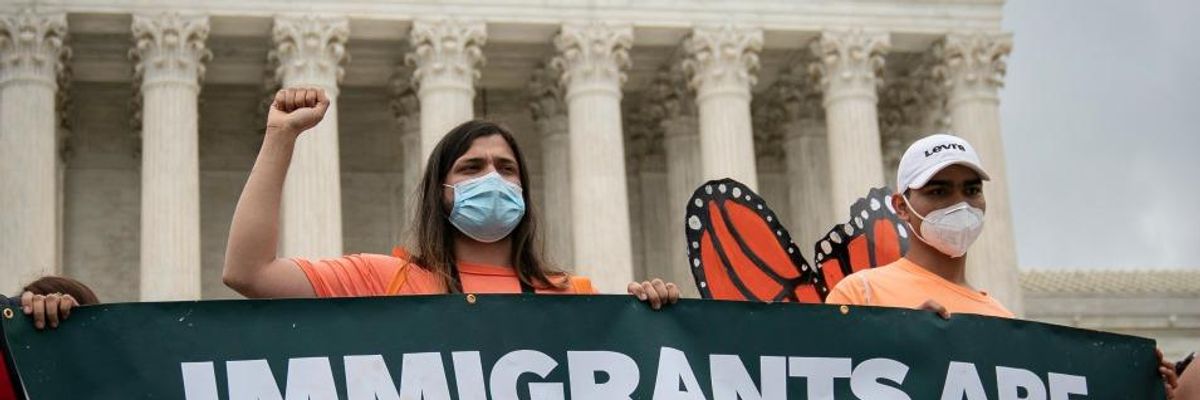
DACA recipients and their supporters rally outside the U.S. Supreme Court on June 18, 2020 in Washington, DC. On Thursday morning, the Supreme Court, in a 5-4 decision, denied the Trump administration's attempt to end DACA, the Deferred Action for Childhood Arrivals program. (Photo: Drew Angerer/Getty Images)
Immigrant rights advocates celebrated a major victory Thursday morning as the U.S. Supreme Court ruled the Trump administration cannot end the Deferred Action for Childhood Arrivals program, which has allowed nearly 800,000 young undocumented immigrants, known as Dreamers, to live and work in the United States.
Chief Justice John Roberts joined the court's four liberal-leaning justices in the 5-4 decision, ruling that the Trump administration had not given sufficient justification for ending the Obama-era DACA program, under which about 27,000 young immigrants have worked as frontline healthcare workers during the coronavirus pandemic.
"DACA was possible because immigrant youth imagined and demanded it. Today's ruling is another reminder that when people directly impacted are those pushing for solutions, that's when transformational change happens."
--Greisa Martinez Rosas, United We Dream
"Termination of DACA during this national health emergency would be catastrophic," immigration lawyers argued in court filings.
In the decision, Roberts wrote that the court had not decided "whether DACA or its rescission are sound policies," instead addressing "only whether the [Department of Homeland Security] complied with the procedural requirement that it provide a reasoned explanation for its action."
"Here the agency failed to consider the conspicuous issues of whether to retain forbearance and what if anything to do about the hardship to DACA recipients," Roberts wrote. "That dual failure raises doubts about whether the agency appreciated the scope of its discretion or exercised that discretion in a reasonable manner."
Justice Sonia Sotomayor, however, objected to Roberts' purely technical analysis of the case, directly addressing President Donald Trump's long record of racist statements and policies regarding immigration.
Trump's comparison of undocumented immigrants to "animals," for example, creates "the strong perception that the rescission decision was contaminated by impermissible discriminatory animus," Sotomayor wrote. "I would not so readily dismiss the allegation that an executive decision disproportionately harms the same racial group that the President branded as less desirable mere months earlier."
The immigrant youth-led network United We Dream called the ruling "a testament to our power as immigrant young people and allies have been fighting to protect DACA from relentless attacks from the Trump administration since he was elected."
"While this win will bring temporary relief to immigrant youth and our families who have been living in limbo since Trump ended DACA in 2017, our fight is not done," said Greisa Martinez Rosas, a DACA recipient and deputy executive director of the group. "We know that the police, and the deportation force of ICE and CBP were born of white supremacy and anti-Blackness and must be defunded. DACA was possible because immigrant youth imagined and demanded it. Today's ruling is another reminder that when people directly impacted are those pushing for solutions, that's when transformational change happens."
On social media, immigrant rights groups and lawmakers applauded the ruling.
Demand Justice noted that the DACA decision comes days after the Supreme Court ruled that LGBTQ Americans are protected from workplace discrimination under the Civil Rights Act of 1964. Both rulings, the advocacy group said, were the result of tireless campaigning by immigrants and LGBTQ people.
"The credit for saving DACA belongs to the Dreamers and allies who built a movement so powerful not even John Roberts could ignore it. Over the past week, the LGBTQ+ and immigrants rights communities have shown that activism matters and that the Supreme Court is not immune to public pressure," said executive director Brian Fallon. "John Roberts may have been the swing vote in this particular case, but he is no savior. He simply recognizes that the Court's standing with the public is in mortal danger if it races too quickly to impose a right-wing agenda that flouts both the rule of law and public opinion."
The Trump administration could feasibly make another attempt to dismantle the DACA program, threatening recipients--90% of whom work in the U.S. and many of whom have not been to their native countries in decades--with deportation. Trump, however, represents a minority of Americans who believe the program should be ended. A poll taken by Pew Research Center earlier this month showed that 74% of Americans believe Dreamers should have permanent legal status, including 54% of Republicans and Republican-leaning independent voters.
Following the ruling, advocates vowed to fight any further attacks on DACA.
"We celebrate this ruling but our fight goes on," tweeted Rep. Pramila Jayapal (D-Wash.), who immigrated to the U.S. from India at the age of 16. "The Senate should immediately pass the American Dream and Promise Act."
Dear Common Dreams reader, It’s been nearly 30 years since I co-founded Common Dreams with my late wife, Lina Newhouser. We had the radical notion that journalism should serve the public good, not corporate profits. It was clear to us from the outset what it would take to build such a project. No paid advertisements. No corporate sponsors. No millionaire publisher telling us what to think or do. Many people said we wouldn't last a year, but we proved those doubters wrong. Together with a tremendous team of journalists and dedicated staff, we built an independent media outlet free from the constraints of profits and corporate control. Our mission has always been simple: To inform. To inspire. To ignite change for the common good. Building Common Dreams was not easy. Our survival was never guaranteed. When you take on the most powerful forces—Wall Street greed, fossil fuel industry destruction, Big Tech lobbyists, and uber-rich oligarchs who have spent billions upon billions rigging the economy and democracy in their favor—the only bulwark you have is supporters who believe in your work. But here’s the urgent message from me today. It's never been this bad out there. And it's never been this hard to keep us going. At the very moment Common Dreams is most needed, the threats we face are intensifying. We need your support now more than ever. We don't accept corporate advertising and never will. We don't have a paywall because we don't think people should be blocked from critical news based on their ability to pay. Everything we do is funded by the donations of readers like you. When everyone does the little they can afford, we are strong. But if that support retreats or dries up, so do we. Will you donate now to make sure Common Dreams not only survives but thrives? —Craig Brown, Co-founder |
Immigrant rights advocates celebrated a major victory Thursday morning as the U.S. Supreme Court ruled the Trump administration cannot end the Deferred Action for Childhood Arrivals program, which has allowed nearly 800,000 young undocumented immigrants, known as Dreamers, to live and work in the United States.
Chief Justice John Roberts joined the court's four liberal-leaning justices in the 5-4 decision, ruling that the Trump administration had not given sufficient justification for ending the Obama-era DACA program, under which about 27,000 young immigrants have worked as frontline healthcare workers during the coronavirus pandemic.
"DACA was possible because immigrant youth imagined and demanded it. Today's ruling is another reminder that when people directly impacted are those pushing for solutions, that's when transformational change happens."
--Greisa Martinez Rosas, United We Dream
"Termination of DACA during this national health emergency would be catastrophic," immigration lawyers argued in court filings.
In the decision, Roberts wrote that the court had not decided "whether DACA or its rescission are sound policies," instead addressing "only whether the [Department of Homeland Security] complied with the procedural requirement that it provide a reasoned explanation for its action."
"Here the agency failed to consider the conspicuous issues of whether to retain forbearance and what if anything to do about the hardship to DACA recipients," Roberts wrote. "That dual failure raises doubts about whether the agency appreciated the scope of its discretion or exercised that discretion in a reasonable manner."
Justice Sonia Sotomayor, however, objected to Roberts' purely technical analysis of the case, directly addressing President Donald Trump's long record of racist statements and policies regarding immigration.
Trump's comparison of undocumented immigrants to "animals," for example, creates "the strong perception that the rescission decision was contaminated by impermissible discriminatory animus," Sotomayor wrote. "I would not so readily dismiss the allegation that an executive decision disproportionately harms the same racial group that the President branded as less desirable mere months earlier."
The immigrant youth-led network United We Dream called the ruling "a testament to our power as immigrant young people and allies have been fighting to protect DACA from relentless attacks from the Trump administration since he was elected."
"While this win will bring temporary relief to immigrant youth and our families who have been living in limbo since Trump ended DACA in 2017, our fight is not done," said Greisa Martinez Rosas, a DACA recipient and deputy executive director of the group. "We know that the police, and the deportation force of ICE and CBP were born of white supremacy and anti-Blackness and must be defunded. DACA was possible because immigrant youth imagined and demanded it. Today's ruling is another reminder that when people directly impacted are those pushing for solutions, that's when transformational change happens."
On social media, immigrant rights groups and lawmakers applauded the ruling.
Demand Justice noted that the DACA decision comes days after the Supreme Court ruled that LGBTQ Americans are protected from workplace discrimination under the Civil Rights Act of 1964. Both rulings, the advocacy group said, were the result of tireless campaigning by immigrants and LGBTQ people.
"The credit for saving DACA belongs to the Dreamers and allies who built a movement so powerful not even John Roberts could ignore it. Over the past week, the LGBTQ+ and immigrants rights communities have shown that activism matters and that the Supreme Court is not immune to public pressure," said executive director Brian Fallon. "John Roberts may have been the swing vote in this particular case, but he is no savior. He simply recognizes that the Court's standing with the public is in mortal danger if it races too quickly to impose a right-wing agenda that flouts both the rule of law and public opinion."
The Trump administration could feasibly make another attempt to dismantle the DACA program, threatening recipients--90% of whom work in the U.S. and many of whom have not been to their native countries in decades--with deportation. Trump, however, represents a minority of Americans who believe the program should be ended. A poll taken by Pew Research Center earlier this month showed that 74% of Americans believe Dreamers should have permanent legal status, including 54% of Republicans and Republican-leaning independent voters.
Following the ruling, advocates vowed to fight any further attacks on DACA.
"We celebrate this ruling but our fight goes on," tweeted Rep. Pramila Jayapal (D-Wash.), who immigrated to the U.S. from India at the age of 16. "The Senate should immediately pass the American Dream and Promise Act."
Immigrant rights advocates celebrated a major victory Thursday morning as the U.S. Supreme Court ruled the Trump administration cannot end the Deferred Action for Childhood Arrivals program, which has allowed nearly 800,000 young undocumented immigrants, known as Dreamers, to live and work in the United States.
Chief Justice John Roberts joined the court's four liberal-leaning justices in the 5-4 decision, ruling that the Trump administration had not given sufficient justification for ending the Obama-era DACA program, under which about 27,000 young immigrants have worked as frontline healthcare workers during the coronavirus pandemic.
"DACA was possible because immigrant youth imagined and demanded it. Today's ruling is another reminder that when people directly impacted are those pushing for solutions, that's when transformational change happens."
--Greisa Martinez Rosas, United We Dream
"Termination of DACA during this national health emergency would be catastrophic," immigration lawyers argued in court filings.
In the decision, Roberts wrote that the court had not decided "whether DACA or its rescission are sound policies," instead addressing "only whether the [Department of Homeland Security] complied with the procedural requirement that it provide a reasoned explanation for its action."
"Here the agency failed to consider the conspicuous issues of whether to retain forbearance and what if anything to do about the hardship to DACA recipients," Roberts wrote. "That dual failure raises doubts about whether the agency appreciated the scope of its discretion or exercised that discretion in a reasonable manner."
Justice Sonia Sotomayor, however, objected to Roberts' purely technical analysis of the case, directly addressing President Donald Trump's long record of racist statements and policies regarding immigration.
Trump's comparison of undocumented immigrants to "animals," for example, creates "the strong perception that the rescission decision was contaminated by impermissible discriminatory animus," Sotomayor wrote. "I would not so readily dismiss the allegation that an executive decision disproportionately harms the same racial group that the President branded as less desirable mere months earlier."
The immigrant youth-led network United We Dream called the ruling "a testament to our power as immigrant young people and allies have been fighting to protect DACA from relentless attacks from the Trump administration since he was elected."
"While this win will bring temporary relief to immigrant youth and our families who have been living in limbo since Trump ended DACA in 2017, our fight is not done," said Greisa Martinez Rosas, a DACA recipient and deputy executive director of the group. "We know that the police, and the deportation force of ICE and CBP were born of white supremacy and anti-Blackness and must be defunded. DACA was possible because immigrant youth imagined and demanded it. Today's ruling is another reminder that when people directly impacted are those pushing for solutions, that's when transformational change happens."
On social media, immigrant rights groups and lawmakers applauded the ruling.
Demand Justice noted that the DACA decision comes days after the Supreme Court ruled that LGBTQ Americans are protected from workplace discrimination under the Civil Rights Act of 1964. Both rulings, the advocacy group said, were the result of tireless campaigning by immigrants and LGBTQ people.
"The credit for saving DACA belongs to the Dreamers and allies who built a movement so powerful not even John Roberts could ignore it. Over the past week, the LGBTQ+ and immigrants rights communities have shown that activism matters and that the Supreme Court is not immune to public pressure," said executive director Brian Fallon. "John Roberts may have been the swing vote in this particular case, but he is no savior. He simply recognizes that the Court's standing with the public is in mortal danger if it races too quickly to impose a right-wing agenda that flouts both the rule of law and public opinion."
The Trump administration could feasibly make another attempt to dismantle the DACA program, threatening recipients--90% of whom work in the U.S. and many of whom have not been to their native countries in decades--with deportation. Trump, however, represents a minority of Americans who believe the program should be ended. A poll taken by Pew Research Center earlier this month showed that 74% of Americans believe Dreamers should have permanent legal status, including 54% of Republicans and Republican-leaning independent voters.
Following the ruling, advocates vowed to fight any further attacks on DACA.
"We celebrate this ruling but our fight goes on," tweeted Rep. Pramila Jayapal (D-Wash.), who immigrated to the U.S. from India at the age of 16. "The Senate should immediately pass the American Dream and Promise Act."