SUBSCRIBE TO OUR FREE NEWSLETTER
Daily news & progressive opinion—funded by the people, not the corporations—delivered straight to your inbox.
5
#000000
#FFFFFF
To donate by check, phone, or other method, see our More Ways to Give page.
Daily news & progressive opinion—funded by the people, not the corporations—delivered straight to your inbox.
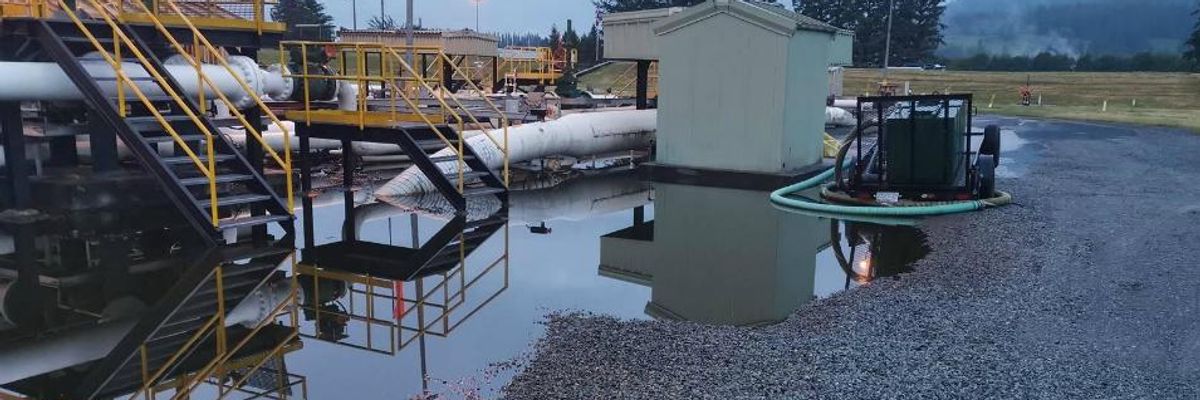
An estimated 50,000 gallons of crude oil leaked from the Trans Mountain pipeline at the Sumas Pump Station in Abbotsford, British Columbia on June 13, 2020 (Photo: Trans Mountain Corporation)
Indigenous leaders are demanding that the Canadian government immediately halt the ongoing expansion of the Trans Mountain pipeline after the leakage of an estimated 50,000 gallons of crude oil at a pump station in British Columbia on Saturday--a spill that once again confirmed warnings of the fossil fuel project's grave threat to the environment.
"The Trans Mountain pipeline has already spilled more than 80 times since it began operating. This is why we continue to fight the Trans Mountain Expansion in the courts."
--Chief Leah George-Wilson, Tsleil-Waututh Nation
Chief Dalton Silver of Sumas First Nation said in a statement (pdf) Sunday that "we cannot continue to have our land desecrated by oil spills."
"The proposed Trans Mountain expansion route would see an additional pipeline crossing one of our sacred sites, Lightning Rock, at two spots," said Silver. "We will do absolutely everything we can to prevent this from happening--an oil spill at Lighting Rock would be horrific for our people."
Leah George-Wilson, chief of Tsleil-Waututh Nation, said spills from the Trans Mountain pipeline--which the Canadian government purchased from Kinder Morgan in 2018 despite widespread opposition--are "inevitable, can't be fully cleaned up, and have devastating effects."
"This most recent spill is another reminder that the risk is too great to accept," said George-Wilson. "The Trans Mountain pipeline has already spilled more than 80 times since it began operating. This is why we continue to fight the Trans Mountain Expansion in the courts."
The oil spill was first detected in the early hours of Saturday morning. Trans Mountain Corporation, a subsidiary of the Canada Development Investment Corporation, claimed in a statement late Sunday that the spill at the Sumas Pump Station in Abbotsford, British Columbia has been fully contained and does not pose a threat to "the public or community."
The pipeline, which transports around 300,000 barrels of crude oil per day from Alberta to Vancouver, was restarted Sunday after it was shut off for just over 24 hours following the spill.
In a joint statement (pdf), the Union of British Columbia Indian Chiefs (UBCIC) said the June 13 spill "occurred just south of the Lightning Rock site--a cultural site and burial grounds of great significance to the Sema:th First Nation and Sto:lo Coast Salish Peoples."
Grand Chief Stewart Phillip, president of UBCIC, called on Canadian Prime Minister Justin Trudeau to stop "investing in old technology for a fossil fuel product that is toxic to our environment."
"The broken and aging Trans Mountain pipeline is a potent symbol of economic uncertainty at a time when Canadians are desperate for recovery from Covid-19," said Phillip. "This is a pivotal moment demanding strong leadership that understands the need for a drastic shift to clean energy development."
Dear Common Dreams reader, It’s been nearly 30 years since I co-founded Common Dreams with my late wife, Lina Newhouser. We had the radical notion that journalism should serve the public good, not corporate profits. It was clear to us from the outset what it would take to build such a project. No paid advertisements. No corporate sponsors. No millionaire publisher telling us what to think or do. Many people said we wouldn't last a year, but we proved those doubters wrong. Together with a tremendous team of journalists and dedicated staff, we built an independent media outlet free from the constraints of profits and corporate control. Our mission has always been simple: To inform. To inspire. To ignite change for the common good. Building Common Dreams was not easy. Our survival was never guaranteed. When you take on the most powerful forces—Wall Street greed, fossil fuel industry destruction, Big Tech lobbyists, and uber-rich oligarchs who have spent billions upon billions rigging the economy and democracy in their favor—the only bulwark you have is supporters who believe in your work. But here’s the urgent message from me today. It's never been this bad out there. And it's never been this hard to keep us going. At the very moment Common Dreams is most needed, the threats we face are intensifying. We need your support now more than ever. We don't accept corporate advertising and never will. We don't have a paywall because we don't think people should be blocked from critical news based on their ability to pay. Everything we do is funded by the donations of readers like you. When everyone does the little they can afford, we are strong. But if that support retreats or dries up, so do we. Will you donate now to make sure Common Dreams not only survives but thrives? —Craig Brown, Co-founder |
Indigenous leaders are demanding that the Canadian government immediately halt the ongoing expansion of the Trans Mountain pipeline after the leakage of an estimated 50,000 gallons of crude oil at a pump station in British Columbia on Saturday--a spill that once again confirmed warnings of the fossil fuel project's grave threat to the environment.
"The Trans Mountain pipeline has already spilled more than 80 times since it began operating. This is why we continue to fight the Trans Mountain Expansion in the courts."
--Chief Leah George-Wilson, Tsleil-Waututh Nation
Chief Dalton Silver of Sumas First Nation said in a statement (pdf) Sunday that "we cannot continue to have our land desecrated by oil spills."
"The proposed Trans Mountain expansion route would see an additional pipeline crossing one of our sacred sites, Lightning Rock, at two spots," said Silver. "We will do absolutely everything we can to prevent this from happening--an oil spill at Lighting Rock would be horrific for our people."
Leah George-Wilson, chief of Tsleil-Waututh Nation, said spills from the Trans Mountain pipeline--which the Canadian government purchased from Kinder Morgan in 2018 despite widespread opposition--are "inevitable, can't be fully cleaned up, and have devastating effects."
"This most recent spill is another reminder that the risk is too great to accept," said George-Wilson. "The Trans Mountain pipeline has already spilled more than 80 times since it began operating. This is why we continue to fight the Trans Mountain Expansion in the courts."
The oil spill was first detected in the early hours of Saturday morning. Trans Mountain Corporation, a subsidiary of the Canada Development Investment Corporation, claimed in a statement late Sunday that the spill at the Sumas Pump Station in Abbotsford, British Columbia has been fully contained and does not pose a threat to "the public or community."
The pipeline, which transports around 300,000 barrels of crude oil per day from Alberta to Vancouver, was restarted Sunday after it was shut off for just over 24 hours following the spill.
In a joint statement (pdf), the Union of British Columbia Indian Chiefs (UBCIC) said the June 13 spill "occurred just south of the Lightning Rock site--a cultural site and burial grounds of great significance to the Sema:th First Nation and Sto:lo Coast Salish Peoples."
Grand Chief Stewart Phillip, president of UBCIC, called on Canadian Prime Minister Justin Trudeau to stop "investing in old technology for a fossil fuel product that is toxic to our environment."
"The broken and aging Trans Mountain pipeline is a potent symbol of economic uncertainty at a time when Canadians are desperate for recovery from Covid-19," said Phillip. "This is a pivotal moment demanding strong leadership that understands the need for a drastic shift to clean energy development."
Indigenous leaders are demanding that the Canadian government immediately halt the ongoing expansion of the Trans Mountain pipeline after the leakage of an estimated 50,000 gallons of crude oil at a pump station in British Columbia on Saturday--a spill that once again confirmed warnings of the fossil fuel project's grave threat to the environment.
"The Trans Mountain pipeline has already spilled more than 80 times since it began operating. This is why we continue to fight the Trans Mountain Expansion in the courts."
--Chief Leah George-Wilson, Tsleil-Waututh Nation
Chief Dalton Silver of Sumas First Nation said in a statement (pdf) Sunday that "we cannot continue to have our land desecrated by oil spills."
"The proposed Trans Mountain expansion route would see an additional pipeline crossing one of our sacred sites, Lightning Rock, at two spots," said Silver. "We will do absolutely everything we can to prevent this from happening--an oil spill at Lighting Rock would be horrific for our people."
Leah George-Wilson, chief of Tsleil-Waututh Nation, said spills from the Trans Mountain pipeline--which the Canadian government purchased from Kinder Morgan in 2018 despite widespread opposition--are "inevitable, can't be fully cleaned up, and have devastating effects."
"This most recent spill is another reminder that the risk is too great to accept," said George-Wilson. "The Trans Mountain pipeline has already spilled more than 80 times since it began operating. This is why we continue to fight the Trans Mountain Expansion in the courts."
The oil spill was first detected in the early hours of Saturday morning. Trans Mountain Corporation, a subsidiary of the Canada Development Investment Corporation, claimed in a statement late Sunday that the spill at the Sumas Pump Station in Abbotsford, British Columbia has been fully contained and does not pose a threat to "the public or community."
The pipeline, which transports around 300,000 barrels of crude oil per day from Alberta to Vancouver, was restarted Sunday after it was shut off for just over 24 hours following the spill.
In a joint statement (pdf), the Union of British Columbia Indian Chiefs (UBCIC) said the June 13 spill "occurred just south of the Lightning Rock site--a cultural site and burial grounds of great significance to the Sema:th First Nation and Sto:lo Coast Salish Peoples."
Grand Chief Stewart Phillip, president of UBCIC, called on Canadian Prime Minister Justin Trudeau to stop "investing in old technology for a fossil fuel product that is toxic to our environment."
"The broken and aging Trans Mountain pipeline is a potent symbol of economic uncertainty at a time when Canadians are desperate for recovery from Covid-19," said Phillip. "This is a pivotal moment demanding strong leadership that understands the need for a drastic shift to clean energy development."