

SUBSCRIBE TO OUR FREE NEWSLETTER
Daily news & progressive opinion—funded by the people, not the corporations—delivered straight to your inbox.
5
#000000
#FFFFFF
To donate by check, phone, or other method, see our More Ways to Give page.
Daily news & progressive opinion—funded by the people, not the corporations—delivered straight to your inbox.
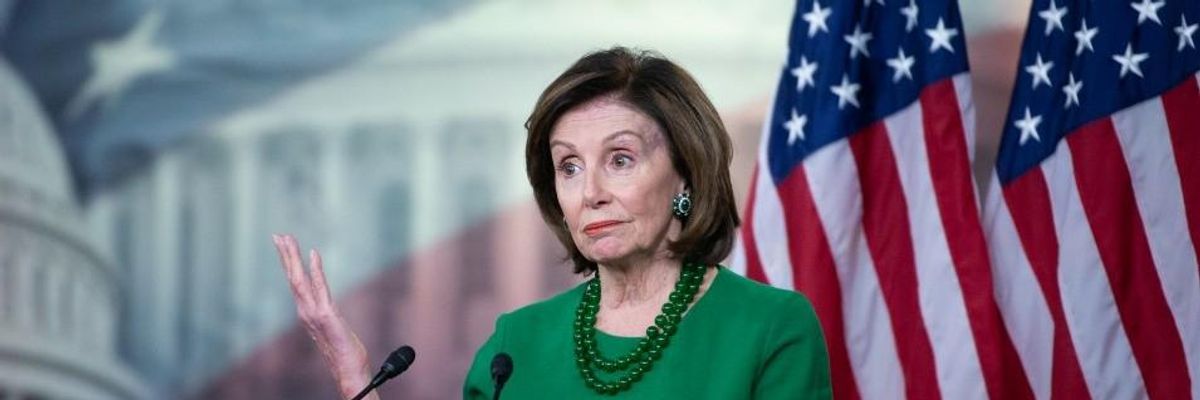
Speaker of the House Nancy Pelosi, (D-Calif.)., speaks during her weekly news conference in Washington on Thursday, March 12, 2020. (Photo: Caroline Brehman/CQ-Roll Call, Inc via Getty Images)
After the U.S. House voted Thursday to request a conference with the Senate for legislation to reauthorize controversial government surveillance powers, civil liberties advocates called out Speaker Nancy Pelosi and other Democratic Party leaders, warning that the move could further weaken a measure that already lacks crucial privacy protections.
"This outrageous move by Speaker Pelosi does nothing but endanger protections specifically designed to protect religious groups and the press."
--Sean Vitka, Demand Progress
"This outrageous move by Speaker Pelosi does nothing but endanger protections specifically designed to protect religious groups and the press," Demand Progress senior policy counsel Sean Vitka declared in response to the 284-122 vote.
"That's exactly what's at stake here, and it's all to prevent representatives from having any chance to strengthen the weak privacy protections in this bill," Vitka added.
The step toward a conference came after Democratic House leadership on Wednesday night postponed a vote on the Senate-approved USA FREEDOM Reauthorization Act of 2020 (H.R. 6172). The bill would reauthorize until December 2023 three Foreign Intelligence Surveillance Act (FISA) authorities that expired on March 15: Section 215 of the USA PATRIOT Act of 2001 as well as the "lone wolf and "roving wiretap" powers.
Privacy advocates had praised the Senate for approving an amendment from Sens. Mike Lee (R-Utah) and Patrick Leahy (D-Vt.) to increase protections for political or religious groups and journalists, but condemned the chamber for failing to pass an amendment from Sens. Steve Daines (R-Mt.) and Ron Wyden (D-Ore.) prohibiting the use of Section 215 for warrantless surveillance of internet search and browsing history.
Faced with pressure from advocates and progressive policymakers to reconsider the Daines-Wyden amendment, Reps. Zoe Lofgren (D-Calif.) and Adam Schiff (D-Calif.), chairman of the House Intelligence Committee, worked out watered-down compromise. The narrower proposal was intially celebrated, but once it was fully understood, it was widely condemned, including by Wyden. That led to a revolt among progressives, which--along with GOP opposition--forced Pelosi to postpone the vote.
The delay was welcomed as "a winning moment for civil-liberties advocates across the political spectrum" by Free Press Action government relations director Sandra Fulton. However, she noted, "this is just a temporary reprieve"--and it didn't last long.
As Vitka put it Thursday: "Speaker Pelosi and Chairman Schiff have done everything in their power to ensure the House cannot vote on the warrantless surveillance of Americans' internet activity, and worse, to ensure Congress doesn't know what it's reauthorizing."
In a series of tweets Thursday, Evan Greer, deputy director of Fight for the Future, detailed the recent moves by Schiff and Pelosi, and accused the speaker of "trying to do an end-run around her own party" with the conference request.
Greer also raised alarm about the uncertain future of the Lee-Leahy amendment. Privacy advocates had celebrated after the Senate passed that measure 77-19.
"Speaker Pelosi has a tremendous amount of power," added Greer. "She should be using it to protect the people the Trump administration is targeting, not hand the Trump administration more power to target them."
As The Hill reported Thursday:
The Senate will also have to vote to formally launch a conference committee. Senate Majority Leader Mitch McConnell (R-Ky.) and House Minority Leader Kevin McCarthy (R-Calif.) talked on Thursday morning about the plan to go to conference to work out the differences.
"The Leaders spoke this morning. Going to a conference committee is regular order when the two chambers disagree," a spokesman for McConnell told The Hill.
If the conference moves forward, Lofgren and Schiff will help lead negotiations for the House, according to The Hill. They will be joined by Rep. Devin Nunes (R-Calif.), ranking member of the House Intelligence Committee, and Reps. Jerrold Nadler (D-N.Y.) and Jim Jordan (R-Ohio), the leaders of the Judiciary Committee.
Dear Common Dreams reader, It’s been nearly 30 years since I co-founded Common Dreams with my late wife, Lina Newhouser. We had the radical notion that journalism should serve the public good, not corporate profits. It was clear to us from the outset what it would take to build such a project. No paid advertisements. No corporate sponsors. No millionaire publisher telling us what to think or do. Many people said we wouldn't last a year, but we proved those doubters wrong. Together with a tremendous team of journalists and dedicated staff, we built an independent media outlet free from the constraints of profits and corporate control. Our mission has always been simple: To inform. To inspire. To ignite change for the common good. Building Common Dreams was not easy. Our survival was never guaranteed. When you take on the most powerful forces—Wall Street greed, fossil fuel industry destruction, Big Tech lobbyists, and uber-rich oligarchs who have spent billions upon billions rigging the economy and democracy in their favor—the only bulwark you have is supporters who believe in your work. But here’s the urgent message from me today. It's never been this bad out there. And it's never been this hard to keep us going. At the very moment Common Dreams is most needed, the threats we face are intensifying. We need your support now more than ever. We don't accept corporate advertising and never will. We don't have a paywall because we don't think people should be blocked from critical news based on their ability to pay. Everything we do is funded by the donations of readers like you. When everyone does the little they can afford, we are strong. But if that support retreats or dries up, so do we. Will you donate now to make sure Common Dreams not only survives but thrives? —Craig Brown, Co-founder |
After the U.S. House voted Thursday to request a conference with the Senate for legislation to reauthorize controversial government surveillance powers, civil liberties advocates called out Speaker Nancy Pelosi and other Democratic Party leaders, warning that the move could further weaken a measure that already lacks crucial privacy protections.
"This outrageous move by Speaker Pelosi does nothing but endanger protections specifically designed to protect religious groups and the press."
--Sean Vitka, Demand Progress
"This outrageous move by Speaker Pelosi does nothing but endanger protections specifically designed to protect religious groups and the press," Demand Progress senior policy counsel Sean Vitka declared in response to the 284-122 vote.
"That's exactly what's at stake here, and it's all to prevent representatives from having any chance to strengthen the weak privacy protections in this bill," Vitka added.
The step toward a conference came after Democratic House leadership on Wednesday night postponed a vote on the Senate-approved USA FREEDOM Reauthorization Act of 2020 (H.R. 6172). The bill would reauthorize until December 2023 three Foreign Intelligence Surveillance Act (FISA) authorities that expired on March 15: Section 215 of the USA PATRIOT Act of 2001 as well as the "lone wolf and "roving wiretap" powers.
Privacy advocates had praised the Senate for approving an amendment from Sens. Mike Lee (R-Utah) and Patrick Leahy (D-Vt.) to increase protections for political or religious groups and journalists, but condemned the chamber for failing to pass an amendment from Sens. Steve Daines (R-Mt.) and Ron Wyden (D-Ore.) prohibiting the use of Section 215 for warrantless surveillance of internet search and browsing history.
Faced with pressure from advocates and progressive policymakers to reconsider the Daines-Wyden amendment, Reps. Zoe Lofgren (D-Calif.) and Adam Schiff (D-Calif.), chairman of the House Intelligence Committee, worked out watered-down compromise. The narrower proposal was intially celebrated, but once it was fully understood, it was widely condemned, including by Wyden. That led to a revolt among progressives, which--along with GOP opposition--forced Pelosi to postpone the vote.
The delay was welcomed as "a winning moment for civil-liberties advocates across the political spectrum" by Free Press Action government relations director Sandra Fulton. However, she noted, "this is just a temporary reprieve"--and it didn't last long.
As Vitka put it Thursday: "Speaker Pelosi and Chairman Schiff have done everything in their power to ensure the House cannot vote on the warrantless surveillance of Americans' internet activity, and worse, to ensure Congress doesn't know what it's reauthorizing."
In a series of tweets Thursday, Evan Greer, deputy director of Fight for the Future, detailed the recent moves by Schiff and Pelosi, and accused the speaker of "trying to do an end-run around her own party" with the conference request.
Greer also raised alarm about the uncertain future of the Lee-Leahy amendment. Privacy advocates had celebrated after the Senate passed that measure 77-19.
"Speaker Pelosi has a tremendous amount of power," added Greer. "She should be using it to protect the people the Trump administration is targeting, not hand the Trump administration more power to target them."
As The Hill reported Thursday:
The Senate will also have to vote to formally launch a conference committee. Senate Majority Leader Mitch McConnell (R-Ky.) and House Minority Leader Kevin McCarthy (R-Calif.) talked on Thursday morning about the plan to go to conference to work out the differences.
"The Leaders spoke this morning. Going to a conference committee is regular order when the two chambers disagree," a spokesman for McConnell told The Hill.
If the conference moves forward, Lofgren and Schiff will help lead negotiations for the House, according to The Hill. They will be joined by Rep. Devin Nunes (R-Calif.), ranking member of the House Intelligence Committee, and Reps. Jerrold Nadler (D-N.Y.) and Jim Jordan (R-Ohio), the leaders of the Judiciary Committee.
After the U.S. House voted Thursday to request a conference with the Senate for legislation to reauthorize controversial government surveillance powers, civil liberties advocates called out Speaker Nancy Pelosi and other Democratic Party leaders, warning that the move could further weaken a measure that already lacks crucial privacy protections.
"This outrageous move by Speaker Pelosi does nothing but endanger protections specifically designed to protect religious groups and the press."
--Sean Vitka, Demand Progress
"This outrageous move by Speaker Pelosi does nothing but endanger protections specifically designed to protect religious groups and the press," Demand Progress senior policy counsel Sean Vitka declared in response to the 284-122 vote.
"That's exactly what's at stake here, and it's all to prevent representatives from having any chance to strengthen the weak privacy protections in this bill," Vitka added.
The step toward a conference came after Democratic House leadership on Wednesday night postponed a vote on the Senate-approved USA FREEDOM Reauthorization Act of 2020 (H.R. 6172). The bill would reauthorize until December 2023 three Foreign Intelligence Surveillance Act (FISA) authorities that expired on March 15: Section 215 of the USA PATRIOT Act of 2001 as well as the "lone wolf and "roving wiretap" powers.
Privacy advocates had praised the Senate for approving an amendment from Sens. Mike Lee (R-Utah) and Patrick Leahy (D-Vt.) to increase protections for political or religious groups and journalists, but condemned the chamber for failing to pass an amendment from Sens. Steve Daines (R-Mt.) and Ron Wyden (D-Ore.) prohibiting the use of Section 215 for warrantless surveillance of internet search and browsing history.
Faced with pressure from advocates and progressive policymakers to reconsider the Daines-Wyden amendment, Reps. Zoe Lofgren (D-Calif.) and Adam Schiff (D-Calif.), chairman of the House Intelligence Committee, worked out watered-down compromise. The narrower proposal was intially celebrated, but once it was fully understood, it was widely condemned, including by Wyden. That led to a revolt among progressives, which--along with GOP opposition--forced Pelosi to postpone the vote.
The delay was welcomed as "a winning moment for civil-liberties advocates across the political spectrum" by Free Press Action government relations director Sandra Fulton. However, she noted, "this is just a temporary reprieve"--and it didn't last long.
As Vitka put it Thursday: "Speaker Pelosi and Chairman Schiff have done everything in their power to ensure the House cannot vote on the warrantless surveillance of Americans' internet activity, and worse, to ensure Congress doesn't know what it's reauthorizing."
In a series of tweets Thursday, Evan Greer, deputy director of Fight for the Future, detailed the recent moves by Schiff and Pelosi, and accused the speaker of "trying to do an end-run around her own party" with the conference request.
Greer also raised alarm about the uncertain future of the Lee-Leahy amendment. Privacy advocates had celebrated after the Senate passed that measure 77-19.
"Speaker Pelosi has a tremendous amount of power," added Greer. "She should be using it to protect the people the Trump administration is targeting, not hand the Trump administration more power to target them."
As The Hill reported Thursday:
The Senate will also have to vote to formally launch a conference committee. Senate Majority Leader Mitch McConnell (R-Ky.) and House Minority Leader Kevin McCarthy (R-Calif.) talked on Thursday morning about the plan to go to conference to work out the differences.
"The Leaders spoke this morning. Going to a conference committee is regular order when the two chambers disagree," a spokesman for McConnell told The Hill.
If the conference moves forward, Lofgren and Schiff will help lead negotiations for the House, according to The Hill. They will be joined by Rep. Devin Nunes (R-Calif.), ranking member of the House Intelligence Committee, and Reps. Jerrold Nadler (D-N.Y.) and Jim Jordan (R-Ohio), the leaders of the Judiciary Committee.

