
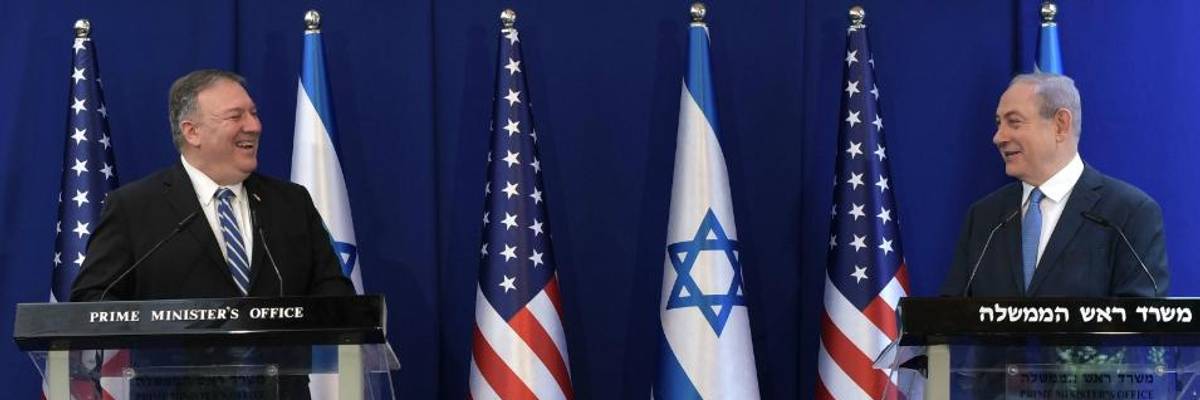
U.S. Secretary of State Mike Pompeo (L) holds a joint press conference with Israeli Prime Minister Benjamin Netanyahu (R) after traveling abroad for the first time amid the novel coronavirus pandemic in West Jerusalem on May 13, 2020. (Photo: Kobi Gideon/GPO/Handout/Anadolu Agency via Getty Images)
Amid Pandemic, Pompeo Heads to Israel to 'Provoke War With Iran,' Ensure West Bank Annexation
Rights groups accuse the Trump administration of giving "Israeli authorities the greenlight to continue violating international laws."
U.S. Secretary of State Mike Pompeo was roundly criticized by international human rights groups on Wednesday for his priorities and remarks during a brief trip to Israel in the midst of the ongoing coronavirus pandemic to meet with the country's Prime Minister Benjamin Netanyahu and Benny Gantz, a former rival with whom Netanyahu is forming a unity government.
Pompeo disembarked his plane in Israel donning a red, white, and blue mask. He shared photos of his arrival on Twitter and wrote that he was meeting with the Israeli leaders to coordinate "on countering two critical threats: Covid-19 and Iran. Israel and the United States will take on these challenges side-by-side."
The anti-war group CodePink responded by pointing out that while people around the world are suffering, "rather than working with foreign leaders to negotiate ceasefires, end sanctions, or provide Covid-19 aid, Pompeo is attempting to provoke war with Iran and ensure the annexation of the West Bank."
Despite weeks of demands for a global ceasefire during the pandemic from diplomats and political leaders worldwide--including United Nations Secretary-General Antonio Guterres--the international community has failed to halt armed conflicts.
That "catastrophic failure," as Oxfam International detailed in a report Tuesday, has included the United States blocking a U.N. Security Council resolution calling for a global ceasefire. The group's interim executive director noted that multiple members of the U.N. body also "remain active participants in conflicts around the world, conducting military operations, selling arms, and supporting third parties."
In addition to facing pressure to support a halt to violence, the Trump administration has been urged by global leaders and advocacy groups to ease economic sanctions on Iran, which has been hit hard by the pandemic. Instead, Pompeo in mid-March announced a fresh wave of sanctions targeting the Mideast country.
CodePink co-founder Medea Benjamin tweeted in response to that move, "It's unconscionable that at a time when the world is clamoring for the U.S. to LIFT its brutal sanctions on Iran during this pandemic, the tone-deaf and ruthless Trump administration turns up the screws."
U.S. State Department spokesperson Morgan Ortagus said in a statement Wednesday that Pompeo and Netanyahu "discussed our nations' ongoing efforts to mitigate the Covid-19 pandemic and counter Iran's destabilizing influence in the region, as well as the steadfast U.S. commitment to Israel's security." Ortagus issued a similar statement about his meeting with Gantz, who is set to be sworn in as defense minister on Thursday.
According to the New York Times:
In brief remarks alongside Prime Minister Benjamin Netanyahu, Mr. Pompeo, no longer wearing his mask, revealed that China, a rare sore spot between the United States and Israel, was also very much on the agenda.
"You're a great partner," Mr. Pompeo said to Mr. Netanyahu. "You share information, unlike some other countries that try and obfuscate and hide information. We'll talk about that country, too."
Pompeo's visit was part of "an attempt to gauge the new government's commitment to a U.S.-backed plan to annex large parts of the Palestinian territories," the Guardian reported. The Trump administration's broader proposal for the region--which Pompeo acknowledged in public remarks in Jerusalem ahead of his meeting with the Israeli prime minister--gives a greenlight to annexation.
With Netanyahu at his side, President Donald Trump unveiled his so-called "Vision for Peace" in January. Critics have condemned the administration's official proposal to the decades-long Israel-Palestine conflict as an "annexation plan" and a "war plan."
Palestinian political leaders were not involved in crafting the U.S.-Israel plan and have cut ties with the Trump administration. Their chief negotiator Saeb Erekat told Al Jazeera that Pompeo's team had not reached out ahead of the visit.
"The Trump administration is collaborating with Israel in its annexation plan in what is both an attempt at burying the rights of the Palestinian people as well as a blatant attack on a rules-based international system," Erekat said.
Noting Pompeo's trip, Amnesty International denounced Israel's plans to annex parts of the West Bank in a series of tweets Wednesday:
The Guardian reported that Israel could encounter barriers to its plans in the form of sanctions imposed by members of the European Union:
The visit took place as potential obstacles grow, with reports that E.U. countries including France, Ireland, and Belgium are considering threatening punitive economic measures if Israel breaks international law by unilaterally claiming sovereignty over land it occupies.
E.U. foreign ministers are meeting on Friday and Josep Borrell, the E.U. foreign policy chief, said annexation would be the "most important" issue on the agenda. He added, however, that unanimity was needed to impose sanctions and the subject was divisive among member states .
Borrell said late last month that any "annexation would constitute a serious violation of international law. The European Union will continue to closely monitor the situation and its broader implications, and will act accordingly."
We are at a crossroads
This country and this world are at a monumental crossroads. In a few short weeks, US voters will have an opportunity to beat back the forces of fascism and confront the billionaires who are rigging the economy, our media system, and our democracy, making it increasingly impossible for ordinary people to get by. We’re not just talking about the election. We’re talking about what must be done once these fascist elements are vanquished from power. We need a bolder set of solutions than what either major party has so far been willing to offer and a working-class movement ready to fight like hell for it. Trump didn't emerge from nowhere. The conditions that fueled MAGA authoritarianism were created by decades of radical neoliberal economic policies and a corrupt political system dominated by corporate interests. They slashed taxes on the super-rich, promising that the benefits would trickle down. They said giveaways to the corporate titans would make life more affordable for the rest of us. It was all bullshit. And when a bitter, betrayed populace searches for someone to blame, right-wing demagogues have little trouble finding scapegoats. People know when they're being lied to, but you won't hear any of this from the corporate media. Only independent journalism—powered and funded by people who believe in building a better world—can deliver truly trustworthy daily news. Our Fall Campaign is underway, and we need your help. To power our newsroom through the rest of the year, we need to raise $125,000 by midnight on October 31. So if you share our vision, please contribute whatever you can to sustain our work. |
U.S. Secretary of State Mike Pompeo was roundly criticized by international human rights groups on Wednesday for his priorities and remarks during a brief trip to Israel in the midst of the ongoing coronavirus pandemic to meet with the country's Prime Minister Benjamin Netanyahu and Benny Gantz, a former rival with whom Netanyahu is forming a unity government.
Pompeo disembarked his plane in Israel donning a red, white, and blue mask. He shared photos of his arrival on Twitter and wrote that he was meeting with the Israeli leaders to coordinate "on countering two critical threats: Covid-19 and Iran. Israel and the United States will take on these challenges side-by-side."
The anti-war group CodePink responded by pointing out that while people around the world are suffering, "rather than working with foreign leaders to negotiate ceasefires, end sanctions, or provide Covid-19 aid, Pompeo is attempting to provoke war with Iran and ensure the annexation of the West Bank."
Despite weeks of demands for a global ceasefire during the pandemic from diplomats and political leaders worldwide--including United Nations Secretary-General Antonio Guterres--the international community has failed to halt armed conflicts.
That "catastrophic failure," as Oxfam International detailed in a report Tuesday, has included the United States blocking a U.N. Security Council resolution calling for a global ceasefire. The group's interim executive director noted that multiple members of the U.N. body also "remain active participants in conflicts around the world, conducting military operations, selling arms, and supporting third parties."
In addition to facing pressure to support a halt to violence, the Trump administration has been urged by global leaders and advocacy groups to ease economic sanctions on Iran, which has been hit hard by the pandemic. Instead, Pompeo in mid-March announced a fresh wave of sanctions targeting the Mideast country.
CodePink co-founder Medea Benjamin tweeted in response to that move, "It's unconscionable that at a time when the world is clamoring for the U.S. to LIFT its brutal sanctions on Iran during this pandemic, the tone-deaf and ruthless Trump administration turns up the screws."
U.S. State Department spokesperson Morgan Ortagus said in a statement Wednesday that Pompeo and Netanyahu "discussed our nations' ongoing efforts to mitigate the Covid-19 pandemic and counter Iran's destabilizing influence in the region, as well as the steadfast U.S. commitment to Israel's security." Ortagus issued a similar statement about his meeting with Gantz, who is set to be sworn in as defense minister on Thursday.
According to the New York Times:
In brief remarks alongside Prime Minister Benjamin Netanyahu, Mr. Pompeo, no longer wearing his mask, revealed that China, a rare sore spot between the United States and Israel, was also very much on the agenda.
"You're a great partner," Mr. Pompeo said to Mr. Netanyahu. "You share information, unlike some other countries that try and obfuscate and hide information. We'll talk about that country, too."
Pompeo's visit was part of "an attempt to gauge the new government's commitment to a U.S.-backed plan to annex large parts of the Palestinian territories," the Guardian reported. The Trump administration's broader proposal for the region--which Pompeo acknowledged in public remarks in Jerusalem ahead of his meeting with the Israeli prime minister--gives a greenlight to annexation.
With Netanyahu at his side, President Donald Trump unveiled his so-called "Vision for Peace" in January. Critics have condemned the administration's official proposal to the decades-long Israel-Palestine conflict as an "annexation plan" and a "war plan."
Palestinian political leaders were not involved in crafting the U.S.-Israel plan and have cut ties with the Trump administration. Their chief negotiator Saeb Erekat told Al Jazeera that Pompeo's team had not reached out ahead of the visit.
"The Trump administration is collaborating with Israel in its annexation plan in what is both an attempt at burying the rights of the Palestinian people as well as a blatant attack on a rules-based international system," Erekat said.
Noting Pompeo's trip, Amnesty International denounced Israel's plans to annex parts of the West Bank in a series of tweets Wednesday:
The Guardian reported that Israel could encounter barriers to its plans in the form of sanctions imposed by members of the European Union:
The visit took place as potential obstacles grow, with reports that E.U. countries including France, Ireland, and Belgium are considering threatening punitive economic measures if Israel breaks international law by unilaterally claiming sovereignty over land it occupies.
E.U. foreign ministers are meeting on Friday and Josep Borrell, the E.U. foreign policy chief, said annexation would be the "most important" issue on the agenda. He added, however, that unanimity was needed to impose sanctions and the subject was divisive among member states .
Borrell said late last month that any "annexation would constitute a serious violation of international law. The European Union will continue to closely monitor the situation and its broader implications, and will act accordingly."
U.S. Secretary of State Mike Pompeo was roundly criticized by international human rights groups on Wednesday for his priorities and remarks during a brief trip to Israel in the midst of the ongoing coronavirus pandemic to meet with the country's Prime Minister Benjamin Netanyahu and Benny Gantz, a former rival with whom Netanyahu is forming a unity government.
Pompeo disembarked his plane in Israel donning a red, white, and blue mask. He shared photos of his arrival on Twitter and wrote that he was meeting with the Israeli leaders to coordinate "on countering two critical threats: Covid-19 and Iran. Israel and the United States will take on these challenges side-by-side."
The anti-war group CodePink responded by pointing out that while people around the world are suffering, "rather than working with foreign leaders to negotiate ceasefires, end sanctions, or provide Covid-19 aid, Pompeo is attempting to provoke war with Iran and ensure the annexation of the West Bank."
Despite weeks of demands for a global ceasefire during the pandemic from diplomats and political leaders worldwide--including United Nations Secretary-General Antonio Guterres--the international community has failed to halt armed conflicts.
That "catastrophic failure," as Oxfam International detailed in a report Tuesday, has included the United States blocking a U.N. Security Council resolution calling for a global ceasefire. The group's interim executive director noted that multiple members of the U.N. body also "remain active participants in conflicts around the world, conducting military operations, selling arms, and supporting third parties."
In addition to facing pressure to support a halt to violence, the Trump administration has been urged by global leaders and advocacy groups to ease economic sanctions on Iran, which has been hit hard by the pandemic. Instead, Pompeo in mid-March announced a fresh wave of sanctions targeting the Mideast country.
CodePink co-founder Medea Benjamin tweeted in response to that move, "It's unconscionable that at a time when the world is clamoring for the U.S. to LIFT its brutal sanctions on Iran during this pandemic, the tone-deaf and ruthless Trump administration turns up the screws."
U.S. State Department spokesperson Morgan Ortagus said in a statement Wednesday that Pompeo and Netanyahu "discussed our nations' ongoing efforts to mitigate the Covid-19 pandemic and counter Iran's destabilizing influence in the region, as well as the steadfast U.S. commitment to Israel's security." Ortagus issued a similar statement about his meeting with Gantz, who is set to be sworn in as defense minister on Thursday.
According to the New York Times:
In brief remarks alongside Prime Minister Benjamin Netanyahu, Mr. Pompeo, no longer wearing his mask, revealed that China, a rare sore spot between the United States and Israel, was also very much on the agenda.
"You're a great partner," Mr. Pompeo said to Mr. Netanyahu. "You share information, unlike some other countries that try and obfuscate and hide information. We'll talk about that country, too."
Pompeo's visit was part of "an attempt to gauge the new government's commitment to a U.S.-backed plan to annex large parts of the Palestinian territories," the Guardian reported. The Trump administration's broader proposal for the region--which Pompeo acknowledged in public remarks in Jerusalem ahead of his meeting with the Israeli prime minister--gives a greenlight to annexation.
With Netanyahu at his side, President Donald Trump unveiled his so-called "Vision for Peace" in January. Critics have condemned the administration's official proposal to the decades-long Israel-Palestine conflict as an "annexation plan" and a "war plan."
Palestinian political leaders were not involved in crafting the U.S.-Israel plan and have cut ties with the Trump administration. Their chief negotiator Saeb Erekat told Al Jazeera that Pompeo's team had not reached out ahead of the visit.
"The Trump administration is collaborating with Israel in its annexation plan in what is both an attempt at burying the rights of the Palestinian people as well as a blatant attack on a rules-based international system," Erekat said.
Noting Pompeo's trip, Amnesty International denounced Israel's plans to annex parts of the West Bank in a series of tweets Wednesday:
The Guardian reported that Israel could encounter barriers to its plans in the form of sanctions imposed by members of the European Union:
The visit took place as potential obstacles grow, with reports that E.U. countries including France, Ireland, and Belgium are considering threatening punitive economic measures if Israel breaks international law by unilaterally claiming sovereignty over land it occupies.
E.U. foreign ministers are meeting on Friday and Josep Borrell, the E.U. foreign policy chief, said annexation would be the "most important" issue on the agenda. He added, however, that unanimity was needed to impose sanctions and the subject was divisive among member states .
Borrell said late last month that any "annexation would constitute a serious violation of international law. The European Union will continue to closely monitor the situation and its broader implications, and will act accordingly."