SUBSCRIBE TO OUR FREE NEWSLETTER
Daily news & progressive opinion—funded by the people, not the corporations—delivered straight to your inbox.
5
#000000
#FFFFFF
To donate by check, phone, or other method, see our More Ways to Give page.
Daily news & progressive opinion—funded by the people, not the corporations—delivered straight to your inbox.
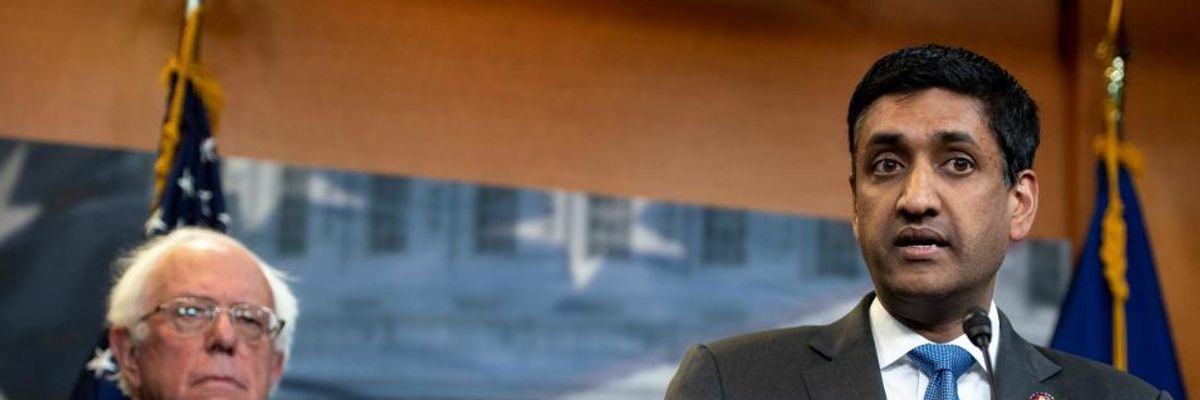
U.S. Rep. Ro Khanna (D-Calif.) and Sen. Bernie Sanders (I-Vt.) introduced legislation Monday to fund the purchase and manufacturing of medical equipment, as healthcare providers continue to report shortages while they fight the Covid-19 pandemic. (Photo: Saul Loeb/AFP via Getty Images)
Sen. Bernie Sanders and Rep. Ro Khanna on Monday introduced legislation to ensure healthcare providers have enough medical equipment and Covid-19 tests, demanding that the federal government dramatically step up its response to the coronavirus pandemic rather than focusing on getting people back to work as soon as possible.
The Emergency Medical Supplies Procurement Act would dedicate $75 billion to the effort, allowing the government to purchase or manufacture supplies including N-95 respirators, surgical gowns, ventilators, testing kits, and other badly-needed medical equipment as well as vaccines and treatments for Covid-19.
The progressive lawmakers introduced the legislation three days after President Donald Trump moved to fire Health and Human Services deputy inspector general Christi Grimm over her report last month about supply shortages at hundreds of medical centers across the country.
"The United States is the richest country in the world. There is no excuse for our medical professionals and essential workers not to have the masks, gloves, gowns and tests they need to keep safe, treat their patients and stop the spread of this deadly pandemic," said Sanders.
According to Sanders and Khanna, the U.S. currently is testing between 100,000 and 200,000 people per day for the coronavirus--while public health experts recommend testing 500,000 to one million people per day before the country considers ending social distancing orders which have forced millions to stay mainly at home for more than a month.
Despite warnings from public health officials, more than half of U.S. states partially reopened their economies in recent days--even as the country saw its highest single-day death toll from Covid-19.
In order to produce the number of tests needed to track the outbreak and the equipment needed to protect healthcare providers and save patients' lives, Khanna and Sanders said, the federal government must be compelled to invoke the Defense Production Act specifically for that purpose.
"Congress must explicitly authorize that the Defense Production Act (DPA) is fully utilized to demand that the private sector manufacture the equipment and products that our medical personnel, patients, and frontline workers desperately need," said Sanders.
The U.S. Congress authorized $1 billion for the production of protective equipment and other hospital necessities--a figure which "pales in comparison to the amount of supplies needed to protect frontline healthcare workers and increase testing capacity," said Khanna and Sanders in a statement.
"It's been three months, but somehow the Trump administration continues to drag its feet in ramping up the production of critical testing and protective equipment that our health care providers are begging for," said Khanna. "Testing is the key to safely restarting our economy and this bill provides the federal government with the resources and directives that will get us where we need to be."
Trump has invoked the DPA only to direct specific companies to manufacture PPE and ventilators, and last week he used the law to compel meat processing plants to stay open during the pandemic, putting thousands of workers at risk in workplaces where social distancing is difficult if not impossible.
Under the Emergency Medical Supplies Procurement Act, the administration would be required to respond promptly requests from states in need of healthcare supplies. With states relying on the Strategic National Stockpile for equipment--and then going directly to manufacturers as that supply dwindled--state governments have been forced into a bidding war over desperately-needed products.
"States and cities should not be forced to bid against each other for scarce and overpriced medical equipment," said Sanders.
The legislation would also include strict oversight and accountability provisions to avoid the misuse of the funding, after other federal programs responding to the pandemic, including the Paycheck Protection Program, were beset with the misappropriation of funds.
"We're also including safeguards to ensure no member of the Trump family or administration gets a dime of recovery funding," tweeted Khanna, two weeks after the president's business, the Trump Organization, sought rent relief due to the pandemic.
Dear Common Dreams reader, It’s been nearly 30 years since I co-founded Common Dreams with my late wife, Lina Newhouser. We had the radical notion that journalism should serve the public good, not corporate profits. It was clear to us from the outset what it would take to build such a project. No paid advertisements. No corporate sponsors. No millionaire publisher telling us what to think or do. Many people said we wouldn't last a year, but we proved those doubters wrong. Together with a tremendous team of journalists and dedicated staff, we built an independent media outlet free from the constraints of profits and corporate control. Our mission has always been simple: To inform. To inspire. To ignite change for the common good. Building Common Dreams was not easy. Our survival was never guaranteed. When you take on the most powerful forces—Wall Street greed, fossil fuel industry destruction, Big Tech lobbyists, and uber-rich oligarchs who have spent billions upon billions rigging the economy and democracy in their favor—the only bulwark you have is supporters who believe in your work. But here’s the urgent message from me today. It's never been this bad out there. And it's never been this hard to keep us going. At the very moment Common Dreams is most needed, the threats we face are intensifying. We need your support now more than ever. We don't accept corporate advertising and never will. We don't have a paywall because we don't think people should be blocked from critical news based on their ability to pay. Everything we do is funded by the donations of readers like you. When everyone does the little they can afford, we are strong. But if that support retreats or dries up, so do we. Will you donate now to make sure Common Dreams not only survives but thrives? —Craig Brown, Co-founder |
Sen. Bernie Sanders and Rep. Ro Khanna on Monday introduced legislation to ensure healthcare providers have enough medical equipment and Covid-19 tests, demanding that the federal government dramatically step up its response to the coronavirus pandemic rather than focusing on getting people back to work as soon as possible.
The Emergency Medical Supplies Procurement Act would dedicate $75 billion to the effort, allowing the government to purchase or manufacture supplies including N-95 respirators, surgical gowns, ventilators, testing kits, and other badly-needed medical equipment as well as vaccines and treatments for Covid-19.
The progressive lawmakers introduced the legislation three days after President Donald Trump moved to fire Health and Human Services deputy inspector general Christi Grimm over her report last month about supply shortages at hundreds of medical centers across the country.
"The United States is the richest country in the world. There is no excuse for our medical professionals and essential workers not to have the masks, gloves, gowns and tests they need to keep safe, treat their patients and stop the spread of this deadly pandemic," said Sanders.
According to Sanders and Khanna, the U.S. currently is testing between 100,000 and 200,000 people per day for the coronavirus--while public health experts recommend testing 500,000 to one million people per day before the country considers ending social distancing orders which have forced millions to stay mainly at home for more than a month.
Despite warnings from public health officials, more than half of U.S. states partially reopened their economies in recent days--even as the country saw its highest single-day death toll from Covid-19.
In order to produce the number of tests needed to track the outbreak and the equipment needed to protect healthcare providers and save patients' lives, Khanna and Sanders said, the federal government must be compelled to invoke the Defense Production Act specifically for that purpose.
"Congress must explicitly authorize that the Defense Production Act (DPA) is fully utilized to demand that the private sector manufacture the equipment and products that our medical personnel, patients, and frontline workers desperately need," said Sanders.
The U.S. Congress authorized $1 billion for the production of protective equipment and other hospital necessities--a figure which "pales in comparison to the amount of supplies needed to protect frontline healthcare workers and increase testing capacity," said Khanna and Sanders in a statement.
"It's been three months, but somehow the Trump administration continues to drag its feet in ramping up the production of critical testing and protective equipment that our health care providers are begging for," said Khanna. "Testing is the key to safely restarting our economy and this bill provides the federal government with the resources and directives that will get us where we need to be."
Trump has invoked the DPA only to direct specific companies to manufacture PPE and ventilators, and last week he used the law to compel meat processing plants to stay open during the pandemic, putting thousands of workers at risk in workplaces where social distancing is difficult if not impossible.
Under the Emergency Medical Supplies Procurement Act, the administration would be required to respond promptly requests from states in need of healthcare supplies. With states relying on the Strategic National Stockpile for equipment--and then going directly to manufacturers as that supply dwindled--state governments have been forced into a bidding war over desperately-needed products.
"States and cities should not be forced to bid against each other for scarce and overpriced medical equipment," said Sanders.
The legislation would also include strict oversight and accountability provisions to avoid the misuse of the funding, after other federal programs responding to the pandemic, including the Paycheck Protection Program, were beset with the misappropriation of funds.
"We're also including safeguards to ensure no member of the Trump family or administration gets a dime of recovery funding," tweeted Khanna, two weeks after the president's business, the Trump Organization, sought rent relief due to the pandemic.
Sen. Bernie Sanders and Rep. Ro Khanna on Monday introduced legislation to ensure healthcare providers have enough medical equipment and Covid-19 tests, demanding that the federal government dramatically step up its response to the coronavirus pandemic rather than focusing on getting people back to work as soon as possible.
The Emergency Medical Supplies Procurement Act would dedicate $75 billion to the effort, allowing the government to purchase or manufacture supplies including N-95 respirators, surgical gowns, ventilators, testing kits, and other badly-needed medical equipment as well as vaccines and treatments for Covid-19.
The progressive lawmakers introduced the legislation three days after President Donald Trump moved to fire Health and Human Services deputy inspector general Christi Grimm over her report last month about supply shortages at hundreds of medical centers across the country.
"The United States is the richest country in the world. There is no excuse for our medical professionals and essential workers not to have the masks, gloves, gowns and tests they need to keep safe, treat their patients and stop the spread of this deadly pandemic," said Sanders.
According to Sanders and Khanna, the U.S. currently is testing between 100,000 and 200,000 people per day for the coronavirus--while public health experts recommend testing 500,000 to one million people per day before the country considers ending social distancing orders which have forced millions to stay mainly at home for more than a month.
Despite warnings from public health officials, more than half of U.S. states partially reopened their economies in recent days--even as the country saw its highest single-day death toll from Covid-19.
In order to produce the number of tests needed to track the outbreak and the equipment needed to protect healthcare providers and save patients' lives, Khanna and Sanders said, the federal government must be compelled to invoke the Defense Production Act specifically for that purpose.
"Congress must explicitly authorize that the Defense Production Act (DPA) is fully utilized to demand that the private sector manufacture the equipment and products that our medical personnel, patients, and frontline workers desperately need," said Sanders.
The U.S. Congress authorized $1 billion for the production of protective equipment and other hospital necessities--a figure which "pales in comparison to the amount of supplies needed to protect frontline healthcare workers and increase testing capacity," said Khanna and Sanders in a statement.
"It's been three months, but somehow the Trump administration continues to drag its feet in ramping up the production of critical testing and protective equipment that our health care providers are begging for," said Khanna. "Testing is the key to safely restarting our economy and this bill provides the federal government with the resources and directives that will get us where we need to be."
Trump has invoked the DPA only to direct specific companies to manufacture PPE and ventilators, and last week he used the law to compel meat processing plants to stay open during the pandemic, putting thousands of workers at risk in workplaces where social distancing is difficult if not impossible.
Under the Emergency Medical Supplies Procurement Act, the administration would be required to respond promptly requests from states in need of healthcare supplies. With states relying on the Strategic National Stockpile for equipment--and then going directly to manufacturers as that supply dwindled--state governments have been forced into a bidding war over desperately-needed products.
"States and cities should not be forced to bid against each other for scarce and overpriced medical equipment," said Sanders.
The legislation would also include strict oversight and accountability provisions to avoid the misuse of the funding, after other federal programs responding to the pandemic, including the Paycheck Protection Program, were beset with the misappropriation of funds.
"We're also including safeguards to ensure no member of the Trump family or administration gets a dime of recovery funding," tweeted Khanna, two weeks after the president's business, the Trump Organization, sought rent relief due to the pandemic.