SUBSCRIBE TO OUR FREE NEWSLETTER
Daily news & progressive opinion—funded by the people, not the corporations—delivered straight to your inbox.
5
#000000
#FFFFFF
To donate by check, phone, or other method, see our More Ways to Give page.
Daily news & progressive opinion—funded by the people, not the corporations—delivered straight to your inbox.
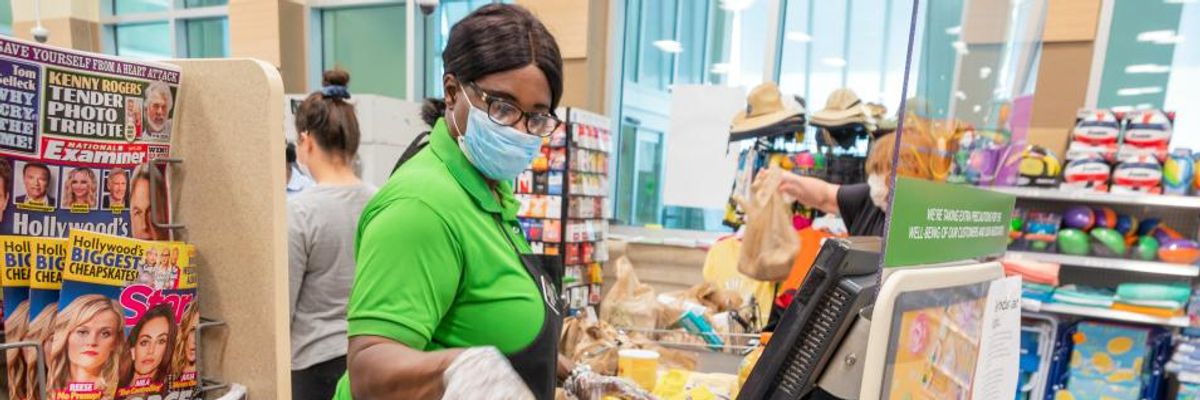
Cashier wearing face mask and gloves at a Publix in Miami, Florida. (Photo: Jeffrey Greenberg/Education Images/Universal Images Group via Getty Images)
Rep. Alexandria Ocasio-Cortez said Tuesday that data showing around half of all U.S. workers stand to bring home more money per week from beefed up unemployment insurance than they would from their regular full-time jobs is an argument in favor of raising wages, not the right-wing solution of rolling back benefits.
"We should be asking ourselves why underpaid workers are being expected to labor for too little money in the first place."
--Michele Evermore, National Employment Law Project
"Maybe we should pay people more," the New York Democrat tweeted in response to a new Wall Street Journal analysis, which found that the average weekly unemployment payment for a laid-off worker will rise to around $978 once the temporary $600-per-week increase from the CARES Act kicks in.
The $600 weekly payment is in addition to the unemployment benefits states already provide, which vary widely.
"Qualified workers will receive the government payout every week through July, and in most cases, the combined $978 weekly payout amounts to better pay than what many workers received before the crisis hit," the Journal reported Tuesday. "Labor Department statistics show half of full-time workers earned $957 or less a week in the first quarter of 2020."
Michael Linden, executive director of the Groundwork Collective, said in response to the analysis that "if $600 a week is a big raise, that's because workers were undervalued."
Last month, as Common Dreams reported, a group of Republicans led by Sens. Lindsey Graham (R-S.C.) and Ben Sasse (R-Neb.) threatened to delay passage of the CARES Act over concerns that the bill's expansion of unemployment benefits was so generous that it would discourage people from working.
Progressives quickly rejected the Republican senators' framing of the issue. "Some of my Republican friends still have not given up on the need to punish the poor and working people," Sen. Bernie Sanders (I-Vt.) said at the time in a fiery speech on the Senate floor. "You haven't raised the minimum wage in ten years. The minimum wage should be at least 15 bucks an hour."
The Senate ultimately voted down Sasse's proposed amendment to the CARES Act that would have ensured no laid-off worker made more money per week from unemployment benefits than their previous job.
Michele Evermore, a senior policy analyst with the National Employment Law Project, wrote in a blog post Monday that "the real problem is that too many workers who qualify for benefits cannot access them," not that workers who access them get too much.
According to an Economic Policy Institute survey released Tuesday, as many as 12.2 million additional Americans could have filed for unemployment benefits over the past month but didn't due to the onerous application process.
"We should be asking ourselves why underpaid workers--who will hopefully be making closer to or above their regular wages, allowing for greater economic stability in these uncertain times--are being expected to labor for too little money in the first place," wrote Evermore. "Wages have stagnated for decades."
"Right now," Evermore said, "our concern should be focused on making sure that workers are able to maintain an adequate income."
Dear Common Dreams reader, It’s been nearly 30 years since I co-founded Common Dreams with my late wife, Lina Newhouser. We had the radical notion that journalism should serve the public good, not corporate profits. It was clear to us from the outset what it would take to build such a project. No paid advertisements. No corporate sponsors. No millionaire publisher telling us what to think or do. Many people said we wouldn't last a year, but we proved those doubters wrong. Together with a tremendous team of journalists and dedicated staff, we built an independent media outlet free from the constraints of profits and corporate control. Our mission has always been simple: To inform. To inspire. To ignite change for the common good. Building Common Dreams was not easy. Our survival was never guaranteed. When you take on the most powerful forces—Wall Street greed, fossil fuel industry destruction, Big Tech lobbyists, and uber-rich oligarchs who have spent billions upon billions rigging the economy and democracy in their favor—the only bulwark you have is supporters who believe in your work. But here’s the urgent message from me today. It's never been this bad out there. And it's never been this hard to keep us going. At the very moment Common Dreams is most needed, the threats we face are intensifying. We need your support now more than ever. We don't accept corporate advertising and never will. We don't have a paywall because we don't think people should be blocked from critical news based on their ability to pay. Everything we do is funded by the donations of readers like you. When everyone does the little they can afford, we are strong. But if that support retreats or dries up, so do we. Will you donate now to make sure Common Dreams not only survives but thrives? —Craig Brown, Co-founder |
Rep. Alexandria Ocasio-Cortez said Tuesday that data showing around half of all U.S. workers stand to bring home more money per week from beefed up unemployment insurance than they would from their regular full-time jobs is an argument in favor of raising wages, not the right-wing solution of rolling back benefits.
"We should be asking ourselves why underpaid workers are being expected to labor for too little money in the first place."
--Michele Evermore, National Employment Law Project
"Maybe we should pay people more," the New York Democrat tweeted in response to a new Wall Street Journal analysis, which found that the average weekly unemployment payment for a laid-off worker will rise to around $978 once the temporary $600-per-week increase from the CARES Act kicks in.
The $600 weekly payment is in addition to the unemployment benefits states already provide, which vary widely.
"Qualified workers will receive the government payout every week through July, and in most cases, the combined $978 weekly payout amounts to better pay than what many workers received before the crisis hit," the Journal reported Tuesday. "Labor Department statistics show half of full-time workers earned $957 or less a week in the first quarter of 2020."
Michael Linden, executive director of the Groundwork Collective, said in response to the analysis that "if $600 a week is a big raise, that's because workers were undervalued."
Last month, as Common Dreams reported, a group of Republicans led by Sens. Lindsey Graham (R-S.C.) and Ben Sasse (R-Neb.) threatened to delay passage of the CARES Act over concerns that the bill's expansion of unemployment benefits was so generous that it would discourage people from working.
Progressives quickly rejected the Republican senators' framing of the issue. "Some of my Republican friends still have not given up on the need to punish the poor and working people," Sen. Bernie Sanders (I-Vt.) said at the time in a fiery speech on the Senate floor. "You haven't raised the minimum wage in ten years. The minimum wage should be at least 15 bucks an hour."
The Senate ultimately voted down Sasse's proposed amendment to the CARES Act that would have ensured no laid-off worker made more money per week from unemployment benefits than their previous job.
Michele Evermore, a senior policy analyst with the National Employment Law Project, wrote in a blog post Monday that "the real problem is that too many workers who qualify for benefits cannot access them," not that workers who access them get too much.
According to an Economic Policy Institute survey released Tuesday, as many as 12.2 million additional Americans could have filed for unemployment benefits over the past month but didn't due to the onerous application process.
"We should be asking ourselves why underpaid workers--who will hopefully be making closer to or above their regular wages, allowing for greater economic stability in these uncertain times--are being expected to labor for too little money in the first place," wrote Evermore. "Wages have stagnated for decades."
"Right now," Evermore said, "our concern should be focused on making sure that workers are able to maintain an adequate income."
Rep. Alexandria Ocasio-Cortez said Tuesday that data showing around half of all U.S. workers stand to bring home more money per week from beefed up unemployment insurance than they would from their regular full-time jobs is an argument in favor of raising wages, not the right-wing solution of rolling back benefits.
"We should be asking ourselves why underpaid workers are being expected to labor for too little money in the first place."
--Michele Evermore, National Employment Law Project
"Maybe we should pay people more," the New York Democrat tweeted in response to a new Wall Street Journal analysis, which found that the average weekly unemployment payment for a laid-off worker will rise to around $978 once the temporary $600-per-week increase from the CARES Act kicks in.
The $600 weekly payment is in addition to the unemployment benefits states already provide, which vary widely.
"Qualified workers will receive the government payout every week through July, and in most cases, the combined $978 weekly payout amounts to better pay than what many workers received before the crisis hit," the Journal reported Tuesday. "Labor Department statistics show half of full-time workers earned $957 or less a week in the first quarter of 2020."
Michael Linden, executive director of the Groundwork Collective, said in response to the analysis that "if $600 a week is a big raise, that's because workers were undervalued."
Last month, as Common Dreams reported, a group of Republicans led by Sens. Lindsey Graham (R-S.C.) and Ben Sasse (R-Neb.) threatened to delay passage of the CARES Act over concerns that the bill's expansion of unemployment benefits was so generous that it would discourage people from working.
Progressives quickly rejected the Republican senators' framing of the issue. "Some of my Republican friends still have not given up on the need to punish the poor and working people," Sen. Bernie Sanders (I-Vt.) said at the time in a fiery speech on the Senate floor. "You haven't raised the minimum wage in ten years. The minimum wage should be at least 15 bucks an hour."
The Senate ultimately voted down Sasse's proposed amendment to the CARES Act that would have ensured no laid-off worker made more money per week from unemployment benefits than their previous job.
Michele Evermore, a senior policy analyst with the National Employment Law Project, wrote in a blog post Monday that "the real problem is that too many workers who qualify for benefits cannot access them," not that workers who access them get too much.
According to an Economic Policy Institute survey released Tuesday, as many as 12.2 million additional Americans could have filed for unemployment benefits over the past month but didn't due to the onerous application process.
"We should be asking ourselves why underpaid workers--who will hopefully be making closer to or above their regular wages, allowing for greater economic stability in these uncertain times--are being expected to labor for too little money in the first place," wrote Evermore. "Wages have stagnated for decades."
"Right now," Evermore said, "our concern should be focused on making sure that workers are able to maintain an adequate income."