SUBSCRIBE TO OUR FREE NEWSLETTER
Daily news & progressive opinion—funded by the people, not the corporations—delivered straight to your inbox.
5
#000000
#FFFFFF
To donate by check, phone, or other method, see our More Ways to Give page.
Daily news & progressive opinion—funded by the people, not the corporations—delivered straight to your inbox.
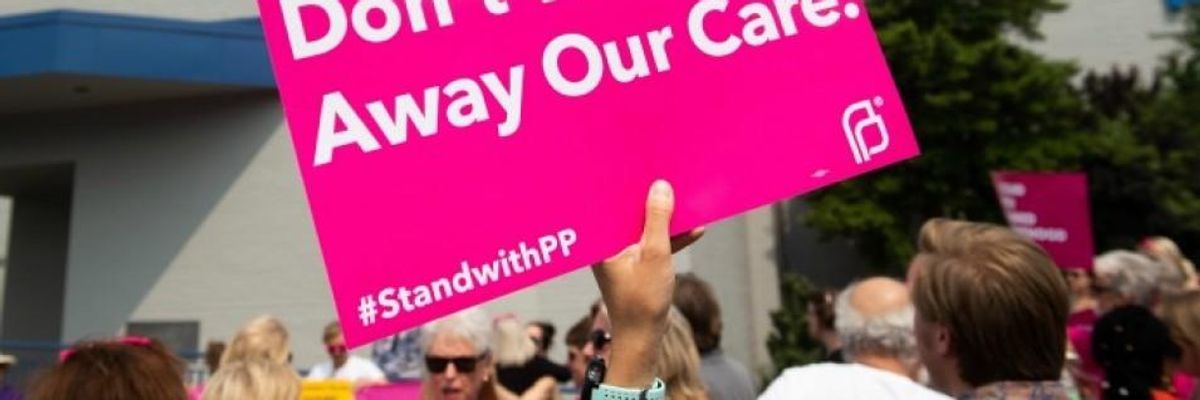
Pro-choice supporters and staff of Planned Parenthood hold a rally outside the Planned Parenthood Reproductive Health Services Center in St. Louis, Missouri, May 31, 2019. (Photo: Saul Loeb/AFP/Getty Images)
Reproductive rights advocates on Monday welcomed rulings from federal judges temporarily blocking three states from implementing orders that would have banned abortion care during the coronavirus crisis.
"To the politicians who used this global pandemic to push their anti-abortion agenda, shame on you," said Amy Hagstrom Miller, president of Whole Woman's Health, an abortion provider in Texas and a plaintiff in one of the cases.
Orders from the Republican-led governments of Alabama, Ohio, and Texas categorized abortion as a non-essential or non-emergency medical procedure amid the outbreak, sparking outcry from healthcare defenders who said the states were exploiting the crisis to attack reproductive rights.
The first ruling to come down Monday was from Texas, as Reuters noted.
"The attorney general's interpretation of the executive order prevents Texas women from exercising what the Supreme Court has declared is their fundamental constitutional right," wrote U.S. District Judge Lee Yeakel.
"This court will not speculate on whether the Supreme Court included a silent 'except-in-a-national-emergency clause' in its previous writings on the issue," he added.
Yeakel's ruling, said NARAL Pro-Choice America, "is an important recognition of what we know to be true--abortion care is essential healthcare."
In Ohio, District Court Judge Michael Barrett also sided with healthcare clinics.
Barrett said that any purported saving of personal protective equipment from banning the procedure "outweighs the harm of eliminating abortion," and would "result in an unconstitutional deprivation of plaintiffs' patients' Fourteenth Amendment right to substantive due process because enforcement creates a substantial obstacle in the path of patients seeking pre-viability abortions, thus creating an undue burden on abortion access."
Elizabeth Watson, a staff attorney with the ACLU's Reproductive Freedom Project, framed the ruling as "a crucial victory for Ohioans' access to essential abortion care, and in the fight to ensure that the response to the COVID-19 crisis is grounded in public health, not politics."
A third ruling came Monday from U.S. District Judge Myron Thompson in Alabama.
"Despite the serious conditions described by defendants and the dire need for medical equipment across the United States, the benefits of some potential increase in the availability of equipment (some of which may be ill-suited to the task of disease containment) do not outweigh the serious, and, in some cases, permanent, harms imposed by the denial of an individual's right to privacy," Thompson wrote.
The Alabama ruling was welcomed by the ACLU.
"Today, the court agreed that Alabama cannot use the COVID-19 crisis as a pretext to prevent patients from accessing abortion care," said Alexa Kolbi-Molinas, senior staff attorney at the group's Reproductive Freedom Project, in a statement Monday.
"This is critical victory and ensures government response to the pandemic is grounded in public health, not politics. We will continue to fight until the state's attacks on abortion are blocked once and for all."
A statement earlier this month from a number of reproductive health groups including the American College of Obstetricians and Gynecologists and the American Board of Obstetrics & Gynecology made clear the legislative moves by Alabama, Ohio, and Texas--as well as Oklahoma, which was hit Monday with a legal challenge over its similar ban--are out of line with expert opinion.
"Abortion is an essential component of comprehensive healthcare," said the groups. "It is also a time-sensitive service for which a delay of several weeks, or in some cases days, may increase the risks or potentially make it completely inaccessible."
"The consequences of being unable to obtain an abortion profoundly impact a person's life, health, and well-being," the health groups continued, and stressed that they "do not support COVID-19 responses that cancel or delay abortion procedures. Community-based and hospital-based clinicians should consider collaboration to ensure abortion access is not compromised during this time."
Dear Common Dreams reader, It’s been nearly 30 years since I co-founded Common Dreams with my late wife, Lina Newhouser. We had the radical notion that journalism should serve the public good, not corporate profits. It was clear to us from the outset what it would take to build such a project. No paid advertisements. No corporate sponsors. No millionaire publisher telling us what to think or do. Many people said we wouldn't last a year, but we proved those doubters wrong. Together with a tremendous team of journalists and dedicated staff, we built an independent media outlet free from the constraints of profits and corporate control. Our mission has always been simple: To inform. To inspire. To ignite change for the common good. Building Common Dreams was not easy. Our survival was never guaranteed. When you take on the most powerful forces—Wall Street greed, fossil fuel industry destruction, Big Tech lobbyists, and uber-rich oligarchs who have spent billions upon billions rigging the economy and democracy in their favor—the only bulwark you have is supporters who believe in your work. But here’s the urgent message from me today. It's never been this bad out there. And it's never been this hard to keep us going. At the very moment Common Dreams is most needed, the threats we face are intensifying. We need your support now more than ever. We don't accept corporate advertising and never will. We don't have a paywall because we don't think people should be blocked from critical news based on their ability to pay. Everything we do is funded by the donations of readers like you. When everyone does the little they can afford, we are strong. But if that support retreats or dries up, so do we. Will you donate now to make sure Common Dreams not only survives but thrives? —Craig Brown, Co-founder |
Reproductive rights advocates on Monday welcomed rulings from federal judges temporarily blocking three states from implementing orders that would have banned abortion care during the coronavirus crisis.
"To the politicians who used this global pandemic to push their anti-abortion agenda, shame on you," said Amy Hagstrom Miller, president of Whole Woman's Health, an abortion provider in Texas and a plaintiff in one of the cases.
Orders from the Republican-led governments of Alabama, Ohio, and Texas categorized abortion as a non-essential or non-emergency medical procedure amid the outbreak, sparking outcry from healthcare defenders who said the states were exploiting the crisis to attack reproductive rights.
The first ruling to come down Monday was from Texas, as Reuters noted.
"The attorney general's interpretation of the executive order prevents Texas women from exercising what the Supreme Court has declared is their fundamental constitutional right," wrote U.S. District Judge Lee Yeakel.
"This court will not speculate on whether the Supreme Court included a silent 'except-in-a-national-emergency clause' in its previous writings on the issue," he added.
Yeakel's ruling, said NARAL Pro-Choice America, "is an important recognition of what we know to be true--abortion care is essential healthcare."
In Ohio, District Court Judge Michael Barrett also sided with healthcare clinics.
Barrett said that any purported saving of personal protective equipment from banning the procedure "outweighs the harm of eliminating abortion," and would "result in an unconstitutional deprivation of plaintiffs' patients' Fourteenth Amendment right to substantive due process because enforcement creates a substantial obstacle in the path of patients seeking pre-viability abortions, thus creating an undue burden on abortion access."
Elizabeth Watson, a staff attorney with the ACLU's Reproductive Freedom Project, framed the ruling as "a crucial victory for Ohioans' access to essential abortion care, and in the fight to ensure that the response to the COVID-19 crisis is grounded in public health, not politics."
A third ruling came Monday from U.S. District Judge Myron Thompson in Alabama.
"Despite the serious conditions described by defendants and the dire need for medical equipment across the United States, the benefits of some potential increase in the availability of equipment (some of which may be ill-suited to the task of disease containment) do not outweigh the serious, and, in some cases, permanent, harms imposed by the denial of an individual's right to privacy," Thompson wrote.
The Alabama ruling was welcomed by the ACLU.
"Today, the court agreed that Alabama cannot use the COVID-19 crisis as a pretext to prevent patients from accessing abortion care," said Alexa Kolbi-Molinas, senior staff attorney at the group's Reproductive Freedom Project, in a statement Monday.
"This is critical victory and ensures government response to the pandemic is grounded in public health, not politics. We will continue to fight until the state's attacks on abortion are blocked once and for all."
A statement earlier this month from a number of reproductive health groups including the American College of Obstetricians and Gynecologists and the American Board of Obstetrics & Gynecology made clear the legislative moves by Alabama, Ohio, and Texas--as well as Oklahoma, which was hit Monday with a legal challenge over its similar ban--are out of line with expert opinion.
"Abortion is an essential component of comprehensive healthcare," said the groups. "It is also a time-sensitive service for which a delay of several weeks, or in some cases days, may increase the risks or potentially make it completely inaccessible."
"The consequences of being unable to obtain an abortion profoundly impact a person's life, health, and well-being," the health groups continued, and stressed that they "do not support COVID-19 responses that cancel or delay abortion procedures. Community-based and hospital-based clinicians should consider collaboration to ensure abortion access is not compromised during this time."
Reproductive rights advocates on Monday welcomed rulings from federal judges temporarily blocking three states from implementing orders that would have banned abortion care during the coronavirus crisis.
"To the politicians who used this global pandemic to push their anti-abortion agenda, shame on you," said Amy Hagstrom Miller, president of Whole Woman's Health, an abortion provider in Texas and a plaintiff in one of the cases.
Orders from the Republican-led governments of Alabama, Ohio, and Texas categorized abortion as a non-essential or non-emergency medical procedure amid the outbreak, sparking outcry from healthcare defenders who said the states were exploiting the crisis to attack reproductive rights.
The first ruling to come down Monday was from Texas, as Reuters noted.
"The attorney general's interpretation of the executive order prevents Texas women from exercising what the Supreme Court has declared is their fundamental constitutional right," wrote U.S. District Judge Lee Yeakel.
"This court will not speculate on whether the Supreme Court included a silent 'except-in-a-national-emergency clause' in its previous writings on the issue," he added.
Yeakel's ruling, said NARAL Pro-Choice America, "is an important recognition of what we know to be true--abortion care is essential healthcare."
In Ohio, District Court Judge Michael Barrett also sided with healthcare clinics.
Barrett said that any purported saving of personal protective equipment from banning the procedure "outweighs the harm of eliminating abortion," and would "result in an unconstitutional deprivation of plaintiffs' patients' Fourteenth Amendment right to substantive due process because enforcement creates a substantial obstacle in the path of patients seeking pre-viability abortions, thus creating an undue burden on abortion access."
Elizabeth Watson, a staff attorney with the ACLU's Reproductive Freedom Project, framed the ruling as "a crucial victory for Ohioans' access to essential abortion care, and in the fight to ensure that the response to the COVID-19 crisis is grounded in public health, not politics."
A third ruling came Monday from U.S. District Judge Myron Thompson in Alabama.
"Despite the serious conditions described by defendants and the dire need for medical equipment across the United States, the benefits of some potential increase in the availability of equipment (some of which may be ill-suited to the task of disease containment) do not outweigh the serious, and, in some cases, permanent, harms imposed by the denial of an individual's right to privacy," Thompson wrote.
The Alabama ruling was welcomed by the ACLU.
"Today, the court agreed that Alabama cannot use the COVID-19 crisis as a pretext to prevent patients from accessing abortion care," said Alexa Kolbi-Molinas, senior staff attorney at the group's Reproductive Freedom Project, in a statement Monday.
"This is critical victory and ensures government response to the pandemic is grounded in public health, not politics. We will continue to fight until the state's attacks on abortion are blocked once and for all."
A statement earlier this month from a number of reproductive health groups including the American College of Obstetricians and Gynecologists and the American Board of Obstetrics & Gynecology made clear the legislative moves by Alabama, Ohio, and Texas--as well as Oklahoma, which was hit Monday with a legal challenge over its similar ban--are out of line with expert opinion.
"Abortion is an essential component of comprehensive healthcare," said the groups. "It is also a time-sensitive service for which a delay of several weeks, or in some cases days, may increase the risks or potentially make it completely inaccessible."
"The consequences of being unable to obtain an abortion profoundly impact a person's life, health, and well-being," the health groups continued, and stressed that they "do not support COVID-19 responses that cancel or delay abortion procedures. Community-based and hospital-based clinicians should consider collaboration to ensure abortion access is not compromised during this time."