SUBSCRIBE TO OUR FREE NEWSLETTER
Daily news & progressive opinion—funded by the people, not the corporations—delivered straight to your inbox.
5
#000000
#FFFFFF
To donate by check, phone, or other method, see our More Ways to Give page.
Daily news & progressive opinion—funded by the people, not the corporations—delivered straight to your inbox.
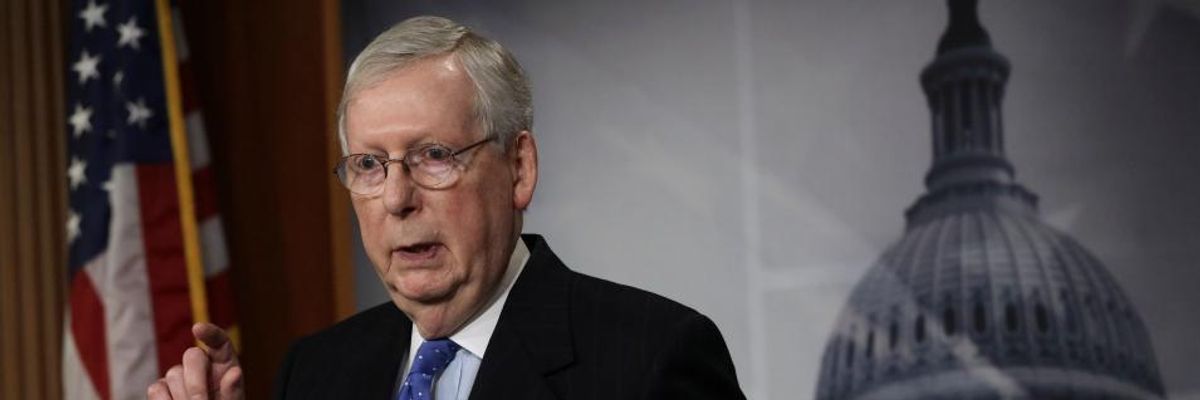
Senate Majority Leader Sen. Mitch McConnell (R-KY) speaks to members of the media during a news conference at the U.S. Capitol on March 17, 2020 in Washington, D.C. (Photo: Alex Wong/Getty Images)
"Heartless," "cruel," and "appalling" were just some of the adjectives progressive critics and analysts used late Thursday to describe the Senate GOP's newly unveiled trillion-dollar economic stimulus package which--by design--would completely deny direct cash payments to the poorest Americans while cutting taxes for corporations, dishing out tens of billions in bailout funds to major industries, and restricting paid leave benefits that were just signed into law this week.
"The Senate GOP package is an utter disgrace," tweeted Richard Trumka, president of the AFL-CIO. "It gives free money to corporations, ignores the health crisis, and does nothing to keep people working or help the unemployed. The labor movement will oppose this Main St. bailout of Wall St. with everything we have."
"I don't know how else to describe this but wantonly wicked. The poorest get zero; low-income households get half of what middle-income households get; and a kid counts for 40% of an adult."
--Daniel Hemel, University of Chicago Law School
The Republican plan, released as the economic fallout from the coronavirus outbreak continues to worsen, would provide means-tested cash payments of up to $1,200 per adult and $500 per child, with the precise amount dependent upon 2018 tax filings.
"Taxpayers with little or no income tax liability, but at least $2,500 of qualifying income, would be eligible for a minimum rebate check of $600 ($1,200 married)," the Republican proposal states. "Qualifying income includes earned income, as well as Social Security retirement benefits and certain compensation and pension benefits paid to veterans."
Observers were quick to point out a gaping hole in the Republican plan: Adults with no qualifying income would get nothing.
"I don't know how else to describe this but wantonly wicked," said Daniel Hemel, a tax expert at the University of Chicago Law School. "The poorest get zero; low-income households get half of what middle-income households get; and a kid counts for 40% of an adult."
Kyle Pomerleau, an economist and resident fellow at the conservative American Enterprise Institute, estimated that "roughly 64 million filers earning less than $50k would not receive the full rebate amount of $1,200/$2,400" under the GOP proposal.
"For a single filer, income must be at least about $23k to get the full $1,200," Pomerleau noted. "For married couple filing jointly, [adjusted gross income] must be about $47k to get the full $2,400."
Senate Majority Leader Mitch McConnell (R-Ky.) pitched the GOP proposal as a starting point for stimulus negotiations with the Democratic Party, but Democratic leaders quickly dismissed the plan as a non-starter.
"We are beginning to review Senator McConnell's proposal, and on first reading, it is not at all pro-worker and instead puts corporations way ahead of workers," House Speaker Nancy Pelosi (D-Calif.) and Senate Minority Leader Chuck Schumer (D-N.Y.) said in a joint statement Thursday night.
Even two Republican lawmakers--Sens. Mitt Romney (R-Utah.) and Josh Hawley (R-Mo.)--dismissed the plan as regressive.
While skimping on aid low-income Americans, the Republican proposal--formally known as the Coronavirus Aid, Relief, and Economic Security (CARES) Act--contains generous gifts for big corporations and billions in relief for industries hit hard by the coronavirus crisis, including $50 billion for airlines.
The 247-page Republican legislation, according to the New York Times, "includes a raft of temporary changes to the tax code that would reduce the tax liability of large corporations, many of them overriding provisions in the 2017 tax overhaul that were meant to raise revenue to offset corporate rate cuts."
The bill would also "place new limits on a paid-leave program that Congress passed and Mr. Trump signed into law this week," the Times reported, "shielding small business owners from any costs of paid leave for workers affected by the virus--and limiting how much pay those workers could receive if they are forced to stay home."
"Senate Republicans are using the COVID-19 pandemic to cut corporate taxes again and stop you from getting paid sick leave," tweeted advocacy group Swing Left. "They called it the CARES Act because Mitch CARES about big businesses, not you."
Dear Common Dreams reader, It’s been nearly 30 years since I co-founded Common Dreams with my late wife, Lina Newhouser. We had the radical notion that journalism should serve the public good, not corporate profits. It was clear to us from the outset what it would take to build such a project. No paid advertisements. No corporate sponsors. No millionaire publisher telling us what to think or do. Many people said we wouldn't last a year, but we proved those doubters wrong. Together with a tremendous team of journalists and dedicated staff, we built an independent media outlet free from the constraints of profits and corporate control. Our mission has always been simple: To inform. To inspire. To ignite change for the common good. Building Common Dreams was not easy. Our survival was never guaranteed. When you take on the most powerful forces—Wall Street greed, fossil fuel industry destruction, Big Tech lobbyists, and uber-rich oligarchs who have spent billions upon billions rigging the economy and democracy in their favor—the only bulwark you have is supporters who believe in your work. But here’s the urgent message from me today. It's never been this bad out there. And it's never been this hard to keep us going. At the very moment Common Dreams is most needed, the threats we face are intensifying. We need your support now more than ever. We don't accept corporate advertising and never will. We don't have a paywall because we don't think people should be blocked from critical news based on their ability to pay. Everything we do is funded by the donations of readers like you. When everyone does the little they can afford, we are strong. But if that support retreats or dries up, so do we. Will you donate now to make sure Common Dreams not only survives but thrives? —Craig Brown, Co-founder |
"Heartless," "cruel," and "appalling" were just some of the adjectives progressive critics and analysts used late Thursday to describe the Senate GOP's newly unveiled trillion-dollar economic stimulus package which--by design--would completely deny direct cash payments to the poorest Americans while cutting taxes for corporations, dishing out tens of billions in bailout funds to major industries, and restricting paid leave benefits that were just signed into law this week.
"The Senate GOP package is an utter disgrace," tweeted Richard Trumka, president of the AFL-CIO. "It gives free money to corporations, ignores the health crisis, and does nothing to keep people working or help the unemployed. The labor movement will oppose this Main St. bailout of Wall St. with everything we have."
"I don't know how else to describe this but wantonly wicked. The poorest get zero; low-income households get half of what middle-income households get; and a kid counts for 40% of an adult."
--Daniel Hemel, University of Chicago Law School
The Republican plan, released as the economic fallout from the coronavirus outbreak continues to worsen, would provide means-tested cash payments of up to $1,200 per adult and $500 per child, with the precise amount dependent upon 2018 tax filings.
"Taxpayers with little or no income tax liability, but at least $2,500 of qualifying income, would be eligible for a minimum rebate check of $600 ($1,200 married)," the Republican proposal states. "Qualifying income includes earned income, as well as Social Security retirement benefits and certain compensation and pension benefits paid to veterans."
Observers were quick to point out a gaping hole in the Republican plan: Adults with no qualifying income would get nothing.
"I don't know how else to describe this but wantonly wicked," said Daniel Hemel, a tax expert at the University of Chicago Law School. "The poorest get zero; low-income households get half of what middle-income households get; and a kid counts for 40% of an adult."
Kyle Pomerleau, an economist and resident fellow at the conservative American Enterprise Institute, estimated that "roughly 64 million filers earning less than $50k would not receive the full rebate amount of $1,200/$2,400" under the GOP proposal.
"For a single filer, income must be at least about $23k to get the full $1,200," Pomerleau noted. "For married couple filing jointly, [adjusted gross income] must be about $47k to get the full $2,400."
Senate Majority Leader Mitch McConnell (R-Ky.) pitched the GOP proposal as a starting point for stimulus negotiations with the Democratic Party, but Democratic leaders quickly dismissed the plan as a non-starter.
"We are beginning to review Senator McConnell's proposal, and on first reading, it is not at all pro-worker and instead puts corporations way ahead of workers," House Speaker Nancy Pelosi (D-Calif.) and Senate Minority Leader Chuck Schumer (D-N.Y.) said in a joint statement Thursday night.
Even two Republican lawmakers--Sens. Mitt Romney (R-Utah.) and Josh Hawley (R-Mo.)--dismissed the plan as regressive.
While skimping on aid low-income Americans, the Republican proposal--formally known as the Coronavirus Aid, Relief, and Economic Security (CARES) Act--contains generous gifts for big corporations and billions in relief for industries hit hard by the coronavirus crisis, including $50 billion for airlines.
The 247-page Republican legislation, according to the New York Times, "includes a raft of temporary changes to the tax code that would reduce the tax liability of large corporations, many of them overriding provisions in the 2017 tax overhaul that were meant to raise revenue to offset corporate rate cuts."
The bill would also "place new limits on a paid-leave program that Congress passed and Mr. Trump signed into law this week," the Times reported, "shielding small business owners from any costs of paid leave for workers affected by the virus--and limiting how much pay those workers could receive if they are forced to stay home."
"Senate Republicans are using the COVID-19 pandemic to cut corporate taxes again and stop you from getting paid sick leave," tweeted advocacy group Swing Left. "They called it the CARES Act because Mitch CARES about big businesses, not you."
"Heartless," "cruel," and "appalling" were just some of the adjectives progressive critics and analysts used late Thursday to describe the Senate GOP's newly unveiled trillion-dollar economic stimulus package which--by design--would completely deny direct cash payments to the poorest Americans while cutting taxes for corporations, dishing out tens of billions in bailout funds to major industries, and restricting paid leave benefits that were just signed into law this week.
"The Senate GOP package is an utter disgrace," tweeted Richard Trumka, president of the AFL-CIO. "It gives free money to corporations, ignores the health crisis, and does nothing to keep people working or help the unemployed. The labor movement will oppose this Main St. bailout of Wall St. with everything we have."
"I don't know how else to describe this but wantonly wicked. The poorest get zero; low-income households get half of what middle-income households get; and a kid counts for 40% of an adult."
--Daniel Hemel, University of Chicago Law School
The Republican plan, released as the economic fallout from the coronavirus outbreak continues to worsen, would provide means-tested cash payments of up to $1,200 per adult and $500 per child, with the precise amount dependent upon 2018 tax filings.
"Taxpayers with little or no income tax liability, but at least $2,500 of qualifying income, would be eligible for a minimum rebate check of $600 ($1,200 married)," the Republican proposal states. "Qualifying income includes earned income, as well as Social Security retirement benefits and certain compensation and pension benefits paid to veterans."
Observers were quick to point out a gaping hole in the Republican plan: Adults with no qualifying income would get nothing.
"I don't know how else to describe this but wantonly wicked," said Daniel Hemel, a tax expert at the University of Chicago Law School. "The poorest get zero; low-income households get half of what middle-income households get; and a kid counts for 40% of an adult."
Kyle Pomerleau, an economist and resident fellow at the conservative American Enterprise Institute, estimated that "roughly 64 million filers earning less than $50k would not receive the full rebate amount of $1,200/$2,400" under the GOP proposal.
"For a single filer, income must be at least about $23k to get the full $1,200," Pomerleau noted. "For married couple filing jointly, [adjusted gross income] must be about $47k to get the full $2,400."
Senate Majority Leader Mitch McConnell (R-Ky.) pitched the GOP proposal as a starting point for stimulus negotiations with the Democratic Party, but Democratic leaders quickly dismissed the plan as a non-starter.
"We are beginning to review Senator McConnell's proposal, and on first reading, it is not at all pro-worker and instead puts corporations way ahead of workers," House Speaker Nancy Pelosi (D-Calif.) and Senate Minority Leader Chuck Schumer (D-N.Y.) said in a joint statement Thursday night.
Even two Republican lawmakers--Sens. Mitt Romney (R-Utah.) and Josh Hawley (R-Mo.)--dismissed the plan as regressive.
While skimping on aid low-income Americans, the Republican proposal--formally known as the Coronavirus Aid, Relief, and Economic Security (CARES) Act--contains generous gifts for big corporations and billions in relief for industries hit hard by the coronavirus crisis, including $50 billion for airlines.
The 247-page Republican legislation, according to the New York Times, "includes a raft of temporary changes to the tax code that would reduce the tax liability of large corporations, many of them overriding provisions in the 2017 tax overhaul that were meant to raise revenue to offset corporate rate cuts."
The bill would also "place new limits on a paid-leave program that Congress passed and Mr. Trump signed into law this week," the Times reported, "shielding small business owners from any costs of paid leave for workers affected by the virus--and limiting how much pay those workers could receive if they are forced to stay home."
"Senate Republicans are using the COVID-19 pandemic to cut corporate taxes again and stop you from getting paid sick leave," tweeted advocacy group Swing Left. "They called it the CARES Act because Mitch CARES about big businesses, not you."