SUBSCRIBE TO OUR FREE NEWSLETTER
Daily news & progressive opinion—funded by the people, not the corporations—delivered straight to your inbox.
5
#000000
#FFFFFF
To donate by check, phone, or other method, see our More Ways to Give page.
Daily news & progressive opinion—funded by the people, not the corporations—delivered straight to your inbox.
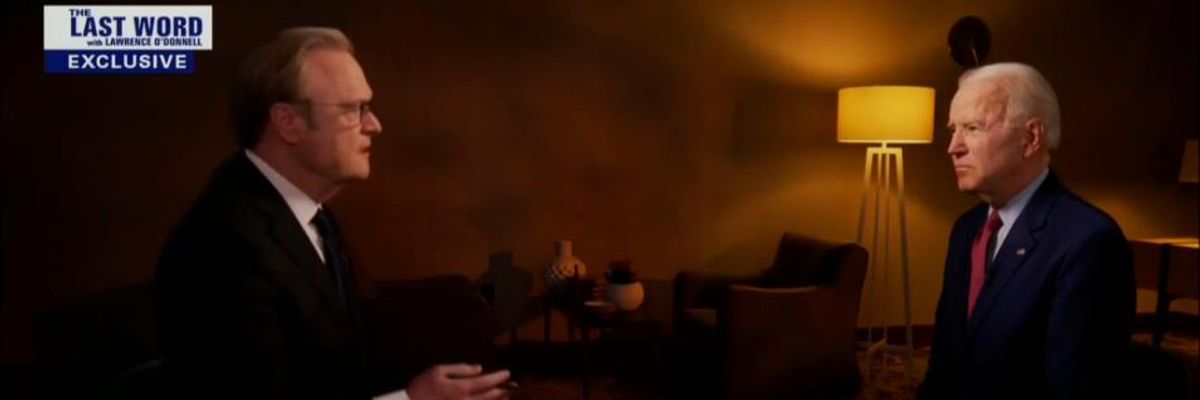
Former Vice President Joe Biden, a 2020 Democratic presidential candidate, during an interview with MSNBC's Lawrence O'Donnell that aired Monday March 9, 2020. (Photo: MSNBC/Screengrab)
One of corporate Democrats' most common talking points against Medicare for All is that such a proposal would never make it through Congress. But Joe Biden, in an interview that aired Monday night, admitted that even if one did--with the approval of his own party--he would not necessarily jump at the historic chance to sign it into law.
Validating Sen. Bernie Sanders' call for a debate with Biden on the details and merits of Medicare for All, the former vice president described Sanders' plan as a budget-busting proposal--without mentioning studies showing it would save the U.S. trillions of dollars--and refused to commit to signing Medicare for All legislation if Congress sent it to his desk, claiming it could delay coverage expansion.
"I would veto anything that delays providing the security and the certainty of healthcare being available now," Biden told MSNBC's Lawrence O'Donnell, who asked Biden how he, if elected president, would handle a situation in which Medicare for All legislation passed a Democrat-controlled Congress.
Biden's remarks were widely interpreted as a suggestion that he would consider vetoing Medicare for All, which--under Sanders' version--would be phased in over a four-year period, lowering the Medicare eligibility age to 55 in the first year and covering everyone in the U.S. by year four. A public option would also be established during the transition period.
"If Democrats passed a Medicare for All bill through the House and Senate, it would be one of the greatest legislative accomplishments in American history. It would realign American politics for a generation or more... and Joe Biden suggested that he might veto it," tweeted journalist Walker Bragman.
While criticizing supposed "delays" in coverage expansion under Medicare for All, Biden failed to mention that his plan--according to the former vice president's own campaign website--would leave millions of Americans uninsured by only covering 97% of the U.S. population.
Biden insisted that he supports the "principle" behind Medicare for All--providing healthcare as a right--but opposes the policy because he believes it is impractical and would raise taxes on the middle class, a right-wing talking point that ignores the savings most U.S. families would see via Medicare for All's elimination of premiums, co-pays, and deductibles.
"My opposition isn't to the principle that you should have Medicare," Biden said. "My opposition relates to whether or not, a, it's doable, and, two, what the cost is and what the consequences to the rest of the budget are. How are going to find $35 trillion over the next 10 years without having profound impacts on everything from taxes for middle class, working class people, as well as the impact on the rest of the budget?"
A Yale study released last month showed that Medicare for All, contrary to Biden's depiction of the policy as prohibitively expensive, would save the U.S. $450 billion annually in overall healthcare spending. The study also found that Medicare for All would save 68,000 lives each year.
"Joe Biden is pretending he's worried about how much Medicare for All would cost," tweeted writer and researcher Andrew Perez. "Odds are his plan would cost much more, just like this analysis of [Pete Buttigieg's] plan found, because it adds new costs while preserving an extraordinarily brutal, inefficient system."
Adam Gaffney, president of Physicians for a National Health Program, argued in a blog post for Health Affairs on Monday that Medicare for All is both economically and politically viable.
"At the end of the day, the vast majority of the nation could benefit from single-payer reform--and that fact makes it winnable," Gaffney wrote. "Above all, however, we can be sure of one thing: not bothering to push for Medicare for All today will guarantee that it doesn't happen tomorrow."
Dear Common Dreams reader, It’s been nearly 30 years since I co-founded Common Dreams with my late wife, Lina Newhouser. We had the radical notion that journalism should serve the public good, not corporate profits. It was clear to us from the outset what it would take to build such a project. No paid advertisements. No corporate sponsors. No millionaire publisher telling us what to think or do. Many people said we wouldn't last a year, but we proved those doubters wrong. Together with a tremendous team of journalists and dedicated staff, we built an independent media outlet free from the constraints of profits and corporate control. Our mission has always been simple: To inform. To inspire. To ignite change for the common good. Building Common Dreams was not easy. Our survival was never guaranteed. When you take on the most powerful forces—Wall Street greed, fossil fuel industry destruction, Big Tech lobbyists, and uber-rich oligarchs who have spent billions upon billions rigging the economy and democracy in their favor—the only bulwark you have is supporters who believe in your work. But here’s the urgent message from me today. It's never been this bad out there. And it's never been this hard to keep us going. At the very moment Common Dreams is most needed, the threats we face are intensifying. We need your support now more than ever. We don't accept corporate advertising and never will. We don't have a paywall because we don't think people should be blocked from critical news based on their ability to pay. Everything we do is funded by the donations of readers like you. When everyone does the little they can afford, we are strong. But if that support retreats or dries up, so do we. Will you donate now to make sure Common Dreams not only survives but thrives? —Craig Brown, Co-founder |
One of corporate Democrats' most common talking points against Medicare for All is that such a proposal would never make it through Congress. But Joe Biden, in an interview that aired Monday night, admitted that even if one did--with the approval of his own party--he would not necessarily jump at the historic chance to sign it into law.
Validating Sen. Bernie Sanders' call for a debate with Biden on the details and merits of Medicare for All, the former vice president described Sanders' plan as a budget-busting proposal--without mentioning studies showing it would save the U.S. trillions of dollars--and refused to commit to signing Medicare for All legislation if Congress sent it to his desk, claiming it could delay coverage expansion.
"I would veto anything that delays providing the security and the certainty of healthcare being available now," Biden told MSNBC's Lawrence O'Donnell, who asked Biden how he, if elected president, would handle a situation in which Medicare for All legislation passed a Democrat-controlled Congress.
Biden's remarks were widely interpreted as a suggestion that he would consider vetoing Medicare for All, which--under Sanders' version--would be phased in over a four-year period, lowering the Medicare eligibility age to 55 in the first year and covering everyone in the U.S. by year four. A public option would also be established during the transition period.
"If Democrats passed a Medicare for All bill through the House and Senate, it would be one of the greatest legislative accomplishments in American history. It would realign American politics for a generation or more... and Joe Biden suggested that he might veto it," tweeted journalist Walker Bragman.
While criticizing supposed "delays" in coverage expansion under Medicare for All, Biden failed to mention that his plan--according to the former vice president's own campaign website--would leave millions of Americans uninsured by only covering 97% of the U.S. population.
Biden insisted that he supports the "principle" behind Medicare for All--providing healthcare as a right--but opposes the policy because he believes it is impractical and would raise taxes on the middle class, a right-wing talking point that ignores the savings most U.S. families would see via Medicare for All's elimination of premiums, co-pays, and deductibles.
"My opposition isn't to the principle that you should have Medicare," Biden said. "My opposition relates to whether or not, a, it's doable, and, two, what the cost is and what the consequences to the rest of the budget are. How are going to find $35 trillion over the next 10 years without having profound impacts on everything from taxes for middle class, working class people, as well as the impact on the rest of the budget?"
A Yale study released last month showed that Medicare for All, contrary to Biden's depiction of the policy as prohibitively expensive, would save the U.S. $450 billion annually in overall healthcare spending. The study also found that Medicare for All would save 68,000 lives each year.
"Joe Biden is pretending he's worried about how much Medicare for All would cost," tweeted writer and researcher Andrew Perez. "Odds are his plan would cost much more, just like this analysis of [Pete Buttigieg's] plan found, because it adds new costs while preserving an extraordinarily brutal, inefficient system."
Adam Gaffney, president of Physicians for a National Health Program, argued in a blog post for Health Affairs on Monday that Medicare for All is both economically and politically viable.
"At the end of the day, the vast majority of the nation could benefit from single-payer reform--and that fact makes it winnable," Gaffney wrote. "Above all, however, we can be sure of one thing: not bothering to push for Medicare for All today will guarantee that it doesn't happen tomorrow."
One of corporate Democrats' most common talking points against Medicare for All is that such a proposal would never make it through Congress. But Joe Biden, in an interview that aired Monday night, admitted that even if one did--with the approval of his own party--he would not necessarily jump at the historic chance to sign it into law.
Validating Sen. Bernie Sanders' call for a debate with Biden on the details and merits of Medicare for All, the former vice president described Sanders' plan as a budget-busting proposal--without mentioning studies showing it would save the U.S. trillions of dollars--and refused to commit to signing Medicare for All legislation if Congress sent it to his desk, claiming it could delay coverage expansion.
"I would veto anything that delays providing the security and the certainty of healthcare being available now," Biden told MSNBC's Lawrence O'Donnell, who asked Biden how he, if elected president, would handle a situation in which Medicare for All legislation passed a Democrat-controlled Congress.
Biden's remarks were widely interpreted as a suggestion that he would consider vetoing Medicare for All, which--under Sanders' version--would be phased in over a four-year period, lowering the Medicare eligibility age to 55 in the first year and covering everyone in the U.S. by year four. A public option would also be established during the transition period.
"If Democrats passed a Medicare for All bill through the House and Senate, it would be one of the greatest legislative accomplishments in American history. It would realign American politics for a generation or more... and Joe Biden suggested that he might veto it," tweeted journalist Walker Bragman.
While criticizing supposed "delays" in coverage expansion under Medicare for All, Biden failed to mention that his plan--according to the former vice president's own campaign website--would leave millions of Americans uninsured by only covering 97% of the U.S. population.
Biden insisted that he supports the "principle" behind Medicare for All--providing healthcare as a right--but opposes the policy because he believes it is impractical and would raise taxes on the middle class, a right-wing talking point that ignores the savings most U.S. families would see via Medicare for All's elimination of premiums, co-pays, and deductibles.
"My opposition isn't to the principle that you should have Medicare," Biden said. "My opposition relates to whether or not, a, it's doable, and, two, what the cost is and what the consequences to the rest of the budget are. How are going to find $35 trillion over the next 10 years without having profound impacts on everything from taxes for middle class, working class people, as well as the impact on the rest of the budget?"
A Yale study released last month showed that Medicare for All, contrary to Biden's depiction of the policy as prohibitively expensive, would save the U.S. $450 billion annually in overall healthcare spending. The study also found that Medicare for All would save 68,000 lives each year.
"Joe Biden is pretending he's worried about how much Medicare for All would cost," tweeted writer and researcher Andrew Perez. "Odds are his plan would cost much more, just like this analysis of [Pete Buttigieg's] plan found, because it adds new costs while preserving an extraordinarily brutal, inefficient system."
Adam Gaffney, president of Physicians for a National Health Program, argued in a blog post for Health Affairs on Monday that Medicare for All is both economically and politically viable.
"At the end of the day, the vast majority of the nation could benefit from single-payer reform--and that fact makes it winnable," Gaffney wrote. "Above all, however, we can be sure of one thing: not bothering to push for Medicare for All today will guarantee that it doesn't happen tomorrow."