SUBSCRIBE TO OUR FREE NEWSLETTER
Daily news & progressive opinion—funded by the people, not the corporations—delivered straight to your inbox.
5
#000000
#FFFFFF
To donate by check, phone, or other method, see our More Ways to Give page.
Daily news & progressive opinion—funded by the people, not the corporations—delivered straight to your inbox.
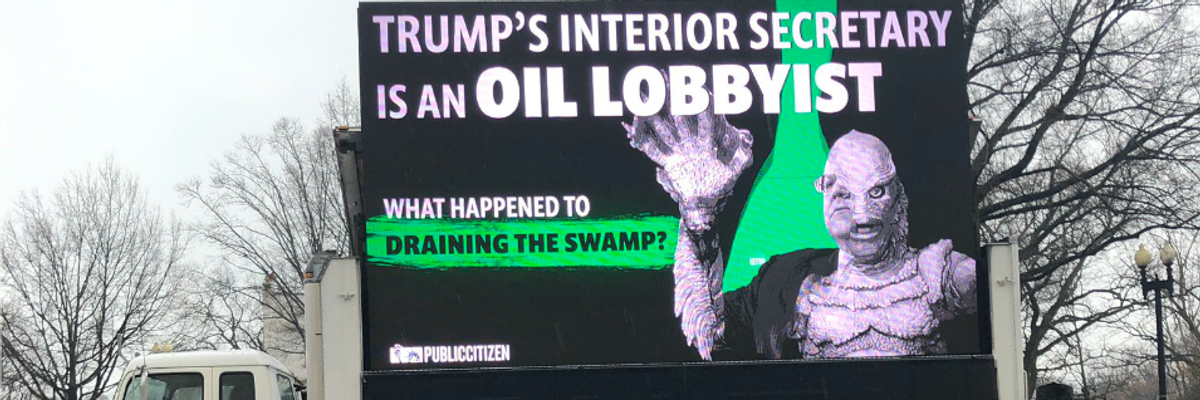
Public Citizen parked a truck with a giant screen outside the U.S. Department of the Interior for eight hours on Tuesday. The screen played on loop a video of Interior Secretary David Bernhardt turning into a "swamp" creature. (Photo: Kelsey Brugger/Twitter)
As activists and experts descended on the U.S. Department of the Interior building in Washington, D.C. Tuesday for a public forum and rally about the Trump administration's recent attack on one of the nation's landmark environmental laws, the advocacy group Public Citizen parked a truck with a massive screen nearby to play a video of a top official morphing into a "swamp monster" on loop for eight hours.
"The video, accompanied by spooky music, will show that it's difficult to distinguish between Interior Secretary David Bernhardt--a former oil and gas lobbyist--and a creature of the Washington, D.C., 'swamp' of lobbyists and corporate cronies that President Donald Trump derided as a candidate but now embraces wholeheartedly," Public Citizen explained.
The protests and hearing (pdf) Tuesday centered on the Trump administration's proposed changes to the National Environmental Policy Act (NEPA). The historic law signed by President Richard Nixon 50 years ago forces federal agencies to produce environmental assessments for major planned actions, including permits for infrastructure projects like fossil fuel pipelines.
Advocacy groups that have raised concerns with the administration's proposal reiterated those critiques Tuesday. Friends of the Earth president Erich Pica said in a statement that NEPA "ensures communities have a right to know the environmental and fiscal impacts, and whether less destructive alternatives exist," and Trump's attack on the law "silences the communities across the nation fighting corporate polluters."
"If this rollback happens, it will weaken communities' efforts to protect their air, water, and public health," Pica warned. "We must not allow this critical tool for public engagement to be eliminated by the businesses determined to destroy our environment for profit. We will not tolerate efforts to dismantle our bedrock environmental laws."
As a Natural Resources Defense Council blog post outlined Monday, the Trump administration's proposed changes include: limiting the actions covered by NEPA, restricting the geographic scope of a review, scrapping conflict-of-interest requirements, and curtailing a directive that agencies rigorously consider reasonable alternatives.
Greenpeace USA senior climate campaigner John Noel said in a statement Tuesday that the changes--which would mean agencies don't have to consider the climate impacts of new infrastructure projects--would significantly curb input from communities that would be most affected by such development.
"Fossil fuel infrastructure projects are overwhelmingly located in underrepresented, working class communities," Noel said. "No oil company wants to put an oil well on top of a Trump golf course, or a fracked gas compressor station next to Mar a Lago--they're building pipelines through Indigenous territory and refineries next to Black and Brown neighborhoods. Based on its attempts to roll back NEPA, it's clear the Trump administration views these communities as sacrifice zones."
"Gutting NEPA is an attempt to silence the communities on the frontlines of fossil fuel industry pollution," he charged. "If Trump truly cared about clean air and water for anyone other than his billionaire buddies, he'd strengthen laws like NEPA. Instead, he's handing out favors to oil and gas executives like candy."
Rep. Raul Grijalva (D-Ariz.), chair of the House Natural Resources Committee, as well as leaders of environmental and labor groups spoke at the D.C. rally Tuesday afternoon.
Activists, advocacy groups, and reporters shared updates from the rally and forum on social media with the hashtags #ProtectYourVoice and #ProtectNEPA:
Grijalva, who also testified at the public hearing, said in a statement Tuesday that "the administration's efforts to gut NEPA through this proposed rule will make it easier for corporate polluters to hide the climate impacts of major projects, including oil and gas projects."
"NEPA's also a critical civil rights tool--it gives all Americans a voice in federal decision-making by allowing communities to be informed and weigh in on major proposed projects affecting their communities," the congressman added. "When the NEPA process is cut short or weakened, ill-conceived projects advance that can have devastating public health and environmental consequences for American communities."
Dear Common Dreams reader, It’s been nearly 30 years since I co-founded Common Dreams with my late wife, Lina Newhouser. We had the radical notion that journalism should serve the public good, not corporate profits. It was clear to us from the outset what it would take to build such a project. No paid advertisements. No corporate sponsors. No millionaire publisher telling us what to think or do. Many people said we wouldn't last a year, but we proved those doubters wrong. Together with a tremendous team of journalists and dedicated staff, we built an independent media outlet free from the constraints of profits and corporate control. Our mission has always been simple: To inform. To inspire. To ignite change for the common good. Building Common Dreams was not easy. Our survival was never guaranteed. When you take on the most powerful forces—Wall Street greed, fossil fuel industry destruction, Big Tech lobbyists, and uber-rich oligarchs who have spent billions upon billions rigging the economy and democracy in their favor—the only bulwark you have is supporters who believe in your work. But here’s the urgent message from me today. It's never been this bad out there. And it's never been this hard to keep us going. At the very moment Common Dreams is most needed, the threats we face are intensifying. We need your support now more than ever. We don't accept corporate advertising and never will. We don't have a paywall because we don't think people should be blocked from critical news based on their ability to pay. Everything we do is funded by the donations of readers like you. When everyone does the little they can afford, we are strong. But if that support retreats or dries up, so do we. Will you donate now to make sure Common Dreams not only survives but thrives? —Craig Brown, Co-founder |
As activists and experts descended on the U.S. Department of the Interior building in Washington, D.C. Tuesday for a public forum and rally about the Trump administration's recent attack on one of the nation's landmark environmental laws, the advocacy group Public Citizen parked a truck with a massive screen nearby to play a video of a top official morphing into a "swamp monster" on loop for eight hours.
"The video, accompanied by spooky music, will show that it's difficult to distinguish between Interior Secretary David Bernhardt--a former oil and gas lobbyist--and a creature of the Washington, D.C., 'swamp' of lobbyists and corporate cronies that President Donald Trump derided as a candidate but now embraces wholeheartedly," Public Citizen explained.
The protests and hearing (pdf) Tuesday centered on the Trump administration's proposed changes to the National Environmental Policy Act (NEPA). The historic law signed by President Richard Nixon 50 years ago forces federal agencies to produce environmental assessments for major planned actions, including permits for infrastructure projects like fossil fuel pipelines.
Advocacy groups that have raised concerns with the administration's proposal reiterated those critiques Tuesday. Friends of the Earth president Erich Pica said in a statement that NEPA "ensures communities have a right to know the environmental and fiscal impacts, and whether less destructive alternatives exist," and Trump's attack on the law "silences the communities across the nation fighting corporate polluters."
"If this rollback happens, it will weaken communities' efforts to protect their air, water, and public health," Pica warned. "We must not allow this critical tool for public engagement to be eliminated by the businesses determined to destroy our environment for profit. We will not tolerate efforts to dismantle our bedrock environmental laws."
As a Natural Resources Defense Council blog post outlined Monday, the Trump administration's proposed changes include: limiting the actions covered by NEPA, restricting the geographic scope of a review, scrapping conflict-of-interest requirements, and curtailing a directive that agencies rigorously consider reasonable alternatives.
Greenpeace USA senior climate campaigner John Noel said in a statement Tuesday that the changes--which would mean agencies don't have to consider the climate impacts of new infrastructure projects--would significantly curb input from communities that would be most affected by such development.
"Fossil fuel infrastructure projects are overwhelmingly located in underrepresented, working class communities," Noel said. "No oil company wants to put an oil well on top of a Trump golf course, or a fracked gas compressor station next to Mar a Lago--they're building pipelines through Indigenous territory and refineries next to Black and Brown neighborhoods. Based on its attempts to roll back NEPA, it's clear the Trump administration views these communities as sacrifice zones."
"Gutting NEPA is an attempt to silence the communities on the frontlines of fossil fuel industry pollution," he charged. "If Trump truly cared about clean air and water for anyone other than his billionaire buddies, he'd strengthen laws like NEPA. Instead, he's handing out favors to oil and gas executives like candy."
Rep. Raul Grijalva (D-Ariz.), chair of the House Natural Resources Committee, as well as leaders of environmental and labor groups spoke at the D.C. rally Tuesday afternoon.
Activists, advocacy groups, and reporters shared updates from the rally and forum on social media with the hashtags #ProtectYourVoice and #ProtectNEPA:
Grijalva, who also testified at the public hearing, said in a statement Tuesday that "the administration's efforts to gut NEPA through this proposed rule will make it easier for corporate polluters to hide the climate impacts of major projects, including oil and gas projects."
"NEPA's also a critical civil rights tool--it gives all Americans a voice in federal decision-making by allowing communities to be informed and weigh in on major proposed projects affecting their communities," the congressman added. "When the NEPA process is cut short or weakened, ill-conceived projects advance that can have devastating public health and environmental consequences for American communities."
As activists and experts descended on the U.S. Department of the Interior building in Washington, D.C. Tuesday for a public forum and rally about the Trump administration's recent attack on one of the nation's landmark environmental laws, the advocacy group Public Citizen parked a truck with a massive screen nearby to play a video of a top official morphing into a "swamp monster" on loop for eight hours.
"The video, accompanied by spooky music, will show that it's difficult to distinguish between Interior Secretary David Bernhardt--a former oil and gas lobbyist--and a creature of the Washington, D.C., 'swamp' of lobbyists and corporate cronies that President Donald Trump derided as a candidate but now embraces wholeheartedly," Public Citizen explained.
The protests and hearing (pdf) Tuesday centered on the Trump administration's proposed changes to the National Environmental Policy Act (NEPA). The historic law signed by President Richard Nixon 50 years ago forces federal agencies to produce environmental assessments for major planned actions, including permits for infrastructure projects like fossil fuel pipelines.
Advocacy groups that have raised concerns with the administration's proposal reiterated those critiques Tuesday. Friends of the Earth president Erich Pica said in a statement that NEPA "ensures communities have a right to know the environmental and fiscal impacts, and whether less destructive alternatives exist," and Trump's attack on the law "silences the communities across the nation fighting corporate polluters."
"If this rollback happens, it will weaken communities' efforts to protect their air, water, and public health," Pica warned. "We must not allow this critical tool for public engagement to be eliminated by the businesses determined to destroy our environment for profit. We will not tolerate efforts to dismantle our bedrock environmental laws."
As a Natural Resources Defense Council blog post outlined Monday, the Trump administration's proposed changes include: limiting the actions covered by NEPA, restricting the geographic scope of a review, scrapping conflict-of-interest requirements, and curtailing a directive that agencies rigorously consider reasonable alternatives.
Greenpeace USA senior climate campaigner John Noel said in a statement Tuesday that the changes--which would mean agencies don't have to consider the climate impacts of new infrastructure projects--would significantly curb input from communities that would be most affected by such development.
"Fossil fuel infrastructure projects are overwhelmingly located in underrepresented, working class communities," Noel said. "No oil company wants to put an oil well on top of a Trump golf course, or a fracked gas compressor station next to Mar a Lago--they're building pipelines through Indigenous territory and refineries next to Black and Brown neighborhoods. Based on its attempts to roll back NEPA, it's clear the Trump administration views these communities as sacrifice zones."
"Gutting NEPA is an attempt to silence the communities on the frontlines of fossil fuel industry pollution," he charged. "If Trump truly cared about clean air and water for anyone other than his billionaire buddies, he'd strengthen laws like NEPA. Instead, he's handing out favors to oil and gas executives like candy."
Rep. Raul Grijalva (D-Ariz.), chair of the House Natural Resources Committee, as well as leaders of environmental and labor groups spoke at the D.C. rally Tuesday afternoon.
Activists, advocacy groups, and reporters shared updates from the rally and forum on social media with the hashtags #ProtectYourVoice and #ProtectNEPA:
Grijalva, who also testified at the public hearing, said in a statement Tuesday that "the administration's efforts to gut NEPA through this proposed rule will make it easier for corporate polluters to hide the climate impacts of major projects, including oil and gas projects."
"NEPA's also a critical civil rights tool--it gives all Americans a voice in federal decision-making by allowing communities to be informed and weigh in on major proposed projects affecting their communities," the congressman added. "When the NEPA process is cut short or weakened, ill-conceived projects advance that can have devastating public health and environmental consequences for American communities."