
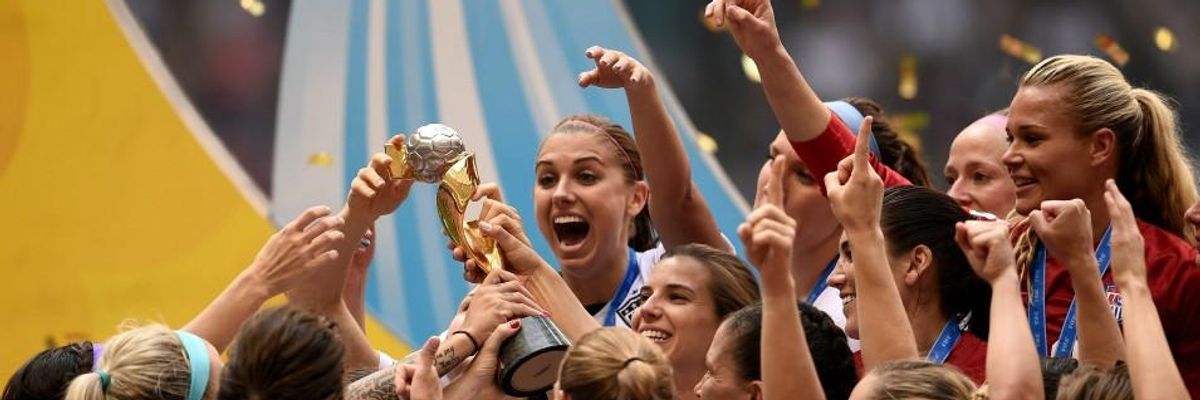
The U.S. women's national team celebrates after winning the FIFA Women's World Cup against Japan on July 5, 2015 in Vancouver, Canada. (Photo: Dennis Grombkowski/Getty Images)
In Show of Solidarity, US Men's Soccer Team Slams Officials for 'Systematic' Pay Discrimination Against USWNT
"Achieving equal pay is so much bigger than our team and our playing fields—women in workforces everywhere deserve equality now."
The union representing the U.S. Men's National Soccer Team waded into the rift between the national women's team and the U.S. Soccer Federation over equal pay Wednesday, demanding that the federation end its "false narrative" over the female players' compensation.
The U.S. National Soccer Team Players Association (USNSTPA) released the statement shortly after contract negotiations between the federation (USSF) and the men's team stalled. The union said the women's current contract, covering 2017 to 2021, offers lower compensation than the men's recently expired deal, which covered 2011 to 2018.
"Our great hope is that 2020 will be the year of equal pay. We are grateful for the support of our male colleagues, and also for the overwhelming solidarity from millions of fans and sponsors around the world who have stood with us to fight USSF's discrimination."
--Megan Rapinoe, USWNT
"What we believe should happen is simple. Pay the women significantly more than our recently expired men's deal," said the union. "In our estimation, the women were due at least triple what our expired deal was worth in player compensation."
After winning the World Cup last summer, 28 players from the women's team (USWNT) filed a lawsuit against the federation, accusing officials of "institutionalized gender discrimination."
Despite outperforming their male counterparts by winning three out of seven women's World Cups, the USWNT says players are paid 38% of what the men's soccer team is paid.
"For more than 20 years, the Federation has resisted any concept of equal pay or basic economic fairness for the USWNT players," reads the statement from the men's team. "Historically, the Federation also refused to include in the women's [collective bargaining agreement] the same provisions as the men's with respect to air travel, hotels, etc. This is systematic gender discrimination that should have never happened."
After the USWNT filed its complaint last year, USSF President Carlos Cordeiro put forward what the men's team called a "false narrative," claiming the USWNT has actually been paid more in total over the past decade than the men.
Cordeiro "highlighted tens of millions of dollars of investment by the federation in women's soccer, noting specifically more than $18 million in direct support for the National Women's Soccer League, the seven-year-old professional league, and millions more in spending on youth programs," reported the New York Times.
Molly Levinson, a spokesperson for the USWNT, countered Cordeiro's claim, calling it both a "ruse" and "sad attempt by the USSF to quell the overwhelming tide of support" for the women's case.
"Any apples to apples comparison shows that the men earn far more than the women," Levinson said last summer. "The fact is the women's team requested the same compensation structure as the men have, so they would be paid equally for equal performance. USSF refused, offering lower compensation in every category for the women in a pay for performance structure. That is patently unequal pay."
Megan Rapinoe, captain of the USWNT, released a statement thanking the USNSTPA for its show of solidarity.
"Our great hope is that 2020 will be the year of equal pay. We are grateful for the support of our male colleagues, and also for the overwhelming solidarity from millions of fans and sponsors around the world who have stood with us to fight USSF's discrimination," the statement said. "Achieving equal pay is so much bigger than our team and our playing fields--women in workforces everywhere deserve equality now."
Observers on social media applauded the men's team for speaking out.
"Sport is a microcosm of society," tweeted attorney Kelsey Trainor. "The USWNT equal pay lawsuit is about so much more."
The men's team called on soccer fans to withdraw support from the USSF's sponsors, including Johnson & Johnson, AT&T, and Nike until the federation does "the right thing and gives the women a new CBA that pays a fair share of the gate receipts and that television and sponsorship revenue to the players."
"Support the players, not the Federation," the union added.
We are at a crossroads
This country and this world are at a monumental crossroads. US voters have an opportunity to beat back the forces of fascism and confront the billionaires who are rigging the economy, our media system, and our democracy, making it increasingly impossible for ordinary people to get by. We’re not just talking about the election. We’re talking about what must be done once these fascist elements are vanquished from power. We need a bolder set of solutions than what either major party has so far been willing to offer and a working-class movement ready to fight like hell for it. Trump didn't emerge from nowhere. The conditions that fueled MAGA authoritarianism were created by decades of radical neoliberal economic policies and a corrupt political system dominated by corporate interests. They slashed taxes on the super-rich, promising that the benefits would trickle down. They said giveaways to the corporate titans would make life more affordable for the rest of us. It was all bullshit. And when a bitter, betrayed populace searches for someone to blame, right-wing demagogues have little trouble finding scapegoats. People know when they're being lied to, but you won't hear any of this from the corporate media. Only independent journalism—powered and funded by people who believe in building a better world—can deliver truly trustworthy daily news. Our Fall Campaign is underway, and we need your help. To power our newsroom through the rest of the year, we need to raise $125,000 by midnight on October 31. So if you share our vision, please contribute whatever you can to sustain our work. |
The union representing the U.S. Men's National Soccer Team waded into the rift between the national women's team and the U.S. Soccer Federation over equal pay Wednesday, demanding that the federation end its "false narrative" over the female players' compensation.
The U.S. National Soccer Team Players Association (USNSTPA) released the statement shortly after contract negotiations between the federation (USSF) and the men's team stalled. The union said the women's current contract, covering 2017 to 2021, offers lower compensation than the men's recently expired deal, which covered 2011 to 2018.
"Our great hope is that 2020 will be the year of equal pay. We are grateful for the support of our male colleagues, and also for the overwhelming solidarity from millions of fans and sponsors around the world who have stood with us to fight USSF's discrimination."
--Megan Rapinoe, USWNT
"What we believe should happen is simple. Pay the women significantly more than our recently expired men's deal," said the union. "In our estimation, the women were due at least triple what our expired deal was worth in player compensation."
After winning the World Cup last summer, 28 players from the women's team (USWNT) filed a lawsuit against the federation, accusing officials of "institutionalized gender discrimination."
Despite outperforming their male counterparts by winning three out of seven women's World Cups, the USWNT says players are paid 38% of what the men's soccer team is paid.
"For more than 20 years, the Federation has resisted any concept of equal pay or basic economic fairness for the USWNT players," reads the statement from the men's team. "Historically, the Federation also refused to include in the women's [collective bargaining agreement] the same provisions as the men's with respect to air travel, hotels, etc. This is systematic gender discrimination that should have never happened."
After the USWNT filed its complaint last year, USSF President Carlos Cordeiro put forward what the men's team called a "false narrative," claiming the USWNT has actually been paid more in total over the past decade than the men.
Cordeiro "highlighted tens of millions of dollars of investment by the federation in women's soccer, noting specifically more than $18 million in direct support for the National Women's Soccer League, the seven-year-old professional league, and millions more in spending on youth programs," reported the New York Times.
Molly Levinson, a spokesperson for the USWNT, countered Cordeiro's claim, calling it both a "ruse" and "sad attempt by the USSF to quell the overwhelming tide of support" for the women's case.
"Any apples to apples comparison shows that the men earn far more than the women," Levinson said last summer. "The fact is the women's team requested the same compensation structure as the men have, so they would be paid equally for equal performance. USSF refused, offering lower compensation in every category for the women in a pay for performance structure. That is patently unequal pay."
Megan Rapinoe, captain of the USWNT, released a statement thanking the USNSTPA for its show of solidarity.
"Our great hope is that 2020 will be the year of equal pay. We are grateful for the support of our male colleagues, and also for the overwhelming solidarity from millions of fans and sponsors around the world who have stood with us to fight USSF's discrimination," the statement said. "Achieving equal pay is so much bigger than our team and our playing fields--women in workforces everywhere deserve equality now."
Observers on social media applauded the men's team for speaking out.
"Sport is a microcosm of society," tweeted attorney Kelsey Trainor. "The USWNT equal pay lawsuit is about so much more."
The men's team called on soccer fans to withdraw support from the USSF's sponsors, including Johnson & Johnson, AT&T, and Nike until the federation does "the right thing and gives the women a new CBA that pays a fair share of the gate receipts and that television and sponsorship revenue to the players."
"Support the players, not the Federation," the union added.