

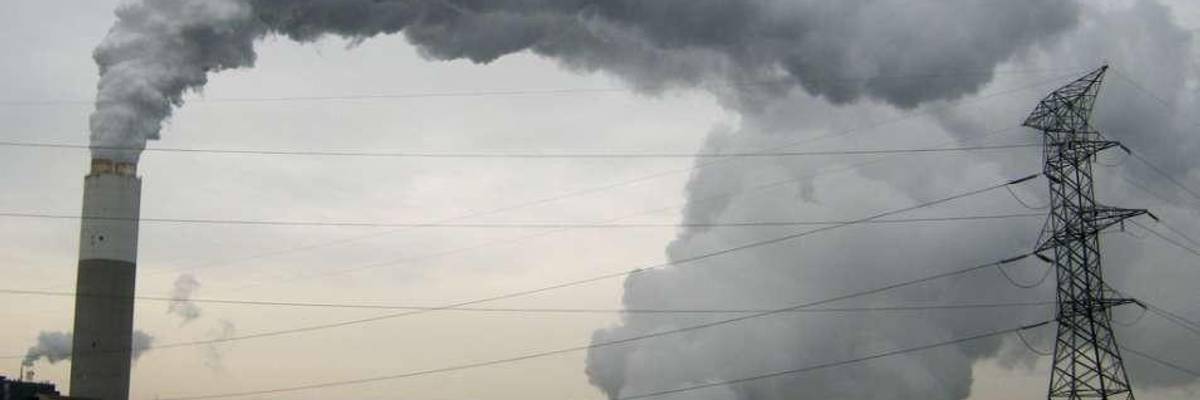
"Any climate proposal that does not explicitly stop the extraction of fossil fuels is not a serious climate proposal. Our first step must be to ban fracking, ban exports and imports of fossil fuels, and stop building new fossil fuel infrastructure," said the Center for Biological Diversity. "Anything less threatens future generations with an uninhabitable planet." (Photo: ribarnica/Flickr/cc)
Senate Democrats' Plan for Net Zero Carbon Emissions by 2050 Is 'Wishful Thinking' on Solving Crisis, Climate Action Groups Say
"We need binding emission reduction targets, in line with what climate justice and historical responsibility demand, far sooner than 2050."
New climate legislation put forward by Senate Democrats is "woefully" insufficient to avoid the worst effects of the climate crisis when compared to the warnings of the world's top scientists, green groups said Wednesday.
Led by Sen. Tom Carper (D-Del.), 34 Democrats released the Clean Economy Act on Wednesday. The bill calls for the gradual reduction of carbon emissions, reaching net zero by 2050--but leaves the action in the control of the EPA.
"If we're going to get out of the mess we've created, Congress needs to start listening to the desperate pleas of scientists and act decisively to cut emissions by at least half by 2030. Sadly this bill just doesn't cut it."
--Brett Hartl, Center for Biological Diversity
The agency, currently headed by former coal lobbyist Andrew Wheeler, would under the new law be directed to phase out carbon emissions with reduction targets in 2025, 2030, and 2040, eventually hitting net zero in 30 years.
"This is the quickest way we can, I think, jump-start government-wide climate action by encouraging agencies to use the tools that they already have," Carper said in a statement.
Friends of the Earth slammed that assesment, saying the legislation puts "too much faith in future administrations."
"We need binding emission reduction targets, in line with what climate justice and historical responsibility demand, far sooner than 2050," Friends of the Earth (FOE) told The Hill. "Unspecified interim targets are ill-suited to our moment of climate emergency."
The Clean Economy Plan is "based in false solutions," FOE added on Twitter.
In 2018, the U.N. Intergovernmental Panel on Climate Change (IPCC) released a study warning that world governments have only until 2030 to keep the warming of the plant to 1.5o Celsius in order to avoid the worst effects of the climate crisis. At the time, Friends of the Earth Europe warned that the European Union's proposal to reach net zero carbon emissions by 2050 was "simply too late."
"The climate crisis will never get solved with wishful thinking and half-measures that punt all-important decisions to the EPA," said Brett Hartl, government affairs director at the Center for Biological Diversity. "If we're going to get out of the mess we've created, Congress needs to start listening to the desperate pleas of scientists and act decisively to cut emissions by at least half by 2030. Sadly this bill just doesn't cut it."
In The Conversation last September, sustainable development professor Tim Jackson wrote a net zero target of 2050 ignores the global carbon budget set by the IPCC, which estimates the budget for the rest of this century is 420 billion tons of carbon.
"It is dangerously misleading for advanced nations to set target dates as far out as 2050," wrote Jackson. "Doing so ignores the importance of staying within a fair carbon budget and gives a false impression that action can be delayed. In reality, the only way to ensure that any developed country remains within its fair budget is to aim for an early net zero target."
Food & Water Action said Wednesday the U.S. is defying its "moral obligation" to quickly phase out all fossil fuels.
"We have to move off fossil fuels now," said Mitch Jones, the group's policy director. "Any climate proposal that does not explicitly stop the extraction of fossil fuels is not a serious climate proposal. Our first step must be to ban fracking, ban exports and imports of fossil fuels, and stop building new fossil fuel infrastructure. Anything less threatens future generations with an uninhabitable planet."
An Urgent Message From Our Co-Founder
Dear Common Dreams reader, It’s been nearly 30 years since I co-founded Common Dreams with my late wife, Lina Newhouser. We had the radical notion that journalism should serve the public good, not corporate profits. It was clear to us from the outset what it would take to build such a project. No paid advertisements. No corporate sponsors. No millionaire publisher telling us what to think or do. Many people said we wouldn't last a year, but we proved those doubters wrong. Together with a tremendous team of journalists and dedicated staff, we built an independent media outlet free from the constraints of profits and corporate control. Our mission has always been simple: To inform. To inspire. To ignite change for the common good. Building Common Dreams was not easy. Our survival was never guaranteed. When you take on the most powerful forces—Wall Street greed, fossil fuel industry destruction, Big Tech lobbyists, and uber-rich oligarchs who have spent billions upon billions rigging the economy and democracy in their favor—the only bulwark you have is supporters who believe in your work. But here’s the urgent message from me today. It's never been this bad out there. And it's never been this hard to keep us going. At the very moment Common Dreams is most needed, the threats we face are intensifying. We need your support now more than ever. We don't accept corporate advertising and never will. We don't have a paywall because we don't think people should be blocked from critical news based on their ability to pay. Everything we do is funded by the donations of readers like you. When everyone does the little they can afford, we are strong. But if that support retreats or dries up, so do we. Will you donate now to make sure Common Dreams not only survives but thrives? —Craig Brown, Co-founder |
New climate legislation put forward by Senate Democrats is "woefully" insufficient to avoid the worst effects of the climate crisis when compared to the warnings of the world's top scientists, green groups said Wednesday.
Led by Sen. Tom Carper (D-Del.), 34 Democrats released the Clean Economy Act on Wednesday. The bill calls for the gradual reduction of carbon emissions, reaching net zero by 2050--but leaves the action in the control of the EPA.
"If we're going to get out of the mess we've created, Congress needs to start listening to the desperate pleas of scientists and act decisively to cut emissions by at least half by 2030. Sadly this bill just doesn't cut it."
--Brett Hartl, Center for Biological Diversity
The agency, currently headed by former coal lobbyist Andrew Wheeler, would under the new law be directed to phase out carbon emissions with reduction targets in 2025, 2030, and 2040, eventually hitting net zero in 30 years.
"This is the quickest way we can, I think, jump-start government-wide climate action by encouraging agencies to use the tools that they already have," Carper said in a statement.
Friends of the Earth slammed that assesment, saying the legislation puts "too much faith in future administrations."
"We need binding emission reduction targets, in line with what climate justice and historical responsibility demand, far sooner than 2050," Friends of the Earth (FOE) told The Hill. "Unspecified interim targets are ill-suited to our moment of climate emergency."
The Clean Economy Plan is "based in false solutions," FOE added on Twitter.
In 2018, the U.N. Intergovernmental Panel on Climate Change (IPCC) released a study warning that world governments have only until 2030 to keep the warming of the plant to 1.5o Celsius in order to avoid the worst effects of the climate crisis. At the time, Friends of the Earth Europe warned that the European Union's proposal to reach net zero carbon emissions by 2050 was "simply too late."
"The climate crisis will never get solved with wishful thinking and half-measures that punt all-important decisions to the EPA," said Brett Hartl, government affairs director at the Center for Biological Diversity. "If we're going to get out of the mess we've created, Congress needs to start listening to the desperate pleas of scientists and act decisively to cut emissions by at least half by 2030. Sadly this bill just doesn't cut it."
In The Conversation last September, sustainable development professor Tim Jackson wrote a net zero target of 2050 ignores the global carbon budget set by the IPCC, which estimates the budget for the rest of this century is 420 billion tons of carbon.
"It is dangerously misleading for advanced nations to set target dates as far out as 2050," wrote Jackson. "Doing so ignores the importance of staying within a fair carbon budget and gives a false impression that action can be delayed. In reality, the only way to ensure that any developed country remains within its fair budget is to aim for an early net zero target."
Food & Water Action said Wednesday the U.S. is defying its "moral obligation" to quickly phase out all fossil fuels.
"We have to move off fossil fuels now," said Mitch Jones, the group's policy director. "Any climate proposal that does not explicitly stop the extraction of fossil fuels is not a serious climate proposal. Our first step must be to ban fracking, ban exports and imports of fossil fuels, and stop building new fossil fuel infrastructure. Anything less threatens future generations with an uninhabitable planet."
New climate legislation put forward by Senate Democrats is "woefully" insufficient to avoid the worst effects of the climate crisis when compared to the warnings of the world's top scientists, green groups said Wednesday.
Led by Sen. Tom Carper (D-Del.), 34 Democrats released the Clean Economy Act on Wednesday. The bill calls for the gradual reduction of carbon emissions, reaching net zero by 2050--but leaves the action in the control of the EPA.
"If we're going to get out of the mess we've created, Congress needs to start listening to the desperate pleas of scientists and act decisively to cut emissions by at least half by 2030. Sadly this bill just doesn't cut it."
--Brett Hartl, Center for Biological Diversity
The agency, currently headed by former coal lobbyist Andrew Wheeler, would under the new law be directed to phase out carbon emissions with reduction targets in 2025, 2030, and 2040, eventually hitting net zero in 30 years.
"This is the quickest way we can, I think, jump-start government-wide climate action by encouraging agencies to use the tools that they already have," Carper said in a statement.
Friends of the Earth slammed that assesment, saying the legislation puts "too much faith in future administrations."
"We need binding emission reduction targets, in line with what climate justice and historical responsibility demand, far sooner than 2050," Friends of the Earth (FOE) told The Hill. "Unspecified interim targets are ill-suited to our moment of climate emergency."
The Clean Economy Plan is "based in false solutions," FOE added on Twitter.
In 2018, the U.N. Intergovernmental Panel on Climate Change (IPCC) released a study warning that world governments have only until 2030 to keep the warming of the plant to 1.5o Celsius in order to avoid the worst effects of the climate crisis. At the time, Friends of the Earth Europe warned that the European Union's proposal to reach net zero carbon emissions by 2050 was "simply too late."
"The climate crisis will never get solved with wishful thinking and half-measures that punt all-important decisions to the EPA," said Brett Hartl, government affairs director at the Center for Biological Diversity. "If we're going to get out of the mess we've created, Congress needs to start listening to the desperate pleas of scientists and act decisively to cut emissions by at least half by 2030. Sadly this bill just doesn't cut it."
In The Conversation last September, sustainable development professor Tim Jackson wrote a net zero target of 2050 ignores the global carbon budget set by the IPCC, which estimates the budget for the rest of this century is 420 billion tons of carbon.
"It is dangerously misleading for advanced nations to set target dates as far out as 2050," wrote Jackson. "Doing so ignores the importance of staying within a fair carbon budget and gives a false impression that action can be delayed. In reality, the only way to ensure that any developed country remains within its fair budget is to aim for an early net zero target."
Food & Water Action said Wednesday the U.S. is defying its "moral obligation" to quickly phase out all fossil fuels.
"We have to move off fossil fuels now," said Mitch Jones, the group's policy director. "Any climate proposal that does not explicitly stop the extraction of fossil fuels is not a serious climate proposal. Our first step must be to ban fracking, ban exports and imports of fossil fuels, and stop building new fossil fuel infrastructure. Anything less threatens future generations with an uninhabitable planet."