SUBSCRIBE TO OUR FREE NEWSLETTER
Daily news & progressive opinion—funded by the people, not the corporations—delivered straight to your inbox.
5
#000000
#FFFFFF
To donate by check, phone, or other method, see our More Ways to Give page.
Daily news & progressive opinion—funded by the people, not the corporations—delivered straight to your inbox.
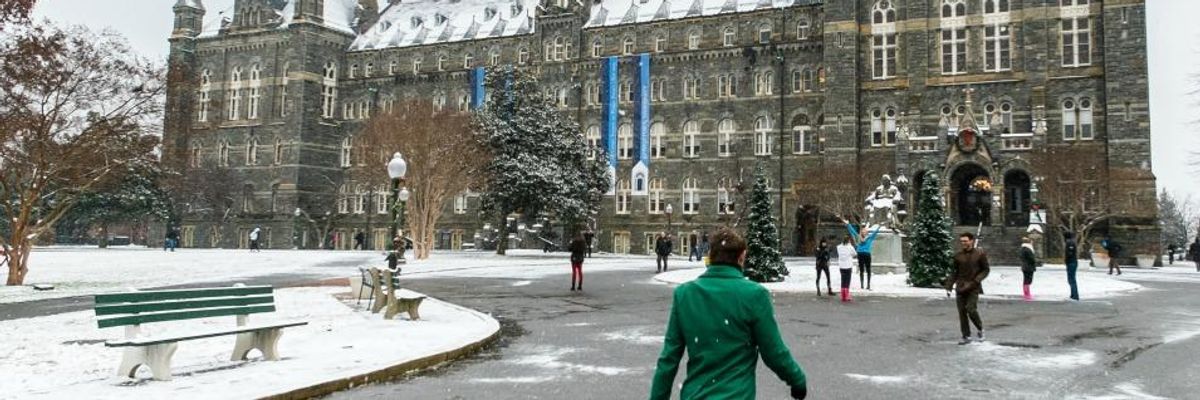
The Georgetown University board of directors announced Thursday it would divest from fossil fuels. (Photo: Ehpien/Flickr/cc)
Student-led anti-fossil fuel campaigns at universities across the country pointed to Georgetown University Friday as the school's board of directors announced it would divest from fossil fuels and redouble its efforts to invest in renewable energy instead.
The university's decision came after a sustained pressure campaign from Georgetown University Fossil Free (GUFF), a student group which submitted multiple proposals to the Georgetown Committee on Investments and Social Responsibility before the panel recommended the divestment this week. The school community also voted on a referendum regarding divestment on Thursday, withn more than 90% voting in favor.
GUFF issued a statement thanking the board of directors for its decision to divest and the school community for participating in the campaign.
"We are thrilled that our university has taken this important step in supporting climate justice, student voices, and financial accountability," GUFF wrote.
Similar groups at other schools called on administrators to follow suit:
Under Georgetown's new policy, the board of directors said, "the university will continue to make investments that target a market rate of return in renewable energy, energy efficiency and related areas while freezing new endowment investments in companies or funds whose primary business is the exploration or extraction of fossil fuels."
The school will divest from public securities in fossil fuel companies in the next five years and existing investments in those companies in the next decade.
"Divestment allows us to divert more capital to fund development of renewable energy projects that will play a vital role in the transition away from fossil fuels--part of the long-term solution required to prevent the most dangerous effects of climate change," Michael Barry, Georgetown's chief investment officer, said in a statement.
Climate action advocates including 350.org co-founder Bill McKibben and author Naomi Klein applauded the move.
"Something big is shifting," Klein wrote.
Another huge divestment win. Something big is shifting, and it lines us up perfectly for a real #GreenNewDeal starting next year - let's not screw this up! https://t.co/dmPob4RkGZ
-- Naomi Klein (@NaomiAKlein) February 7, 2020
In November, hundreds of Harvard and Yale students stormed the field during the two schools' annual football game to demand the institutions divest from fossil fuels. The University of California system announced it would divest last September, and more than 1,000 other institutions around the world have committed to divestment in recent years.
As Georgetown students and faculty were celebrating the board's decision Friday, the Sunrise Movement chapter at George Washington University two miles away expressed frustration with the school's board of trustees, which announced it would form an "environmental, social, and governance responsibility" task force without naming divestment from fossil fuels as an immediate goal.
"There is absolutely no need to 'explore' whether or not GW's endowment should divest from fossil fuels," wrote the group. "The moral imperative is clear and does not need a moment's thought as to whether or not it is actively contributing to the degradation of our planet."
The Sunrise Movement chapter vowed to make sure it was "sufficiently considered in this process" and demanded the university join Georgetown in fully divesting from fossil fuels.
Dear Common Dreams reader, It’s been nearly 30 years since I co-founded Common Dreams with my late wife, Lina Newhouser. We had the radical notion that journalism should serve the public good, not corporate profits. It was clear to us from the outset what it would take to build such a project. No paid advertisements. No corporate sponsors. No millionaire publisher telling us what to think or do. Many people said we wouldn't last a year, but we proved those doubters wrong. Together with a tremendous team of journalists and dedicated staff, we built an independent media outlet free from the constraints of profits and corporate control. Our mission has always been simple: To inform. To inspire. To ignite change for the common good. Building Common Dreams was not easy. Our survival was never guaranteed. When you take on the most powerful forces—Wall Street greed, fossil fuel industry destruction, Big Tech lobbyists, and uber-rich oligarchs who have spent billions upon billions rigging the economy and democracy in their favor—the only bulwark you have is supporters who believe in your work. But here’s the urgent message from me today. It's never been this bad out there. And it's never been this hard to keep us going. At the very moment Common Dreams is most needed, the threats we face are intensifying. We need your support now more than ever. We don't accept corporate advertising and never will. We don't have a paywall because we don't think people should be blocked from critical news based on their ability to pay. Everything we do is funded by the donations of readers like you. When everyone does the little they can afford, we are strong. But if that support retreats or dries up, so do we. Will you donate now to make sure Common Dreams not only survives but thrives? —Craig Brown, Co-founder |
Student-led anti-fossil fuel campaigns at universities across the country pointed to Georgetown University Friday as the school's board of directors announced it would divest from fossil fuels and redouble its efforts to invest in renewable energy instead.
The university's decision came after a sustained pressure campaign from Georgetown University Fossil Free (GUFF), a student group which submitted multiple proposals to the Georgetown Committee on Investments and Social Responsibility before the panel recommended the divestment this week. The school community also voted on a referendum regarding divestment on Thursday, withn more than 90% voting in favor.
GUFF issued a statement thanking the board of directors for its decision to divest and the school community for participating in the campaign.
"We are thrilled that our university has taken this important step in supporting climate justice, student voices, and financial accountability," GUFF wrote.
Similar groups at other schools called on administrators to follow suit:
Under Georgetown's new policy, the board of directors said, "the university will continue to make investments that target a market rate of return in renewable energy, energy efficiency and related areas while freezing new endowment investments in companies or funds whose primary business is the exploration or extraction of fossil fuels."
The school will divest from public securities in fossil fuel companies in the next five years and existing investments in those companies in the next decade.
"Divestment allows us to divert more capital to fund development of renewable energy projects that will play a vital role in the transition away from fossil fuels--part of the long-term solution required to prevent the most dangerous effects of climate change," Michael Barry, Georgetown's chief investment officer, said in a statement.
Climate action advocates including 350.org co-founder Bill McKibben and author Naomi Klein applauded the move.
"Something big is shifting," Klein wrote.
Another huge divestment win. Something big is shifting, and it lines us up perfectly for a real #GreenNewDeal starting next year - let's not screw this up! https://t.co/dmPob4RkGZ
-- Naomi Klein (@NaomiAKlein) February 7, 2020
In November, hundreds of Harvard and Yale students stormed the field during the two schools' annual football game to demand the institutions divest from fossil fuels. The University of California system announced it would divest last September, and more than 1,000 other institutions around the world have committed to divestment in recent years.
As Georgetown students and faculty were celebrating the board's decision Friday, the Sunrise Movement chapter at George Washington University two miles away expressed frustration with the school's board of trustees, which announced it would form an "environmental, social, and governance responsibility" task force without naming divestment from fossil fuels as an immediate goal.
"There is absolutely no need to 'explore' whether or not GW's endowment should divest from fossil fuels," wrote the group. "The moral imperative is clear and does not need a moment's thought as to whether or not it is actively contributing to the degradation of our planet."
The Sunrise Movement chapter vowed to make sure it was "sufficiently considered in this process" and demanded the university join Georgetown in fully divesting from fossil fuels.
Student-led anti-fossil fuel campaigns at universities across the country pointed to Georgetown University Friday as the school's board of directors announced it would divest from fossil fuels and redouble its efforts to invest in renewable energy instead.
The university's decision came after a sustained pressure campaign from Georgetown University Fossil Free (GUFF), a student group which submitted multiple proposals to the Georgetown Committee on Investments and Social Responsibility before the panel recommended the divestment this week. The school community also voted on a referendum regarding divestment on Thursday, withn more than 90% voting in favor.
GUFF issued a statement thanking the board of directors for its decision to divest and the school community for participating in the campaign.
"We are thrilled that our university has taken this important step in supporting climate justice, student voices, and financial accountability," GUFF wrote.
Similar groups at other schools called on administrators to follow suit:
Under Georgetown's new policy, the board of directors said, "the university will continue to make investments that target a market rate of return in renewable energy, energy efficiency and related areas while freezing new endowment investments in companies or funds whose primary business is the exploration or extraction of fossil fuels."
The school will divest from public securities in fossil fuel companies in the next five years and existing investments in those companies in the next decade.
"Divestment allows us to divert more capital to fund development of renewable energy projects that will play a vital role in the transition away from fossil fuels--part of the long-term solution required to prevent the most dangerous effects of climate change," Michael Barry, Georgetown's chief investment officer, said in a statement.
Climate action advocates including 350.org co-founder Bill McKibben and author Naomi Klein applauded the move.
"Something big is shifting," Klein wrote.
Another huge divestment win. Something big is shifting, and it lines us up perfectly for a real #GreenNewDeal starting next year - let's not screw this up! https://t.co/dmPob4RkGZ
-- Naomi Klein (@NaomiAKlein) February 7, 2020
In November, hundreds of Harvard and Yale students stormed the field during the two schools' annual football game to demand the institutions divest from fossil fuels. The University of California system announced it would divest last September, and more than 1,000 other institutions around the world have committed to divestment in recent years.
As Georgetown students and faculty were celebrating the board's decision Friday, the Sunrise Movement chapter at George Washington University two miles away expressed frustration with the school's board of trustees, which announced it would form an "environmental, social, and governance responsibility" task force without naming divestment from fossil fuels as an immediate goal.
"There is absolutely no need to 'explore' whether or not GW's endowment should divest from fossil fuels," wrote the group. "The moral imperative is clear and does not need a moment's thought as to whether or not it is actively contributing to the degradation of our planet."
The Sunrise Movement chapter vowed to make sure it was "sufficiently considered in this process" and demanded the university join Georgetown in fully divesting from fossil fuels.