SUBSCRIBE TO OUR FREE NEWSLETTER
Daily news & progressive opinion—funded by the people, not the corporations—delivered straight to your inbox.
5
#000000
#FFFFFF
To donate by check, phone, or other method, see our More Ways to Give page.
Daily news & progressive opinion—funded by the people, not the corporations—delivered straight to your inbox.
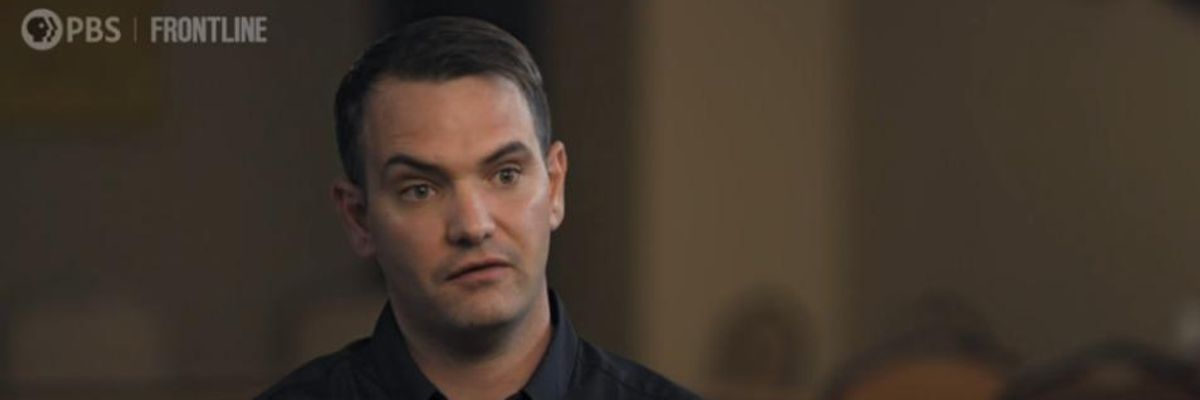
Border Patrol agent Wesley Farris told "Frontline" that separating families at the southern U.S. border was "the most horrible thing" he had ever done but that "we were all told to do this." (Photo: screenshot/"Frontline")
In a new Frontline documentary, a Border Patrol agent describes taking part in a pilot program to separate families nearly a year before the Trump administration officially unveiled the policy--saying that while he was unhappy about separating children from their parents, he and other agents were following orders.
Journalist Martin Smith interviews agent Wesley Farris in "Targeting El Paso" about the program Farris worked on in the summer of 2017 in El Paso, Texas. Agents were instructed to separate families as the administration tested the theory that doing so would deter people from trying to enter the U.S. at the border city.
"That was the most horrible thing I've ever done," Farris tells Smith in an excerpt released ahead of the documentary. "You can't help but see your own kids."
Farris describes one experience in particular which caused him to ask his supervisor to take him out of the pilot program.
"It was a young boy. I think he was about two. The world was upside down to that kid," Farris says. "So when the contractor tried to take him away, he reached for me and he climbed up on me again, and he was holding on to me. So that that one got me a little bit."
"I said at that one, 'I'm not doing this anymore. I won't do it,'" he tells Smith. "I went back to the supervisor and I told him, 'Don't assign me to do that anymore.'"
Farris "wanted to" take his complaint up the chain of command, he says, but the Border Patrol agents who were separating families were required to do as they were told.
"I mean, none of us were happy about it," Farris says. "We were all told to do this."
Journalist Brooke Binkowski suggested in a tweet that Farris's defense mirrored that of numerous war criminals who have invoked the "Nuremberg defense," infamously used by Nazi official Adolf Eichmann in the Nuremberg trials after World War II.
"So he was just doing his job? Where have we heard that defense before?" tweeted Binkowski.
The Trump administration announced six months after the pilot program ended that it would begin separating families on a much larger scale, eventually separating more than 5,000 children from their parents or guardians at the border.
As the program rapidly drew international outrage in the summer of 2018, then-Homeland Security Secretary Kirstjen Nielsen scoffed at the suggestion that the administration was separating families as a deterrent to asylum-seekers and migrants--but "Targeting El Paso" presents new evidence that it was doing just that.
"It aligned with my experience, in the times where we applied a consequence to people who cross the border illegally, we got less of them crossing the border illegally," Ronald Vitiello, former acting director of U.S. Immigration and Customs Enforcement (ICE), tells Frontline. "And so when zero tolerance is discussed as a way forward, we knew that it was going to be a benefit to us."
"Targeting El Paso" will premiere on PBS stations on Tuesday evening.
Dear Common Dreams reader, It’s been nearly 30 years since I co-founded Common Dreams with my late wife, Lina Newhouser. We had the radical notion that journalism should serve the public good, not corporate profits. It was clear to us from the outset what it would take to build such a project. No paid advertisements. No corporate sponsors. No millionaire publisher telling us what to think or do. Many people said we wouldn't last a year, but we proved those doubters wrong. Together with a tremendous team of journalists and dedicated staff, we built an independent media outlet free from the constraints of profits and corporate control. Our mission has always been simple: To inform. To inspire. To ignite change for the common good. Building Common Dreams was not easy. Our survival was never guaranteed. When you take on the most powerful forces—Wall Street greed, fossil fuel industry destruction, Big Tech lobbyists, and uber-rich oligarchs who have spent billions upon billions rigging the economy and democracy in their favor—the only bulwark you have is supporters who believe in your work. But here’s the urgent message from me today. It's never been this bad out there. And it's never been this hard to keep us going. At the very moment Common Dreams is most needed, the threats we face are intensifying. We need your support now more than ever. We don't accept corporate advertising and never will. We don't have a paywall because we don't think people should be blocked from critical news based on their ability to pay. Everything we do is funded by the donations of readers like you. When everyone does the little they can afford, we are strong. But if that support retreats or dries up, so do we. Will you donate now to make sure Common Dreams not only survives but thrives? —Craig Brown, Co-founder |
In a new Frontline documentary, a Border Patrol agent describes taking part in a pilot program to separate families nearly a year before the Trump administration officially unveiled the policy--saying that while he was unhappy about separating children from their parents, he and other agents were following orders.
Journalist Martin Smith interviews agent Wesley Farris in "Targeting El Paso" about the program Farris worked on in the summer of 2017 in El Paso, Texas. Agents were instructed to separate families as the administration tested the theory that doing so would deter people from trying to enter the U.S. at the border city.
"That was the most horrible thing I've ever done," Farris tells Smith in an excerpt released ahead of the documentary. "You can't help but see your own kids."
Farris describes one experience in particular which caused him to ask his supervisor to take him out of the pilot program.
"It was a young boy. I think he was about two. The world was upside down to that kid," Farris says. "So when the contractor tried to take him away, he reached for me and he climbed up on me again, and he was holding on to me. So that that one got me a little bit."
"I said at that one, 'I'm not doing this anymore. I won't do it,'" he tells Smith. "I went back to the supervisor and I told him, 'Don't assign me to do that anymore.'"
Farris "wanted to" take his complaint up the chain of command, he says, but the Border Patrol agents who were separating families were required to do as they were told.
"I mean, none of us were happy about it," Farris says. "We were all told to do this."
Journalist Brooke Binkowski suggested in a tweet that Farris's defense mirrored that of numerous war criminals who have invoked the "Nuremberg defense," infamously used by Nazi official Adolf Eichmann in the Nuremberg trials after World War II.
"So he was just doing his job? Where have we heard that defense before?" tweeted Binkowski.
The Trump administration announced six months after the pilot program ended that it would begin separating families on a much larger scale, eventually separating more than 5,000 children from their parents or guardians at the border.
As the program rapidly drew international outrage in the summer of 2018, then-Homeland Security Secretary Kirstjen Nielsen scoffed at the suggestion that the administration was separating families as a deterrent to asylum-seekers and migrants--but "Targeting El Paso" presents new evidence that it was doing just that.
"It aligned with my experience, in the times where we applied a consequence to people who cross the border illegally, we got less of them crossing the border illegally," Ronald Vitiello, former acting director of U.S. Immigration and Customs Enforcement (ICE), tells Frontline. "And so when zero tolerance is discussed as a way forward, we knew that it was going to be a benefit to us."
"Targeting El Paso" will premiere on PBS stations on Tuesday evening.
In a new Frontline documentary, a Border Patrol agent describes taking part in a pilot program to separate families nearly a year before the Trump administration officially unveiled the policy--saying that while he was unhappy about separating children from their parents, he and other agents were following orders.
Journalist Martin Smith interviews agent Wesley Farris in "Targeting El Paso" about the program Farris worked on in the summer of 2017 in El Paso, Texas. Agents were instructed to separate families as the administration tested the theory that doing so would deter people from trying to enter the U.S. at the border city.
"That was the most horrible thing I've ever done," Farris tells Smith in an excerpt released ahead of the documentary. "You can't help but see your own kids."
Farris describes one experience in particular which caused him to ask his supervisor to take him out of the pilot program.
"It was a young boy. I think he was about two. The world was upside down to that kid," Farris says. "So when the contractor tried to take him away, he reached for me and he climbed up on me again, and he was holding on to me. So that that one got me a little bit."
"I said at that one, 'I'm not doing this anymore. I won't do it,'" he tells Smith. "I went back to the supervisor and I told him, 'Don't assign me to do that anymore.'"
Farris "wanted to" take his complaint up the chain of command, he says, but the Border Patrol agents who were separating families were required to do as they were told.
"I mean, none of us were happy about it," Farris says. "We were all told to do this."
Journalist Brooke Binkowski suggested in a tweet that Farris's defense mirrored that of numerous war criminals who have invoked the "Nuremberg defense," infamously used by Nazi official Adolf Eichmann in the Nuremberg trials after World War II.
"So he was just doing his job? Where have we heard that defense before?" tweeted Binkowski.
The Trump administration announced six months after the pilot program ended that it would begin separating families on a much larger scale, eventually separating more than 5,000 children from their parents or guardians at the border.
As the program rapidly drew international outrage in the summer of 2018, then-Homeland Security Secretary Kirstjen Nielsen scoffed at the suggestion that the administration was separating families as a deterrent to asylum-seekers and migrants--but "Targeting El Paso" presents new evidence that it was doing just that.
"It aligned with my experience, in the times where we applied a consequence to people who cross the border illegally, we got less of them crossing the border illegally," Ronald Vitiello, former acting director of U.S. Immigration and Customs Enforcement (ICE), tells Frontline. "And so when zero tolerance is discussed as a way forward, we knew that it was going to be a benefit to us."
"Targeting El Paso" will premiere on PBS stations on Tuesday evening.