SUBSCRIBE TO OUR FREE NEWSLETTER
Daily news & progressive opinion—funded by the people, not the corporations—delivered straight to your inbox.
5
#000000
#FFFFFF
To donate by check, phone, or other method, see our More Ways to Give page.
Daily news & progressive opinion—funded by the people, not the corporations—delivered straight to your inbox.
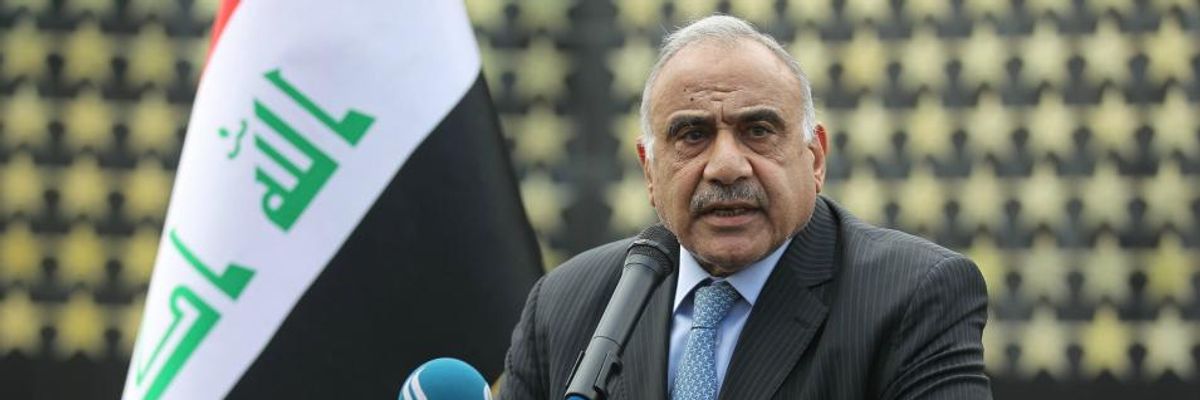
Iraq's Prime Minister Adel Abdel Mahdi speaks during afuneral ceremony in Baghdad on October 23, 2019. (Photo: Ahmad Al-Rubaye/AFP via Getty Images)
Update:
Iraq's parliament voted in an extraordinary session Sunday to expel all American troops from the country and file a United Nations complaint against the U.S. for violating Iraq's sovereignty with its assassination of Iranian General Qasem Soleimani in Baghdad.
Ahead of the vote, chants of "No, no, America" rang out inside the hall.
"Iraq called on the U.N. Security Council to condemn the bombing and assassinations," Iraq's foreign ministry said in a statement following the vote.
As The National reported, the Iraqi parliament approved "a five-point action plan that would require the Iraqi government to end the presence of foreign troops in the country, and withdraw its request for assistance from the anti-ISIS global coalition."
"Parliament also called on the government to ban the use of Iraqi airspace by any foreign power," according to The National. The resolution is non-binding, and the plan to expel American troops still requires the approval of the Iraqi government.
The U.S. currently has around 5,000 troops stationed in Iraq.
Earlier:
Speaking before an extraordinary session of parliament Sunday, Iraq's outgoing Prime Minister Adil Abdul-Mahdi recommended that the nation's lawmakers approve a measure to end U.S. troop presence in "immediately" following the assassination of Iranian General Qasem Soleimani in Baghdad.
The prime minister's remarks came before Iraqi lawmakers are set to vote on a resolution to end permission for American troops to remain in Iraq.
Washington Post reporter Mustafa Salim summarized Mahdi's recommendations:
The U.S. assassination Soleimani on Iraqi soil was met with fierce condemnation from Iraq's foreign ministry and the prime minister, who called the drone strike a violation of the nation's sovereignty.
"What happened was a political assassination," Mahdi said. "Iraq cannot accept this."
In a previously undisclosed detail one observer described as "stunning," Mahdi said Soleimani was in Baghdad to meet with him about a Saudi request for dialogue to relieve tensions in the region--not, as the U.S. has claimed, to plan attacks against American forces.
Dear Common Dreams reader, It’s been nearly 30 years since I co-founded Common Dreams with my late wife, Lina Newhouser. We had the radical notion that journalism should serve the public good, not corporate profits. It was clear to us from the outset what it would take to build such a project. No paid advertisements. No corporate sponsors. No millionaire publisher telling us what to think or do. Many people said we wouldn't last a year, but we proved those doubters wrong. Together with a tremendous team of journalists and dedicated staff, we built an independent media outlet free from the constraints of profits and corporate control. Our mission has always been simple: To inform. To inspire. To ignite change for the common good. Building Common Dreams was not easy. Our survival was never guaranteed. When you take on the most powerful forces—Wall Street greed, fossil fuel industry destruction, Big Tech lobbyists, and uber-rich oligarchs who have spent billions upon billions rigging the economy and democracy in their favor—the only bulwark you have is supporters who believe in your work. But here’s the urgent message from me today. It's never been this bad out there. And it's never been this hard to keep us going. At the very moment Common Dreams is most needed, the threats we face are intensifying. We need your support now more than ever. We don't accept corporate advertising and never will. We don't have a paywall because we don't think people should be blocked from critical news based on their ability to pay. Everything we do is funded by the donations of readers like you. When everyone does the little they can afford, we are strong. But if that support retreats or dries up, so do we. Will you donate now to make sure Common Dreams not only survives but thrives? —Craig Brown, Co-founder |
Update:
Iraq's parliament voted in an extraordinary session Sunday to expel all American troops from the country and file a United Nations complaint against the U.S. for violating Iraq's sovereignty with its assassination of Iranian General Qasem Soleimani in Baghdad.
Ahead of the vote, chants of "No, no, America" rang out inside the hall.
"Iraq called on the U.N. Security Council to condemn the bombing and assassinations," Iraq's foreign ministry said in a statement following the vote.
As The National reported, the Iraqi parliament approved "a five-point action plan that would require the Iraqi government to end the presence of foreign troops in the country, and withdraw its request for assistance from the anti-ISIS global coalition."
"Parliament also called on the government to ban the use of Iraqi airspace by any foreign power," according to The National. The resolution is non-binding, and the plan to expel American troops still requires the approval of the Iraqi government.
The U.S. currently has around 5,000 troops stationed in Iraq.
Earlier:
Speaking before an extraordinary session of parliament Sunday, Iraq's outgoing Prime Minister Adil Abdul-Mahdi recommended that the nation's lawmakers approve a measure to end U.S. troop presence in "immediately" following the assassination of Iranian General Qasem Soleimani in Baghdad.
The prime minister's remarks came before Iraqi lawmakers are set to vote on a resolution to end permission for American troops to remain in Iraq.
Washington Post reporter Mustafa Salim summarized Mahdi's recommendations:
The U.S. assassination Soleimani on Iraqi soil was met with fierce condemnation from Iraq's foreign ministry and the prime minister, who called the drone strike a violation of the nation's sovereignty.
"What happened was a political assassination," Mahdi said. "Iraq cannot accept this."
In a previously undisclosed detail one observer described as "stunning," Mahdi said Soleimani was in Baghdad to meet with him about a Saudi request for dialogue to relieve tensions in the region--not, as the U.S. has claimed, to plan attacks against American forces.
Update:
Iraq's parliament voted in an extraordinary session Sunday to expel all American troops from the country and file a United Nations complaint against the U.S. for violating Iraq's sovereignty with its assassination of Iranian General Qasem Soleimani in Baghdad.
Ahead of the vote, chants of "No, no, America" rang out inside the hall.
"Iraq called on the U.N. Security Council to condemn the bombing and assassinations," Iraq's foreign ministry said in a statement following the vote.
As The National reported, the Iraqi parliament approved "a five-point action plan that would require the Iraqi government to end the presence of foreign troops in the country, and withdraw its request for assistance from the anti-ISIS global coalition."
"Parliament also called on the government to ban the use of Iraqi airspace by any foreign power," according to The National. The resolution is non-binding, and the plan to expel American troops still requires the approval of the Iraqi government.
The U.S. currently has around 5,000 troops stationed in Iraq.
Earlier:
Speaking before an extraordinary session of parliament Sunday, Iraq's outgoing Prime Minister Adil Abdul-Mahdi recommended that the nation's lawmakers approve a measure to end U.S. troop presence in "immediately" following the assassination of Iranian General Qasem Soleimani in Baghdad.
The prime minister's remarks came before Iraqi lawmakers are set to vote on a resolution to end permission for American troops to remain in Iraq.
Washington Post reporter Mustafa Salim summarized Mahdi's recommendations:
The U.S. assassination Soleimani on Iraqi soil was met with fierce condemnation from Iraq's foreign ministry and the prime minister, who called the drone strike a violation of the nation's sovereignty.
"What happened was a political assassination," Mahdi said. "Iraq cannot accept this."
In a previously undisclosed detail one observer described as "stunning," Mahdi said Soleimani was in Baghdad to meet with him about a Saudi request for dialogue to relieve tensions in the region--not, as the U.S. has claimed, to plan attacks against American forces.