SUBSCRIBE TO OUR FREE NEWSLETTER
Daily news & progressive opinion—funded by the people, not the corporations—delivered straight to your inbox.
5
#000000
#FFFFFF
To donate by check, phone, or other method, see our More Ways to Give page.
Daily news & progressive opinion—funded by the people, not the corporations—delivered straight to your inbox.
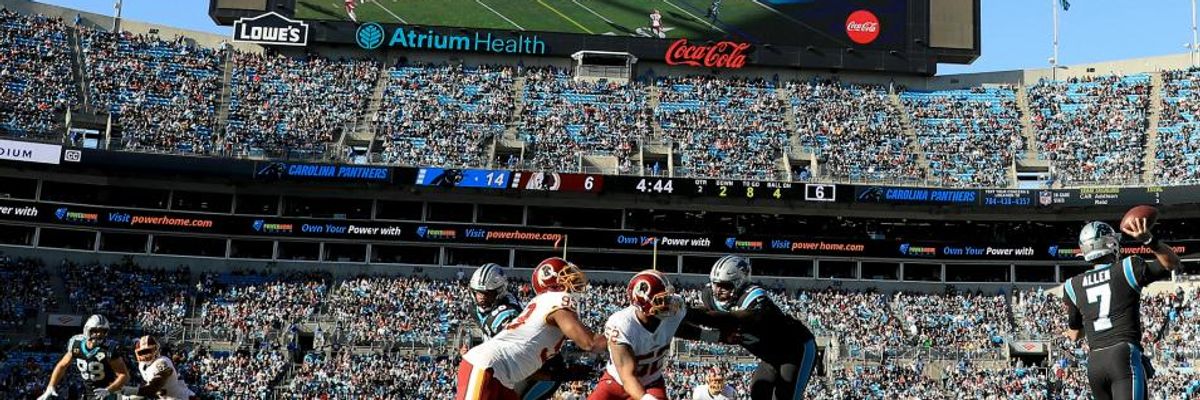
Kyle Allen of the Carolina Panthers throws an interception at Bank of America Stadium on December 1, 2019 in Charlotte, North Carolina. (Photo: Streeter Lecka/Getty Images)
Rule changes proposed by the Trump administration last week could let banks classify investments in professional sports stadiums as aid to the poor, and then give the financial institutions a significant tax break for their efforts.
The changes are part of an Office of the Comptroller of the Currency (OCC) and Federal Deposit Insurance Corporation (FDIC) plan to overhaul the Community Reinvestment Act of 1977, which requires banks to invest in low-income communities.
Both bank regulators are run by appointees of President Donald Trump.
As Bloomberg reported Monday, "the agencies drafted a long list hypothetical ways banks could seek to meet their obligations [under the Community Reinvestment Act], including this sentence on page 100 of their proposal: 'Investment in a qualified opportunity fund, established to finance improvements to an athletic stadium in an opportunity zone that is also [a low- or moderate-income] census tract.'"
"There are well over a dozen NFL venues nestled in so-called opportunity zones," Bloomberg noted. "They include M&T Bank Stadium in Baltimore, home of the National Football League's Ravens, which this year completed $120 million in upgrades such as a new sound system... There also are facilities for professional baseball, basketball, soccer, and hockey teams in the zones."
Under the 2017 tax law signed by President Donald Trump, real estate developers and financial institutions that invest in "opportunity zones" receive a capital gains tax cut.
The tax incentive sparked criticism from lawmakers including Sen. Ron Wyden (D-Ore.), who warned in a statement last month that "there are no safeguards to ensure taxpayers are not simply subsidizing handouts for billionaires with no benefit to the low-income communities this program was supposed to help."
" Republicans who support the program should work with Democrats to ensure it does not become a boondoggle," Wyden said.
Critics reacted with incredulity to the Trump administration's proposed rule changes.
"The proposed credit for financing 'improvements' to stadiums soon raised eyebrows among policy wonks," Bloomberg reported. "That may put pressure on regulators to clarify whether banks really can satisfy CRA obligations by, say, funding a 200-foot video screen."
Daily Beast reporter Lachlan Markey said the proposal is "simply astonishing."
Pat Garofalo, managing editor of Talk Poverty and author of the "Boondoggle" newsletter, tweeted that the proposed rule changes are "truly wild."
"A potential change to the Community Reinvestment Act--the federal anti-redlining law--would allow banks to meet their obligations by investing in sports stadiums in Opportunity Zones," said Garofalo. "Opportunity Zones are a bad giveaway to investors gentrifying neighborhoods. Stadium subsidies are a huge waste of money."
Dear Common Dreams reader, It’s been nearly 30 years since I co-founded Common Dreams with my late wife, Lina Newhouser. We had the radical notion that journalism should serve the public good, not corporate profits. It was clear to us from the outset what it would take to build such a project. No paid advertisements. No corporate sponsors. No millionaire publisher telling us what to think or do. Many people said we wouldn't last a year, but we proved those doubters wrong. Together with a tremendous team of journalists and dedicated staff, we built an independent media outlet free from the constraints of profits and corporate control. Our mission has always been simple: To inform. To inspire. To ignite change for the common good. Building Common Dreams was not easy. Our survival was never guaranteed. When you take on the most powerful forces—Wall Street greed, fossil fuel industry destruction, Big Tech lobbyists, and uber-rich oligarchs who have spent billions upon billions rigging the economy and democracy in their favor—the only bulwark you have is supporters who believe in your work. But here’s the urgent message from me today. It's never been this bad out there. And it's never been this hard to keep us going. At the very moment Common Dreams is most needed, the threats we face are intensifying. We need your support now more than ever. We don't accept corporate advertising and never will. We don't have a paywall because we don't think people should be blocked from critical news based on their ability to pay. Everything we do is funded by the donations of readers like you. When everyone does the little they can afford, we are strong. But if that support retreats or dries up, so do we. Will you donate now to make sure Common Dreams not only survives but thrives? —Craig Brown, Co-founder |
Rule changes proposed by the Trump administration last week could let banks classify investments in professional sports stadiums as aid to the poor, and then give the financial institutions a significant tax break for their efforts.
The changes are part of an Office of the Comptroller of the Currency (OCC) and Federal Deposit Insurance Corporation (FDIC) plan to overhaul the Community Reinvestment Act of 1977, which requires banks to invest in low-income communities.
Both bank regulators are run by appointees of President Donald Trump.
As Bloomberg reported Monday, "the agencies drafted a long list hypothetical ways banks could seek to meet their obligations [under the Community Reinvestment Act], including this sentence on page 100 of their proposal: 'Investment in a qualified opportunity fund, established to finance improvements to an athletic stadium in an opportunity zone that is also [a low- or moderate-income] census tract.'"
"There are well over a dozen NFL venues nestled in so-called opportunity zones," Bloomberg noted. "They include M&T Bank Stadium in Baltimore, home of the National Football League's Ravens, which this year completed $120 million in upgrades such as a new sound system... There also are facilities for professional baseball, basketball, soccer, and hockey teams in the zones."
Under the 2017 tax law signed by President Donald Trump, real estate developers and financial institutions that invest in "opportunity zones" receive a capital gains tax cut.
The tax incentive sparked criticism from lawmakers including Sen. Ron Wyden (D-Ore.), who warned in a statement last month that "there are no safeguards to ensure taxpayers are not simply subsidizing handouts for billionaires with no benefit to the low-income communities this program was supposed to help."
" Republicans who support the program should work with Democrats to ensure it does not become a boondoggle," Wyden said.
Critics reacted with incredulity to the Trump administration's proposed rule changes.
"The proposed credit for financing 'improvements' to stadiums soon raised eyebrows among policy wonks," Bloomberg reported. "That may put pressure on regulators to clarify whether banks really can satisfy CRA obligations by, say, funding a 200-foot video screen."
Daily Beast reporter Lachlan Markey said the proposal is "simply astonishing."
Pat Garofalo, managing editor of Talk Poverty and author of the "Boondoggle" newsletter, tweeted that the proposed rule changes are "truly wild."
"A potential change to the Community Reinvestment Act--the federal anti-redlining law--would allow banks to meet their obligations by investing in sports stadiums in Opportunity Zones," said Garofalo. "Opportunity Zones are a bad giveaway to investors gentrifying neighborhoods. Stadium subsidies are a huge waste of money."
Rule changes proposed by the Trump administration last week could let banks classify investments in professional sports stadiums as aid to the poor, and then give the financial institutions a significant tax break for their efforts.
The changes are part of an Office of the Comptroller of the Currency (OCC) and Federal Deposit Insurance Corporation (FDIC) plan to overhaul the Community Reinvestment Act of 1977, which requires banks to invest in low-income communities.
Both bank regulators are run by appointees of President Donald Trump.
As Bloomberg reported Monday, "the agencies drafted a long list hypothetical ways banks could seek to meet their obligations [under the Community Reinvestment Act], including this sentence on page 100 of their proposal: 'Investment in a qualified opportunity fund, established to finance improvements to an athletic stadium in an opportunity zone that is also [a low- or moderate-income] census tract.'"
"There are well over a dozen NFL venues nestled in so-called opportunity zones," Bloomberg noted. "They include M&T Bank Stadium in Baltimore, home of the National Football League's Ravens, which this year completed $120 million in upgrades such as a new sound system... There also are facilities for professional baseball, basketball, soccer, and hockey teams in the zones."
Under the 2017 tax law signed by President Donald Trump, real estate developers and financial institutions that invest in "opportunity zones" receive a capital gains tax cut.
The tax incentive sparked criticism from lawmakers including Sen. Ron Wyden (D-Ore.), who warned in a statement last month that "there are no safeguards to ensure taxpayers are not simply subsidizing handouts for billionaires with no benefit to the low-income communities this program was supposed to help."
" Republicans who support the program should work with Democrats to ensure it does not become a boondoggle," Wyden said.
Critics reacted with incredulity to the Trump administration's proposed rule changes.
"The proposed credit for financing 'improvements' to stadiums soon raised eyebrows among policy wonks," Bloomberg reported. "That may put pressure on regulators to clarify whether banks really can satisfy CRA obligations by, say, funding a 200-foot video screen."
Daily Beast reporter Lachlan Markey said the proposal is "simply astonishing."
Pat Garofalo, managing editor of Talk Poverty and author of the "Boondoggle" newsletter, tweeted that the proposed rule changes are "truly wild."
"A potential change to the Community Reinvestment Act--the federal anti-redlining law--would allow banks to meet their obligations by investing in sports stadiums in Opportunity Zones," said Garofalo. "Opportunity Zones are a bad giveaway to investors gentrifying neighborhoods. Stadium subsidies are a huge waste of money."