SUBSCRIBE TO OUR FREE NEWSLETTER
Daily news & progressive opinion—funded by the people, not the corporations—delivered straight to your inbox.
5
#000000
#FFFFFF
To donate by check, phone, or other method, see our More Ways to Give page.

New data released Monday explains the numbers behind Sen. Bernie Sanders' often-cited statistic that the three richest Americans hold more wealth than the 160 million people who make up the bottom 50% of the population.
Washington Post columnist Greg Sargent published what he called "stunning" findings from UC Berkeley economist Gabriel Zucman, showing how both an explosion in annual earnings by the rich and an increasingly regressive tax structure have combined to allow the top 1% of Americans' wealth to triple over the past five decades.
Meanwhile, working people are taking home just $8,000 more per year than they did in 1970.
In what Sargent called "the triumph of the rich, which is one of the defining stories of our time," the richer a household is, the more its take-home wealth has grown in the past 50 years.
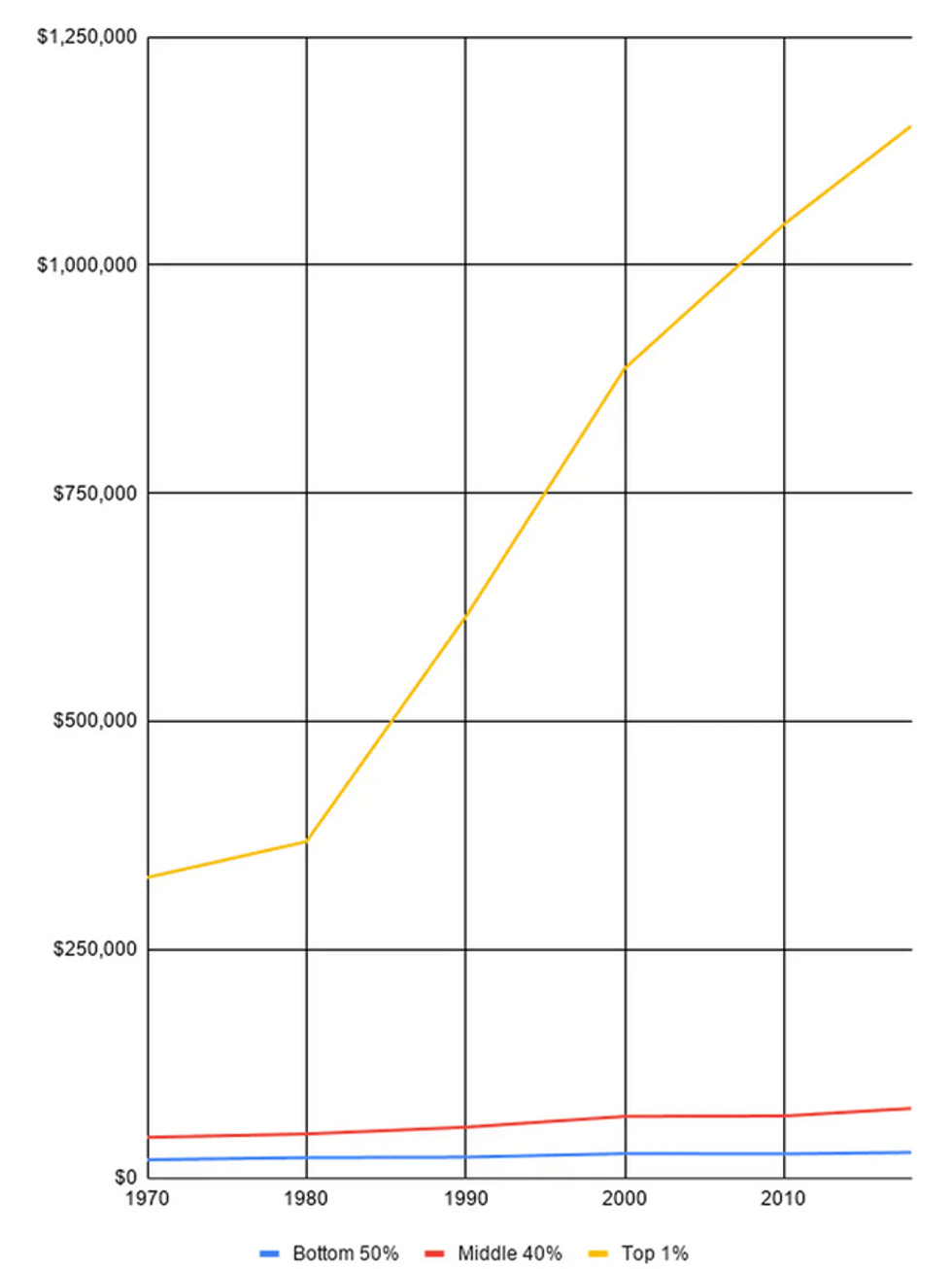
The top 1% of earners make an average of more than $1 million per year after accounting for taxes they pay, a 50-year increase of more than $800,000--100 times the growth rate of the bottom 50%.
The wealth of the top .1% is five times larger than it was in 1970, while that of the top .01% is seven times larger, at over $24 million in 2018.
Zucman and fellow economist Emmanuel Saez, his co-author of the new book "The Triumph of Injustice," provided a chart showing how each group of earners' take-home pay has changed since 1970. The wealthiest Americans' assets skyrocketed by millions of dollars even in the first decade of the 21st century--when people in the bottom 50% saw their average take-home income decrease.
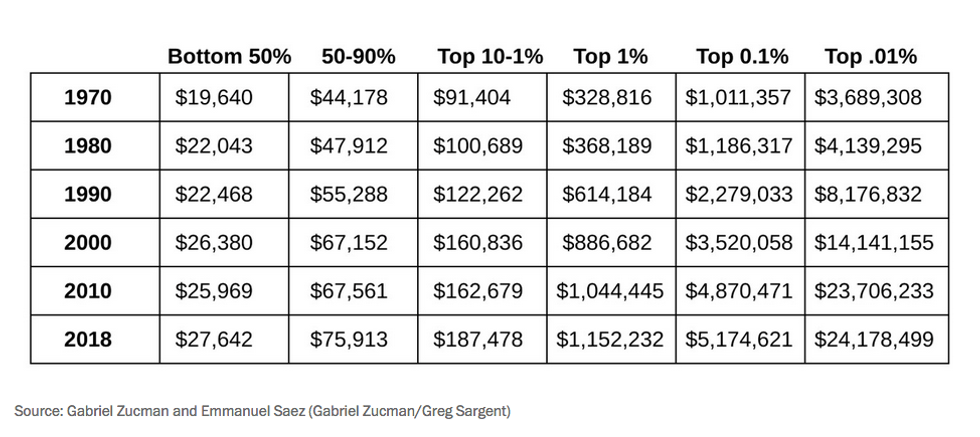
For middle-income earners since 1970, income-plus-effective tax rates have gone from $44,000 to about $75,000--a greater increase than those in the bottom 50% of earners, "but still their income growth rate has been very low," Zucman told the Post.
Zucman, who with Saez advised Sen. Elizabeth Warren (D-Mass.) on her Ultra-Millionaires Tax, emphasized that both the explosion of yearly income at the top and the effective tax rates of people in all income brackets must be taken into account to understand the massive wealth gap.
"You have two trends reinforcing each other," Zucman told the Post. "There has been the rise in market income inequality--the rise in pretax income inequality. At the same time, the tax system has become much less progressive at the top of the income distribution."
"People have this idea that government redistribution has upset some of the rise in inequality, but essentially that's not the case," the economist added.
Zucman's findings were revealed two months after New York Times columnist David Leonhardt published a graphic showing how in 2018, for the first time in U.S. history, the 400 richest Americans paid less in taxes than any other income group.
The richest Americans have benefited from numerous changes to tax laws and enforcement in recent decades, Sargent wrote, "including domestic and international tax avoidance, the whittling away of the estate and corporate taxes, and the repeated downsizing of top marginal rates."
Tony Annett of the Center for Sustainable Development at Columbia University wrote that Zucman's research shows how "it is no longer meaningful to rely on GDP" as a measure of economic well-being, since the benefits of growth are no longer being shared among all earners as they were in previous eras.
Seth D. Michaels of the Union of Concerned Scientists described Zucman's findings as showing how many people of his generation have seen the bulk of economic growth "captured and concentrated in a few hands."
"The tiny number of people raking in the overwhelming majority of the last 40 years of economic growth are distorting the economy and the political system like a black hole, everything falling toward their interests at high speed," Michaels wrote.
New data released Monday explains the numbers behind Sen. Bernie Sanders' often-cited statistic that the three richest Americans hold more wealth than the 160 million people who make up the bottom 50% of the population.
Washington Post columnist Greg Sargent published what he called "stunning" findings from UC Berkeley economist Gabriel Zucman, showing how both an explosion in annual earnings by the rich and an increasingly regressive tax structure have combined to allow the top 1% of Americans' wealth to triple over the past five decades.
Meanwhile, working people are taking home just $8,000 more per year than they did in 1970.
In what Sargent called "the triumph of the rich, which is one of the defining stories of our time," the richer a household is, the more its take-home wealth has grown in the past 50 years.
The top 1% of earners make an average of more than $1 million per year after accounting for taxes they pay, a 50-year increase of more than $800,000--100 times the growth rate of the bottom 50%.
The wealth of the top .1% is five times larger than it was in 1970, while that of the top .01% is seven times larger, at over $24 million in 2018.
Zucman and fellow economist Emmanuel Saez, his co-author of the new book "The Triumph of Injustice," provided a chart showing how each group of earners' take-home pay has changed since 1970. The wealthiest Americans' assets skyrocketed by millions of dollars even in the first decade of the 21st century--when people in the bottom 50% saw their average take-home income decrease.
For middle-income earners since 1970, income-plus-effective tax rates have gone from $44,000 to about $75,000--a greater increase than those in the bottom 50% of earners, "but still their income growth rate has been very low," Zucman told the Post.
Zucman, who with Saez advised Sen. Elizabeth Warren (D-Mass.) on her Ultra-Millionaires Tax, emphasized that both the explosion of yearly income at the top and the effective tax rates of people in all income brackets must be taken into account to understand the massive wealth gap.
"You have two trends reinforcing each other," Zucman told the Post. "There has been the rise in market income inequality--the rise in pretax income inequality. At the same time, the tax system has become much less progressive at the top of the income distribution."
"People have this idea that government redistribution has upset some of the rise in inequality, but essentially that's not the case," the economist added.
Zucman's findings were revealed two months after New York Times columnist David Leonhardt published a graphic showing how in 2018, for the first time in U.S. history, the 400 richest Americans paid less in taxes than any other income group.
The richest Americans have benefited from numerous changes to tax laws and enforcement in recent decades, Sargent wrote, "including domestic and international tax avoidance, the whittling away of the estate and corporate taxes, and the repeated downsizing of top marginal rates."
Tony Annett of the Center for Sustainable Development at Columbia University wrote that Zucman's research shows how "it is no longer meaningful to rely on GDP" as a measure of economic well-being, since the benefits of growth are no longer being shared among all earners as they were in previous eras.
Seth D. Michaels of the Union of Concerned Scientists described Zucman's findings as showing how many people of his generation have seen the bulk of economic growth "captured and concentrated in a few hands."
"The tiny number of people raking in the overwhelming majority of the last 40 years of economic growth are distorting the economy and the political system like a black hole, everything falling toward their interests at high speed," Michaels wrote.
New data released Monday explains the numbers behind Sen. Bernie Sanders' often-cited statistic that the three richest Americans hold more wealth than the 160 million people who make up the bottom 50% of the population.
Washington Post columnist Greg Sargent published what he called "stunning" findings from UC Berkeley economist Gabriel Zucman, showing how both an explosion in annual earnings by the rich and an increasingly regressive tax structure have combined to allow the top 1% of Americans' wealth to triple over the past five decades.
Meanwhile, working people are taking home just $8,000 more per year than they did in 1970.
In what Sargent called "the triumph of the rich, which is one of the defining stories of our time," the richer a household is, the more its take-home wealth has grown in the past 50 years.
The top 1% of earners make an average of more than $1 million per year after accounting for taxes they pay, a 50-year increase of more than $800,000--100 times the growth rate of the bottom 50%.
The wealth of the top .1% is five times larger than it was in 1970, while that of the top .01% is seven times larger, at over $24 million in 2018.
Zucman and fellow economist Emmanuel Saez, his co-author of the new book "The Triumph of Injustice," provided a chart showing how each group of earners' take-home pay has changed since 1970. The wealthiest Americans' assets skyrocketed by millions of dollars even in the first decade of the 21st century--when people in the bottom 50% saw their average take-home income decrease.
For middle-income earners since 1970, income-plus-effective tax rates have gone from $44,000 to about $75,000--a greater increase than those in the bottom 50% of earners, "but still their income growth rate has been very low," Zucman told the Post.
Zucman, who with Saez advised Sen. Elizabeth Warren (D-Mass.) on her Ultra-Millionaires Tax, emphasized that both the explosion of yearly income at the top and the effective tax rates of people in all income brackets must be taken into account to understand the massive wealth gap.
"You have two trends reinforcing each other," Zucman told the Post. "There has been the rise in market income inequality--the rise in pretax income inequality. At the same time, the tax system has become much less progressive at the top of the income distribution."
"People have this idea that government redistribution has upset some of the rise in inequality, but essentially that's not the case," the economist added.
Zucman's findings were revealed two months after New York Times columnist David Leonhardt published a graphic showing how in 2018, for the first time in U.S. history, the 400 richest Americans paid less in taxes than any other income group.
The richest Americans have benefited from numerous changes to tax laws and enforcement in recent decades, Sargent wrote, "including domestic and international tax avoidance, the whittling away of the estate and corporate taxes, and the repeated downsizing of top marginal rates."
Tony Annett of the Center for Sustainable Development at Columbia University wrote that Zucman's research shows how "it is no longer meaningful to rely on GDP" as a measure of economic well-being, since the benefits of growth are no longer being shared among all earners as they were in previous eras.
Seth D. Michaels of the Union of Concerned Scientists described Zucman's findings as showing how many people of his generation have seen the bulk of economic growth "captured and concentrated in a few hands."
"The tiny number of people raking in the overwhelming majority of the last 40 years of economic growth are distorting the economy and the political system like a black hole, everything falling toward their interests at high speed," Michaels wrote.