SUBSCRIBE TO OUR FREE NEWSLETTER
Daily news & progressive opinion—funded by the people, not the corporations—delivered straight to your inbox.
5
#000000
#FFFFFF
To donate by check, phone, or other method, see our More Ways to Give page.
Daily news & progressive opinion—funded by the people, not the corporations—delivered straight to your inbox.
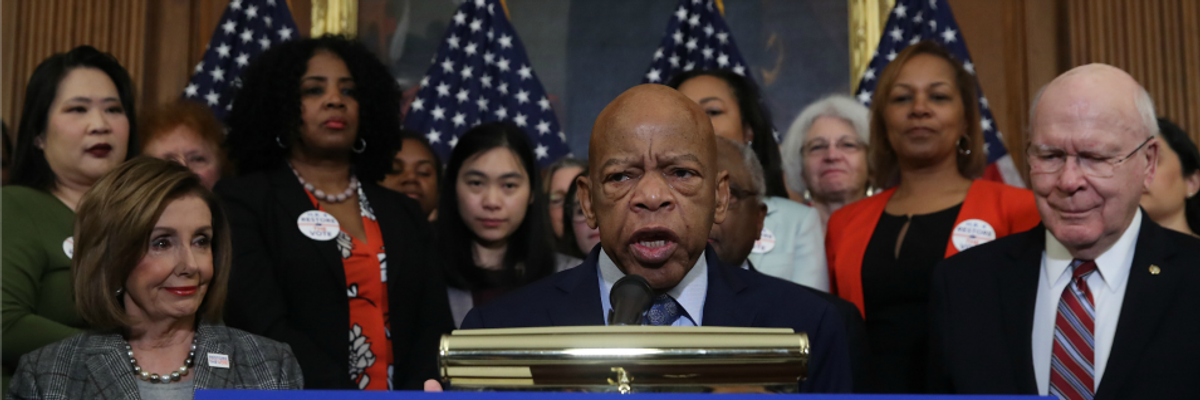
Rep. John Lewis (D-Ga.) speaks to the media ahead of the House voting on the H.R. 4, the Voting Rights Advancement Act, on December 6, 2019 in Washington, D.C. (Photo: Mark Wilson/Getty Images)
Just one Republican--Rep. Brian Fitzpatrick of Pennsylvania--joined a united House Democratic caucus on Friday to pass what rights groups hailed as "historic" legislation to restore and expand voter protections that were gutted by the Supreme Court in 2013.
Lisa Gilbert, vice president of legislative affairs for Public Citizen, said passage of the Voting Rights Advancement Act (H.R. 4) is a "critical step" in combating Republican voter suppression efforts that have proliferated in the six years since the Supreme Court's infamous decision in Shelby County v. Holder.
"Numerous state legislatures have undertaken targeted and deliberate steps to limit or impede the right to vote for communities of color, students, the elderly, and people with disabilities," said Gilbert. "Americans who are eligible to vote but are denied that right due to fabricated or illegal barriers are being deprived of the full privilege of our democracy."
"If we want a true democracy, we must protect the right to vote for all," said Rep. Pramila Jayapal (D-Wash.), co-chair of the Congressional Progressive Caucus. "The Voting Rights Advancement Act is critical to getting there."
The legislation now heads to the Senate, which is controlled by Republicans. Senate Majority Leader Mitch McConnell (R-Ky.) has refused to allow a vote on Democrats' For the People Act (H.R. 1), to which the Voting Rights Advancement Act was previously attached.
"To Majority Leader McConnell, we ask: why are you afraid of all Americans having their full right to vote?" Sylvia Albert, director of voting and elections at Common Cause, said in a statement.
As Ari Berman of Mother Jones reported, H.R. 4--sponsored by Rep. Terri Sewell (D-Ala.)--would "initially cover 11 states: nine in the South, plus California and New York, which have more recently been found to discriminate against Latinos and Asian Americans."
"The bill would also require all states to get federal approval for election changes that are known to disproportionately affect voters of color, such as strict voter ID laws, tighter voter registration requirements, and polling place closures in areas with large numbers of minority voters," Berman noted.
Vanita Gupta, president and CEO of The Leadership Conference on Civil and Human Rights, applauded the House for passing H.R. 4 and demanded that McConnell bring the bill up for a vote in the Senate as soon as possible.
"The passage of H.R. 4 in the House of Representatives today brings us one step closer to restoring the Voting Rights Act and undoing the tremendous damage of Shelby," Gupta said in a statement. "The VRAA is too important--and the right to vote is too fundamental--to end up buried in the McConnell legislative graveyard."
Dear Common Dreams reader, It’s been nearly 30 years since I co-founded Common Dreams with my late wife, Lina Newhouser. We had the radical notion that journalism should serve the public good, not corporate profits. It was clear to us from the outset what it would take to build such a project. No paid advertisements. No corporate sponsors. No millionaire publisher telling us what to think or do. Many people said we wouldn't last a year, but we proved those doubters wrong. Together with a tremendous team of journalists and dedicated staff, we built an independent media outlet free from the constraints of profits and corporate control. Our mission has always been simple: To inform. To inspire. To ignite change for the common good. Building Common Dreams was not easy. Our survival was never guaranteed. When you take on the most powerful forces—Wall Street greed, fossil fuel industry destruction, Big Tech lobbyists, and uber-rich oligarchs who have spent billions upon billions rigging the economy and democracy in their favor—the only bulwark you have is supporters who believe in your work. But here’s the urgent message from me today. It's never been this bad out there. And it's never been this hard to keep us going. At the very moment Common Dreams is most needed, the threats we face are intensifying. We need your support now more than ever. We don't accept corporate advertising and never will. We don't have a paywall because we don't think people should be blocked from critical news based on their ability to pay. Everything we do is funded by the donations of readers like you. When everyone does the little they can afford, we are strong. But if that support retreats or dries up, so do we. Will you donate now to make sure Common Dreams not only survives but thrives? —Craig Brown, Co-founder |
Just one Republican--Rep. Brian Fitzpatrick of Pennsylvania--joined a united House Democratic caucus on Friday to pass what rights groups hailed as "historic" legislation to restore and expand voter protections that were gutted by the Supreme Court in 2013.
Lisa Gilbert, vice president of legislative affairs for Public Citizen, said passage of the Voting Rights Advancement Act (H.R. 4) is a "critical step" in combating Republican voter suppression efforts that have proliferated in the six years since the Supreme Court's infamous decision in Shelby County v. Holder.
"Numerous state legislatures have undertaken targeted and deliberate steps to limit or impede the right to vote for communities of color, students, the elderly, and people with disabilities," said Gilbert. "Americans who are eligible to vote but are denied that right due to fabricated or illegal barriers are being deprived of the full privilege of our democracy."
"If we want a true democracy, we must protect the right to vote for all," said Rep. Pramila Jayapal (D-Wash.), co-chair of the Congressional Progressive Caucus. "The Voting Rights Advancement Act is critical to getting there."
The legislation now heads to the Senate, which is controlled by Republicans. Senate Majority Leader Mitch McConnell (R-Ky.) has refused to allow a vote on Democrats' For the People Act (H.R. 1), to which the Voting Rights Advancement Act was previously attached.
"To Majority Leader McConnell, we ask: why are you afraid of all Americans having their full right to vote?" Sylvia Albert, director of voting and elections at Common Cause, said in a statement.
As Ari Berman of Mother Jones reported, H.R. 4--sponsored by Rep. Terri Sewell (D-Ala.)--would "initially cover 11 states: nine in the South, plus California and New York, which have more recently been found to discriminate against Latinos and Asian Americans."
"The bill would also require all states to get federal approval for election changes that are known to disproportionately affect voters of color, such as strict voter ID laws, tighter voter registration requirements, and polling place closures in areas with large numbers of minority voters," Berman noted.
Vanita Gupta, president and CEO of The Leadership Conference on Civil and Human Rights, applauded the House for passing H.R. 4 and demanded that McConnell bring the bill up for a vote in the Senate as soon as possible.
"The passage of H.R. 4 in the House of Representatives today brings us one step closer to restoring the Voting Rights Act and undoing the tremendous damage of Shelby," Gupta said in a statement. "The VRAA is too important--and the right to vote is too fundamental--to end up buried in the McConnell legislative graveyard."
Just one Republican--Rep. Brian Fitzpatrick of Pennsylvania--joined a united House Democratic caucus on Friday to pass what rights groups hailed as "historic" legislation to restore and expand voter protections that were gutted by the Supreme Court in 2013.
Lisa Gilbert, vice president of legislative affairs for Public Citizen, said passage of the Voting Rights Advancement Act (H.R. 4) is a "critical step" in combating Republican voter suppression efforts that have proliferated in the six years since the Supreme Court's infamous decision in Shelby County v. Holder.
"Numerous state legislatures have undertaken targeted and deliberate steps to limit or impede the right to vote for communities of color, students, the elderly, and people with disabilities," said Gilbert. "Americans who are eligible to vote but are denied that right due to fabricated or illegal barriers are being deprived of the full privilege of our democracy."
"If we want a true democracy, we must protect the right to vote for all," said Rep. Pramila Jayapal (D-Wash.), co-chair of the Congressional Progressive Caucus. "The Voting Rights Advancement Act is critical to getting there."
The legislation now heads to the Senate, which is controlled by Republicans. Senate Majority Leader Mitch McConnell (R-Ky.) has refused to allow a vote on Democrats' For the People Act (H.R. 1), to which the Voting Rights Advancement Act was previously attached.
"To Majority Leader McConnell, we ask: why are you afraid of all Americans having their full right to vote?" Sylvia Albert, director of voting and elections at Common Cause, said in a statement.
As Ari Berman of Mother Jones reported, H.R. 4--sponsored by Rep. Terri Sewell (D-Ala.)--would "initially cover 11 states: nine in the South, plus California and New York, which have more recently been found to discriminate against Latinos and Asian Americans."
"The bill would also require all states to get federal approval for election changes that are known to disproportionately affect voters of color, such as strict voter ID laws, tighter voter registration requirements, and polling place closures in areas with large numbers of minority voters," Berman noted.
Vanita Gupta, president and CEO of The Leadership Conference on Civil and Human Rights, applauded the House for passing H.R. 4 and demanded that McConnell bring the bill up for a vote in the Senate as soon as possible.
"The passage of H.R. 4 in the House of Representatives today brings us one step closer to restoring the Voting Rights Act and undoing the tremendous damage of Shelby," Gupta said in a statement. "The VRAA is too important--and the right to vote is too fundamental--to end up buried in the McConnell legislative graveyard."