

SUBSCRIBE TO OUR FREE NEWSLETTER
Daily news & progressive opinion—funded by the people, not the corporations—delivered straight to your inbox.
5
#000000
#FFFFFF
To donate by check, phone, or other method, see our More Ways to Give page.
Daily news & progressive opinion—funded by the people, not the corporations—delivered straight to your inbox.
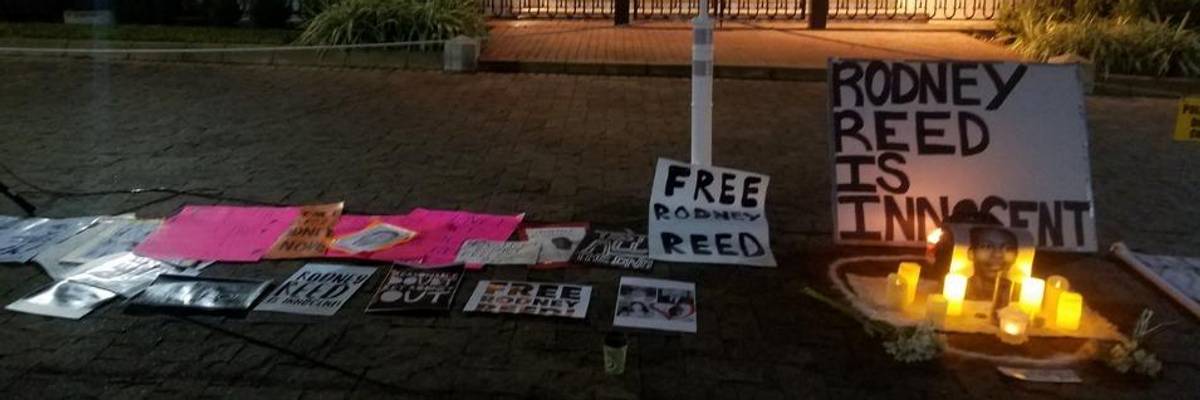
Supporters have held vigils in recent days outside the Governor's Mansion in Austin, Texas to demand that Gov. Greg Abbott grant clemency to Rodney Reed. (Photo: Amnesty International Austin/Twitter)
This story has been updated.
As the Supreme Court debated Friday whether to take up the case of death row inmate Rodney Reed, Amnesty International demanded that Republican Texas Gov. Greg Abbott grant clemency in the case as evidence mounts that Reed, who is scheduled to be executed in days, did not commit the crime he was convicted of two decades ago.
Amnesty has campaigned on Reed's behalf since 2015 and called on its members around the world this month to write to Abbott and demand that he arrange for Reed's retrial and exoneration in the murder and rape of Stacey Stites in 1996.
"The death penalty is applied disproportionally against people of color, and Rodney Reed's case is a glaring example," said Kristina Roth, senior program officer for Criminal Justice Programs at Amnesty International USA, in a statement. "Killing a person creates a murderer out of the executioner, is not justice for Stacey Stites, and deprives Rodney Reed of dignity and humanity: this--and every--execution is a cruel, inhuman, and degrading violation."
Amnesty and its members joined U.S. lawmakers from across the political spectrum, Texas prosecutors, supporters who have held vigils in recent days outside the U.S. Supreme Court and the Texas Governor's Mansion, and celebrities in calling for Reed's case to be retried.
On Friday afternoon, the Texas Board of Pardons and Parole unanimously voted to recommend to Abbott a 120-day reprieve for Reed.
Abbott has not spoken publicly about Reed despite the worldwide outcry.
Reed "maintains his innocence and several experts cast doubts on his conviction," the letter sent by Amnesty members to Abbott reads. "The death penalty is the ultimate denial of human rights. Since 1973, 166 people have been exonerated from U.S. death rows on innocence grounds. I urge you to recommend and grant clemency to Rodney Reed and stop his and any future executions."
New evidence in Reed's case has emerged in recent years. Witnesses have corroborated his claims that he was in a consensual sexual relationship with Stites at the time, which could explain why his DNA was found at the crime scene. Years after Reed's conviction, according to the Innocence Project, Stites's fiance told a fellow inmate while he was in prison for the murder and rape of another women, that he had killed Stites as revenge for her relationship with Reed.
Forensic experts also dispute Stites's time of death, calling into question the timeline that implicated Reed, and advocates for Reed have noted that the murder weapon used in the crime was never DNA-tested.
"International safeguards guaranteeing the rights of those facing the death penalty state that the punishment may only be imposed when the guilt of the person charged is based upon clear and convincing evidence leaving no room for an alternative explanation of the facts," said Amnesty International. "This is clearly not the case with Rodney Reed."
Reed's family members were joined by other supporters this week at an overnight vigil outside the Supreme Court, calling on the court to take up Reed's case. Lawyers representing Reed at the Innocence Project filed a petition in September asking the high court to examine the case.
The justices were reportedly debating whether to take up the case on Friday.
"If they grant Rodney Reed a new trial, Rodney Reed will be exonerated," Rodrick Reed, Rodney's brother, said on the steps of the Supreme Court.
Dear Common Dreams reader, It’s been nearly 30 years since I co-founded Common Dreams with my late wife, Lina Newhouser. We had the radical notion that journalism should serve the public good, not corporate profits. It was clear to us from the outset what it would take to build such a project. No paid advertisements. No corporate sponsors. No millionaire publisher telling us what to think or do. Many people said we wouldn't last a year, but we proved those doubters wrong. Together with a tremendous team of journalists and dedicated staff, we built an independent media outlet free from the constraints of profits and corporate control. Our mission has always been simple: To inform. To inspire. To ignite change for the common good. Building Common Dreams was not easy. Our survival was never guaranteed. When you take on the most powerful forces—Wall Street greed, fossil fuel industry destruction, Big Tech lobbyists, and uber-rich oligarchs who have spent billions upon billions rigging the economy and democracy in their favor—the only bulwark you have is supporters who believe in your work. But here’s the urgent message from me today. It's never been this bad out there. And it's never been this hard to keep us going. At the very moment Common Dreams is most needed, the threats we face are intensifying. We need your support now more than ever. We don't accept corporate advertising and never will. We don't have a paywall because we don't think people should be blocked from critical news based on their ability to pay. Everything we do is funded by the donations of readers like you. When everyone does the little they can afford, we are strong. But if that support retreats or dries up, so do we. Will you donate now to make sure Common Dreams not only survives but thrives? —Craig Brown, Co-founder |
This story has been updated.
As the Supreme Court debated Friday whether to take up the case of death row inmate Rodney Reed, Amnesty International demanded that Republican Texas Gov. Greg Abbott grant clemency in the case as evidence mounts that Reed, who is scheduled to be executed in days, did not commit the crime he was convicted of two decades ago.
Amnesty has campaigned on Reed's behalf since 2015 and called on its members around the world this month to write to Abbott and demand that he arrange for Reed's retrial and exoneration in the murder and rape of Stacey Stites in 1996.
"The death penalty is applied disproportionally against people of color, and Rodney Reed's case is a glaring example," said Kristina Roth, senior program officer for Criminal Justice Programs at Amnesty International USA, in a statement. "Killing a person creates a murderer out of the executioner, is not justice for Stacey Stites, and deprives Rodney Reed of dignity and humanity: this--and every--execution is a cruel, inhuman, and degrading violation."
Amnesty and its members joined U.S. lawmakers from across the political spectrum, Texas prosecutors, supporters who have held vigils in recent days outside the U.S. Supreme Court and the Texas Governor's Mansion, and celebrities in calling for Reed's case to be retried.
On Friday afternoon, the Texas Board of Pardons and Parole unanimously voted to recommend to Abbott a 120-day reprieve for Reed.
Abbott has not spoken publicly about Reed despite the worldwide outcry.
Reed "maintains his innocence and several experts cast doubts on his conviction," the letter sent by Amnesty members to Abbott reads. "The death penalty is the ultimate denial of human rights. Since 1973, 166 people have been exonerated from U.S. death rows on innocence grounds. I urge you to recommend and grant clemency to Rodney Reed and stop his and any future executions."
New evidence in Reed's case has emerged in recent years. Witnesses have corroborated his claims that he was in a consensual sexual relationship with Stites at the time, which could explain why his DNA was found at the crime scene. Years after Reed's conviction, according to the Innocence Project, Stites's fiance told a fellow inmate while he was in prison for the murder and rape of another women, that he had killed Stites as revenge for her relationship with Reed.
Forensic experts also dispute Stites's time of death, calling into question the timeline that implicated Reed, and advocates for Reed have noted that the murder weapon used in the crime was never DNA-tested.
"International safeguards guaranteeing the rights of those facing the death penalty state that the punishment may only be imposed when the guilt of the person charged is based upon clear and convincing evidence leaving no room for an alternative explanation of the facts," said Amnesty International. "This is clearly not the case with Rodney Reed."
Reed's family members were joined by other supporters this week at an overnight vigil outside the Supreme Court, calling on the court to take up Reed's case. Lawyers representing Reed at the Innocence Project filed a petition in September asking the high court to examine the case.
The justices were reportedly debating whether to take up the case on Friday.
"If they grant Rodney Reed a new trial, Rodney Reed will be exonerated," Rodrick Reed, Rodney's brother, said on the steps of the Supreme Court.
This story has been updated.
As the Supreme Court debated Friday whether to take up the case of death row inmate Rodney Reed, Amnesty International demanded that Republican Texas Gov. Greg Abbott grant clemency in the case as evidence mounts that Reed, who is scheduled to be executed in days, did not commit the crime he was convicted of two decades ago.
Amnesty has campaigned on Reed's behalf since 2015 and called on its members around the world this month to write to Abbott and demand that he arrange for Reed's retrial and exoneration in the murder and rape of Stacey Stites in 1996.
"The death penalty is applied disproportionally against people of color, and Rodney Reed's case is a glaring example," said Kristina Roth, senior program officer for Criminal Justice Programs at Amnesty International USA, in a statement. "Killing a person creates a murderer out of the executioner, is not justice for Stacey Stites, and deprives Rodney Reed of dignity and humanity: this--and every--execution is a cruel, inhuman, and degrading violation."
Amnesty and its members joined U.S. lawmakers from across the political spectrum, Texas prosecutors, supporters who have held vigils in recent days outside the U.S. Supreme Court and the Texas Governor's Mansion, and celebrities in calling for Reed's case to be retried.
On Friday afternoon, the Texas Board of Pardons and Parole unanimously voted to recommend to Abbott a 120-day reprieve for Reed.
Abbott has not spoken publicly about Reed despite the worldwide outcry.
Reed "maintains his innocence and several experts cast doubts on his conviction," the letter sent by Amnesty members to Abbott reads. "The death penalty is the ultimate denial of human rights. Since 1973, 166 people have been exonerated from U.S. death rows on innocence grounds. I urge you to recommend and grant clemency to Rodney Reed and stop his and any future executions."
New evidence in Reed's case has emerged in recent years. Witnesses have corroborated his claims that he was in a consensual sexual relationship with Stites at the time, which could explain why his DNA was found at the crime scene. Years after Reed's conviction, according to the Innocence Project, Stites's fiance told a fellow inmate while he was in prison for the murder and rape of another women, that he had killed Stites as revenge for her relationship with Reed.
Forensic experts also dispute Stites's time of death, calling into question the timeline that implicated Reed, and advocates for Reed have noted that the murder weapon used in the crime was never DNA-tested.
"International safeguards guaranteeing the rights of those facing the death penalty state that the punishment may only be imposed when the guilt of the person charged is based upon clear and convincing evidence leaving no room for an alternative explanation of the facts," said Amnesty International. "This is clearly not the case with Rodney Reed."
Reed's family members were joined by other supporters this week at an overnight vigil outside the Supreme Court, calling on the court to take up Reed's case. Lawyers representing Reed at the Innocence Project filed a petition in September asking the high court to examine the case.
The justices were reportedly debating whether to take up the case on Friday.
"If they grant Rodney Reed a new trial, Rodney Reed will be exonerated," Rodrick Reed, Rodney's brother, said on the steps of the Supreme Court.