SUBSCRIBE TO OUR FREE NEWSLETTER
Daily news & progressive opinion—funded by the people, not the corporations—delivered straight to your inbox.
5
#000000
#FFFFFF
To donate by check, phone, or other method, see our More Ways to Give page.
Daily news & progressive opinion—funded by the people, not the corporations—delivered straight to your inbox.
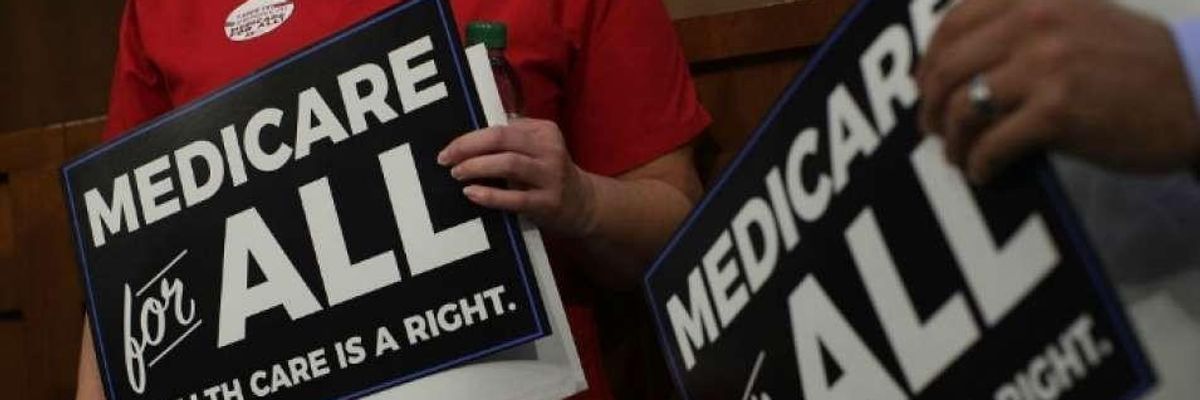
Supporters of U.S. Sen. Bernie Sanders (I-Vt.) hold signs during an event on healthcare September 13, 2017 on Capitol Hill in Washington, D.C. (Photo: Alex Wong/Getty Images)
Medicare for All would give most U.S. workers "the biggest take-home pay raise in a generation," two economists from the University of California, Berkeley said Friday, countering one of the main insurance industry talking points against single-payer.
In an op-ed for The Guardian, Emmanuel Saez and Gabriel Zucman directly challenged the claim that Medicare for All would "involve massive tax increases for the middle class," an attack line centrist Democratic presidential candidates like former Vice President Joe Biden and South Bend, Indiana Mayor Pete Buttigieg have recently deployed against the popular proposal.
"In other words, the Dems saying Medicare for All is a middle class tax hike are deliberately lying."
--David Sirota, speechwriter for Sen. Bernie Sanders' presidential campaign
"Supporters of Medicare for All are right," said Saez and Zucman, leading experts on income and wealth inequality. "Funding universal health insurance through taxes would lead to a large tax cut for the vast majority of workers."
The two economists argued that health insurance premiums are effectively taxes taken out of workers' paychecks and paid to for-profit insurance companies instead of the government.
"Insurance premiums are the most regressive possible type of tax: a poll tax. The secretary pays the same amount as the executive," Saez and Zucman wrote. "Proposals such as Medicare for All would replace the current privatized poll tax by taxes based on ability to pay. Some believe that it would result in a big tax increase for America's middle class."
But the Medicare for All legislation authored by Sen. Bernie Sanders (I-Vt.) and backed by Sen. Elizabeth Warren (D-Mass.) "would, in fact, lead to large income gains for the vast majority of workers" by eliminating private health insurance premiums, Saez and Zucman said.
The economists offered an example:
Take again the case of a secretary earning $50,000 in wage and currently contributing $15,000 through her employer to an insurance company. With universal health insurance, her wage would rise to $65,000--her full labor compensation. With an income tax of 6%--which, if applied to a base large enough, would be enough to fund universal health insurance--she would have to pay about $4,000 more in tax. But the net gain would be enormous: $11,000. Instead of taking home $50,000, the secretary would take home $61,000.
"With smart new taxes--such as broad income taxes exempting low wages and retirees--it is possible to make the vast majority of the population win from a transition to universal health insurance," said Saez and Zucman.
The Sanders presidential campaign quickly seized upon the Saez and Zucman op-ed to bolster the argument that 2020 Democrats attacking Medicare for All as a tax hike on the middle class are being dishonest.
"Industry-bankrolled presidential candidates have spent months reciting GOP talking points claiming that Bernie's Medicare for All plan would raise middle class taxes--but as of this morning, those wildly dishonest claims have been comprehensively debunked by renowned economists," Sanders' speechwriter David Sirota wrote in the campaign's Bern Notice newsletter.
The Saez and Zucman op-ed comes as Sanders and Warren are facing a barrage of questions from the media and 2020 Democratic rivals over how they are going to "pay for" Medicare for All, even though observers have noted that the incremental alternatives offered by Biden and Buttigieg could cost as much as single-payer over the long run.
Sanders in April unveiled a list of possible financing mechanisms alongside his 100-page Medicare for All legislation. The slate of proposals Sanders offered included a 70% top marginal tax rate on Americans earning over $10 million per year, a 77% top tax rate on estates above $1 billion, and a 4% income-based payroll tax that would exempt the first $29,000 in income for a family of four.
"Under every single one of these options," Sanders said at the time, "the average American family will save thousands of dollars a year because it will no longer be writing large checks to private health insurance companies."
"It drives me nuts when people say this is so complicated. It's not."
--Robert Pollin, University of Massachusetts Amherst
The Washington Post reported Thursday that Warren is fielding advice from internal and outside economic advisers on how to finance Medicare for All.
"Robert C. Hockett, a Cornell University professor who has also advised Warren and Sanders, said he has urged Warren's team to propose financing Medicare for All in part with a 'public premium' that would function similarly to a tax," according to the Post. "Under this idea, Warren would propose raising revenue for a Medicare for All fund from a premium charge that would go to the government rather than a private insurance company."
Robert Pollin, an economist at the University of Massachusetts Amherst and author of a 2018 study that found Medicare for All could save the U.S. $5.1 trillion over 10 years, told the Post that two-thirds of the single-payer program can be funded by redirecting existing government healthcare spending from Medicare, Medicaid, and the Department of Veterans Affairs.
Pollin emphasized to the Post that the basics of funding Medicare for All "are very simple."
"It drives me nuts when people say this is so complicated. It's not," Pollin said.
As Pollin put it during The Sanders Institute Gathering in Burlingon, Vermont last year, "It's easy to pay for something that costs less."
Dear Common Dreams reader, It’s been nearly 30 years since I co-founded Common Dreams with my late wife, Lina Newhouser. We had the radical notion that journalism should serve the public good, not corporate profits. It was clear to us from the outset what it would take to build such a project. No paid advertisements. No corporate sponsors. No millionaire publisher telling us what to think or do. Many people said we wouldn't last a year, but we proved those doubters wrong. Together with a tremendous team of journalists and dedicated staff, we built an independent media outlet free from the constraints of profits and corporate control. Our mission has always been simple: To inform. To inspire. To ignite change for the common good. Building Common Dreams was not easy. Our survival was never guaranteed. When you take on the most powerful forces—Wall Street greed, fossil fuel industry destruction, Big Tech lobbyists, and uber-rich oligarchs who have spent billions upon billions rigging the economy and democracy in their favor—the only bulwark you have is supporters who believe in your work. But here’s the urgent message from me today. It's never been this bad out there. And it's never been this hard to keep us going. At the very moment Common Dreams is most needed, the threats we face are intensifying. We need your support now more than ever. We don't accept corporate advertising and never will. We don't have a paywall because we don't think people should be blocked from critical news based on their ability to pay. Everything we do is funded by the donations of readers like you. When everyone does the little they can afford, we are strong. But if that support retreats or dries up, so do we. Will you donate now to make sure Common Dreams not only survives but thrives? —Craig Brown, Co-founder |
Medicare for All would give most U.S. workers "the biggest take-home pay raise in a generation," two economists from the University of California, Berkeley said Friday, countering one of the main insurance industry talking points against single-payer.
In an op-ed for The Guardian, Emmanuel Saez and Gabriel Zucman directly challenged the claim that Medicare for All would "involve massive tax increases for the middle class," an attack line centrist Democratic presidential candidates like former Vice President Joe Biden and South Bend, Indiana Mayor Pete Buttigieg have recently deployed against the popular proposal.
"In other words, the Dems saying Medicare for All is a middle class tax hike are deliberately lying."
--David Sirota, speechwriter for Sen. Bernie Sanders' presidential campaign
"Supporters of Medicare for All are right," said Saez and Zucman, leading experts on income and wealth inequality. "Funding universal health insurance through taxes would lead to a large tax cut for the vast majority of workers."
The two economists argued that health insurance premiums are effectively taxes taken out of workers' paychecks and paid to for-profit insurance companies instead of the government.
"Insurance premiums are the most regressive possible type of tax: a poll tax. The secretary pays the same amount as the executive," Saez and Zucman wrote. "Proposals such as Medicare for All would replace the current privatized poll tax by taxes based on ability to pay. Some believe that it would result in a big tax increase for America's middle class."
But the Medicare for All legislation authored by Sen. Bernie Sanders (I-Vt.) and backed by Sen. Elizabeth Warren (D-Mass.) "would, in fact, lead to large income gains for the vast majority of workers" by eliminating private health insurance premiums, Saez and Zucman said.
The economists offered an example:
Take again the case of a secretary earning $50,000 in wage and currently contributing $15,000 through her employer to an insurance company. With universal health insurance, her wage would rise to $65,000--her full labor compensation. With an income tax of 6%--which, if applied to a base large enough, would be enough to fund universal health insurance--she would have to pay about $4,000 more in tax. But the net gain would be enormous: $11,000. Instead of taking home $50,000, the secretary would take home $61,000.
"With smart new taxes--such as broad income taxes exempting low wages and retirees--it is possible to make the vast majority of the population win from a transition to universal health insurance," said Saez and Zucman.
The Sanders presidential campaign quickly seized upon the Saez and Zucman op-ed to bolster the argument that 2020 Democrats attacking Medicare for All as a tax hike on the middle class are being dishonest.
"Industry-bankrolled presidential candidates have spent months reciting GOP talking points claiming that Bernie's Medicare for All plan would raise middle class taxes--but as of this morning, those wildly dishonest claims have been comprehensively debunked by renowned economists," Sanders' speechwriter David Sirota wrote in the campaign's Bern Notice newsletter.
The Saez and Zucman op-ed comes as Sanders and Warren are facing a barrage of questions from the media and 2020 Democratic rivals over how they are going to "pay for" Medicare for All, even though observers have noted that the incremental alternatives offered by Biden and Buttigieg could cost as much as single-payer over the long run.
Sanders in April unveiled a list of possible financing mechanisms alongside his 100-page Medicare for All legislation. The slate of proposals Sanders offered included a 70% top marginal tax rate on Americans earning over $10 million per year, a 77% top tax rate on estates above $1 billion, and a 4% income-based payroll tax that would exempt the first $29,000 in income for a family of four.
"Under every single one of these options," Sanders said at the time, "the average American family will save thousands of dollars a year because it will no longer be writing large checks to private health insurance companies."
"It drives me nuts when people say this is so complicated. It's not."
--Robert Pollin, University of Massachusetts Amherst
The Washington Post reported Thursday that Warren is fielding advice from internal and outside economic advisers on how to finance Medicare for All.
"Robert C. Hockett, a Cornell University professor who has also advised Warren and Sanders, said he has urged Warren's team to propose financing Medicare for All in part with a 'public premium' that would function similarly to a tax," according to the Post. "Under this idea, Warren would propose raising revenue for a Medicare for All fund from a premium charge that would go to the government rather than a private insurance company."
Robert Pollin, an economist at the University of Massachusetts Amherst and author of a 2018 study that found Medicare for All could save the U.S. $5.1 trillion over 10 years, told the Post that two-thirds of the single-payer program can be funded by redirecting existing government healthcare spending from Medicare, Medicaid, and the Department of Veterans Affairs.
Pollin emphasized to the Post that the basics of funding Medicare for All "are very simple."
"It drives me nuts when people say this is so complicated. It's not," Pollin said.
As Pollin put it during The Sanders Institute Gathering in Burlingon, Vermont last year, "It's easy to pay for something that costs less."
Medicare for All would give most U.S. workers "the biggest take-home pay raise in a generation," two economists from the University of California, Berkeley said Friday, countering one of the main insurance industry talking points against single-payer.
In an op-ed for The Guardian, Emmanuel Saez and Gabriel Zucman directly challenged the claim that Medicare for All would "involve massive tax increases for the middle class," an attack line centrist Democratic presidential candidates like former Vice President Joe Biden and South Bend, Indiana Mayor Pete Buttigieg have recently deployed against the popular proposal.
"In other words, the Dems saying Medicare for All is a middle class tax hike are deliberately lying."
--David Sirota, speechwriter for Sen. Bernie Sanders' presidential campaign
"Supporters of Medicare for All are right," said Saez and Zucman, leading experts on income and wealth inequality. "Funding universal health insurance through taxes would lead to a large tax cut for the vast majority of workers."
The two economists argued that health insurance premiums are effectively taxes taken out of workers' paychecks and paid to for-profit insurance companies instead of the government.
"Insurance premiums are the most regressive possible type of tax: a poll tax. The secretary pays the same amount as the executive," Saez and Zucman wrote. "Proposals such as Medicare for All would replace the current privatized poll tax by taxes based on ability to pay. Some believe that it would result in a big tax increase for America's middle class."
But the Medicare for All legislation authored by Sen. Bernie Sanders (I-Vt.) and backed by Sen. Elizabeth Warren (D-Mass.) "would, in fact, lead to large income gains for the vast majority of workers" by eliminating private health insurance premiums, Saez and Zucman said.
The economists offered an example:
Take again the case of a secretary earning $50,000 in wage and currently contributing $15,000 through her employer to an insurance company. With universal health insurance, her wage would rise to $65,000--her full labor compensation. With an income tax of 6%--which, if applied to a base large enough, would be enough to fund universal health insurance--she would have to pay about $4,000 more in tax. But the net gain would be enormous: $11,000. Instead of taking home $50,000, the secretary would take home $61,000.
"With smart new taxes--such as broad income taxes exempting low wages and retirees--it is possible to make the vast majority of the population win from a transition to universal health insurance," said Saez and Zucman.
The Sanders presidential campaign quickly seized upon the Saez and Zucman op-ed to bolster the argument that 2020 Democrats attacking Medicare for All as a tax hike on the middle class are being dishonest.
"Industry-bankrolled presidential candidates have spent months reciting GOP talking points claiming that Bernie's Medicare for All plan would raise middle class taxes--but as of this morning, those wildly dishonest claims have been comprehensively debunked by renowned economists," Sanders' speechwriter David Sirota wrote in the campaign's Bern Notice newsletter.
The Saez and Zucman op-ed comes as Sanders and Warren are facing a barrage of questions from the media and 2020 Democratic rivals over how they are going to "pay for" Medicare for All, even though observers have noted that the incremental alternatives offered by Biden and Buttigieg could cost as much as single-payer over the long run.
Sanders in April unveiled a list of possible financing mechanisms alongside his 100-page Medicare for All legislation. The slate of proposals Sanders offered included a 70% top marginal tax rate on Americans earning over $10 million per year, a 77% top tax rate on estates above $1 billion, and a 4% income-based payroll tax that would exempt the first $29,000 in income for a family of four.
"Under every single one of these options," Sanders said at the time, "the average American family will save thousands of dollars a year because it will no longer be writing large checks to private health insurance companies."
"It drives me nuts when people say this is so complicated. It's not."
--Robert Pollin, University of Massachusetts Amherst
The Washington Post reported Thursday that Warren is fielding advice from internal and outside economic advisers on how to finance Medicare for All.
"Robert C. Hockett, a Cornell University professor who has also advised Warren and Sanders, said he has urged Warren's team to propose financing Medicare for All in part with a 'public premium' that would function similarly to a tax," according to the Post. "Under this idea, Warren would propose raising revenue for a Medicare for All fund from a premium charge that would go to the government rather than a private insurance company."
Robert Pollin, an economist at the University of Massachusetts Amherst and author of a 2018 study that found Medicare for All could save the U.S. $5.1 trillion over 10 years, told the Post that two-thirds of the single-payer program can be funded by redirecting existing government healthcare spending from Medicare, Medicaid, and the Department of Veterans Affairs.
Pollin emphasized to the Post that the basics of funding Medicare for All "are very simple."
"It drives me nuts when people say this is so complicated. It's not," Pollin said.
As Pollin put it during The Sanders Institute Gathering in Burlingon, Vermont last year, "It's easy to pay for something that costs less."