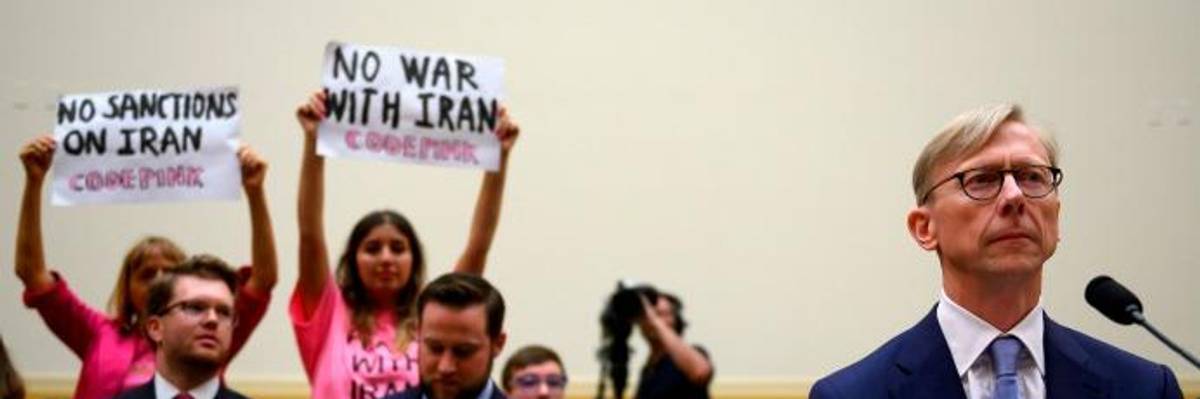
Brian Hook, the U.S. Special Representative for Iran, testifies before a House Foreign Affairs Subcommittee on the Middle East, North Africa, and International Terrorism hearing at the Capitol in Washington, D.C. on June 19, 2019. (Photo: Andrew Caballero-Reynolds/AFP/Getty Images)
Threatening Food and Medicines, Trump Admin Accused of Putting Iranian People in 'Cross-Hairs of Its Ongoing Economic War'
The new designation under Section 311, the adminstration was warned, would mean foreign banks no longer processing humanitarian-related transactions.
The Trump administration was accused of sounding "the death knell for humanitarian trade with Iran" on Friday after the State and Treasury Departments announced new measures targeting the sanctions-hit country.
"Through its action today," said National Iranian American Council (NIAC) president Jamal Abdi, "the administration has made clear that the Iranian people are in the cross-hairs of their ongoing economic war against Iran and that the deliberate targeting of food and medicine to the Iranian people is fair game."
In a press statement, the departments announced two restrictions. The first was a mechanism the administration asserted would "help the international community perform enhanced due diligence on humanitarian trade to ensure that funds associated with permissible trade in support of the Iranian people are not diverted by the Iranian regime to develop ballistic missiles, support terrorism, or finance other malign activities." The second was to assert its authority under Section 311 of the PATRIOT Act and classify Iran as a jurisdiction of primary money laundering concern.
The latter action, said Abdi, "severed what limited remaining ties Iran has to the global financial system."
"Foreign banks have warned the U.S. Treasury Department that Iran's designation under Section 311 will force them to stop processing humanitarian-related transactions in the future," Abdi said. "Yet, the Trump administration has accepted, if not deliberately encouraged, those consequences."
The so-called "humanitarian mechanism" the administration announced demands foreign governments and financial institutions "conduct enhanced due diligence and provide to Treasury a substantial and unprecedented amount of information." Brian Hook, the State Department's Special Envoy to Iran, claimed the "channel will make it easier for foreign governments, financial institutions, and private companies to engage in legitimate humanitarian trade on behalf of the Iranian people while reducing the risk that money ends up in the wrong hands. The U.S. will continue to stand with the Iranian people."
NIAC's Abdi, however, countered that framing.
This "humanitarian channel functions more like a sanctions wall, erecting stringent conditions on foreign bank participation in humanitarian trade with Iran," he said. "Let's be clear: There is unlikely to be a single banker in the world that will accept these conditions and participate in the trade. The Trump administration is surely aware of this fact, and its humanitarian channel should be viewed as nothing more than farce."
"Today's announcement does nothing to alleviate the real challenges sanctions pose to humanitarian trade," Abdi continued, "and in fact add new burdens apparently intended to end the provision of life-saving medicine to Iran."
The new development, Abdi said, "makes the United States the equivalent of human rights violators that similarly target humanitarian goods in order to achieve their political objectives."
Abdi wasn't alone in his criticism, as Laura Rozen reported for Al-Monitor.
Tyler Cullis, an attorney with Ferrari & Associates U.S. economics sanctions, told the outlet the chances of financial institutions being willing to comply with the humanitarian mechanism's required monthly reporting of "enhanced due diligence" were slim.
"Not a single banker in the world will look at that and say, 'yeah, we will do that.' Not a single one," Cullis told Al-Monitor.
We are at a crossroads
This country and this world are at a monumental crossroads. In a few short weeks, US voters will have an opportunity to beat back the forces of fascism and confront the billionaires who are rigging the economy, our media system, and our democracy, making it increasingly impossible for ordinary people to get by. We’re not just talking about the election. We’re talking about what must be done once these fascist elements are vanquished from power. We need a bolder set of solutions than what either major party has so far been willing to offer and a working-class movement ready to fight like hell for it. Trump didn't emerge from nowhere. The conditions that fueled MAGA authoritarianism were created by decades of radical neoliberal economic policies and a corrupt political system dominated by corporate interests. They slashed taxes on the super-rich, promising that the benefits would trickle down. They said giveaways to the corporate titans would make life more affordable for the rest of us. It was all bullshit. And when a bitter, betrayed populace searches for someone to blame, right-wing demagogues have little trouble finding scapegoats. People know when they're being lied to, but you won't hear any of this from the corporate media. Only independent journalism—powered and funded by people who believe in building a better world—can deliver truly trustworthy daily news. Our Fall Campaign is underway, and we need your help. To power our newsroom through the rest of the year, we need to raise $125,000 by midnight on October 31. So if you share our vision, please contribute whatever you can to sustain our work. |
The Trump administration was accused of sounding "the death knell for humanitarian trade with Iran" on Friday after the State and Treasury Departments announced new measures targeting the sanctions-hit country.
"Through its action today," said National Iranian American Council (NIAC) president Jamal Abdi, "the administration has made clear that the Iranian people are in the cross-hairs of their ongoing economic war against Iran and that the deliberate targeting of food and medicine to the Iranian people is fair game."
In a press statement, the departments announced two restrictions. The first was a mechanism the administration asserted would "help the international community perform enhanced due diligence on humanitarian trade to ensure that funds associated with permissible trade in support of the Iranian people are not diverted by the Iranian regime to develop ballistic missiles, support terrorism, or finance other malign activities." The second was to assert its authority under Section 311 of the PATRIOT Act and classify Iran as a jurisdiction of primary money laundering concern.
The latter action, said Abdi, "severed what limited remaining ties Iran has to the global financial system."
"Foreign banks have warned the U.S. Treasury Department that Iran's designation under Section 311 will force them to stop processing humanitarian-related transactions in the future," Abdi said. "Yet, the Trump administration has accepted, if not deliberately encouraged, those consequences."
The so-called "humanitarian mechanism" the administration announced demands foreign governments and financial institutions "conduct enhanced due diligence and provide to Treasury a substantial and unprecedented amount of information." Brian Hook, the State Department's Special Envoy to Iran, claimed the "channel will make it easier for foreign governments, financial institutions, and private companies to engage in legitimate humanitarian trade on behalf of the Iranian people while reducing the risk that money ends up in the wrong hands. The U.S. will continue to stand with the Iranian people."
NIAC's Abdi, however, countered that framing.
This "humanitarian channel functions more like a sanctions wall, erecting stringent conditions on foreign bank participation in humanitarian trade with Iran," he said. "Let's be clear: There is unlikely to be a single banker in the world that will accept these conditions and participate in the trade. The Trump administration is surely aware of this fact, and its humanitarian channel should be viewed as nothing more than farce."
"Today's announcement does nothing to alleviate the real challenges sanctions pose to humanitarian trade," Abdi continued, "and in fact add new burdens apparently intended to end the provision of life-saving medicine to Iran."
The new development, Abdi said, "makes the United States the equivalent of human rights violators that similarly target humanitarian goods in order to achieve their political objectives."
Abdi wasn't alone in his criticism, as Laura Rozen reported for Al-Monitor.
Tyler Cullis, an attorney with Ferrari & Associates U.S. economics sanctions, told the outlet the chances of financial institutions being willing to comply with the humanitarian mechanism's required monthly reporting of "enhanced due diligence" were slim.
"Not a single banker in the world will look at that and say, 'yeah, we will do that.' Not a single one," Cullis told Al-Monitor.
The Trump administration was accused of sounding "the death knell for humanitarian trade with Iran" on Friday after the State and Treasury Departments announced new measures targeting the sanctions-hit country.
"Through its action today," said National Iranian American Council (NIAC) president Jamal Abdi, "the administration has made clear that the Iranian people are in the cross-hairs of their ongoing economic war against Iran and that the deliberate targeting of food and medicine to the Iranian people is fair game."
In a press statement, the departments announced two restrictions. The first was a mechanism the administration asserted would "help the international community perform enhanced due diligence on humanitarian trade to ensure that funds associated with permissible trade in support of the Iranian people are not diverted by the Iranian regime to develop ballistic missiles, support terrorism, or finance other malign activities." The second was to assert its authority under Section 311 of the PATRIOT Act and classify Iran as a jurisdiction of primary money laundering concern.
The latter action, said Abdi, "severed what limited remaining ties Iran has to the global financial system."
"Foreign banks have warned the U.S. Treasury Department that Iran's designation under Section 311 will force them to stop processing humanitarian-related transactions in the future," Abdi said. "Yet, the Trump administration has accepted, if not deliberately encouraged, those consequences."
The so-called "humanitarian mechanism" the administration announced demands foreign governments and financial institutions "conduct enhanced due diligence and provide to Treasury a substantial and unprecedented amount of information." Brian Hook, the State Department's Special Envoy to Iran, claimed the "channel will make it easier for foreign governments, financial institutions, and private companies to engage in legitimate humanitarian trade on behalf of the Iranian people while reducing the risk that money ends up in the wrong hands. The U.S. will continue to stand with the Iranian people."
NIAC's Abdi, however, countered that framing.
This "humanitarian channel functions more like a sanctions wall, erecting stringent conditions on foreign bank participation in humanitarian trade with Iran," he said. "Let's be clear: There is unlikely to be a single banker in the world that will accept these conditions and participate in the trade. The Trump administration is surely aware of this fact, and its humanitarian channel should be viewed as nothing more than farce."
"Today's announcement does nothing to alleviate the real challenges sanctions pose to humanitarian trade," Abdi continued, "and in fact add new burdens apparently intended to end the provision of life-saving medicine to Iran."
The new development, Abdi said, "makes the United States the equivalent of human rights violators that similarly target humanitarian goods in order to achieve their political objectives."
Abdi wasn't alone in his criticism, as Laura Rozen reported for Al-Monitor.
Tyler Cullis, an attorney with Ferrari & Associates U.S. economics sanctions, told the outlet the chances of financial institutions being willing to comply with the humanitarian mechanism's required monthly reporting of "enhanced due diligence" were slim.
"Not a single banker in the world will look at that and say, 'yeah, we will do that.' Not a single one," Cullis told Al-Monitor.