

SUBSCRIBE TO OUR FREE NEWSLETTER
Daily news & progressive opinion—funded by the people, not the corporations—delivered straight to your inbox.
5
#000000
#FFFFFF
To donate by check, phone, or other method, see our More Ways to Give page.
Daily news & progressive opinion—funded by the people, not the corporations—delivered straight to your inbox.
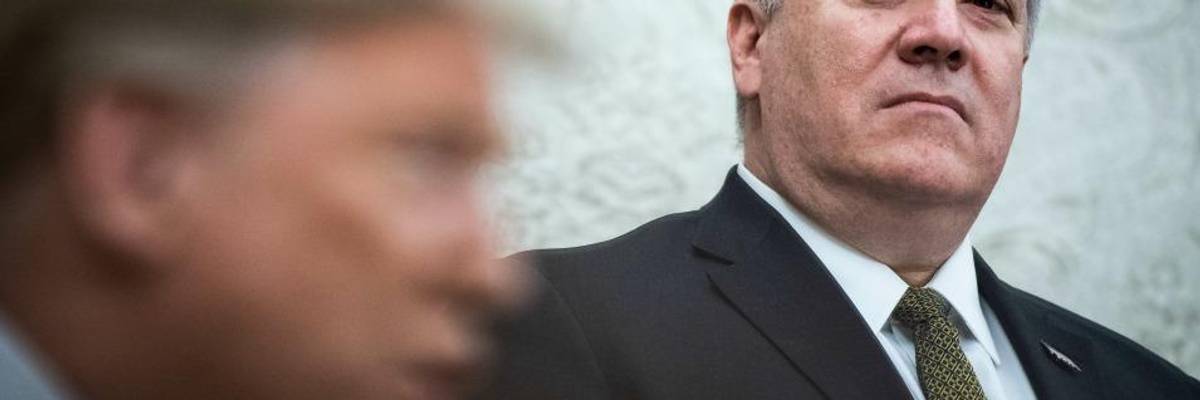
U.S. Secretary of State Mike Pompeo admitted on Wednesday that he was on the phone call between President Donald Trump and Ukrainian President Volodymyr Zelensy in July, in which Trump asked Zelensky to investigate 2020 Democratic presidential candidate Joe Biden's son. (Photo: Jabin Botsford/The Washington Post via Getty Images)
Secretary of State Mike Pompeo admitted Wednesday that he participated in a White House phone call with Ukrainian leader Volodymyr Zelensky, an incident which is at the center of the impeachment inquiry into President Donald Trump.
The admission came as at least three State Department officials prepared to speak with House committees regarding the Trump administration's relations with Ukraine and the phone call.
While visiting Rome, Pompeo told reporters, "As for was I on the phone call? I was on the phone call." The statement contradicted his earlier indication that he knew nothing about the call.
Pompeo's comments came amid news that the inspector general of the State Department, Steve Linick, has requested an "urgent" closed-door meeting on Wednesday with the House Oversight, Intelligence, and Foreign Affairs Committees, which subpoenaed Pompeo last week. The committees demanded documents related to the phone call by October 4 and asked for depositions from five other State Department officials. Pompeo said Tuesday that he would not obey the subpoena.
The secretary of state said the phone call was part of standard communications between the U.S. and Ukraine and was focused on the Trump administration's support for the country. Pompeo's deflection of questions about the appropriateness of the phone call, in which Trump asked Zelensky to find incriminating information about 2020 Democratic candidate Joe Biden's son, represented the administration's familiar pattern of admitting wrongdoing, one critic noted on social media.
The admission comes in stark contrast to Pompeo dodging a direct question last week about whether he knew anything about the conversation between Trump and Zelensky.
Some on social media said Linick's urgent request to speak with the panels may lead to the release of significant new information that Pompeo has refused to give the committees.
"The truth will come out," legal analyst Barb McQuade tweeted.
As Linick prepared to address the committees, at least two State Department officials whose depositions were requested said that they would speak with the committees in the coming days. Recently-resigned Ukraine envoy Kurt Volker plans to meet with the Democratic-led panels Thursday while former U.S. Ambassador Marie Yovanovitch will address them on Oct. 11.
While Pompeo accused House Democrats of "bullying" and "intimidating" State Department officials on Tuesday, The Guardian reported that "it soon became clear that Pompeo had only limited power to stop the congressional committees from gathering evidence for an impeachment inquiry."
Former Obama White House official Ben Rhodes tweeted that Pompeo's conduct since news broke of Trump's call with Zelensky should be considered an impeachable offense.
Dear Common Dreams reader, It’s been nearly 30 years since I co-founded Common Dreams with my late wife, Lina Newhouser. We had the radical notion that journalism should serve the public good, not corporate profits. It was clear to us from the outset what it would take to build such a project. No paid advertisements. No corporate sponsors. No millionaire publisher telling us what to think or do. Many people said we wouldn't last a year, but we proved those doubters wrong. Together with a tremendous team of journalists and dedicated staff, we built an independent media outlet free from the constraints of profits and corporate control. Our mission has always been simple: To inform. To inspire. To ignite change for the common good. Building Common Dreams was not easy. Our survival was never guaranteed. When you take on the most powerful forces—Wall Street greed, fossil fuel industry destruction, Big Tech lobbyists, and uber-rich oligarchs who have spent billions upon billions rigging the economy and democracy in their favor—the only bulwark you have is supporters who believe in your work. But here’s the urgent message from me today. It's never been this bad out there. And it's never been this hard to keep us going. At the very moment Common Dreams is most needed, the threats we face are intensifying. We need your support now more than ever. We don't accept corporate advertising and never will. We don't have a paywall because we don't think people should be blocked from critical news based on their ability to pay. Everything we do is funded by the donations of readers like you. When everyone does the little they can afford, we are strong. But if that support retreats or dries up, so do we. Will you donate now to make sure Common Dreams not only survives but thrives? —Craig Brown, Co-founder |
Secretary of State Mike Pompeo admitted Wednesday that he participated in a White House phone call with Ukrainian leader Volodymyr Zelensky, an incident which is at the center of the impeachment inquiry into President Donald Trump.
The admission came as at least three State Department officials prepared to speak with House committees regarding the Trump administration's relations with Ukraine and the phone call.
While visiting Rome, Pompeo told reporters, "As for was I on the phone call? I was on the phone call." The statement contradicted his earlier indication that he knew nothing about the call.
Pompeo's comments came amid news that the inspector general of the State Department, Steve Linick, has requested an "urgent" closed-door meeting on Wednesday with the House Oversight, Intelligence, and Foreign Affairs Committees, which subpoenaed Pompeo last week. The committees demanded documents related to the phone call by October 4 and asked for depositions from five other State Department officials. Pompeo said Tuesday that he would not obey the subpoena.
The secretary of state said the phone call was part of standard communications between the U.S. and Ukraine and was focused on the Trump administration's support for the country. Pompeo's deflection of questions about the appropriateness of the phone call, in which Trump asked Zelensky to find incriminating information about 2020 Democratic candidate Joe Biden's son, represented the administration's familiar pattern of admitting wrongdoing, one critic noted on social media.
The admission comes in stark contrast to Pompeo dodging a direct question last week about whether he knew anything about the conversation between Trump and Zelensky.
Some on social media said Linick's urgent request to speak with the panels may lead to the release of significant new information that Pompeo has refused to give the committees.
"The truth will come out," legal analyst Barb McQuade tweeted.
As Linick prepared to address the committees, at least two State Department officials whose depositions were requested said that they would speak with the committees in the coming days. Recently-resigned Ukraine envoy Kurt Volker plans to meet with the Democratic-led panels Thursday while former U.S. Ambassador Marie Yovanovitch will address them on Oct. 11.
While Pompeo accused House Democrats of "bullying" and "intimidating" State Department officials on Tuesday, The Guardian reported that "it soon became clear that Pompeo had only limited power to stop the congressional committees from gathering evidence for an impeachment inquiry."
Former Obama White House official Ben Rhodes tweeted that Pompeo's conduct since news broke of Trump's call with Zelensky should be considered an impeachable offense.
Secretary of State Mike Pompeo admitted Wednesday that he participated in a White House phone call with Ukrainian leader Volodymyr Zelensky, an incident which is at the center of the impeachment inquiry into President Donald Trump.
The admission came as at least three State Department officials prepared to speak with House committees regarding the Trump administration's relations with Ukraine and the phone call.
While visiting Rome, Pompeo told reporters, "As for was I on the phone call? I was on the phone call." The statement contradicted his earlier indication that he knew nothing about the call.
Pompeo's comments came amid news that the inspector general of the State Department, Steve Linick, has requested an "urgent" closed-door meeting on Wednesday with the House Oversight, Intelligence, and Foreign Affairs Committees, which subpoenaed Pompeo last week. The committees demanded documents related to the phone call by October 4 and asked for depositions from five other State Department officials. Pompeo said Tuesday that he would not obey the subpoena.
The secretary of state said the phone call was part of standard communications between the U.S. and Ukraine and was focused on the Trump administration's support for the country. Pompeo's deflection of questions about the appropriateness of the phone call, in which Trump asked Zelensky to find incriminating information about 2020 Democratic candidate Joe Biden's son, represented the administration's familiar pattern of admitting wrongdoing, one critic noted on social media.
The admission comes in stark contrast to Pompeo dodging a direct question last week about whether he knew anything about the conversation between Trump and Zelensky.
Some on social media said Linick's urgent request to speak with the panels may lead to the release of significant new information that Pompeo has refused to give the committees.
"The truth will come out," legal analyst Barb McQuade tweeted.
As Linick prepared to address the committees, at least two State Department officials whose depositions were requested said that they would speak with the committees in the coming days. Recently-resigned Ukraine envoy Kurt Volker plans to meet with the Democratic-led panels Thursday while former U.S. Ambassador Marie Yovanovitch will address them on Oct. 11.
While Pompeo accused House Democrats of "bullying" and "intimidating" State Department officials on Tuesday, The Guardian reported that "it soon became clear that Pompeo had only limited power to stop the congressional committees from gathering evidence for an impeachment inquiry."
Former Obama White House official Ben Rhodes tweeted that Pompeo's conduct since news broke of Trump's call with Zelensky should be considered an impeachable offense.

