SUBSCRIBE TO OUR FREE NEWSLETTER
Daily news & progressive opinion—funded by the people, not the corporations—delivered straight to your inbox.
5
#000000
#FFFFFF
To donate by check, phone, or other method, see our More Ways to Give page.
Daily news & progressive opinion—funded by the people, not the corporations—delivered straight to your inbox.
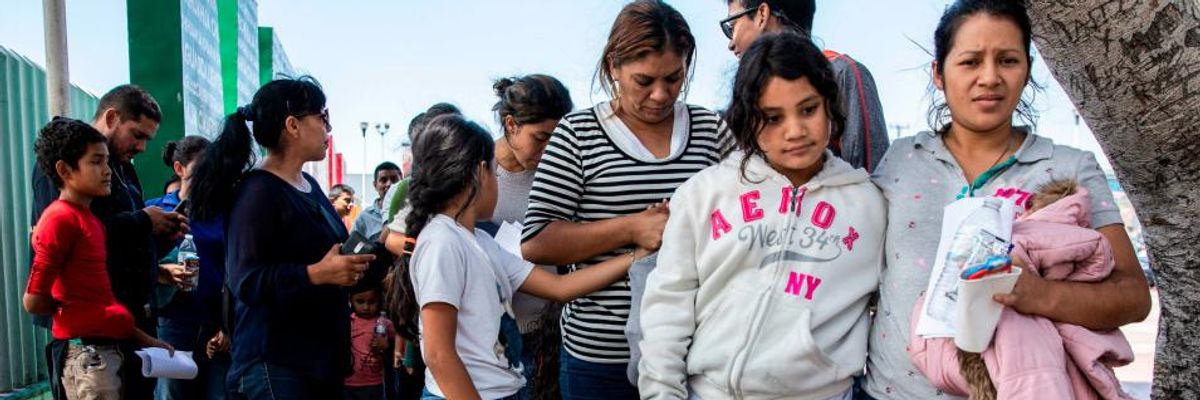
Central American migrants wait in line at the El Chaparral border crossing before being transported to a shelter in Tijuana, Mexico, on July 22, 2019. (Photo: Eduardo Jaramillo Castro/AFP/Getty Images)
In what rights groups condemned as a move driven not by America's capacity to resettle those fleeing violence and persecution but solely by President Donald Trump's hate-filled political agenda, the State Department on Thursday said the U.S. will accept no more than 18,000 refugees over the next fiscal year.
The cap marks an all-time low since the U.S. refugee admissions program was established in 1980. The previous low of 30,000 was set by the Trump administration last year.
"The president is abusing his power by using people seeking safety as an opportunity to rile up hostility and create a climate of fear."
--Ryan Mace, Amnesty International USA
Trump on Thursday also signed an executive order that would empower states and localities to refuse to resettle refugees.
"To cut the number of refugees the U.S. will accept to this low of a number reflects nothing more than this administration's attempts to further hate, division, and prejudice in a country that once valued dignity, equality, and fairness," Ryan Mace, grassroots advocacy and refugee specialist at Amnesty International USA, said in a statement.
"Sadly, this number isn't based in fact," said Mace. "The fact is, the U.S. has the capacity to accept far more refugees than this. We know that we can vet them and resettle them at rates far higher than this--because the U.S. has done it for decades. This is purely a political decision, and one that couldn't come at a worse time. The president is abusing his power by using people seeking safety as an opportunity to rile up hostility and create a climate of fear."
The "unprecedented reduction in admissions" for fiscal year 2020 represents the third consecutive year the Trump administration has dramatically lowered the number of refugees allowed to enter and resettle in the United States. In July, as Common Dreams reported, Trump administration officials privately floated the possibility of cutting the refugee cap to zero.
According to Politico, which obtained a document on the administration's new refugee cap, "the 18,000-person refugee ceiling contains several carveouts":
The administration will reserve 5,000 slots for refugee persecuted on the basis of religion, and 4,000 spaces for Iraqis who assisted U.S. forces in that country. Another 1,500 refugee placements will be set aside for residents of Guatemala, El Salvador and Honduras, according to the document.
After the carveouts, the administration will make another 7,500 spaces available to the remainder of the refugee pool. The document shared with lawmakers said that group could include referrals from U.S. embassies, refugees joining family members and refugees to be resettled as the result of an Obama-era agreement with Australia.
David Miliband, president and CEO of the International Rescue Committee, said in a statement that the Trump administration's refugee limit represents "unspeakable setback for refugee mothers who wish to see their children in school, parents who wish to work and support their family, and children who deserve a chance at life that isn't solely defined by the instability and the trauma of their childhood."
"This is a very sad day for America," said Miliband. "Refugee resettlement is an essential lifeline that the U.S. provides for the most vulnerable refugees at a time of unprecedented global crisis."
Dear Common Dreams reader, It’s been nearly 30 years since I co-founded Common Dreams with my late wife, Lina Newhouser. We had the radical notion that journalism should serve the public good, not corporate profits. It was clear to us from the outset what it would take to build such a project. No paid advertisements. No corporate sponsors. No millionaire publisher telling us what to think or do. Many people said we wouldn't last a year, but we proved those doubters wrong. Together with a tremendous team of journalists and dedicated staff, we built an independent media outlet free from the constraints of profits and corporate control. Our mission has always been simple: To inform. To inspire. To ignite change for the common good. Building Common Dreams was not easy. Our survival was never guaranteed. When you take on the most powerful forces—Wall Street greed, fossil fuel industry destruction, Big Tech lobbyists, and uber-rich oligarchs who have spent billions upon billions rigging the economy and democracy in their favor—the only bulwark you have is supporters who believe in your work. But here’s the urgent message from me today. It's never been this bad out there. And it's never been this hard to keep us going. At the very moment Common Dreams is most needed, the threats we face are intensifying. We need your support now more than ever. We don't accept corporate advertising and never will. We don't have a paywall because we don't think people should be blocked from critical news based on their ability to pay. Everything we do is funded by the donations of readers like you. When everyone does the little they can afford, we are strong. But if that support retreats or dries up, so do we. Will you donate now to make sure Common Dreams not only survives but thrives? —Craig Brown, Co-founder |
In what rights groups condemned as a move driven not by America's capacity to resettle those fleeing violence and persecution but solely by President Donald Trump's hate-filled political agenda, the State Department on Thursday said the U.S. will accept no more than 18,000 refugees over the next fiscal year.
The cap marks an all-time low since the U.S. refugee admissions program was established in 1980. The previous low of 30,000 was set by the Trump administration last year.
"The president is abusing his power by using people seeking safety as an opportunity to rile up hostility and create a climate of fear."
--Ryan Mace, Amnesty International USA
Trump on Thursday also signed an executive order that would empower states and localities to refuse to resettle refugees.
"To cut the number of refugees the U.S. will accept to this low of a number reflects nothing more than this administration's attempts to further hate, division, and prejudice in a country that once valued dignity, equality, and fairness," Ryan Mace, grassroots advocacy and refugee specialist at Amnesty International USA, said in a statement.
"Sadly, this number isn't based in fact," said Mace. "The fact is, the U.S. has the capacity to accept far more refugees than this. We know that we can vet them and resettle them at rates far higher than this--because the U.S. has done it for decades. This is purely a political decision, and one that couldn't come at a worse time. The president is abusing his power by using people seeking safety as an opportunity to rile up hostility and create a climate of fear."
The "unprecedented reduction in admissions" for fiscal year 2020 represents the third consecutive year the Trump administration has dramatically lowered the number of refugees allowed to enter and resettle in the United States. In July, as Common Dreams reported, Trump administration officials privately floated the possibility of cutting the refugee cap to zero.
According to Politico, which obtained a document on the administration's new refugee cap, "the 18,000-person refugee ceiling contains several carveouts":
The administration will reserve 5,000 slots for refugee persecuted on the basis of religion, and 4,000 spaces for Iraqis who assisted U.S. forces in that country. Another 1,500 refugee placements will be set aside for residents of Guatemala, El Salvador and Honduras, according to the document.
After the carveouts, the administration will make another 7,500 spaces available to the remainder of the refugee pool. The document shared with lawmakers said that group could include referrals from U.S. embassies, refugees joining family members and refugees to be resettled as the result of an Obama-era agreement with Australia.
David Miliband, president and CEO of the International Rescue Committee, said in a statement that the Trump administration's refugee limit represents "unspeakable setback for refugee mothers who wish to see their children in school, parents who wish to work and support their family, and children who deserve a chance at life that isn't solely defined by the instability and the trauma of their childhood."
"This is a very sad day for America," said Miliband. "Refugee resettlement is an essential lifeline that the U.S. provides for the most vulnerable refugees at a time of unprecedented global crisis."
In what rights groups condemned as a move driven not by America's capacity to resettle those fleeing violence and persecution but solely by President Donald Trump's hate-filled political agenda, the State Department on Thursday said the U.S. will accept no more than 18,000 refugees over the next fiscal year.
The cap marks an all-time low since the U.S. refugee admissions program was established in 1980. The previous low of 30,000 was set by the Trump administration last year.
"The president is abusing his power by using people seeking safety as an opportunity to rile up hostility and create a climate of fear."
--Ryan Mace, Amnesty International USA
Trump on Thursday also signed an executive order that would empower states and localities to refuse to resettle refugees.
"To cut the number of refugees the U.S. will accept to this low of a number reflects nothing more than this administration's attempts to further hate, division, and prejudice in a country that once valued dignity, equality, and fairness," Ryan Mace, grassroots advocacy and refugee specialist at Amnesty International USA, said in a statement.
"Sadly, this number isn't based in fact," said Mace. "The fact is, the U.S. has the capacity to accept far more refugees than this. We know that we can vet them and resettle them at rates far higher than this--because the U.S. has done it for decades. This is purely a political decision, and one that couldn't come at a worse time. The president is abusing his power by using people seeking safety as an opportunity to rile up hostility and create a climate of fear."
The "unprecedented reduction in admissions" for fiscal year 2020 represents the third consecutive year the Trump administration has dramatically lowered the number of refugees allowed to enter and resettle in the United States. In July, as Common Dreams reported, Trump administration officials privately floated the possibility of cutting the refugee cap to zero.
According to Politico, which obtained a document on the administration's new refugee cap, "the 18,000-person refugee ceiling contains several carveouts":
The administration will reserve 5,000 slots for refugee persecuted on the basis of religion, and 4,000 spaces for Iraqis who assisted U.S. forces in that country. Another 1,500 refugee placements will be set aside for residents of Guatemala, El Salvador and Honduras, according to the document.
After the carveouts, the administration will make another 7,500 spaces available to the remainder of the refugee pool. The document shared with lawmakers said that group could include referrals from U.S. embassies, refugees joining family members and refugees to be resettled as the result of an Obama-era agreement with Australia.
David Miliband, president and CEO of the International Rescue Committee, said in a statement that the Trump administration's refugee limit represents "unspeakable setback for refugee mothers who wish to see their children in school, parents who wish to work and support their family, and children who deserve a chance at life that isn't solely defined by the instability and the trauma of their childhood."
"This is a very sad day for America," said Miliband. "Refugee resettlement is an essential lifeline that the U.S. provides for the most vulnerable refugees at a time of unprecedented global crisis."