SUBSCRIBE TO OUR FREE NEWSLETTER
Daily news & progressive opinion—funded by the people, not the corporations—delivered straight to your inbox.
5
#000000
#FFFFFF
To donate by check, phone, or other method, see our More Ways to Give page.
Daily news & progressive opinion—funded by the people, not the corporations—delivered straight to your inbox.
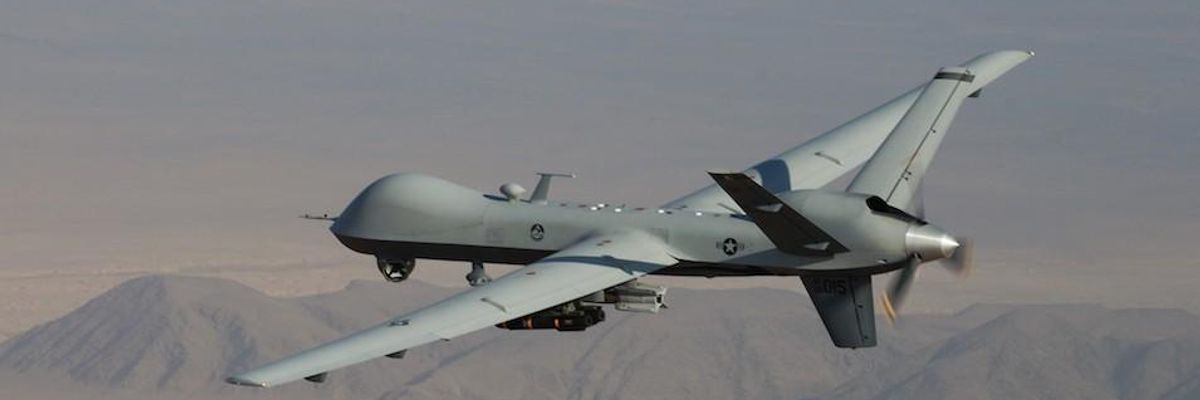
An MQ-9 Reaper drone flies a combat mission. (Photo: Lt. Col. Leslie Pratt/U.S. Air Force)
A U.S. drone attack killed 30 pine nut farmers and wounded at least 40 others in Afghanistan Wednesday night, the latest killing of innocent civilians by American forces as the "war on terror" enters its 19th year.
"Some of us managed to escape, some were injured, but many were killed."
--Juma Gul, farm worker
The farmers had just finished work and were sitting by a fire when the strike happened, according to tribal elder Malik Rahat Gul.
"Some of us managed to escape, some were injured, but many were killed," said farm laborer Juma Gul.
Retuers reported that there may be more farmers missing:
Haidar Khan, who owns the pine nut fields, said about 150 workers were there for harvesting, with some still missing as well as the confirmed dead and injured.
A survivor of the drone strike said about 200 laborers were sleeping in five tents pitched near the farm when the attack happened.
In a statement, Colonel Sonny Leggett, the spokesman for the U.S. campaign in Afghanistan, said the attack was aimed at "Da'esh (IS) terrorists in Nangarhar" province.
"We are aware of allegations of the death of non-combatants and are working with local officials to determine the facts," said Leggett.
However, Leggett said, the blame for the massacre is squarely on IS and the Taliban--not U.S. forces.
"We are fighting in a complex environment against those who intentionally kill and hide behind civilians, as well as use dishonest claims of noncombatant casualties as propaganda weapons," Leggett said.
Human rights group Amnesty International, in a statement, said that the strike was "unacceptable and suggests a shocking disregard for civilian life."
"U.S. forces in Afghanistan must ensure that all possible precautions are taken to avoid civilian casualties in military operations," said Amnesty.
In a tweet, journalist Emran Feroz said his reporting from the region indicates that the reality of U.S. policy with respect to attacks in Nangarhar is different than Leggett's claims.
"Seems that recent drone strikes in Nangarhar's Khogyani district ended in a total massacre killing far more than 30 civilians," said Feroz. "When I visited Khogyani in 2017, locals told us that drone strikes against farmers and other civilians are taking place regularly."
Rita Siemion, the director of National Security Advocacy at Human Rights First, told Common Dreams that the U.S. military cannot knowingly continue to use a process that repeatedly kills civilians by mistake.
"Mistakes can happen, but this strike is part of a pattern that suggests that there are serious flaws in the Pentagon's targeting processes that need to be addressed," said Siemion. "Knowingly using a process that fails to adequately distinguish between civilians and combatants would violate the laws of war and be detrimental to the overall mission."
In a tweet, The Intercept's Mehdi Hasan noted just how little attention the massacre perpetrated by the U.S. military was likely to receive.
MSNBC host Chris Hayes tweeted Thursday that Americans should pay attention to the attack and try to put themselves in Afghan shoes.
"It is so easy to read this and be upset or shake your head and still see it as an abstraction," said Hayes. "But take a second to play through a missile from, say, Iran landing in Iowa and killing 30 farmers and what that would do to domestic politics."
Dear Common Dreams reader, It’s been nearly 30 years since I co-founded Common Dreams with my late wife, Lina Newhouser. We had the radical notion that journalism should serve the public good, not corporate profits. It was clear to us from the outset what it would take to build such a project. No paid advertisements. No corporate sponsors. No millionaire publisher telling us what to think or do. Many people said we wouldn't last a year, but we proved those doubters wrong. Together with a tremendous team of journalists and dedicated staff, we built an independent media outlet free from the constraints of profits and corporate control. Our mission has always been simple: To inform. To inspire. To ignite change for the common good. Building Common Dreams was not easy. Our survival was never guaranteed. When you take on the most powerful forces—Wall Street greed, fossil fuel industry destruction, Big Tech lobbyists, and uber-rich oligarchs who have spent billions upon billions rigging the economy and democracy in their favor—the only bulwark you have is supporters who believe in your work. But here’s the urgent message from me today. It's never been this bad out there. And it's never been this hard to keep us going. At the very moment Common Dreams is most needed, the threats we face are intensifying. We need your support now more than ever. We don't accept corporate advertising and never will. We don't have a paywall because we don't think people should be blocked from critical news based on their ability to pay. Everything we do is funded by the donations of readers like you. When everyone does the little they can afford, we are strong. But if that support retreats or dries up, so do we. Will you donate now to make sure Common Dreams not only survives but thrives? —Craig Brown, Co-founder |
A U.S. drone attack killed 30 pine nut farmers and wounded at least 40 others in Afghanistan Wednesday night, the latest killing of innocent civilians by American forces as the "war on terror" enters its 19th year.
"Some of us managed to escape, some were injured, but many were killed."
--Juma Gul, farm worker
The farmers had just finished work and were sitting by a fire when the strike happened, according to tribal elder Malik Rahat Gul.
"Some of us managed to escape, some were injured, but many were killed," said farm laborer Juma Gul.
Retuers reported that there may be more farmers missing:
Haidar Khan, who owns the pine nut fields, said about 150 workers were there for harvesting, with some still missing as well as the confirmed dead and injured.
A survivor of the drone strike said about 200 laborers were sleeping in five tents pitched near the farm when the attack happened.
In a statement, Colonel Sonny Leggett, the spokesman for the U.S. campaign in Afghanistan, said the attack was aimed at "Da'esh (IS) terrorists in Nangarhar" province.
"We are aware of allegations of the death of non-combatants and are working with local officials to determine the facts," said Leggett.
However, Leggett said, the blame for the massacre is squarely on IS and the Taliban--not U.S. forces.
"We are fighting in a complex environment against those who intentionally kill and hide behind civilians, as well as use dishonest claims of noncombatant casualties as propaganda weapons," Leggett said.
Human rights group Amnesty International, in a statement, said that the strike was "unacceptable and suggests a shocking disregard for civilian life."
"U.S. forces in Afghanistan must ensure that all possible precautions are taken to avoid civilian casualties in military operations," said Amnesty.
In a tweet, journalist Emran Feroz said his reporting from the region indicates that the reality of U.S. policy with respect to attacks in Nangarhar is different than Leggett's claims.
"Seems that recent drone strikes in Nangarhar's Khogyani district ended in a total massacre killing far more than 30 civilians," said Feroz. "When I visited Khogyani in 2017, locals told us that drone strikes against farmers and other civilians are taking place regularly."
Rita Siemion, the director of National Security Advocacy at Human Rights First, told Common Dreams that the U.S. military cannot knowingly continue to use a process that repeatedly kills civilians by mistake.
"Mistakes can happen, but this strike is part of a pattern that suggests that there are serious flaws in the Pentagon's targeting processes that need to be addressed," said Siemion. "Knowingly using a process that fails to adequately distinguish between civilians and combatants would violate the laws of war and be detrimental to the overall mission."
In a tweet, The Intercept's Mehdi Hasan noted just how little attention the massacre perpetrated by the U.S. military was likely to receive.
MSNBC host Chris Hayes tweeted Thursday that Americans should pay attention to the attack and try to put themselves in Afghan shoes.
"It is so easy to read this and be upset or shake your head and still see it as an abstraction," said Hayes. "But take a second to play through a missile from, say, Iran landing in Iowa and killing 30 farmers and what that would do to domestic politics."
A U.S. drone attack killed 30 pine nut farmers and wounded at least 40 others in Afghanistan Wednesday night, the latest killing of innocent civilians by American forces as the "war on terror" enters its 19th year.
"Some of us managed to escape, some were injured, but many were killed."
--Juma Gul, farm worker
The farmers had just finished work and were sitting by a fire when the strike happened, according to tribal elder Malik Rahat Gul.
"Some of us managed to escape, some were injured, but many were killed," said farm laborer Juma Gul.
Retuers reported that there may be more farmers missing:
Haidar Khan, who owns the pine nut fields, said about 150 workers were there for harvesting, with some still missing as well as the confirmed dead and injured.
A survivor of the drone strike said about 200 laborers were sleeping in five tents pitched near the farm when the attack happened.
In a statement, Colonel Sonny Leggett, the spokesman for the U.S. campaign in Afghanistan, said the attack was aimed at "Da'esh (IS) terrorists in Nangarhar" province.
"We are aware of allegations of the death of non-combatants and are working with local officials to determine the facts," said Leggett.
However, Leggett said, the blame for the massacre is squarely on IS and the Taliban--not U.S. forces.
"We are fighting in a complex environment against those who intentionally kill and hide behind civilians, as well as use dishonest claims of noncombatant casualties as propaganda weapons," Leggett said.
Human rights group Amnesty International, in a statement, said that the strike was "unacceptable and suggests a shocking disregard for civilian life."
"U.S. forces in Afghanistan must ensure that all possible precautions are taken to avoid civilian casualties in military operations," said Amnesty.
In a tweet, journalist Emran Feroz said his reporting from the region indicates that the reality of U.S. policy with respect to attacks in Nangarhar is different than Leggett's claims.
"Seems that recent drone strikes in Nangarhar's Khogyani district ended in a total massacre killing far more than 30 civilians," said Feroz. "When I visited Khogyani in 2017, locals told us that drone strikes against farmers and other civilians are taking place regularly."
Rita Siemion, the director of National Security Advocacy at Human Rights First, told Common Dreams that the U.S. military cannot knowingly continue to use a process that repeatedly kills civilians by mistake.
"Mistakes can happen, but this strike is part of a pattern that suggests that there are serious flaws in the Pentagon's targeting processes that need to be addressed," said Siemion. "Knowingly using a process that fails to adequately distinguish between civilians and combatants would violate the laws of war and be detrimental to the overall mission."
In a tweet, The Intercept's Mehdi Hasan noted just how little attention the massacre perpetrated by the U.S. military was likely to receive.
MSNBC host Chris Hayes tweeted Thursday that Americans should pay attention to the attack and try to put themselves in Afghan shoes.
"It is so easy to read this and be upset or shake your head and still see it as an abstraction," said Hayes. "But take a second to play through a missile from, say, Iran landing in Iowa and killing 30 farmers and what that would do to domestic politics."