SUBSCRIBE TO OUR FREE NEWSLETTER
Daily news & progressive opinion—funded by the people, not the corporations—delivered straight to your inbox.
5
#000000
#FFFFFF
To donate by check, phone, or other method, see our More Ways to Give page.
Daily news & progressive opinion—funded by the people, not the corporations—delivered straight to your inbox.
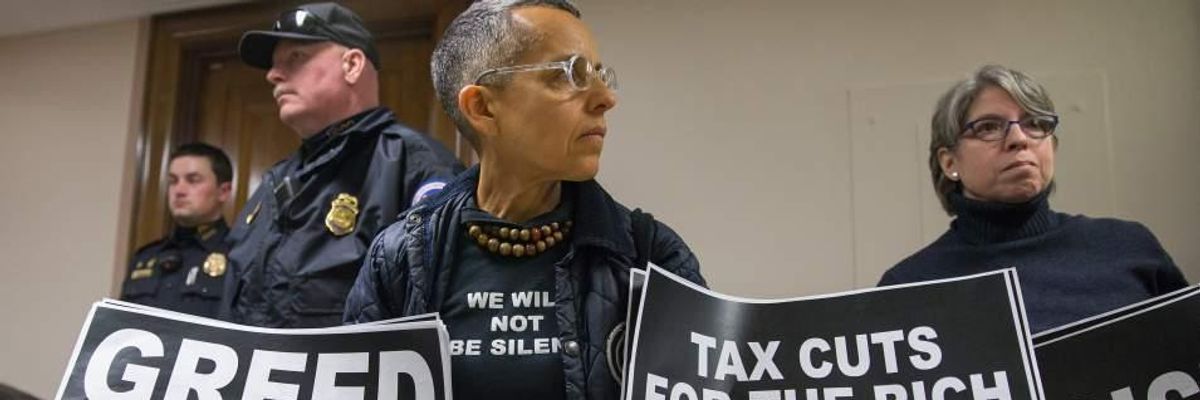
Protesters demonstrated near the full Senate budget committee markup of the tax reform legislation on Capital Hill Nov. 28, 2017 in Washington, D.C. (Photo: Tasos Katopodis/Getty Images)
Urban policy experts along with progressive groups and politicians responded with outrage to a New York Times report published Saturday that detailed how the Trump administration's "signature plan" to help low-income communities across the United States with a multibillion-dollar tax break has "fueled a wave of developments financed by and built for the wealthiest Americans."
The tax break was part of the legislation critics dubbed the GOP tax scam, which Republicans forced through Congress and President Donald Trump signed into law in December of 2017. Linking to the new report, the progressive advocacy organization MoveOn tweeted, "Like everything else about the GOP's 2017 tax scam, a program supposedly meant to benefit poor communities is just another handout to the rich."
According to the Times:
Among the early beneficiaries of the tax incentive are billionaire financiers like Leon Cooperman and business magnates like Sidney Kohl--and Mr. Trump's family members and advisers.
Former Gov. Chris Christie of New Jersey; Richard LeFrak, a New York real estate titan who is close to the president; Anthony Scaramucci, a former White House aide who recently had a falling out with Mr. Trump; and the family of Jared Kushner, Mr. Trump's son-in-law and senior adviser, all are looking to profit from what is shaping up to be a once-in-a-generation bonanza for elite investors.
The purpose of the program, as the Times explained, "was to coax investors to pump cash into poor neighborhoods" by allowing them "to sell stocks or other investments and delay capital gains taxes for years--as long as they plow the proceeds into projects in federally certified opportunity zones."
However, instead of low-income communities reaping the benefits of such investments, "billions of untaxed investment profits are beginning to pour into high-end apartment buildings and hotels, storage facilities that employ only a handful of workers, and student housing in bustling college towns, among other projects," the Times reported.
Though the report sparked immediate criticism of the program, Yonah Freemark, a doctoral candidate in MIT's Department of Urban Studies and Planning, noted on Twitter that "we always knew that this was going to happen--it's how the bill was written."
Among those who highlighted the report were 2020 Democratic presidential primary candidates Bill de Blasio, mayor of New York City, and Sen. Bernie Sanders (I-Vt.).
"President Trump has many critics," tweeted Sanders. "But as a con artist, he is a talent of the highest caliber."
Dear Common Dreams reader, It’s been nearly 30 years since I co-founded Common Dreams with my late wife, Lina Newhouser. We had the radical notion that journalism should serve the public good, not corporate profits. It was clear to us from the outset what it would take to build such a project. No paid advertisements. No corporate sponsors. No millionaire publisher telling us what to think or do. Many people said we wouldn't last a year, but we proved those doubters wrong. Together with a tremendous team of journalists and dedicated staff, we built an independent media outlet free from the constraints of profits and corporate control. Our mission has always been simple: To inform. To inspire. To ignite change for the common good. Building Common Dreams was not easy. Our survival was never guaranteed. When you take on the most powerful forces—Wall Street greed, fossil fuel industry destruction, Big Tech lobbyists, and uber-rich oligarchs who have spent billions upon billions rigging the economy and democracy in their favor—the only bulwark you have is supporters who believe in your work. But here’s the urgent message from me today. It's never been this bad out there. And it's never been this hard to keep us going. At the very moment Common Dreams is most needed, the threats we face are intensifying. We need your support now more than ever. We don't accept corporate advertising and never will. We don't have a paywall because we don't think people should be blocked from critical news based on their ability to pay. Everything we do is funded by the donations of readers like you. When everyone does the little they can afford, we are strong. But if that support retreats or dries up, so do we. Will you donate now to make sure Common Dreams not only survives but thrives? —Craig Brown, Co-founder |
Urban policy experts along with progressive groups and politicians responded with outrage to a New York Times report published Saturday that detailed how the Trump administration's "signature plan" to help low-income communities across the United States with a multibillion-dollar tax break has "fueled a wave of developments financed by and built for the wealthiest Americans."
The tax break was part of the legislation critics dubbed the GOP tax scam, which Republicans forced through Congress and President Donald Trump signed into law in December of 2017. Linking to the new report, the progressive advocacy organization MoveOn tweeted, "Like everything else about the GOP's 2017 tax scam, a program supposedly meant to benefit poor communities is just another handout to the rich."
According to the Times:
Among the early beneficiaries of the tax incentive are billionaire financiers like Leon Cooperman and business magnates like Sidney Kohl--and Mr. Trump's family members and advisers.
Former Gov. Chris Christie of New Jersey; Richard LeFrak, a New York real estate titan who is close to the president; Anthony Scaramucci, a former White House aide who recently had a falling out with Mr. Trump; and the family of Jared Kushner, Mr. Trump's son-in-law and senior adviser, all are looking to profit from what is shaping up to be a once-in-a-generation bonanza for elite investors.
The purpose of the program, as the Times explained, "was to coax investors to pump cash into poor neighborhoods" by allowing them "to sell stocks or other investments and delay capital gains taxes for years--as long as they plow the proceeds into projects in federally certified opportunity zones."
However, instead of low-income communities reaping the benefits of such investments, "billions of untaxed investment profits are beginning to pour into high-end apartment buildings and hotels, storage facilities that employ only a handful of workers, and student housing in bustling college towns, among other projects," the Times reported.
Though the report sparked immediate criticism of the program, Yonah Freemark, a doctoral candidate in MIT's Department of Urban Studies and Planning, noted on Twitter that "we always knew that this was going to happen--it's how the bill was written."
Among those who highlighted the report were 2020 Democratic presidential primary candidates Bill de Blasio, mayor of New York City, and Sen. Bernie Sanders (I-Vt.).
"President Trump has many critics," tweeted Sanders. "But as a con artist, he is a talent of the highest caliber."
Urban policy experts along with progressive groups and politicians responded with outrage to a New York Times report published Saturday that detailed how the Trump administration's "signature plan" to help low-income communities across the United States with a multibillion-dollar tax break has "fueled a wave of developments financed by and built for the wealthiest Americans."
The tax break was part of the legislation critics dubbed the GOP tax scam, which Republicans forced through Congress and President Donald Trump signed into law in December of 2017. Linking to the new report, the progressive advocacy organization MoveOn tweeted, "Like everything else about the GOP's 2017 tax scam, a program supposedly meant to benefit poor communities is just another handout to the rich."
According to the Times:
Among the early beneficiaries of the tax incentive are billionaire financiers like Leon Cooperman and business magnates like Sidney Kohl--and Mr. Trump's family members and advisers.
Former Gov. Chris Christie of New Jersey; Richard LeFrak, a New York real estate titan who is close to the president; Anthony Scaramucci, a former White House aide who recently had a falling out with Mr. Trump; and the family of Jared Kushner, Mr. Trump's son-in-law and senior adviser, all are looking to profit from what is shaping up to be a once-in-a-generation bonanza for elite investors.
The purpose of the program, as the Times explained, "was to coax investors to pump cash into poor neighborhoods" by allowing them "to sell stocks or other investments and delay capital gains taxes for years--as long as they plow the proceeds into projects in federally certified opportunity zones."
However, instead of low-income communities reaping the benefits of such investments, "billions of untaxed investment profits are beginning to pour into high-end apartment buildings and hotels, storage facilities that employ only a handful of workers, and student housing in bustling college towns, among other projects," the Times reported.
Though the report sparked immediate criticism of the program, Yonah Freemark, a doctoral candidate in MIT's Department of Urban Studies and Planning, noted on Twitter that "we always knew that this was going to happen--it's how the bill was written."
Among those who highlighted the report were 2020 Democratic presidential primary candidates Bill de Blasio, mayor of New York City, and Sen. Bernie Sanders (I-Vt.).
"President Trump has many critics," tweeted Sanders. "But as a con artist, he is a talent of the highest caliber."