

SUBSCRIBE TO OUR FREE NEWSLETTER
Daily news & progressive opinion—funded by the people, not the corporations—delivered straight to your inbox.
5
#000000
#FFFFFF
To donate by check, phone, or other method, see our More Ways to Give page.
Daily news & progressive opinion—funded by the people, not the corporations—delivered straight to your inbox.
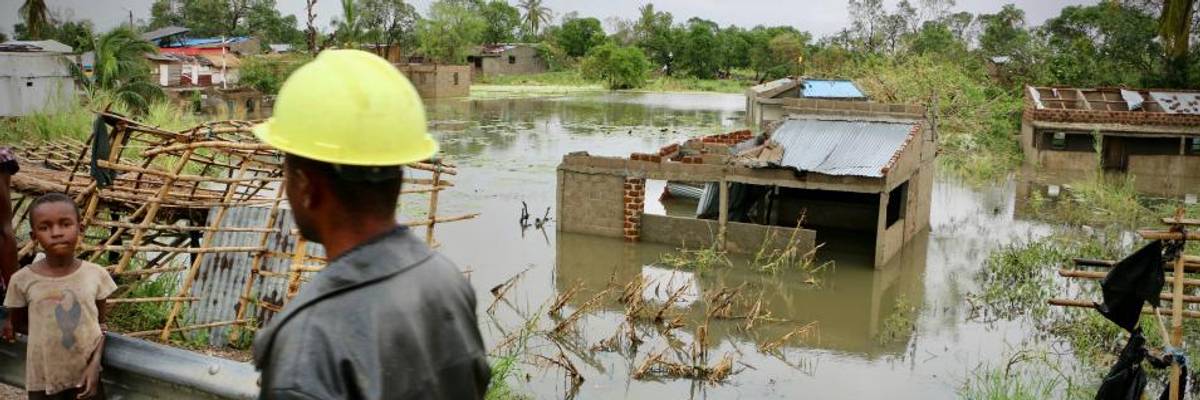
Locals stand near the flooded village of Tica, central Mozambique, on March 19, 2019, after the area was hit by the Cyclone Idai. (Photo: Adrien Barbier/AFP/Getty Images)
Environmentalists reacted with outrage after the U.S. Export-Import Bank's board of directors on Thursday approved $5 billion in funding for a liquefied natural gas plant in Mozambique that could pump an estimated 5.2 million tons of planet-warming carbon dioxide into the atmosphere each year.
Doug Norlen, director of the economic policy program at Friends of the Earth, called EXIM's decision "irresponsible" and said it "proves the agency can't be trusted to manage billions of dollars in public funds."
"It makes one worry about Mozambique's future. Investment from the U.S. will only amplify all of the troubles and conflicts in Mozambique caused by this project and push them out of control."
--Daniel Ribeiro, Friends of the Earth Mozambique
"By approving $5 billion in fossil fuel financing, EXIM is accelerating the climate crisis while causing local environmental damage and propelling human rights violations in Mozambique," Norlen said in a statement. "Either EXIM financing for fossil fuels must be stopped or the agency should not be reauthorized by Congress."
Climate groups have repeatedly raised alarm over the bank's funding of fossil fuel projects and demanded fundamental reforms.
According to Reuters, the Mozambique natural gas plant is the agency's largest export deal in years.
"The project would be the single biggest financing deal since EXIM's full lending powers were restored in May with the confirmation of three new board members," Reuters reported Thursday. "EXIM said the Mozambique [liquefied natural gas] project would begin to develop the Rovuma Basin, one of he world's most extensive untapped reserves of natural gas."
U.S. Commerce Secretary Wilbur Ross applauded the project as a "win for American companies and workers" as well as "the people of Mozambique."
Daniel Ribeiro of Friends of the Earth Mozambique said the opposite is true, warning in a statement that--in addition to its significant climate impact--the project will "fuel the numerous local land conflicts, the human rights abuses, and infrastructure bottlenecks" in the African nation, which was devastated by two powerful cyclones earlier this year.
"If there is a project with serious alarm bells, it's this one," said Ribeiro. "This dirty project is located in a sensitive world biosphere, embroiled in an emerging extremist armed conflict. It is being pushed by a government that has recently faced one of the biggest corruption cases in Africa."
"It makes one worry about Mozambique's future," Ribeiro added. "Investment from the U.S. will only amplify all of the troubles and conflicts in Mozambique caused by this project and push them out of control."
Dear Common Dreams reader, It’s been nearly 30 years since I co-founded Common Dreams with my late wife, Lina Newhouser. We had the radical notion that journalism should serve the public good, not corporate profits. It was clear to us from the outset what it would take to build such a project. No paid advertisements. No corporate sponsors. No millionaire publisher telling us what to think or do. Many people said we wouldn't last a year, but we proved those doubters wrong. Together with a tremendous team of journalists and dedicated staff, we built an independent media outlet free from the constraints of profits and corporate control. Our mission has always been simple: To inform. To inspire. To ignite change for the common good. Building Common Dreams was not easy. Our survival was never guaranteed. When you take on the most powerful forces—Wall Street greed, fossil fuel industry destruction, Big Tech lobbyists, and uber-rich oligarchs who have spent billions upon billions rigging the economy and democracy in their favor—the only bulwark you have is supporters who believe in your work. But here’s the urgent message from me today. It's never been this bad out there. And it's never been this hard to keep us going. At the very moment Common Dreams is most needed, the threats we face are intensifying. We need your support now more than ever. We don't accept corporate advertising and never will. We don't have a paywall because we don't think people should be blocked from critical news based on their ability to pay. Everything we do is funded by the donations of readers like you. When everyone does the little they can afford, we are strong. But if that support retreats or dries up, so do we. Will you donate now to make sure Common Dreams not only survives but thrives? —Craig Brown, Co-founder |
Environmentalists reacted with outrage after the U.S. Export-Import Bank's board of directors on Thursday approved $5 billion in funding for a liquefied natural gas plant in Mozambique that could pump an estimated 5.2 million tons of planet-warming carbon dioxide into the atmosphere each year.
Doug Norlen, director of the economic policy program at Friends of the Earth, called EXIM's decision "irresponsible" and said it "proves the agency can't be trusted to manage billions of dollars in public funds."
"It makes one worry about Mozambique's future. Investment from the U.S. will only amplify all of the troubles and conflicts in Mozambique caused by this project and push them out of control."
--Daniel Ribeiro, Friends of the Earth Mozambique
"By approving $5 billion in fossil fuel financing, EXIM is accelerating the climate crisis while causing local environmental damage and propelling human rights violations in Mozambique," Norlen said in a statement. "Either EXIM financing for fossil fuels must be stopped or the agency should not be reauthorized by Congress."
Climate groups have repeatedly raised alarm over the bank's funding of fossil fuel projects and demanded fundamental reforms.
According to Reuters, the Mozambique natural gas plant is the agency's largest export deal in years.
"The project would be the single biggest financing deal since EXIM's full lending powers were restored in May with the confirmation of three new board members," Reuters reported Thursday. "EXIM said the Mozambique [liquefied natural gas] project would begin to develop the Rovuma Basin, one of he world's most extensive untapped reserves of natural gas."
U.S. Commerce Secretary Wilbur Ross applauded the project as a "win for American companies and workers" as well as "the people of Mozambique."
Daniel Ribeiro of Friends of the Earth Mozambique said the opposite is true, warning in a statement that--in addition to its significant climate impact--the project will "fuel the numerous local land conflicts, the human rights abuses, and infrastructure bottlenecks" in the African nation, which was devastated by two powerful cyclones earlier this year.
"If there is a project with serious alarm bells, it's this one," said Ribeiro. "This dirty project is located in a sensitive world biosphere, embroiled in an emerging extremist armed conflict. It is being pushed by a government that has recently faced one of the biggest corruption cases in Africa."
"It makes one worry about Mozambique's future," Ribeiro added. "Investment from the U.S. will only amplify all of the troubles and conflicts in Mozambique caused by this project and push them out of control."
Environmentalists reacted with outrage after the U.S. Export-Import Bank's board of directors on Thursday approved $5 billion in funding for a liquefied natural gas plant in Mozambique that could pump an estimated 5.2 million tons of planet-warming carbon dioxide into the atmosphere each year.
Doug Norlen, director of the economic policy program at Friends of the Earth, called EXIM's decision "irresponsible" and said it "proves the agency can't be trusted to manage billions of dollars in public funds."
"It makes one worry about Mozambique's future. Investment from the U.S. will only amplify all of the troubles and conflicts in Mozambique caused by this project and push them out of control."
--Daniel Ribeiro, Friends of the Earth Mozambique
"By approving $5 billion in fossil fuel financing, EXIM is accelerating the climate crisis while causing local environmental damage and propelling human rights violations in Mozambique," Norlen said in a statement. "Either EXIM financing for fossil fuels must be stopped or the agency should not be reauthorized by Congress."
Climate groups have repeatedly raised alarm over the bank's funding of fossil fuel projects and demanded fundamental reforms.
According to Reuters, the Mozambique natural gas plant is the agency's largest export deal in years.
"The project would be the single biggest financing deal since EXIM's full lending powers were restored in May with the confirmation of three new board members," Reuters reported Thursday. "EXIM said the Mozambique [liquefied natural gas] project would begin to develop the Rovuma Basin, one of he world's most extensive untapped reserves of natural gas."
U.S. Commerce Secretary Wilbur Ross applauded the project as a "win for American companies and workers" as well as "the people of Mozambique."
Daniel Ribeiro of Friends of the Earth Mozambique said the opposite is true, warning in a statement that--in addition to its significant climate impact--the project will "fuel the numerous local land conflicts, the human rights abuses, and infrastructure bottlenecks" in the African nation, which was devastated by two powerful cyclones earlier this year.
"If there is a project with serious alarm bells, it's this one," said Ribeiro. "This dirty project is located in a sensitive world biosphere, embroiled in an emerging extremist armed conflict. It is being pushed by a government that has recently faced one of the biggest corruption cases in Africa."
"It makes one worry about Mozambique's future," Ribeiro added. "Investment from the U.S. will only amplify all of the troubles and conflicts in Mozambique caused by this project and push them out of control."

